Archives » poetry

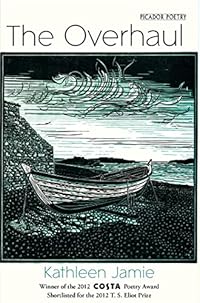
The Overhaul by Kathleen Jamie

Picador, 2012, 59 p

 The Overhaul cover

Winner of the 2012 Costa Poetry Award, shortlisted for the 2012 T S Eliot Prize.

35 poems, most one pagers, one six pages, the rest two. 2 are eftir Hölderlin (as is one in Jamie’s later collection The Bonniest Companie). Hölderlin seems to be one of her favourite models. Most poems here are in English with the odd Scots word but some are entirely Scots. Nature, or those working in the outdoors, is an inspiration for many and there is an abiding seriousness to her poems, though she is not beyond essaying a pun for a last line. An odd quirk was that some poems had missing full stops at their conclusion, as if they’re unfinished. Understandable enough for those two entitled Fragment 1 and Fragment 2.

I most enjoyed Excavation and Recovery with its evocation of deep time partly because I have seen (in Perth and Abernethy Museums respectively) the log boat whose archaeological recovery it partly describes and a depiction of the dig process.

The Bonniest Companie by Kathleen Jamie

Picador, 2015, 70 p including 1p Notes and Acknowledgements.

The Bonniest Companie cover

This, Jamie’s latest book of poetry, won the Saltire Society Book of the Year Award for 2016.

There are 47 poems here of which only two stretch over 1 page in length. Most take the form, if not the formal structure, of a sonnet, though Soledades has eight lines of what look like prose before opening out in its last three lines. Some are very short indeed. The last, Gale, has only 16 syllables, shorter than a haiku. The longest, Another You, bears out the potency of cheap music, the titular deer in The Hinds are “the bonniest companie”. Ben Lomond refers to the bonny banks in a poem which, like the song containing those lines, is about death and remembrance. 23/9/14 is an injunction to gird up again after the Scottish Independence Referendum. High Water compares ocean tides to an adulterous affair, Scotland’s Splendour scopes out the delights of memories from a book stumbled on in a charity shop, Wings Over Scotland is a litany of the recorded deaths of birds of prey on various landed estates, taken – verbatim it would seem – from the original reports.

The language Jamie uses goes from standard English to various degrees of Scots depending on the poem. Migratory II, (eftir Hölderlin) is the most uncompromisingly Scottish. The prevalence of poems about animals or landscape places Jamie’s poetry firmly within the tradition of Scottish literature.

Pedant’s corner:- midgies (I know Scottish spelling is a moveable feast but midges, please,) “one less left” (“one fewer” sounds more natural to me.)

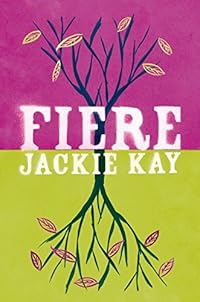
Fiere by Jackie Kay

Picador, 2011, 76 p.

 Fiere cover

I borrowed this from a doomed library the day before Kay was announced as Scotland’s latest Makar.

Once again it shows that poetry – or modern poetry – is not my thing. The poems herein are interesting enough but none of them really grabbed me. Some of them deal with Kay’s visit to Nigeria (from where her birth father originated; her mother was Scottish and she was adopted by a Scottish couple.) In Nigeria she discovers she is regarded as a white woman. The reference to, and quotes from, MacDiarmid in “from A Drunk Woman Looks at her Nipple” (that titling suggests an extract but it doesn’t seem to be) were diverting though.

Pedant’s corner:- In Road to Amaudo (the village of peace in Igbo) the word is spelled like that twice before Amadou is used, again twice, later on. It is possible that Amadou is a different place, as on its second appearance it is followed by “the road to my heart”.

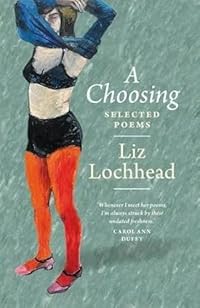
A Choosing by Liz Lochhead

Selected Poems Polygon, 2011, 103 p. Borrowed from a threatened library.

 A Choosing cover

Lochhead, a poet and playwright, is Scotland’s second Makar, which is to say national poet. This book shows she is capable of not only a perfect standard sonnet such as Epithalamium but of a wide range of poems, though mostly not with formal structures.

View of Scotland/Love Poem articulates the experience of Hogmanay, After the War the material changes that happened in a short lifetime, Sorting Through the loose ends that still remain after a parent dies, Social History the differences in attitudes to sex of different generations, The Choosing the unseen/unfelt pressures that determine lives, Kidspoem/Bairnsang the dichotomy between the formal English of school and the felt experience of Scottishness, My Rival’s House the enmities between a mother and the woman who will take away her son, Poets Need Not the sense that for a poet a completed poem is its own reward.

Worth a read, whether you’re into poetry or not.

Pedant’s corner:- on its second appearance Hogmanay was rendered Hogmany.

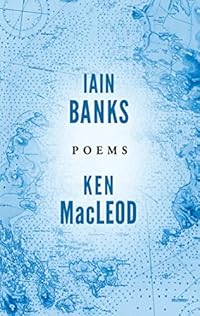
Poems. Iain Banks and Ken MacLeod

Borrowed from a threatened library.

 Poems cover

Poetry is not really my comfort zone but I felt I had to read this for completeness as it would mean I have now read all of Banks’s published works (and I think all of MacLeod’s.) Before he became aware of his final illness Banks had suggested to MacLeod that they publish a book of their (separately written) poems. The idea was that each might provide cover for the other. MacLeod initially demurred but bowed to Banks’s insistence. This collection is the result.

The Banks poems feature first and show a considerable fondness for wordplay, always likely to endear itself to me. (Indeed, the line, ‘I suspect the boy has hidden shallows’ – from I to I – contains an example I have used myself in conversation but was liable to occur to anyone whose mind runs along similar lines.) “The truth is just a lie/that corresponds to the facts” from Revue is a more contentious inversion. Check out, though, the sentiments in A Word to the Wise.

MacLeod’s poems tend to have less wordplay (but it is not entirely absent) and he is more willing to essay poems containing the demands of a rhyme scheme – with its attendant danger of descent into doggerel; a danger which he rises effortlessly above. Macleod’s poems have perhaps a greater tendency to express left wing sentiments than those of Banks. The opening line “I cannae write in Scots” from Scots Poet, Not where he appears to lament his parents’ decision only to speak English to him as a child, also struck a chord with me, as my mother’s parents both came up from England before they met in Glasgow and Scots therefore didn’t form a large part of my background.

Pedant’s corner:- math (maths, please,) Fom (From.)

Poetry in the Great War

The Great War is remembered through the poetry it inspired – In Flanders Fields, the works of Sassoon, Owen and Rosenberg – most of which emphasise the loss and the pity.

It’s perhaps difficult to appreciate now but there was a burst of enthusiasm for war in the immediate aftermath of its declaration in 1914. This also manifested itself in poetry particularly that of Rupert Brooke whose The Soldier perhaps epitomises a romanticisation that was to be overwhelmed by mud, gas, barbed wire, machine guns and shells.

The earlier sonnets in the sequence that ends with The Soldier take a similar tack, in particular the first line of Peace, “Now, God be thanked Who has matched us with His hour,” but also the sentiments of The Dead, “And we have come into our heritage.”

That feeling that this is what young men are made for, that their purpose is to undertake stirring deeds, is one of the first casualties of any war.

Periodic Tales by Hugh Aldersey-Williams

The Curious Lives of the Elements, Viking, 2011, 428 p.

The first thing to say is that, despite its title(s), this is not a Chemistry book. In its index there are eight references to Shakespeare (only one fewer than for the chemist Jöns Jacob Berzelius and more than for any individual scientist barring Humphry Davy, Carl Scheele, William Ramsay, Marie Curie and Dmitri Mendeleev) – four to Goethe, three each to Wagner and Van Gogh. Other seemingly unlikely name checks are given to Wilfred Owen and Barbara Hepworth, not to mention Hunter S Thompson’s novel Fear and Loathing in Las Vegas.

What it is, is a book about how Chemistry permeates our lives, not just in the biological sense – for without Chemistry our bodies could not work – but in the cultural sphere, in our day-to-day existence. (There is even a reference to Irn Bru! – in a frankly bizarre context.) As such the book ought to appeal to the general reader rather than just Chemists. But the importance of Chemistry in painting, sculpture, opera, poetry, fiction, even architecture ought not to surprise. As the back of the book reminds us, “Everything is made of them [the elements,] from the furthest reaches of the universe to this book you are holding in your hands, including you.” English words for white (apart from snow) are bound up with the compounds of calcium they embody, marble, alabaster, chalk, ivory, bone, teeth. (I object, here, that the “White Cliffs of Dover” are anything but; unless seen from a distance.) The Latin calx yields the Italian calcio for what Aldersey-Williams calls soccer, perhaps because a goal is scored by the ball crossing a chalked line. The word for railway in nearly every language except English reflects the iron from which it is constructed, chemin de fer, Eisenbahn, ferrovia, vía fería, järnväg, tetsudou. Akin to gold in its chemical unreactivity, the valuation of platinum – the only element first isolated by pre-Columbian Americans – over gold is a cultural choice; not due to rarity but snobbishness.

The book contains photographic illustrations every so often but they can at times be a little indistinct as they are reproduced only in monochrome.

Like his Swedish compatriot Carl Scheele (who has a fair claim to have discovered oxygen) Jöns Jacob Berzelius is all but forgotten – despite pioneering laboratory staples like filter paper and (the now superseded) rubber tubing for connecting laboratory equipment together, first using the words catalysis and protein, inventing chemical symbology and coming up with the idea that elements combined in fixed proportions and hence chemical formulae. If his name had been attached to these as Bunsen’s was to his – admittedly splendid – invention that might not be the case. But it seems the Swedes were/are reticent about blowing their trumpets. Due to their chemists’ wielding of an essential piece of technology – the blow-pipe – no less than seven elements – ytterbium, yttrium, terbium, erbium, holmium, scandium and tantalum – were identified from ores that came from a single mine near the town of Ytterby but there is now no trace of the mine nor is there a visitor’s centre. The Swedes may be missing a trick there.

Discovery of “new” elements has always to an extent depended on available technology. Better furnaces and higher temperatures explain the historical progression of metal extraction through the Bronze and Iron Ages and the isolation of zinc in India by the 13th century, the alkali metals, highly reactive and thus resistant to chemical extraction, were only torn from their compounds by the greater power of electricity – not harnessed till just before 1800 – the spectroscope enabled elements to be inferred from the incursion of additional lines in the resultant spectra, transuranics could only be synthesised when atom–colliding machines became available. New liquefaction techniques allowed William Ramsay in the 1890s to conjure new elements out of thin air. (Well, since it was liquefied, I suppose it was really thick air.) Ramsay populated a whole previously unknown Periodic Table Group, the noble gases – neon et al – using this method.

Aldersey-Williams has a tendency to employ the words light or heavy instead of low/high density respectively and to refer to an element when strictly it is the presence of its compounds, atoms or ions that is under discussion. Plus he infers ozone is bonded in a triangle. Its atoms may be arranged in a triangle but its bonds are not. He also says “sodium is now the colour of the city at night” as well as “our principal means of knowing this element.” My local street may be “lit from above by the sodium lamps,” but these have been largely replaced by the blueish white of mercury vapour lights on main roads.

He has however written an interesting and informative, at times quirky, book.
free hit counter script