Asterix and the Pechts
Posted in Reading Reviewed at 12:00 on 2 February 2016
Scrievit by Jean-Yves Ferri. Illustraitit by Didier Conrad. Translaitit by Matthew Fitt.
Dalen Alba and Itchy Coo, 2013, 48 p. Originally published as Astérix et les Pictes, 2013, by Les Éditions Albert René.
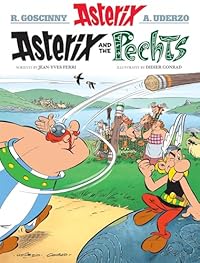
A bit of fun. This is the Scots version of Asterix and the Picts the first Asterix book not to be written by either René Goscinny or his original illustrator Albert Uderzo. Here Asterix and Obelix retain their familiar names but the “clachan warlock” is rendered not as Getafix but instead Kensawthetrix, we also have Heidbummerix for the chief, Gieitbiglix, plus the inspired name Magonaglix for the bard; but my favourite of these is actually the fish seller, Minginhaddix.
The story starts when an ice-bound, kilted body washes up near Asterix’s clachan. This turns out to be MacHoolet who when thawed out cannot speak at first but nevertheless is a big hit with the local ladies. When MacHoolet, who Tourette’s-like, breaks out in anachronistic song every so often (Mak me wanna shout, Auld Lang Syne, I’ll tak the high road, Boom-Bang-a-Bang, I wid walk 500 miles, I feel it in my fingirs, Ally Bally) and utters the impeccably Doric phrase “foosyerdoos”, finally manages to communicate his origins to the village they set off to take him home and reunite him with his love Camomilla, whom the Pictish chief Macrammie (a nice double pun here on textile working and the Scots for a disputatious contretemps) wants for his own. En route they encounter Nessie’s ancestor Nechtan. They arrive in time to interrupt – with Camomilla’s help – a gathering of the clans to elect a new king (Muirlain Pechts, Plookie Pechts, Joco Pechts, Fattygus Pechts, Pechts fae the wids, Pechts fae the yella watter, White Pechts) as well as to send the Romans home to think again. When MacHoolet calls for new rules of inheritance there is a sly reference to the proportional representation element of the Scottish Parliament’s make-up, ‘we could tak names fae a regional leet’. There are other contemporary references such as ‘Vote Aye. Vote Naw. Better Thegither. It’s Pechtland’s Peat.’ Great stuff: but I doubt non-Scots would make much of it.
Though it is one of the spellings in Scots of that ancient people’s name and Matthew Fitt does make the pun during his translation I would have preferred an alternative (Picht? Peht?) to Pechts. It makes them sound as if they’re out of breath.