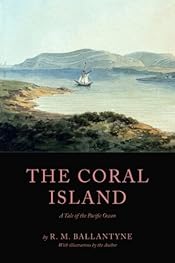
A Tale of the Pacific Ocean.
EriK Publishing, 2017, 239 p. First published 1858. One of the 100 best Scottish Books.
When I first saw this on the list of 100 best Scottish books I wondered if I had read it in my youth. Reading it now (which I would not have done were it not on the list) its contents struck absolutely no bells in my memory.
This is a tale narrated by Ralph Rover of three cheery lads; himself, the older Jack Martin and the younger Peterkin Gay, and their life after shipwreck on the coral island of the title, a place with bountiful food, not only cocoa-nuts, bread-fruit, yams, taro, plums and potatoes, but also pigs and ducks and of course fish. Their ingenuity and resourcefulness (not, what with all that bounty, do they really need them much) allow them to lead a happy life until it is disrupted first by the descent on their shores by South Sea natives at war with each other (one side whom our heroes naturally get the better of, the other side then becoming free to return to their home) then by pirates. Ralph falls into the latter’s hands and is transported across and around the Pacific islands before eventually finding his way back to rescue Mark and Peterkin.
The book is of course riddled with the cultural assumptions of the time in which it was written. A flavour of this is given when Peterkin asserts of potential black inhabitants, very early on when the three don’t know what exactly they will find, “‘Of course we’ll rise, naturally, to the top of affairs: white men always do in savage countries.’” (Those sensitively disposed should note the text contains one instance of the word “niggers” and that is put into the mouth of a pirate.)
Much play is made of this “savagery” and of the cannibalism of the region’s as yet unconverted natives as contrasted with Ralph’s intermittent piety (after he lost his Bible in the shipwreck.) To a man – and woman – the natives are redeemed, civilised and instantly ennobled by the adoption of Christianity. The more, though, that the text insisted that those tales of cannibalism and savagery are true the more I came to resist the thought. In any case, the savagery displayed was no more than the pirates are shown to be capable of.
Reunited, the three set off to aid one of the native women of the freed warring party whose chief Ralph had become aware was refusing to allow her to marry whom she pleased and now threatened to kill her. That chief is much displeased when they turn up and soon imprisons them. The book ends with an almost literal deus ex machina as the three are saved by the conversion of their captor by a missionary.
The Coral Island is not the shipwreck on a deserted island ur-text – that would be Robinson Crusoe – but with its depiction of pirates it clearly had an influence on Treasure Island and Peter Pan and its suffocating certainties apparently festered in William Golding’s head and led to its antithesis in Lord of the Flies. That it holds such a position is the only possible reason to include it in a list of 100 best books. In terms of literary merit or insight into the human condition it belongs nowhere near one.
Pedant’s corner:- Both the cover and the title page bear the words “with illustrations by the author.” None were to be found inside. Otherwise; contains mid-nineteenth century spellings – cocoa-nuts, sewed, etc. Otherwise; occasional omissions of commas before pieces of direct speech, ricochetting, (ricocheting,) maw (it’s not a mouth,) “signed to several of attendants” (of his attendants,) “seized Jack and Peterkin and violently by the collars” (doesn’t need that second ‘and’.)


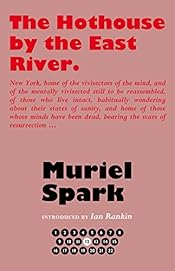 Another of Spark’s enigmatic novels, unusually this time set in 1970s New York. Paul and Elsa are a relatively well off British couple living in Manhattan with a view of the East River. Elsa’s behaviour is erratic and Paul wonders if she is mad. As an emblem of this, great play is made of the appearance of Elsa’s shadow which always falls wrongly, as if she is lit from a different direction. Her analyst, Garven, spends a lot with them and later takes on the job of butler.