Archives » Penang

The Gift of Rain by Tan Twan Eng

Myrmidon, 2007, 508 p, including 2 p maps of Penang and Malaya.
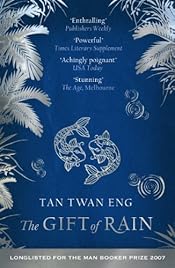
Fifty years after the end of the Second World War a Japanese woman, Michiko Murakami, comes to visit Philip Hutton at his home in Penang, bringing with her the katana which his sensei, Hayato Endo, a follower of Morihei Ueshiba, had had made for him. Endo is buried on a small island just off Hutton’s land and Michiko was once his inamorata before circumstances meant they could not be together. Over a few nights Hutton relates the course of his relationship with Endo-san, being taught the martial art of aikijujutsu, and his unwitting participation in the preparations for the Japanese invasion of Malaya in 1941.

Philip was the last child of Noel Hutton, owner of a large trading company. Philip’s mother was his father’s second wife, a Chinese woman, but who died. He grew up a misfit, not quite belonging to the British set but yet not Chinese either. He is doubly estranged since his mother’s family did not approve of the match and he has had little contact with them. In a weak moment his father does let slip that the pair had been very much in love.

The rest of his family, father and half-siblings William, Edward and Isabel, are away on a visit to England in 1941 when Endo-san, to whom the small island had been let, befriends Philip and decides to induct him in the way of aikijujutsu. This not only involves combat training – even though the emphasis is on defence and never killing – but requires that they trust each other fully. This trust will, of course, be stretched to breaking point by world events.

In the course of their friendship Endo-san asks Philip to take him on trips round the island.  It is here the reader gets somewhat ahead of the narrative with the suspicion that Endo-san is a Japanese spy. He does admit that he is serving the Japanese government because his father had implicitly criticised the Emperor and his service is to prevent harm coming to his father.

The invasion when it comes still seems sudden and shocking, the British response shamefully inadequate. In its aftermath Philip is plunged into a quandary: loyalty to Endo-san or to his family (and its prospects) and to his friend who has joined the British resistance movement, Force 136. His acquiescence to the Japanese authorities, his acceptance of a translating job with them is seen as a betrayal by some but in other respects allows him to soften some of its harshness; albeit only in a small way.

There is much more nuance to this novel than the above might imply. Philip makes a relationship with his Chinese grandfather, colludes with the resistance while maintaining cooperation with the Japanese authorities but in the end, despite Endo-san’s shielding, is unable to safeguard everything that he would wish. The brutality of some Japanese actions contrasts vividly with the non-violent aspects of Endo-san’s instruction.

One thing that struck me as odd was that there seemed to be a large Japanese presence in pre-war Penang; not just Endo-san but also consular officials – and soldiers, who still seemed to roam free unarrested after the invasion of Malaya had begun but before the invading forces had reached Penang itself. Eng is more likely to be on top of these details than I am though.

This is a very good novel indeed, aspects of the writing are exemplary, the characters agreeably shaded (apart from the out and out cruelty of some Japanese soldiers; which is of course a matter of historical fact) the examination of aikijujutsu philosophy illuminating, but it fell from the absolute highest drawer of literature when it tumbled over into the spying aspect. Moreover, it was unreasonable for Philip to have provided (even if unwittingly) just about all the information about the Malayan peninsula which informed the tactical elements of the Japanese invasion. Yet without that Eng’s story would have been different.

Its core is the relationship between Philip and Endo-san. But is this a meeting of minds or an example of a kind of grooming? Endo-san is older and (apparently) wiser but there is a strand – which is not overly stressed – where the relationship between Philip and Endo-san apparently goes much deeper than mere friendship as their fates have seemingly been entwined through various incarnations in history.


Pedant’s corner:- “was roused out his stupor” (out of his stupor,) “and and” (only one ‘and’ was needed,) “gave smile” (gave a smile,) whiskey (whisky?) a missing end quote mark, “Kon make a move” (made a move,) “round the bend was hidden spot” (was a hidden spot.)

In Another Light by Andrew Greig

Pheonix, 2004, 510 p.

In Another Light cover

Love, sex and death again; but literature’s subject matter doesn’t get any bigger. And Greig deals with them superbly.

In In Another Light it is death which is the early preoccupation of Eddie Mackay, though love and sex do get a look in. Prior to the immediate events of the novel Eddie suffered from hydrocephalus as a result of a colloid cyst which meant fluid built up in his brain. He therefore feels the imminence of extinction everywhere, “‘Because I was nearly dead once and I’m trying to live with that.’” During his recovery from having a shunt fitted to drain the fluid from his brain to his stomach Eddie experiences the presence of his dead father, who according to Eddie’s mother had, long before she met him, been sent home in disgrace from Malaya after an affair with his superior’s wife. Eddie doubts the truth of this but sets out to find as much as he can about his father’s time in the colony. Eddie is working for a tidal generation project whose headquarters overlook Scapa Flow in Orkney. The jungle drums and the tangled relationships of Stromness become a running theme in the book. Of comments about his liaison with Mica Moar, another of Greig’s complicated female characters (a bit – but only a bit – like Kim Russell in Electric Brae) he says, “‘In my experience there’s only one way to keep a secret in a wee town’ … ‘Plant the sapling of truth in a forest of rumours.’”

This strand of the book, delivered in a first person past tense looking back over the path which brought Eddie to the final scene, with occasional present tense interludes setting that scene, is intertwined with a third person present tense narration of the voyage of his father Sandy, as he was then known, to Penang in Malaya and his brief sojourn there. Medical graduate Sandy hopes to improve the birth survival rates in Penang’s maternity hospital. The boat out is a hotbed of illicit goings on of which deeply moral Sandy is mildly contemptuous. The acquaintances he makes on the trip, US citizen Alan Hayman and the two Simpson sisters, Ann and Adele, “both beautiful, one a gazelle” the elder of whom, Adele, is married and chaperoning the younger, are fateful. A further sister, Emily, also on the boat, is still a child. Each chapter contains several sequences from both stories, generally alternating. The greeting, “‘Oh, there you are,’” bounces around the two narratives. Both strands are thick with metaphor. The descriptions of Orkney and Penang make them almost characters in themselves – particularly Orkney. Certain images also resonate between the two locations.

The text is seasoned with sly critiques of Scottish attitudes, “I was in joyous life-affirming Scottish mode that morning and no mistake.” “Scotland’s a place where everyone explains what is not possible, that it’ll all end in tears, we’re here to make the best of a bad job then die and get a good rest till we’re woken up to be informed we’re damned.” To Sandy’s traditional toast “‘Here’s tae us, wha’s like us? Gey few – and they’re aa deid’” Hayman says, “‘You guys, you can’t even celebrate without bringing death into it.’”

Eddie’s thoughts occasionally stray back to the subject of death. He raises with us the question of “How are we to live in the face of the sure and certain knowledge we will lose parents, friends, lover, the whole shebang and caboodle?” only to answer it immediately with, “Wholeheartedly. Of this one thing I am sure.” Later he tells us, “It’s such a simple and shallow thing, death, only there’s no bottom to it and no way across.”

He reflects that maturity is, “knowing you’ve more or less arrived at yourself and the world will keep changing but you won’t much, and then living with that,” while, “Pure lust, I’d noticed, eventually collapses under the weight of its own contradictions – rather like capitalism, but much quicker.” However, “We need meaning, I thought. The world might not have any, but we need it,” and, “Meaning is something we have to make.”

Greig’s numerous characters are all well drawn, their behaviour sometimes unexpected and contrary. I wouldn’t go quite so far as the cover quote (from The Times) “It will be a long time since a book has made you care as much.” Not for me. At least not since the same author’s Fair Helen. He seems to have a gift for it. Add in computer programmes for generating music from tidal movements, the compromises of secret service work in the colonies, a thoroughly worked through plot (which admittedly may be a little too neatly tied in,) the perennial failure of true love (or lust) to run smooth and the whole thing’s a delight.

Pedant’s corner:- “‘I’d left my [gas] mask back in the Mess’” (the Mess? In the trenches in WW1?) Brechin Pier (does Brechin have a pier?) “for a while neither of them speak” (neither speaks.) “Stacked alongside the reference books are a series of different coloured hardback files” (is a series,) baragraphs (barographs,) the phrase, “he was sad under his funny,” (seems to be missing a final word,) furlough (is more a USian usage,) “The Moonlight Band play foxtrots” (plays,) “a think about what the heck’s he’s getting into,” (what the heck,) sub-periphrenaic abscess (a google search for sub-periphrenaic yields only a quote from In Another Light: Andrew Greig,) whigmalerie (spelling of Scots words can be variable but this is usually whigmaleerie,) murmers (murmurs,) Theramin Dr Who electronic music (Theremin: also Dr Who’s electronic instrument wasn’t a theremin which as an instrument should be lower case,) “he scooped more peanuts down his maw” (I suppose it could mean stomach here,) “a group of macaque monkeys come running” (a group comes,) “He’s stares” (He stares,) whispy (context suggests wispy,) tweaked it it (one it is enough,) an assortment of … appear (an assortment appears,) Siouxie and the Banshees (doesn’t she spell it Siouxsie?) vocal chords (it’s cords,) Arshak Sarkies’ (Sarkies’s,) for completeness’ sake (completeness’s,) light defraction (diffraction? refraction? or is this a portmanteau word Greig has invented?) became (in a present tense narration this should be becomes.)

free hit counter script