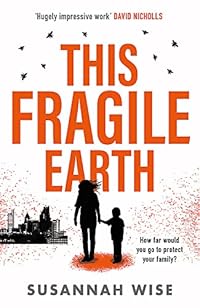
This Fragile Earth by Susannah Wise
Posted in My ParSec reviews, Reading Reviewed, Reviews published in ParSec, Science Fiction at 12:00 on 10 May 2022
Gollancz, 2021, 356 p. Reviewed for ParSec 1.
In the 1950s and up to the mid-1960s British SF consisted mainly of stories of worldwide disaster – a subgenre which Brian Aldiss somewhat unkindly dubbed cosy catastrophes – whose most prolific contributors were the Johns, Wyndham and Christopher, but also to which, at a stretch, J G Ballard’s early novels could be assigned. While the disaster story never disappeared completely the vogue did ebb and British SF began to cleave the paper light years with the best of them.
In recent times SF writers more generally perhaps sensed the coming contagion. Emily St John Mandel’s Station Eleven helped to revive the concept of a fictional worldwide disaster and Caroline Hardaker’s Composite Creatures (also reviewed for ParSec 1) has elements of the form. In this book Susannah Wise inhabits that global catastrophe tradition full on – and in a British context.
It is an altered Britain though, which has a heavy Chinese influence. Six year-old Jed’s schoolteacher is a Miss Yue, a supermarket chain is called Lianhua, noodles and rambutan are common foods and a mysterious company called Shīluò zhì lurks in the background.
The common elements of the catastrophe novel are present: communication breakdown, food queues, barricaded roads, troops on the streets. Less usual ingredients here are that bees have gone extinct (though attempts have been made to restore them synthetically) with their pollination tasks in the meantime replaced by tiny drones; following on from beetle blight a rampant disease called Bovine Staph is apparently transmitted through rainwater and can affect humans; venturing outdoors requires UV goggles to be worn to protect against eye damage from sunlight; the currency is exclusively digital – Litecoin spent via Lite-cards.
Pre-disaster just about every service is accessed wirelessly or via AI robots such as BinX, DoctreX, MediX and WaitreX. GScopes, mediated by a system named GQOS, have replaced mobile phones. Roads are constructed from fibre-glass panelling and road signs are exclusively electronic. Agrico-bots roam the countryside.
Then one day the drones start to malfunction, the electricity goes off and everything shuts down. Viewpoint character Signy comes home to a fridge in meltdown, its food rotting. Despite the resultant lack of amenities her partner Matthew keeps saying things will be all right “tomorrow” but one night, while Signy and Jed hide in the loft, Matthew confronts burglars at their house and is killed. Signy sets off from London with Jed to try to reach her mother’s home in Northamptonshire – by bicycle. Along the way they meet the usual assortment of people who either help or steal from them but also uncover the importance of TrincXcode and its links to musical form.
Wise’s writing is fine but in what is presumably a striving for immediacy she exhibits an over-fondness for verbless sentences. Like this one. Her characterisation is generally convincing enough but her portrayal of Jed is inconsistent. As indications of his youth he sometimes has to have words defined to him and he refers to “Mr Mack Wrecker” from the Peter Rabbit books but he also comes out with absurdly adult phrases supposedly remembered from Miss Yue. Things like, “Quantum field which allows the system to work out infinite possibilities,” and, “The system can work out in milliseconds every possible outcome that can happen from any action it takes in multiple universe models and make the best choice.” OK, the reader is getting the info dump but these sentences read as unlikely to come from the mouth of a six year-old, however tech savvy. There is also his memory from three years earlier of his grandfather telling him something “terrible and important,” to wit, “TrincX is the birth of true Artificial Intelligence – God’s daughter come to walk on Earth,” a warning now come true.
This central role of AIs in the background of the narrative has the effect of making the book’s resolution a literal deus ex machina, or, rather, dei ex machinae. Whether that makes it cosy or not is a fine judgement but it certainly leans towards it.
Pedant’s corner:- GQOS’ (GQOS’s,) “the Orkneys” (the locals prefer the designation Orkney, or, the Orkney Islands,) “more combustible that the old carbon boiler” (than,) gotten (in dialogue? In Britain?) Signy rushes out the front door with no mention of its mechanism previously not working due to the shutdown of communications, hummous (hummus.) “‘Danny!’.” (doesn’t need that full stop, the exclamation mark provides that function.) “It lay uncertain rays across” (It laid uncertain rays,) “‘I bought it from home.’” (brought it.) “‘It’s wasn’t Lau Chen was it?’” (‘It wasn’t’.)