Cold Water by Dave Hutchinson
Posted in My ParSec reviews, Reviews published in ParSec, Science Fiction at 12:00 on 6 December 2023
Solaris, 2022, 417 p. Reviewed for ParSec 7.
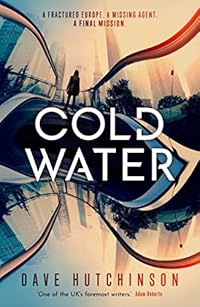 This is set in the alternative future familiar from the author’s sequence of four previous books – each with Europe in its title – where, after the devastation of the Xian flu, the continent’s political structures have fractured into a patchwork of states and statelets. Main viewpoint character Carey Tews has been invited back from retirement by Les Coureurs des Bois, that secretive organisation which conveys packages (and sometimes people) across the multitude of borders now garlanding the continent, to look into the death, near Gliwice in Poland, of her fellow Coureur – and former lover – Maksim Petrauskas. Despite misgivings she agrees, but swiftly realises there are odd inconsistencies at the scene and among the supposed circumstances: patchy police notes, improbable timings, its sheer unlikelihood.
The book’s first few sections also contain scenes from two other viewpoints, Krista Lindmaa, a police officer in Tallinn, and Lenna, a journalist sacked for poor time-keeping and insufficient research. Both are introduced while enduring a power blackout in the city, an event which is a precursor to Lindmaa’s deceased father (an ex-cop) being implicated in police killings of ethnic Russians back in the day and its supposed cover-up. All but destitute, Lenna accepts the offer of a Mr Reinsalu to probe into the affair. While Krista has a part to play in the unfurling of the plot, Lenna’s appearances soon peter out.
The leveraging of the discontent of ethnic Russians in Estonia is elaborated on by Krista’s Uncle Stepan. “‘People are angry all the time. Not about any one thing, just this hot explosive core of anger waiting to be aimed at something. Doesn’t even matter what it is. All you have to do is point them at it and off they go,’” adding, “‘Sometimes it’s quite easy to convince even the most rational people that someone else is trying to take away something that’s theirs. Their money, their property, their rights.’” Russians, he says, know this and work on it. Disinformation is now about making people unsure what to believe. If all news is fake where does the truth lie?
Maksim was the person who was instrumental in recruiting Carey as a Coureur. About the state of Europe he opined, “‘Borders are primitive, mediaeval. They promote division and nationalism. They’re offensive frankly.’” Knowing him as she did even then, Carey replied, “‘It’s also a great business opportunity.’” Elements of Carey’s back story such as this soon lead the reader to suspect that the resourceful and slippery Maksim is not in fact dead and something deeper is going on.
Which there is – and that is over and above the additional complication in Hutchinson’s scenario of the existence of the Community, a separate pocket universe where Europe was settled in the 18th century by the English. The Community’s borders with Carey’s world are both nebulous and porous, and its government may be responsible for all sorts of mischief. Events soon briefly drag Carey and Krista into a third such world, Arcadia, situated in what we would call North America. Hutchinson’s resolutely down to earth style ensures this Science Fictional gloss on a story, which is (the procurement and use of an electronic device known as a cloth laptop notwithstanding) only peripherally SF, is treated matter-of-factly by his characters for whom it is merely part of life. The reading experience here is firmly that of the spy thriller, a contrast with Carey’s belief that, “Real life was always disappointing and complicated and shabby and not very exciting, and it constantly amazed her that people were surprised by that.”
Hutchinson is a very good writer indeed. His books are peopled with utterly believable characters and his plotting is intricate. Here, calls on Carey’s phone asking, “Who are you?” are subtly placed, as is the importance of Maksim’s admiration of Herman Melville’s Moby Dick.
That Cold Water is at its heart a spy thriller does not lessen any of that. Science Fiction is uniquely placed to explore all of space and time. Make that spaces and times.
The following did not appear in the published review.
“Time interval later” count; six or so.
Pedant’s corner:- “the only real variations Carey had ever noticed was a choice of heels” (variation.) “‘What,’ she said.” (it was a question, ‘“What?” she said’,) span (spun,) mediaeval (yay!) miniscule (x 2, minuscule.) “‘So far all we’ve done is stepped on the toes’” (all we’ve done is step on the toes,) aberation (aberration.)
 The Nightingale Sings at Night is a fable outlining a creation myth garnished with a touch of Just So story. It tells how Boy and Girl (later to become Man and Woman) were the first to name things in the world made by Dame Kind in times when the Moon could talk, and did so slyly. And it tells us why the nightingale, who only ever had this one idea, came to sing only at night.
