Harvill, 1994 320 p. Translated from the Serbo-Croat, Na Drini cuprija, by Lovett F Edwards. First published by Prosveta Publishing Company, Belgrade, 1945.
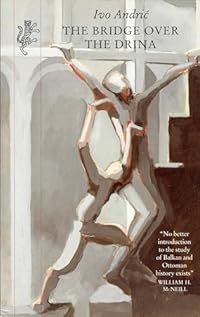
Not many novelists could get away with an introductory passage describing a bridge. As if to show that there are no real rules for writing fiction this book begins in exactly this way. But when your title names just such a structure I don’t suppose you have much alternative. Then again while nominally a novel The Bridge Over the Drina, in spanning the centuries, cannot be anything like conventional and the book is more like a series of short stories, mythical or legendary accounts, or even anecdotes, linked only by the events in them taking place in, on or near the bridge. The legends include children buried amongst the bridge’s stones, the negro (though he was Arabic this is the word used in the town and so in the translation) half of whose body was entombed in the bridge as the result of an accident during its construction, whose ghost still inhabits it and the sight of which means death. Among the stories are those of the man impaled for impeding its construction, the severed heads mounted on its parapet after executions, another man’s ear being nailed to a wooden beam fixed to the central portion. The book is also a history of the bridge’s times and its location in Bosnia, with all that entails. Very few examples of violence are given on the page but we are treated to a description of the grisly mechanics of impalement (that curiously Balkan form of execution.)
The eleven spans of white stone are at Višegrad, erected during the height of Turkish power in the region at the behest of the Vezir Mehmed Pasha, who in his youth had been part of the blood tribute wherein sons of Christians living in the Ottoman Empire were taken away to serve as janissaries in the Sultan’s armies or as his administrators, some of whom rose to great power and wealth. (Vezir, rather than the more common vizier, is the spelling adopted here.) The town is inhabited by a mix of Christians and Turks or Muslims – these two terms tend to be used interchangeably though the latter is spelled Moslem throughout. Later in the story (and the bridge’s life) some Jews make up part of the town’s fabric. At the heart of the bridge is a kapia, made from two terraces dangling out on either side to provide a space twice the bridge’s normal width, which acts as a playground for children and a meeting- and market- place for adults. On the kapia “generation upon generation learnt not to mourn overmuch what the troubled waters had borne away. …. Life was an incomprehensible marvel, since it was incessantly wasted and spent, yet none the less it lasted and endured ‘like the bridge on the Drina’.” The bridge is the “link between East and West, … one of the great and good works of man, which do not know what it means to change and grow old, and which, or so it seemed, do not share the fate of the transient things of this world.”
While various insurrections pass they mostly leave the town untouched. Things go along for centuries in more or less the time-honoured fashion with little but the usual human foibles to disturb the townspeople but after the granting of the Austrian protectorate Christians became more like the incomers in dress and behaviour, part of the mutual changes between the Austrians and the inhabitants. With the arrival of the twentieth century things change even more, the pace of life quickens, politics and news come into the people’s lives. On the saving in journey time the railway has brought, a Muslim man opines it is, “not important how much time a man saved, but what he did with it when he had saved it. If you are going to hell, then it is better that you should go slowly.” A notice pinned on the bridge preceding the annexation crisis of 1908 is greeted by the same Muslim with the pronouncement that, “Whenever a government feels the need of promising peace and prosperity to its citizens by means of a proclamation, it is time to be on guard and expect the opposite.” He later reflects that, “Lands and provinces, and, with them, living men and their habitations passed from hand to hand like small change,” and “the Turkish candle was burned out.”
In the aftermath of the crisis the bridge is mined by the Austrian authorities. After the Balkan wars of 1912 and 1913 the Turkish frontier moves from 8 to over 600 miles away. Events were, “looked on in the town with diametrically opposed feelings by the Serbs and the Moslems: only in their intensity and depth were they perhaps equal….. Those desires which for hundreds of years had flown before the slow pace of history could no longer keep pace with it but outdistanced it. …. All that had lain quiescent in men, as ancient as that bridge and equally dumb and motionless, now suddenly came alive and began to influence their everyday life, their general mood and the personal fate of every individual.”
Of the ear incident Andrić tells us, “In moments of general excitement something has to be done, something big and unusual.” Elsewhere we have, “Moments of social upset and great inevitable change usually throw up just such men, unbalanced and incomplete, to turn things inside out or lead them astray. That is one of the signs of times of disorder,” and “Hard times cannot pass without misfortune for someone.” In the Bosnian context, “The dark background of consciousness… preparing for later far-off times unsuspected changes and catastrophes without which, it seems, peoples cannot exist and above all the peoples of this land.” More generally, in an observation attributed to the Osmanlis, “There are three things which cannot be hidden: love, a cough and poverty.”
The assassination of Franz Ferdinand precipitates the final crisis of the book. “That wild beast, which lives in man and does not dare to show itself until the barriers of law and custom have been removed, was now set free….. permission was tacitly granted for acts of violence and plunder, even for murder, if they were carried out in the name of higher interests, according to established rules, and against a limited number of men of a particular type and belief.” Serbs are again, as in Turkish times, potential enemies of the state. One of them, held hostage to the safety of the bridge thinks, “He had worked, saved, worried and made money. He had taken care not to hurt a fly, been civil to all and looked only straight ahead of him, keeping silent. And here was where it had led him: to sit between two soldiers like the lowest of brigands and wait until some shell or infernal machine should damage the bridge and, for that reason, to have his throat cut or be shot.” Reading this book is a reminder that in Bosnia the people seem always to live in interesting times.
The back page blurb states that The Bridge Over the Drina won Andrić the Nobel Prize for Literature. While under the impression that said prize was given for a body of work rather than a single novel the book certainly contains nearly all of human life: sex is only implied; but there is love – and death aplenty. It is a compendious account of what it means to live in disputed territory.
Pedant’s corner:- I haven’t seen troublous before but on looking it up it does have a slightly different meaning to troublesome, “like the eyes in their head” (heads,) scelerotic (sclerotic,) span (spun,) “waiting for the peasant woman and buying from them” (that would be women, then,) beggers (beggars,) beserk (berserk,) concorn (?) “behave as if was sober”, (as if he was sober,) handsomer (more handsome, surely?) “which will have have”, gage (gauge,) Skoplje (Skopje?) on pension (this seems more awkward than “on a pension” would,) “beetles than can be seen” (that,) “nor would see America” (nor would she see America,) “so that they could see only their heads and shoulders” (so that he could see only their heads and shoulders,) “on the slope … lay Alihodja and breathed out his life” (this reads very awkwardly.)