Archives » Nick Harkaway

The Gone-Away World by Nick Harkaway

William Heinemann, 2008, 540 p.

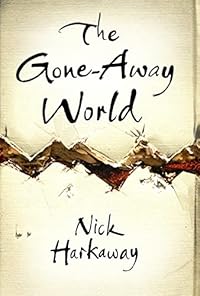
 The Gone Away World cover

The Jorgmund Pipe circles the Gone-Away world, protecting its environs from the Stuff which conjures new people and things out of dreams snatched from the minds of survivors of the Go Away War by delivering FOX (inFOrmationally eXtra-saturated matter) into the air surrounding it. It is the aftermath of said War, so-called because of the deployment of Go Away bombs (which do as their name suggests; their targets simply disappear.) Not quite as secret a weapon as its original users thought, though, since retaliation in kind came swiftly, leaving only pockets of normality in its wake and the unforeseen side-effect of strange apparitions/demons/monsters, (delete as to taste) swirling out of the affected areas, manifestations of Stuff.

Nothing hereafter ought to detract from what in the end turned out to be an engaging, emotionally involving read. Harkaway is a talent, as he has shown in subsequent books, but this novel is not without its flaws – even if it does have a daring conceit as its turning point.

We kick off when (despite an anonymous phone call advising its employees not to) the Haulage & Hazmat Emergency Civil Freebooting Company of Exmoor County, of which our narrator is a member, takes up a contract to put out a fire which threatens to destroy both the Pipe and the factory producing FOX. The company’s unwieldy title is an indicator of Harkaway’s approach here, an exuberance of word-play which tends to the wearing – at least until the book settles down. The author is certainly not afraid to call a spade a horticultural implement and otherwise circumlocute all the way around a subject in an attempt to provide levity, or (if you wish to be generous) to avoid cliché or the humdrum. It certainly makes for an impressive word-count. It was Harkaway’s first novel though, so we may forgive a little exuberance. (A little, but not a lot.)

Despite the destruction wrought by the Gone-Away bombs, there are still buses and cars (leaving me to wonder where the petrol for them came from) streetlamps, shops – gentlemen’s outfitters no less – and hierarchies of wealth much like that in the world before the war. Despite all having changed, in the larger settlements of the Pipe’s environment things appear to be much as they were before the War. (A nit-picking complaint, I agree, the author’s invention and creativity have been expended in other areas and it is possible to ask too much of a narrative, but it seemed to me to land on a default which the scenario would have made unlikely and thus undermined it.)

Then there is the book’s structure. By all means begin as near to the end as possible (as a piece of writing advice I read recently had it) but it is perhaps a mistake to presage a set-piece then – for all that it is the novel’s fulcrum – delay its depiction for well more than half the book. From that set-up we jump to our narrator’s back-story and relationship with his lifelong friend, Gonzo Lubitsch, his tutelage by a Zen master known as Wu Shenyang, his dabbling with roughly left-wing politics as a means to accessing girls, his targeting as a subversive and turning into a soldier and counter-insurgent, his encounter with the inventor of the Go-Away bomb, his awareness of the dirtiness of politics and international financial manœuvrings, his experience of the War and of its aftermath in the building of the Jorgmund Pipe. One highlight of this is a description of the difficulties of organising and carrying through a first-date – or making flapjacks – in a war zone; a ‘normal’ war zone at that.

The piece of authorial bravado at the heart of the book – which in its own terms justifies that structural choice – does not quite make up for it. For what happens when we are finally shown the Civil Freebooting Company extinguishing the fire – and incidentally discover along with the characters just how FOX is made – calls into question all that has come before. Not quite as in Kate Atkinson’s A God in Ruins but in a similar vein (yet opposite sense.) It does though highlight the question of what it might mean to be human. That is, of course, fiction’s job.

Pedant’s corner:- a few commas missing before pieces of direct speech, “one less layer” (one fewer,) “to test their metal” (Dearie me! The thing is you test is mettle,) hiccough (there is no derivational evidence for this spelling; hiccup,) “dinted grill” (grille,) appalls (appals,) genii (except in the sense of ‘spirit’ – which here it was not – the English plural of genius is geniuses,) infinitessimal (infinitesimal,) “so now there is now a crowd” (one ‘now’ too many,) “layed out” (laid out,) “beautiful woman are not rare” (women,) rarified (rarefied,) “‘I thought you were a gonner’” (a goner,) “I have kneeled” (knelt,) burglarised (for heaven’s sake! The word is burgled,) squidgey (squidgy,) Archimedes’ (Archimedes’s,) an opened parenthesis which is never closed (unless it was by the parenthesis later on the same page. But it didn’t read like that.)
Angelmaker by Nick Harkaway

Windmill Books, 2012, 574 p (plus no fewer than 9 p of puffs before the publishing information page.)

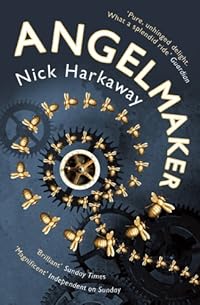
 Angelmaker cover

Clockworker Joshua Joseph Spork, son of Matthew a now dead former denizen of the Night Market, by contrast likes to keep his head down and his nose clean. An old woman called Edie Banister with her one-toothed, marble-eyed dog; the Death Clock left to Spork by his father; a plague of mechanical bees; various varieties of heavies, governmental and not, all lead to him becoming active rather than passive. On the way we encounter a train called the Ada Lovelace, which is a kind of travelling Bletchley Park, an Asian fiefdom ruled by a ruthless would-be-god, not to mention the resourceful Polly Cradle, all wrapped up in a plot which revolves around an Apprehension Engine, “‘a device which would allow one to know the truth of a situation, without fear of error,’” aka Angelmaker as, “‘It makes angels out of men…. It makes the world better, just by being,’” but with the potential to make the world infinitely worse.

Any plot summary suffers the possibility of being thought bonkers but we are driven on throughout by an insistent present tense – in which even the flash-backs are couched – and the brio of the storytelling plus the incidental details render any tendency to disbelief otiose. (Polly Cradle’s bed is a memorable construction.) The Night Market has echoes of Hugo and the names of Arvin Cummerbund, Rodney Titwhistle, Frankie Fossoyeur and Vaughn Parry evoke Dickens but this is really sui generis.

The book is exquisitely written – and fantastic entertainment – but in the end not much more than entertainment. I was left with a slight sense of disappointment that it wasn’t more meaningful. Still, that would be greedy. As it is Edie Banister and Polly Cradle are wonderful creations. To have two such in the one book is a pleasure indeed. I shall look out for more Harkaway.

Pedant’s corner:- the work gang look like astronauts from another world (the work gang looks like,) medieval. “But he has no Scots lilt, just a pure English diction… (Scots don’t speak pure English????) Brits (was this designation in use in the 1940s?) “Having your own engine means no timetables, no delays” (yes, acknowledging that signals etc will have to be set to accommodate this,) twenty foot away (feet; please,) “a wild exultant creel of power” (a wild exultant “rack”, or “basket for fish”, of power?) Decent batter (of Don Bradman; the English – as opposed to USian – usage is batsman,) “‘even with the new bodyline’” (in the 1940s bodyline was well past new,) twinging (twingeing?) mischievious (why do people add that extraneous “i” into mischievous?) “none of these blessings place the Watsons in the clutches of the system” (none of these places the Watsons,) “the enemy knows they’re on the edge” (the enemy knows it’s on the edge,) surpresses (suppresses,) “X-rayed, MRI’d and electron microscoped” (I would prefer MRI-ed; there are no letters missing to warrant an apostrophe. Also, the first two techniques would delve into the depths of an object – the required goal here – but electron microscopy only reveals surface details,) oxidisation (the verb is oxidise but the noun is oxidation,) novagenarian (nonagenarian, I think,) “‘I think I may have over-egged the nitro and gone a bit heavy on the toluene’” (a good line but a touch inaccurate. The first of these is possible, though chemically difficult, but the second would have the opposite effect to the one implied,) “written in a European alphabet Joe doesn’t recognise” (? As far as I’m aware European alphabets are Roman, Cyrillic or Greek. Surely all three are recognisable?) a magnet … so that any metal will move the catch (not any metal: only iron – hence its alloy, steel – nickel and cobalt are magnetic.) “The fire service withdraw their operators” (withdraws its operators,) the wrecking crew strip the dead machines (the crew strips; on the previous page we had, correctly, the crew slips away,) veterbrae (vertebrae.) I liked “brook no denay.”

Irregularity. Edited by Jared Shurin.

Jurassic London, 2014, 303 p. Reviewed for Interzone 256, Jan-Feb 2015.

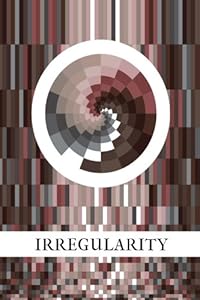
 Irregularity cover

Irregularity is an anthology of short stories inspired by the history of Science from the seventeenth to the mid-nineteenth centuries (the back cover invokes the Age of Reason) and intended to coincide with an exhibition, Ships, Clocks and Stars, The Quest for Longitude, at the National Maritime Museum, Greenwich.

To emphasise the “olde” feel the book is printed in a reconstruction of a seventeenth century typeface – though we are spared that italic-f-shape once used for the letter “s”. It has an unusual dedication, “To failure,” plus five internal illustrations adapted from paintings in the Museum’s collection.

The Prologue, Irregularity by Nick Harkaway, which sets the tone, has a woman bequeathed a library in which she finds a book which bears a cover described as similar (to all intents and purposes identical) to the one we are reading, not only relating her life story up to that point but also seeming to tell her future.
In the Afterword, Richard Dunn and Sophie Waring broadly define Science as the search for nature’s laws in order to codify them and ask what happens when things don’t fit. (Answering that last question is actually the most important scientific endeavour.) Irregularity’s contents are about just such attempts to understand the world.

As a coda, positioned after the afterword and which could easily be missed by a less than careful reader, an “email” to the editor comments on the impossibility of a book that loops back on itself.
The authors have interpreted their remit widely, the stories ranging from Science Fiction through Fantasy to Horror. Some could fall under the rubric of steampunk or alternative history. The literary antecedents being what they are it is perhaps not surprising that the majority lean towards the form of journal or diary extracts and epistolary accounts.

And so we have the inevitable pastiche of Samuel Pepys, M Suddain’s The Darkness, set in a steampunk 17th century with radio, telemessages and air defence antenna arrays, where the French are experimenting with Darke Materials, Restoration London has Tunnelcars and Skycars and a Black Fire of nothingness has begun to eat the city.

Of course, encountering well-known names is one of the pleasures of an anthology like this and there are plenty more to conjure with. Two for the price of one in Adam Roberts’s The Assassination of Isaac Newton by the Coward Robert Boyle, a piece of Robertsian playfulness in which Boyle has had access to modern physics (even discoursing with Brian May, whom Boyle says Newton resembles) and wishes to preserve the more human cosmogony which Newton’s work will displace. Chock full of allusion – including an extended riff on the “operatic” section of Bohemian Rhapsody – this story might just possibly be too knowing for its own good. Charles Darwin appears in Claire North’s The Voyage of the Basset where we follow him on his second sea voyage, utilising his knowledge of the lycaenidae to ensure nothing can mar the glory of Queen Victoria’s coronation. Ada Lovelace helps produce steam-driven animatronic dinosaurs in Simon Guerrier’s An Experiment in the Formulae of Thought, while Fairchild’s Folly by Tiffani Angus muses on the possible classification of love within a taxonomy via the epistolary relationship between Carl Linnaeus and Thomas Fairchild, who crossed a sweet william with a carnation to produce a sterile plant dubbed Fairchild’s mule. In Kim Curran’s A Woman out of Time unnamed creatures relate how they prevented Émilie du Chatelet from disseminating modern Physics too early. A Game Proposition by Rose Biggin has four women get together once every month to play a game which decides the fate of ships, incidentally giving William Dampier the knowledge to compile his atlas of the trade winds.

The most chilling tale is perhaps Roger Luckhurst’s Circulation, wherein a book-keeper is sent out from London to the island of San Domingue to investigate irregularities in the returns from the plantations there and comes upon the secrets of circulation as discovered by “the wizard Sangatte”.

Elsewhere; in Linnaean era Stockholm a young girl has dreams of the future, inspired by spiders; a maker of maritime clocks, in competition with Harrison for the Longitude prize, uses a variety of gruesome fluids to fine tune his escapement; a taxonomist travels to Southern Africa to seek out unusual beasts and finds the egg of a creature variously called gumma, gauma, gomerah, ghimmra, sjeemera; a found manuscript story with not one, but two introductions, suggests a reason for the rebuilding of St Paul’s Cathedral after London’s Great Fire on a realigned axis; an artist and his apprentice, commissioned to depict an anatomy lesson, witness the subject’s heart beating after death.

The stories work well in their own terms, but in totality are rather relentlessly “olde worlde”.

The following comments did not appear in the review:-
In my edition one of the stories was not in the order given on the Contents page.
Span count 1, sunk 1, as you no doubt you anticipated (one “you” is enough,) off of (x 2,) rolled a dice (a die,) court-marshalled (court-martialled,), the committee force me to seethe (forced,) at prices that seems almost scandalous (seemed,) her voice is a echo (an echo,) baster gang (?) a missing “it” (x 2,) two references to “three years” since the Great Fire of London (in diary entries dated 1667,) now used now (one “now” is enough,) can secret a substance (secrete,) they toppled the lids of those wooden prisons and relased their cargo (released,) I might find pick my way back through the canes back to the house (no find?) in sight of one of another (one “of” is enough,) walleyed with lust (wall-eyed,) inside of (inside,) to humour and old man (an old man.)

Clarke Award Shortlist

Last year it was Chris Priest who incited controversy over the Clarke Award, this year it seems to be the judges themselves – for not including a book by a woman on their shortlist.

The contending books are:-

Nod by Adrian Barnes (Bluemoose)
Dark Eden by Chris Beckett (Corvus)*
Angelmaker by Nick Harkaway (William Heinemann)
The Dog Stars by Peter Heller (Headline)
Intrusion by Ken MacLeod (Orbit)*
2312 by Kim Stanley Robinson (Orbit)*

I’ve read the last two of these and Dark Eden is on the TBR pile.

The overlap with this year’s BSFA Awards novel short list is strong (asterisked titles) but only 2312 is also up for the Hugo.

I’m a bit surprised that M John Harrison’s Empty Space didn’t make the list, it’s the sort of book that Clarke Award juries tend to like.

free hit counter script