Archives » Milan Kundera

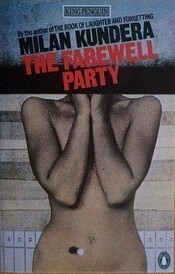
The Farewell Party by Milan Kundera

King Penguin, 1987, 186 p. Translated from the Czech by Peter Kussi. First published as La Valse aux adieux, © Éditions Gallimard, Paris, 1976.

This novel’s story unfolds over five days, the events of each of which make up the book’s sections.

Klima is a jazz trumpeter who has an erotic secret. As he tells his friend Bartleff, a rich American, “I love my wife.” That, however, has not stopped Klima from having sex with other women, one of whom, Ruzena, is a nurse in a fertility clinic in the spa town where Bartleff lives. An earlier phone call from Ruzena to Klima announcing she is pregnant has brought Klima scurrying to the town to try to resolve the situation. Their story is mixed in with that of Dr Skreta who runs the clinic, his friend Jakub, a former political dissident who has just received permission to leave the country and Jakub’s ward, Olga, the daughter of the man who betrayed Jakub to the authorities.

Skreta has had great success in enabling his clients to have babies. He has a sperm bank using his own semen as a result of which many of them have features resembling those of the doctor. “I have cured quite a few women of childlessness by using this approach.”

Klima wishes Ruzena to have an abortion but she refuses, at least initially. Skreta heads the abortion committee before which Ruzena would have to appear. Its two mature women members are generally unsympathetic to those who come before them wishing the procedure, an attitude Skreta interprets by saying women are the greatest misogynists in the world, always doing other women down. Misogyny, though, is a strain which tends to run through the book.

The character of Jakub allows Kundera to comment on the restrictions of a repressive state and the traits that inculcates, “All you have to do to turn people into murderers is to remove them from their peaceful circle of family home and work. Every now and again history exposes humans to certain pressures and traps which nobody can resist.” On people who seek revenge for their plight on the descendants of their persecutors he opines that victims are no better than their oppressors.

Bartleff, too, has observations to make, including that Saint Paul was not only a disciple of Jesus but a falsifier of his teaching. “His somersault from Saul to Paul. Haven’t we seen enough of those passionate fanatics who jump overnight from one faith to another?” (I note here that Christianity’s evolution after Saul’s conversion makes a case for the religion(s) it became to be named Paulinity rather than Christianity.)

The Farewell Party (some translations give the title as The Farewell Waltz) is intricately plotted, the connections between the two main strands woven together in an unexpected but somehow inevitable – albeit harsh – way. The overall feeling though is one of distance, that we see the characters as through frosted glass. They don’t seem to act for themselves so much as take the parts ascribed to them. But that is what living under a repressive regime must be like.

Pedant’s corner:- “surely a more likable being that Raskolnikov’s usurious hag” (than Raskolnikov’s,) missing full stops at the end of two sentences.

Milan Kundera

I saw in the Guardian yesterday that Milan Kundera has died.

He was undoubtedly one of the most important European writers of the late twentieth and early twenty first centuries.

All writers are products of their time and place. Not all are accepted for that. In Kundera’s case that lack of acceptance by the government led to him having to leave his homeland, the then Czechoslovakia, and making a life for himself in France. So much so that his later books were written in French.

I have reviewed his books, here, here, here, here, and here. I still have some unread to look forward to.

Milan Kundera: 1/4/1929 – 11/7/2023. So it goes.

Ignorance by Milan Kundera

faber and faber, 2003, 197 p. Translated from the French L’Ignorance by Linda Asher.

Kundera left Czechoslovakia (as it then was) in 1975 to live in France. His last few books have all been written in French and he wishes them to be considered as French literature, not Czech. This novel could have been designed as a riposte to anyone who questions that wish, dealing as it does with the condition of the émigré, especially one who makes a return to his/her original country.

He tells us, “the émigré is always thought to be forever longing for his/her homeland” and, citing the Odyssey as a template, says, “Homer glorified nostalgia with a laurel wreath and thereby laid out a moral hierarchy of emotions.”

Kundera begs to differ. For his émigré characters here, that hierarchy (taken as read by others) is an unwarranted assumption. They do not have such a longing. They have made a life for themselves elsewhere, have memories of those lives and do not have the same memories as those who stayed. There is a mutual incomprehension there, “for memory to function well it needs constant practice.” That practice is not available to someone no longer living in a country and “nostalgia does not heighten memory’s activity, it does not awaken recollections; it suffices unto itself, unto its own feelings, so fully absorbed is it by its suffering and nothing else.” Indeed on return even the native language appears at first to be barely intelligible.

Kundera also notes the unthinking cruelty of a US journalist who asked the composer Schoenberg only a few years after the Holocaust had led him to leave Europe, “Does an artist’s inspiration wither when it no longer has the roots of their native soil to nourish it?” Well, no. But what insensitivity.

Kundera’s absence from his native land has certainly not quenched his inspiration. Ignorance is saturated with thoughts of Czech identity, the Czech experience. Twice, he says, in 1938 and 1968, Czechs had been willing to die “to keep that landscape their own.” He says, “To be willing to die for one’s country: every nation has known that temptation to sacrifice.” However, the patriotism of large nations is different: “they are buoyed by their glory, their importance, their universal mission. The Czechs loved their country not because it was glorious but because it was unknown; not because it was big but because it was small and in constant danger. Their patriotism was an enormous compassion for their country.”

Geography is a factor in this. “The Scandinavians, the Dutch, the English are privileged to have had no important dates since 1945.” (Actually, as far as the English are concerned, twenty years on from when that thought was published, it is arguable that that ‘privilege’ has had a baleful effect.)

The two émigrés in Ignorance, Irena and Josef, meet by chance in a Paris airport waiting for a flight to Prague. Irena believes she had a connection to Josef when they were still in Czechoslovakia but Josef cannot remember her. They tentatively arrange to meet once they get to Prague. Both have unfortunate encounters with their relatives or friends who stayed behind and when they get together in a hotel room the outcome is as disheartening as might be expected.

Then again, the modern world is a constant distraction. Kundera tells us Schoenberg said, “Radio is an enemy …it force-feeds us music,” over the hearing of which we have no choice, hence music becomes just noise. I wondered idly if, to Kundera, sex, or the description of it, is just noise. In Ignorance it isn’t necessarily joyful. For example, in her absence, Irene’s husband Gustaf, who has set up a branch of his business in Prague, is seduced by her mother. Surprised, his initial reaction is “an immemorial error of men: having appropriated for themselves the role of seducers, they never even consider any women but the ones they might desire; the idea doesn’t occur to them that a woman who is ugly or old, or who simply stands outside their erotic imagining, might want to possess them.” The thought doesn’t stop him though.

Despite discussing what might be called high ideas Kundera invites us to mistrust them. “Conversations carried on in the stratospheres of the mind are always myopic about what goes on, with no reason or logic, down below: two great armies are battling to the death over sacred causes; but some minuscule plague bacterium comes along and lays them both low.”

Josef’s past life, when he rejected a girlfriend, leading to a bizarre consequence unknown to him, seems like a different world. Perhaps because it is; both to him as an émigré and to us as readers in translation.

Pedant’s corner:- Odysseus’ (Odysseus’s,) “by the emotion wracking that beauty and distorting it” (racking.)

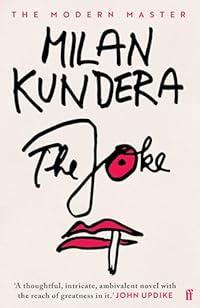
The Joke by Milan Kundera

faber and faber, 1998, 327 p including 5 p Author’s Note. Translated by Michael Henry Heim, the author himself, and Aaron Asher from the Czech Žert, originally published by Československỳ Spisovatel, 1967.

 The Joke cover

Kundera’s first novel endured a peculiar journey- outlined in the Author’s Note – to get to this publication, the fifth English language version of the novel. Kundera was unsatisfied with all previous renderings of The Joke as they contained altered syntax, different divisions, reconstructions, shortenings or omissions. He says he, “once left a publisher for the sole reason that he tried to change my semi-colons for periods,” but promises us, since he more or less undertook it himself, this will be the last translation.

The novel is a depiction of Czech life in the early to middle period of Soviet influence in the country. Main protagonist Ludvik Jahn provides the viewpoint for the odd numbered Parts – Part Two is narrated by a woman named Helena, Part Four by a man called Jaroslav, Part Five by another, Kostka, and Part Seven by Ludvik, Jaroslav and Helena in separate but intermixed sections.

Told from the perspective of a return to Ludvik’s home town in mid-life, we see the incidents influencing Ludvik’s circumstances from his time as a university student and part-time clarinet player in a cimbalom band, when he was a committed Communist. His life began to unravel when to impress a woman called Marketa he unwisely set down on a postcard the thought, “Optimism is the opium of the people! A healthy atmosphere stinks of stupidity! Long live Trotsky!” signed, and then sent it. When he was brought before a disciplinary hearing for this transgression, every member of his class voted for him to be punished. Despite his protestations that his action was a joke he was sent to a special Army unit, in effect a punishment battalion, not for training with weapons but set to work in mines. In what free time he was allowed Ludvik struck up a friendship with Lucie, but her reluctance to have sex with him (for which we later learn she had a very good reason,) made the relationship end badly.

Ludvik’s experiences are later given perspective by the thought, “no great movement designed to change the world can bear sarcasm and mockery, because they are a rust that corrodes all it touches.” So, too, is the sheer impossibility of proving yourself innocent in a world that sees evidence of guilt even in denial of the charge, still more in any efforts to prove loyalty.

Within the details of Ludvik’s life and embittered attempts at petty revenge Kundera finds time to touch on the importance of folk culture and traditions to a nation’s sense of itself. “During the seventeenth and eighteenth centuries the Czech nation almost ceased to exist. In the nineteenth century it was virtually reborn. Among the old European nations it was a child. True, it also had its own great past, but it was cut off from that past by a gap of two hundred years, when the Czech language retreated to the countryside, the exclusive property of the illiterate. But even in their midst it never ceased to create its own culture. A modest culture, completely hidden from the eyes of Europe. A culture of songs, fairy tales, ancient rites and customs, proverbs and sayings. The only narrow footbridge across a two-hundred-year gap….. The only fragile stem of an unbroken tradition. That is why the men who at the turn of the nineteenth century began to create a new Czech literature and music grafted them onto this stem…. why the first Czech poets and musicians spent so much time collecting tales and songs.”

Kundera goes on to argue that stripping away the veils of Czech music culture reveals the residue of the Great Moravian Empire, whose borders were swept away a thousand years ago, yet its legacy remains imprinted today in the most ancient stratum of folk songs. “The folk song or folk rite is a tunnel beneath history, a tunnel that reserves much of what wars, revolutions, civilization have long since destroyed aboveground,” even preserving classical antiquity for us.

When the state sanctions this culture though, it loses force. “The fact that something like folk music was on the radio constantly should not delude us.” What they play, “is more like opera or operetta, or light music…. A folk instrument band with a conductor, a score, and music stands! What bastardization! … Real folk art is dead.” And it can be abused in other ways. “Drunkards are the most loyal supporters of folk festivals. Once in a while, at least, they have a noble pretext for taking a drink.”

Translated fiction is arguably a necessary endeavour, revealing to others aspects of the world and thought systems of which they otherwise would not be fully aware, a reminder that the ability to read widely – and without restriction – is a blessing.

Consider the alternative. “We lived in a devastated world; and because we did not know how to commiserate with the devastated things, we turned away from them and so injured them, and ourselves as well.”

Pedant’s corner:- Translated into USian. Otherwise; repertory (repertoire,) “a slipshod permanent crumpling her hair” (ie, permanent wave; the British usage is perm,) aboveground (above ground,) “‘your not a woman who’” (you’re,) the opening quotation mark (deliberately) missing when a chapter begins with dialogue, Jesus’ (Jesus’s,) “head bowed bowed” (only one “bowed” needed,) Mathias’ (Mathias’s.) “There are a number of hypotheses” (there is a number of.) “A group of people were walking after it” (a group of people was walking.)

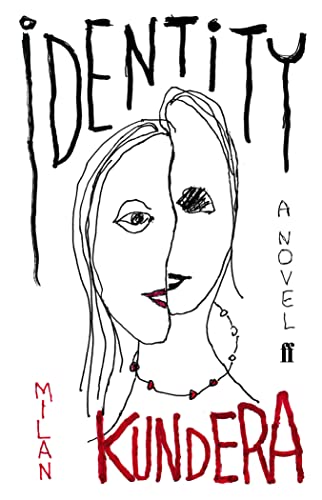
Identity by Milan Kundera

faber and faber, 1999, 155 p. Translated from the French L’identité (Gallimard, 1998?) by Linda Asher.

Identity cover

After the loss of a baby from a previous marriage, the constant refrain from her husband and his family that another child would set things right Chantal left to take up with Jean-Marc, who feels he only engages with the world through her but is fearful that is only an illusion and without her he’d lose any connection to the world. Her realisation that, ‘Men don’t turn to look at me any more,’ is the starting point of the couple’s estrangement. She begins to receive anonymous letters, keeping them from Jean-Marc, and imagines who might be their writer. Eventually their contents contain too many details of her activities to be the work of someone who does not know her well. The confrontation that ensues sees Chantal take a trip to London, in part to escape.

In its early stages this book reminded me of the work of John Banville but then it took a left turn into a phantasia of unlikely occurrences which it is a tribute to Kundera’s skill are nevertheless entered seamlessly without any jarring to the reader.

Identity, the awareness of self, is of course the theme of the book. “Remembering our past, carrying it with us always, may be the necessary requirement for maintaining the wholeness of the self.” Saying friends help to bolster this sense, Jean-Marc calls into evidence Dumas’s four musketeers and claims friendship is, “proof of the existence of something stronger than ideology, than religion, than the nation,” but Chantal tells him. “Friendship is a problem for men. It’s their romanticism. Not ours.”

Chantal works at an advertising agency. One of her colleagues declares, “‘Only a very small minority really enjoys sex.’” When challenged, he adds, ‘If someone interrogates you on your sex life, are you going to tell the truth?….. while everyone may covet the erotic life everyone also hates it, as the source of their troubles, their frustrations, their yearnings, their complexes, their sufferings.’” Sex is never far from the surface in a Kundera book. Here advertising is characterised as, “Toilet paper, nappies, detergent, food. That is man’s sacred circle, and our mission is not only to discover it, seize it, and map it, but to make it beautiful, to transform it into song.” We are, “condemned to food and coitus and toilet paper.”

Identity is a slight volume at 155 pages but packs a lot in. However, the simile in, “her voice wavering like the lament of a woman raped,” strikes an off-note.

Pedant’s corner:- Patroclus’ (Patroclus’s,) Alexandre Dumas’ (Dumas’s,) unfriendlike (is that a translation of a French word for which there is no direct English equivalent?) “an burdensome thing” (a burdensome thing, surely? Or was it a peculiar emphasis in the French?) a missing comma before a piece of direct speech, Britannicus’ (Britannicus’s,) “to épater les bourgeois” (not translated, but italicised,) a curious shift to past tense for one paragraph in a section otherwise rendered in the present.

Spaceman of Bohemia by Jaroslav Kalfař

Sceptre, 2017, 283 p.

 Spaceman of Bohemia cover

This is a brilliant debut novel but an odd reading experience, like Science Fiction as if written by Milan Kundera. Some of its tonal quality is, perhaps more understandably, also reminiscent of Stanisław Lem’s Solaris.

The set-up is that a comet has entered the Milky Way “from the Canis Major galaxy” and swept our solar system with a sandstorm of intergalactic dust. Consequently a purple cloud, named Chopra by its New Delhi discoverers, has formed between Venus and Earth. (I wondered here if there is perhaps a nod to M P Shiel’s 1901 novel, The Purple Cloud. Then again there is no reason for Kalfař, Czech born but who emigrated – the blurb says immigrated, there’s an end-point bias for you – to the US when he was sixteen.)

The Spaceman of the title, and our narrator, is Jakub Procházka, a man with a professional fascination with space dust and a professorship in astrophysics. With no other country publicly willing to investigate the Chopra phenomenon, the Czech Republic steps up to the mark, launching him from Petřín Hill on the space shuttle JanHus1. However, the book is not much concerned with the Science-Fictional scaffolding of this premise but more on Jakub’s life before the mission and his mental state while on it.

Not long into his voyage Jakub begins to perceive another living creature in his spaceship, a spider-like being whom he dubs Hanuš, after the maker of Prague’s astronomical clock, and which talks to him and enquires about his life. Kalfař’s writing leaves open the question as to whether this is an actual alien or an hallucination and Hanuš’s philosophy gradually begins to drive Jakub’s actions. Even at the end of the novel Hanuš is still a very real presence to Jakub.

The spaceship chapters are up to the last quarter of the book interspersed with the story of Jakub’s life until he became chosen for the mission. Jakub’s father had been a keen Communist and indeed a state torturer. With the fall of the Soviet Union the family’s fortunes of course changed, not helped by his parents’ death in a car crash, and Jakub’s late childhood, being looked after by his grandparents, was dogged by persecution by his peers. One day a man arrived carrying a rusty metal shoe which he said Jakub’s father once used to torture him. This “Shoe Man” now has the law on his side and causes the Procházkas’ eviction from their ancestral home – a telling reminder that injustice does not only exist under oppressive régimes. The most engaging of these “real life” chapters are those which deal with Jakub’s wife, Lenka, how he met her, their life together, and how, unknowingly to Jakub, they began drifting apart. This is a detailed portrait of a relationship.

In a clever decision by Kalfař the flashbacks are narrated in the present tense while the story of Jakub’s trip in space and its aftermath are in the past tense. This adds to the dreamy, hallucinatory nature of the space-based sections while the Earth bound sections are agreeably gritty. At one point Jakub sees Laika the dog drift past his ship, “her body preserved by the kindness of the vacuum, denying the corrosive effects of oxygen.” (Quite how she escaped the confines of the capsule she had been launched in Kalfař doesn’t explain, but it had me wondering.) This is of course a touch that borders on magic realism, emphasising the strangeness of Jakub’s voyage, but one of the novel’s concerns is the necessity to fight against or to accept the absurdity, the sheer unlikeliness, of the universe. In Jakub’s world even in space persecution cannot be avoided. Hanuš’s species has been pursued across galaxies by creatures called Gorompeds intent on its extinction. It is a neat touch that while Jakub uses the word humanity to describe our kind, Hanuš characterises us as humanry.

The book is also a primer on the history of Prague, the Czechs, and their achievements. To this end we are shown the martyrdom of Jan Hus (though in an apparent aside which is also a neat piece of foreshadowing Kalfař considers the possibility that Hus might have been replaced by a relative lookalike and lived out his days in seclusion,) the tragedy of Vaclav Havel – a man wanting only to write poetry but who instead became public property – who “lost his typewriter,” the plot of the opera Rusalka and the line from it, “All sacrifices are futile” that seems to apply to Jakub’s imminent demise at the hands (tendrils?) of the Chopra cloud, the impossible dilemma faced by Emile Hácha in Hitler’s office as he was offered ignominy or the slaughter of his country.

As the JanHus1 disintegrates in the purple cloud Hanuš disappears and Jakub is rescued by a “phantom” (deniable, incognito) Russian spaceship. He thwarts their authorities’ intention to detain him forever by interfering with the ship’s controls on its landing descent, making it crash, and so limps on into an afterlife in which everyone but the Shoe Man, whom he confronts in a park and whose complicity in his choice for the mission he uncovers, thinks he is dead.

The strangeness of the part of the narrative taking place in space, the distancing Jakub feels even when back on Earth, is echoed by the question he asks himself, “What if our existence is a field of study in probability conducted by the universe?”

My main thought during reading this is that in the flashback sections it bears far more similarity to a mainstream novel from Central/Eastern Europe than to Science Fiction. Kalfař writes in USian but odd word choices, phrases and emphases sometimes make the text seem like a translation – yet all of these add to the overall effect.

To see an examination of the history – and present – of a small country in the guise of a Science Fiction novel is an unusual but welcome phenomenon. But is this a trick Kalfař can pull off again?

One of my books of the year though, without a doubt.

Pedant’s corner:- the Canis Major galaxy (Canis Major is not a galaxy, it’s a constellation,) spit (spat; I know it’s USian usage but it still grates,) “the creature has ahold of me” (a hold,) a missing start quote mark when a chapter began with a piece of dialogue, “over the clothing lines fastened to poles outside their windows” (clothes lines – clothing line is a fashion industry term,) “a deceptively still malt of sand and rock” (malt? Did Kalfař mean meld?) aircrafts (aircraft,) “cut my parents’ retirement” (is this use of retirement in the sense of pension USian? Or is it perhaps a Czech usage?) A missing end quote mark, “to give her a grandchild” (her was Jakub’s grandmother so that would be a great grandchild.) “Millions of eggs circumvent a small planet” (circumscribe,) “I didn’t know what happened to my wife” (what had happened,) by all standards (by any standards is more usual,) scruff (scurf,) a candlewick (it wasn’t a bedspread; so, candle wick.)
Plus points though for the “whom” in “I’m not sure whom to be angry with” and for the use of wee to mean small.
Immortality by Milan Kundera

faber and faber, 1991, 391 p. Translated from the Czech Nesmrtelnost by Peter Kussi.

Immortality cover

In the first chapter the narrator tells of seeing a gesture by a woman who was just leaving a swimming pool and which inspired him to write the novel. I was struck by the ageist perspective with which Kundera treats this incident. Be that as it may, gestures and their meanings, their particularity or otherwise, are a feature of the book.

Set mainly in Paris (where Kundera settled after leaving Czechoslovakia) the meat of the book lies in the relationships between Agnes, her husband Paul, and her sister Laura. There are similarities here to the writing of Irène Némirovsky, also an exile in Paris, but at an earlier time. Unlike Némirovsky though, Kundera delves into the deeper past in order to interrogate the means of achieving immortality, in the sense of remaining famous after death, by examining the relationship between Bettina Brentano (later von Arnim) and Goethe, which has mostly been seen through the lens of Brentano’s accounts. Ernest Hemingway too makes appearances – notably in discussions with Goethe in the afterlife – as does Beethoven, and there is a disquisition on Don Quixote. The author himself also features as a character. (Perhaps it was this book which gave Orhan Pamuk that idea.)

The narration comments on itself at various points, and at times does not so much foreshadow as give the later game away. We are told of the death of one character and explore its consequences long before being shown it and that in Part Six a new character will appear and then vanish without trace – as indeed he does; but only to present us with a connection to another that had hitherto not been mentioned (or deliberately hidden.)

The narrator/Kundera notes a historical transition in the toppling of Richard Nixon not by arms nor intrigues but the mere force of questioning, the power of the Eleventh Commandment “Tell the truth.” (Sadly that power no longer seems to work.) He also tells us that nineteenth century writers ended their novels with a marriage not to protect their readers from marital boredom but to save them from intercourse. “All the great European love stories take place in an extra-coital setting…. there was no great love after pre-coital love, and there couldn’t be…. Extra-coital love: a pot on the fire, in which feeling boils to a passion, and makes the lid shake and dance like a soul possessed.” How much of this is an echo of Kundera’s own attitude to intercourse is a matter for conjecture. (Compare “The Unbelievable Prevalence of Bonking” as Iain Banks, in The Crow Road, characterised another of Kundera’s works.)

In amongst all the narrator’s philosophising are sprinkled some bons mots, “A person is nothing but his image” and “I think therefore I am is the statement of an intellectual who underrates toothaches. I feel therefore I am is a truth much more universally valid.”

While at times the prose had the feel of a history book and of the literary work in general – one incident in particular reminded me of Mario Vargas Llosa’s Aunt Julia and the ScriptwriterImmortality was never difficult to read – a tribute to the translator, Peter Kussi, perhaps.

Pedant’s corner:- Saint Vitus’ dance (Vitus’s,) Agnes’ (Agnes’s,) assininity (asininity,) Avenarius’ (Avenarius’s,) Hals’ (Hals’s.)

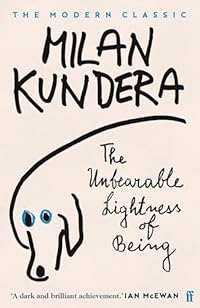
The Unbearable Lightness Of Being by Milan Kundera

Translated from the Czech, Nesnesitelná lehkost byti, by Michael Henry Heim.
Faber, 1995. 305 p.

This is a book to bring home how parochial and inward looking most fiction written in the English language is. There is no possible way that The Unbearable Lightness Of Being could have been written by a British or US author, or indeed any other anglophile. The mind set, the life experiences and especially the history it is written from are all too different. While the thrust of this book is by no means the same, I was reminded by its sensibility of the work of Bohumil Hrabal – not surprisingly also a Czech author.

The book is unusual in another sense; it breaks most of the rules that aspiring writers are advised to adhere to. A lot of the action is told to us rather than shown, Kundera addresses the reader directly, inserts his opinions into the narrative, tells us his interpretations of the characters. He also messes with chronology (admittedly not a major drawback, if one at all) and parenthetically gives us important information about some characters in sections which ostensibly deal with others. In parts, especially in the author’s musings on kitsch as the denial of the existence of crap – in all its senses – in the world, it reads as a treatise rather than an exploration of the human condition. That is, at times it is not fiction at all.

Kundera is highly regarded, so is this the essence of high art in fiction? That, as well as dealing with “important” subjects – or perhaps being considered to be circumscribed yet still endeavouring to tell truth to power (whatever truth may be) – the author should step beyond the bounds of narrative; of story?

The problem with such an approach is that it tends to undermine suspension of disbelief. The characters become too obviously constructs; the reader is in danger of losing sympathy, or empathy, with them; or indeed to care. It is a fine line to tread.

Where The Unbearable Lightness Of Being is not unusual is in its treatment of those novelistic eternals love, sex and death. Indeed at times it seems to be fixated on sex.

While the exigencies of living in a totalitarian state do colour the narrative, the treatment is matter of fact, oblique, almost incidental. The choices the characters make merely fall within the constraints of such a system. It is true, however, that something similar could be said for characters in any milieu. There are constraints on us all.

What I did find disappointing was that rather than finish, the book just seemed to stop. While the fates of the characters Kundera leaves us with are already known, this hardly seemed fair. “Leave them wanting more” may be an old showbiz adage but in the context of a one-off novel might be thought to be a failing.

free hit counter script