Posted in Eric Brown, Events dear boy. Events, Science Fiction at 12:00 on 24 March 2023
This is a post I’ve been dreading.
My dear friend Eric Brown has died.
He had not been well for some time and had borne it with fortitude and good grace (and not a little optimism, or so it seemed when we visited him) but though this outcome was always likely the news nevertheless came as a shock.
A proud Yorkshireman – born and brought up in Haworth – and not shy of living up to the stereotype, Eric was neverthless one of the kindest, friendliest people I have ever met. His writing embodied those attributes and always had a warm, human heart to it but was not appreciated as widely as it ought to have been and never achieved as much success as it deserved.
Among many other things I’ll miss our mutual commiserations about the fortunes of our respective beloved football teams (in his case Leeds United.)
He is a great loss not only to the field of Science Fiction (and with his Langham and Dupré stories to the ‘cosy crime’ genre) and as a friend to the good lady and myself but most of all to his wife Finn and daughter Freya, taken from them far too soon.
Words are not enough.
Eric Brown: 24/5/1960 – 21/3/2023. So it goes.
1 Comment »
Posted in Eric Brown, Reading Reviewed at 12:00 on 16 June 2016
Severn House, 2016, 208 p.
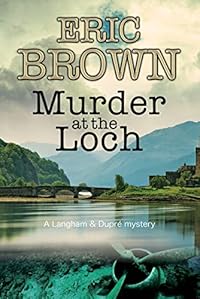
If you want an example of how character can be established with economy look no further. Brown does this with facility. Witness how much we learn about Gabriel Gordon from the reactions of Sophie, living in an artists’ commune in London, to Maria Dupré seeking him out. This, in the third of Brown’s Langham and Dupré mysteries, is in part of the narrative where Maria is looking into Gordon’s background while Don Langham is investigating an attempted murder at a hotel in the Scottish Highlands. Langham’s wartime comrade, private detective Ralph Ryland, enlisted his aid when their wartime commanding officer Major Gordon, who now owns the hotel, called for assistance after he and a guest were shot at while they were involved in work on a project to raise the wreck of a German Dornier aeroplane which had crash landed in the nearby loch in February 1945.
The inhabitants of the hotel, not only Gabriel Gordon but also Hungarian emigré Renata Káldor, the German Ulrich Meyer – an expert on World War 2 aircraft – a Professor Hardwick (who is delving into the hotel’s history of paranormal phenomena) and Major Gordon’s ward Elspeth Stuart (with whom Gabriel had a fling before the Major put a stop to it) provide plenty of scope for suspicion.
The splitting of Langham and Dupré is a device Brown has employed before and is a useful tool when background information has to be sought from different locations many miles apart. It also handily allows both to be placed in jeopardy separately. Here the fifties setting yields a benefit to raising tension in that communication between the pair has to be by an unreliable telephone connection. The book also sees the welcome return of Langham’s literary agent, Charles Elder, released from jail, where he made a new friend. (It remains to be seen whether this will be a wise liaison.)
This isn’t quite a locked room mystery (though a winter snow storm makes it more or less a hotel in lock-down one.) However, the actual murder when it occurs – with which another years previously is connected – comes close to the classic scenario. And there is nothing gratuitous here. Brown adheres pretty closely to the template and feel of the stories he is echoing. If at times his Langham and Dupré mysteries may seem to have a soft edge that isn’t necessarily a drawback. Those fifties crime stories were primarily entertainment and still are.
Pedant’s corner:- Inverness is described as a “little town.” In the 1950s? “Soon they were tooling along,” (tootling?) “economical with the truth” (in dialogue – but was it in use in the 1950s?) “a crack at the Bosch!” (Boche,) “a Hungarian who had fled her homeland when the Nazis invaded” (I think the Nazis already had a presence there and so took over rather than invaded, but they certainly occupied the country in an attempt to prevent it changing sides as Romania had just done,) jerry-rigged (jury-rigged,) Camus’ (Camus’s,) “it appeared as first glance” (at,) primeval (I prefer primaeval,) “She said It was unlikely” (insert quote marks or make “it” lower case,) of the Loch Corraig Castle (of Loch Corraig Castle,) “drawing is revolver” (his.) Plus sixteen instances of “time interval later” (but two of these were in dialogue and another two not very glaring.) Also one “within minutes.”
No Comments »
Posted in Eric Brown, Reading Reviewed at 12:00 on 22 December 2015
Severn House, 2014, 214 p.
The second of Brown’s Langham and Dupré stories this one promises to be a locked room mystery but the locking is cleared up very quickly. Donald Langham’s acquaintance Edward Endicott is the one who has disappeared. His son, Alasdair fears he has been harmed as he had fallen under the influence of a man claiming to be Victorian Satanist Vivian Stafford.
Retracing the possible path along which Endicott’s dog returned, Lanham, Dupré and former Hollywood actress Caroline Dequincy come upon a body. It is not Endicott’s though, but Stafford’s. The web of connections Brown then constructs involves most of the leading characters. I note here the appearance of artist, Haverford Dent, not the first time an artist has appeared in Brown’s fiction. The unwinding of the circumstances leading to Stafford’s murder and to the death of the local village’s vicar, Marcus Denbigh, involves a lot of toing and froing – not to mention sipping of pints. The hesitancies of the relationship between Langham and Dupré do take up quite a bit of the book’s time, though.
Though there are some sharp edges Brown again emulates well the cosiness of the classic detective story. However, a few of his characters seem more free-minded than might perhaps be expected of his 50s setting.
Pedant’s corner:- A “time interval later” count of 33 plus one instance of “a little later.”
“The bells of the neighbouring churchyard peeled” (that should be pealed – which was used for the same bells further into the book,) medieval, “the latter forbore the attention” (“bore the attention” makes more sense,) vol-au-vents (I still think the plural should be vols-aux-vents; I’m obviously in the minority here,) “aware of the sadness in actress’s words” (the actress’s words,) I thought there was a continuity error when Langham says to Maria “On top of the brandy?” – she’d been drinking only tonic water previously, registry office (Register office,) “Her smiled faltered” (smile,) veniality, (this means easily excused or forgiven; pardonable: I think venality, the condition or quality of being venal; openness to bribery or corruption was intended,) curb (kerb.)
No Comments »
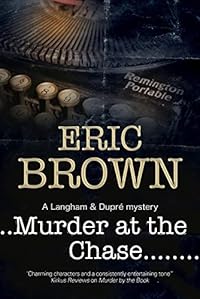
Posted in Eric Brown, Other fiction, Reading Reviewed at 20:46 on 15 March 2014
Crème de la Crime, 2013, 218 p.
After a myriad of SF books and stories this is the author’s first foray into straight detective fiction. I don’t read very much in the crime genre but this one worked for me. Partly that was the result of the old-fashioned, and welcome, feel of the story, which can be read as an homage to the golden age of detective fiction.
We are in the 1950s. Donald Langham is a writer of detective stories with a good relationship with his patrician agent, the florid of speech Charles Elder, and an unstated affection for Elder’s more than competent secretary Maria Dupré, the daughter of a French diplomat. The murders of the title have started before the narrative does but we do not learn this till later. The first crime we read about is the blackmailing of Elder for gross indecency with a rent boy. Before he settled down to writing Langham had previous experience of detecting so he offers to investigate and find the blackmailer. Things do not go easily and it is not long before Maria has to make a contribution to the endeavour. Meanwhile it emerges that writers of detective stories are dying or being murdered in ways that nag at Langham’s mind. The plot bowls along, with plenty twists and turns and the narrative incorporates both the camaraderie and the resentments of crime writers.
Keen observers of Brown’s previous works will notice certain resonances in the text, especially in the nascent and building relationship between Langham and Maria, which at times has more than a feel of Brown’s “Starship Seasons” quartet of novellas, among others.
In an article in the Guardian Review on Saturday 8th March John Banville identified an “unacknowledged but vital ingredient of a really satisfying whodunnit: cosiness.” In setting his book in the 1950s Brown has caught that cosiness perfectly. It is, after all, the function of the detective story to set the world to rights.
There is at least one more Langham and Dupré novel to come. I’m looking forward to it.
No Comments »