Posted in Reading Reviewed, Science Fiction at 13:00 on 29 October 2016
Jo Fletcher, 2014, 345 p, plus i p acknowledgements and v p bonus content.
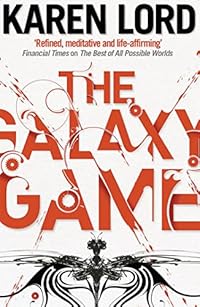
Humans are spread over five extraterrestrial planets, Saraldi, Zhinu, Punartam, Cygnus Beta and Ntshune with Earth embargoed. Psionic abilities necessary for swift transit between solar systems are frowned upon in Cygnus Beta where Rafi lives. Since he may follow his father in being be so endowed he is administered a cap to monitor his urges/proclivities. However, Rafi swiftly moves on to Punartam where his abilities are encouraged and developed in a wall-running game which – like the similar task in Orson Scott Card’s Ender’s Game – has much more significance than at first appears. Third person narration is interspersed with first person sections from one of Rafi’s friends; which seemed to me rather an odd authorial decision.
Unfortunately I found out too late that The Galaxy Game seems to be a sequel to one of Lord’s previous novels, The Best of All Possible Worlds, which I have not read and knowledge of which may have improved my appreciation of this one. As it is, two weeks on from reading this I can barely recall what it was about except that too many things were reported rather than narrated, even in the first person sections.
I enjoyed Lord’s first novel, Redemption in Indigo, which was set in Africa, much more than this even though it was more of a fantasy rather than the straightforward SF of The Galaxy Game.
Pedant’s corner:- directed a student (at a student,) “‘are you in love with Rafi,'” (question mark rather than comma,) “he was staring a collection of shapes, colours and textures that coalesced … under the identity Naraldi,” (staring at a collection,) “a handful of Uplanders were (a handful was,) a skilled team who knows (team who know,) must have showed (shown,) practise (practice? practise is USian?) “anything that the worlds ….. has seen (have seen,) mentions an ice-bound world that nevertheless has a stable and favourable atmosphere (what produces the oxygen that makes it breathable? On our world it is plants and photosynthetic algae. Is that going to be true for an ice-covered world?) “She quickly reached in and detached the upper casing from their pod.” (Only one person was in the pod; so his, not their,) by slight increase in gravity (by a slight increase,) hovercrafts (hovercraft’s plural is hovercraft,) “according whatever terms were agreeable to us” (according to whatever terms) tumbling out thin air (out of thin air,) paid with their pilots lives (pilots’.)
Plus points for the “fewer” in “fewer drugs and less malaise” though.
No Comments »
Posted in Andrew Crumey, Eric Brown, Orhan Pamuk, Other fiction, Reading Reviewed, Science Fiction at 12:00 on 31 December 2012
I don’t usually do end of year round-ups – mostly because most folk write theirs before Christmas and that offends my sensibilities. The year ends on 31st Dec, not before.
Whatever, I looked through all the fiction books I read this year and found twelve that stood out. In order of reading they were:-
PfITZ by Andrew Crumey
Zoo City by Lauren Beukes
The Master and Margarita by Mikhail Bulgakov
The Song of Achilles by Madeline Miller
The Kings of Eternity by Eric Brown
the Tiger’s Wife by Téa Obreht
And The Land Lay Still by James Robertson
The Museum of Innocence by Orhan Pamuk
Redemption in Indigo by Karen Lord
New Model Army by Adam Roberts
Galileo’s Dream by Kim Stanley Robinson
D’Alembert’s Principle by Andrew Crumey
That’s four by women and eight by men, which is a pretty high strike rate for the distaff side compared to my fiction reading as a whole, 12:45 – is that shockingly low or a reflection of publishing? Four were SF, eight not; though that ratio alters if you count the fantastical – the Lord, the Obreht, the Bulgakov, and the Crumeys which feature stories from a city made up within one of the two. Only the Robertson and the Pamuk lie wholly within the realm of the naturalistic.
I don’t propose to rank the twelve in any way.
No Comments »
Posted in Fable, Reading Reviewed at 19:00 on 11 October 2012
Jo Fletcher Books, 2010, 280p.
Lord is a Barbadian with a background in Science, English language and Sociology. Out of that she has produced a very readable, literarily aware, fable apparently based on a Senegalese folk-tale.
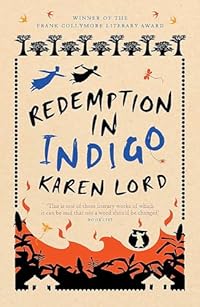
The narrative takes place in an unspecified country which feels more African than Caribbean. The main character, Paama, a marvellous cook, has left her gluttonous husband and gone back to her parents’ house. When he tries to win her back all sorts of misfortunes befall him due to his shortcomings. Mixed in with this tale is the gift to Paama from the spirits known as djombi of a Chaos Stick which has the effect of making improbable events less so, of enabling unlikely occurrences. There is one mention of quantum fluctuations but it is no more than a sop to a possible scientific explanation. For this is a universe where insects can talk and other-worldly beings like the djombi, twisters and baccou are unremarkable, or at least accepted. A certain djombi, deprived of some of his powers by the others, seeks out Paama to take the Stick and thereby regain them.
A title like Redemption in Indigo does rather suggest someone will undergo a transformation and this indeed takes place but to reveal of whom and why would be a spoiler.
Lord at times knowingly addresses the reader (the tale telling tradition embodied in the book implies a hearer could be the intended audience) or otherwise demonstrates she is in charge of the story she is telling thus lending the novel a literary air.
However you read it, Redemption in Indigo is a fine modern fable.
No Comments »