Posted in My Interzone Reviews, Reviews published in Interzone at 12:00 on 6 January 2018
Erica L Satifka’s Editorial states her surprise and delight at winning the best newcomer award at Fantasycon for her novel Stay Close. Jonathan McCalmont’s column1 comments on the ebb and flow of the Science Fictional year due to the awards cycle and bemoans the narrowing down of discourse to only the professional sphere. Nina Allan extols the merits of the French short SF film La Jetée. Book Zone is now relegated to coming after Nick Lowe’s Mutant Popcorn film reviews. This edition features my review of Frances Hardinge’s A Skinful of Shadows plus others on Gnomon2 by Nick Harkaway, 2084 an anthology edited by George Sandison, Raven Stratagem by Yoon Ha Lee, Tricia Sullivan’s Sweet Dreams, the new Ann Leckie, Provenance, Jane O’Reilly’s Blue Shift, Jane Yolen’s collection, The Emerald Circus, the tie-in book to the Channel 4 series Philip K Dick’s Electric Dreams, Jeanette Ng’s Under the Pendulum Sun: a Novel of the Fae and The Overneath3, a collection by Peter S Beagle.
In the fiction we have:-
Looking for Laika4 by Laura Maro, an altered history where the Soviet Union seems to have survived longer than in our timeline. An adolescent with fears of atomic conflict consoles his younger sister with tales of Laika the first space dog travelling the universe in search of a better planet. Off-stage in this story London is immolated in a nuclear strike.
After the Titans5 by Rachael Cupp is a fabular construction in a bucolic setting where Titans roam the land and ordinary folk are as flies to the gods.
In the future of Dan Grace’s Fully Automated Nostalgia Capitalism people are pervaded by mites of all sorts that protect them from the harmful effects of smoking and the like. But the mites also act as agents for control. Nevertheless petty acts of defiance are possible.
The Big So-So6 by Erica L Satifka is set in the aftermath of an alien takeover where they used a drug to pacify and classify the populace. Then they withdrew it and themselves.
The Garden of Eating7 by R Boyczuk riffs on the Garden of Eden theme in a post-apocalypse setting where an (AI?) remnant of the UN counsels a young boy against a police-like entity called the Amerigun.
James White Award Winner The Morrigan8 by Stewart Horn is narrated in a style flavoured by demotic Glaswegian. While well-written it depressingly panders to the “hard man” image and the gang culture by describing the influence of the (possibly other-worldly) woman who instigates the biggest gang fight in Glasgow’s history.
Pedant’s corner:- 1“less time, less money, and less staff,” (I know staff is technically singular but fewer staff is a more natural usage,) “that might have an influence on the discourse: Ordinary fans (surely needs a full stop. Not a colon.) 2 “into which a body is broke” (broken?) 3”The sheer breath of theme” (breadth,) “eventually a pair of elderly Turkish mystics take the tenants to..” (a pair takes,) “characters getting out of their depth” (characters, so depths,) “in which monarch’s relinquish power” (monarchs,) “intervenes in a case of marital fidelity and creates chaos” (infidelity? Possibly not.) 4“Taken a deep shuddering breath, and began to read” (the previous sentence was in the pluperfect so begun to read,) “they lay in rows” (this one is present tense, so “they lie in rows”. Mauro has the preterite, lain, correct, though.) 5To emphasise the ‘ancient’ nature of the tale this has a ligature between the letters s and t – as in st – when they occur consecutively within a word. “I say, May all creatures tremble,” and, “He says, Make to me a sacrifice” (why not put in the quote marks?) Cronus’ (Cronus’s.) 6written in USian, “none of them look at us” (none looks.) 7Written in USian. 8Crosslea park (that’s a proper noun so Crosslea Park,) “‘They’re gonnae to be” (no “to” required,) “like was made for cutting” (like it was made for cutting.)
No Comments »
Posted in Fantasy, Reading Reviewed, Science Fiction at 12:00 on 25 November 2017
TTA Press
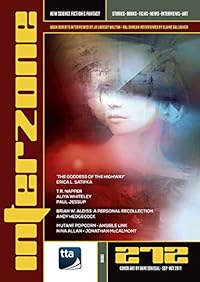
Andy Hedgecock’s Editorial1 is an appreciation of the late Brian Aldiss of blessed memory. Jonathan McCalmont2 ponders the uses of allusion, contrasting the reductive and lazy with the dense or expansive. Nina Allan welcomes post-SF. Book Zone has an interesting and discursive author interview by Jo Walton3 with Adam Roberts to tie in with his new novel The Real-Time Murders but neglects to review the book. Duncan Lunan4 reviews Paul Kincaid’s book of criticism Iain M Banks mostly by relating his experiences of the late master. There is also Juliet E McKenna’s take on Charles Stross’s Delirium Brief, Stephen Theaker5 on Ada Palmer’s Too Like the Lightning while John Howard reviews Xeelee Vengeance by Stephen Baxter, with the final item a review of Hal Duncan’s A Scruffian Survival Guide by Elaine C Gallagher who also interviews6 the author.
In the fiction:
As the world slowly rebuilds after war and ecological disaster, Blessings Erupt by Aliya Whiteley tells the story of the last of the original plastic eaters, consuming the hydrocarbon-based tumours that afflict the population in return for years of service to the company he represents.
The Music of Ghosts7 by Paul Jessop is set on a generation starship after Earth has been destroyed. The voyagers’ essences are supposed to be uploaded into the library after their death but things go wrong.
In a Melbourne fifty years past any relevance it ever had Ghosts of a Neon God8 by T R Napper tells of two small time crooks who are unwittingly embroiled in a dispute between the Chinese who run the place.
A white mist of unknown origin – possibly alien, possibly human – has “clouded cognitive processes and slowed down conscious thought” and in Erica L Satifka’s The Goddess of the Highway9 people are fitted with plates in their heads in a caste system to suit each to their new roles. Viewpoint characters Harp, a Plastic who monitors a truck criss-crossing the former US, and Spike, a Platinum, come together to try to join the resistance. The titular goddess may be a manifestation of the plates.
Pedant’s corner:- 1Aldiss’ (Aldiss’s.) 2Written in USian, “the crowd are right” (the crowd is.) 3Lord Peter Whimsy (did Roberts actually say that? I believe him capable of such punnery but in English English – as opposed to Scottish English – the correct, Wimsey, and the pun, whimsy, are much less distinguishable,) descendent (descendant,) 4Banks’ (Banks’s,) “human affairs are so complex than any stance (that any stance,) 5“A series of innovations have set this world apart” (a series has,) 6fit (fitted) 7Written in USian, “the sun grew wane and hungry with light” (wan?) “the whirring of machines are chugging” (the whirring is chugging but even that is clumsy.) Ray stops programming for a moment and touches Ray’s hands” (Mark’s hands.) The story is riddled with errors in tense. It’s written in the present but has past tense verb forms intruding, “He’d been training for this day” (He’s ) “And his heart was a wild thing inside his ribs” (is.) “They ran into the storage facility” (run,) “and then she turned” (turns.) 8“Now it may as well not even existed” (exist,) his practiced stride (practised,) focussed (focused.) 9Written in USian, hocking up (hawking,) “the majority of what gets shipped are luxuries” (the majority is,) “intersecting a round sphere” (I’d like to see a sphere that isn’t round!)
No Comments »
Posted in My Interzone Reviews, Reviews published in Interzone, Science Fiction at 20:00 on 25 July 2017
The latest issue of Interzone, number 271, arrived last week.
Along with the usual columns from Jonathan McCalmont, Nina Allan, plus David Langford’s Ansible Link, there are six short stories.
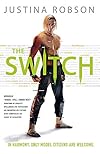
The book review section features an interview with Nina Allan and Emily B Cataneo focusing on their latest books The Rift and Speaking to Skull Kings and Other Stories respectively, and my review of Justina Robson’s The Switch.
No Comments »
Posted in My Interzone Reviews, Reading Reviewed, Reviews published in Interzone, Science Fiction, Scottish Fiction at 10:00 on 29 December 2016
TTA Press
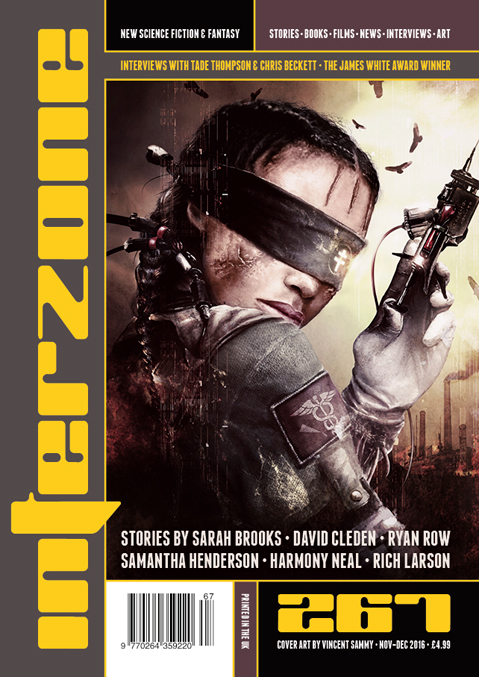
The Editorial is by Martin McGrath and discusses the continuing importance of the James White Award, whose latest winner* is published in this issue, Jonathan McCalmont’s column1 bemoans the recent trend towards magical policemen solving crimes in old London town as having a reactionary effect while Nina Allan praises Scottish Science Fiction’s engagement with political themes. In the Book Zone I review Dave Hutchinson’s Winter in Europe and there are interviews with Tade Thompson and Chris Beckett.
Alts2 by Harmony Neal is a tale of humans genetically modified by StateCorp into a kind of slavery.
The narrator of Ryan Row’s Dogfights in Olympus and Other Absences3 is a mercenary pilot involved in a multi-party conflict over a planet called Olympus which has a desirable hyper potential energy dense matter core. The relativistic aspects of his 0.2 light year separation from his family affect the relationship.
The Hunger of Auntie Tiger by Sarah Brook is set on a planet where people of Chinese origin, left more or less to their own devices by “the Company” relive myths.
Rich Larson’s You Make Payata4 suggests there is really only a small number of tales that can be written as this one of an attempted scam has a familiar template but is nevertheless well executed and full of Science-fictional gloss.
*Rock, Paper, Scissors5 by David Cleden literalises the game alluded to in its title vinto a contest between the bodily-transformed representatives of two tribes for the annual rights to the hunting grounds.
In My Generations Shall Praise6 by Samantha Henderson a woman on death row is persuaded to have her mind overwritten so that someone else can use her body.
Pedant’s corner:- 1Morris’ (Morris’s,) use of they and them as pronouns for an individual. 2Written in USian. “She wasn’t sure the exact details of his alteration” (of the exact details,) “everyone holding their breath (their; so breaths,) sunk (sank.) 3 Written in USian. “Curealian and silver beams” (Cerulean?) “where his family makes their home” (“makes” is the singular; so “makes its home”,) “above him the naked stars lay out in the dark” (lie out; the narration is present tense,) dying her hair (dyeing.) 4 Written in USian, pretenses (pretences,) “‘when you get the hotel’” (to the hotel,) florescent (is this USian? – fluorescent.) A collection were (a collection was.) 5mold (mould,) vocal chords x 2 (cords,) “growing soft and downy my back” (on my back?) “the Tribe grow quiet” (grows; several more instances of Tribe as plural,) “‘Your foe will keep their distance’” (his distance; his is used later,) “‘when they tire’” (when he tires,) “‘though they beg you’” (though he begs you,) the attack is borne of frustration (born of.) 6Written in USian. “‘Will they let her in short notice?’” (At short notice? On short notice? With short notice?)
No Comments »
Posted in Alastair Reynolds, My Interzone Reviews, Reading Reviewed, Reviews published in Interzone, Science Fiction at 20:00 on 3 December 2016
TTA Press

Stephen Theaker’s Editorial muses on awards; their disadvantages and their necessity. Jonathan McCalmont’s column1 discusses Emma Geen’s The Many Selves of Katharine North favourably while Nina Allan reflects on the connections between classical and folk music on the one hand and the weird/faery on the other.
In the Book Zone I review Alastair Reynolds’s Revenger (recommended.) Also gaining approval are Paul Kearney’s The Wolf in the Attic (even if it does require a sequel,) Peter S Beagle’s Summerlong and Gaie Sebold’s Sparrow Falling.
In the fiction, Tade Thompson’s The Apologists is set in the aftermath of an invasion of Earth by aliens who hadn’t realised it was inhabited. Discovering their oversight, they keep six remnants alive on a simulated world.
Extraterrestrial Folk Metal Fusion2 by Georgina Bruce is a tongue-in-cheek tale of the discovery of a signal from outer space which is soon parlayed into opportunities for profit, either personal or monetary.
Narrated by the best friend of the test pilot (who tells him what happened in a disturbing first flight) Ray Cluley’s Sideways3 is an excellent, affecting story about a 1950s rocket propelled prototype craft that can go sideways. That word is deployed strategically throughout the story to underline its strangeness.
In Three Love Letters From an Unrepeatable Garden by Aliva Whiteley the titular letters are to the lover of a gardener protecting a unique but dying flower.
One by one in The End of Hope Street4 by Malcolm Devlin, the houses in the street become unliveable. If you are in them when they do then you die. A tale of neighbourliness in adversity but told in an oddly distanced way.
Pedant’s corner:- 1octopi (it’s not Latin!! The Greek plural is octopodes but octopuses is perfectly good English,) the real meat… lays in (lies in.) 2maw (it was a black hole so I suppose could be interpreted as a stomach.) 3sliver mirror (silver,) 4he was stuck with a … sense of horror (struck?) inside of (inside x2; ditto outside of,) the community prided themselves (itself,) there had been only few major incidents (there had been few, or, only a few,) everyone was on their feet (was, so everyone is singular; so how then, their feet? Avoid such a construction,) the neighbourhood fought to free themselves (ditto, neighbourhood is singular,) to examine it closer (more closely.)
No Comments »
Posted in My Interzone Reviews, Reviews published in Interzone at 15:00 on 5 November 2016
Jo L Walton’s Editorial welcomes the arrival of the Sputnik AwardsTM. Jonathan McCalmont rightly eviscerates Becky Chambers’s1 the long way to a small angry planet (its title is not capitalised on the cover) for its self-satisfaction and its lack of challenge. Nina Allan’s Timepiece argues that the canon (both SF and the wider literary one) ought not to be restrictive. In the Book Zone Lisa Tuttle is interviewed, I review Extinction by Kazuaki Takano and Two Years Eight Months and Twenty-Eight Nights by Salman Rushdie while Sofia Samatar’s The Winged Histories, James Lovegrove’s World of Water and Guy Gavriel Kay’s Children of Earth and Sky gain approval.
As to the fiction:-
All Your Cities I Will Burn2 by John Schoffstall is set in the aftermath of a 2042 meteor strike on Earth. Humanity has just about survived. Then strange creatures arise from the sea. This story contains fine speculation about the implications for life on Earth from meteor-borne organisms.
The Eye of Job3 by Dan Reade. An alien tower twenty miles high and ten in diameter “covers most of Omaha.” An air force psychologist is still trying to come to terms with the ramifications.
Belong4 by Suzanne Palmer sees gwenna Thirty-Seven rejected for Placement in QuangEngXorp’s exploitation team despite always achieving the highest marks in training.
The title and subject matter of Ken Hinckley’s on the techno-erotic potential of Donald Trump under conditions of partially induced psychosis does of course invite comparisons with a certain J G Ballard short story. Its setting in a high-rise, its harping on the diesel fumes emanating from lorries on a motorway junction below, not to mention a vehicle crash and the matching style of its attendant author information appendix only add to this temptation. As you might expect it is estranged stuff but, to take up the invitation, Mr Hinckley is no Ballard. (Then again, who is?)
The Inside Out5 by Andrew Kozma. The eponymous structure (aka IO) is an abandoned Dyson sphere to which the remnants of humanity have been transported.
A Man of Modest Means6 by Robert Reed relates the encounter between a woman and a man who are both not what the reader first assumes.
Pedant’s corner:- All the fiction was written in USian. 1McCalmont has Chambers’. 2at loose ends (at a loose end?) “I would expatiate my guilt and despair” (expiate, expatiate means something else entirely,) not thrall to his own fears (in thrall.) 3“covers most of Omaha” (granted the tower would dominate the countryside but I’m sure Omaha is more than ten miles across,) Amos’ (Amos’s,) “behind him are a trio of radio towers” (is a trio,) “None of us do.” (None of us does.) 4“in the line from her shoulder down near her wrist” (to near her wrist?) “the enemies lay there peacefully” (lie there,) 5humongous (more usually humungous?) 6wack job (is usually spelt whack job,) “How would describe that gesture” (missing an “I” after would?) a double “the” in the author information.
No Comments »
Posted in Reading Reviewed, Science Fiction at 12:00 on 27 August 2016
In his column Jonathan McCalmont extols the value of experimental narrative while in hers Nina Allan argues that there is such a thing as a daunting book and they may even be necessary. However is it possible that James Smythe’s position on “difficult” books can be interpreted more favourably? His Twitter quote, “Saying that patience is needed to read those books both demeans the books, and suggests that you’re not mentally able to read them … Here’s a novel thought: stop acting like a book is a mountain. Start acting like they’re a thing people read for fun, in their free time,” might mean that people ought to be encouraged to read them rather than discouraged from doing so. In the Book Zone Jo L Walton praises Catherynne M Valente’s Radiance and Ian Hunter suggests Adam Roberts’s The Thing Itself is already one of the books of the year. As to the fiction:-
Alexander Marsh Freed’s Ten Confessions of Blue Mercury Addicts, by Anna Spencer examines the effects of blue mercury, a drug that slows down time – or speeds you up, the experience is the same – but is addictive.
In Spine1 by Christopher Fowler, as an outbreak of deaths by sting occurs in Terrance Bay it seems as if jellyfish have become intelligent pack animals.
Not Recommended for Guests of a Philosophically Uncertain Disposition by Michelle Ann King features two workers at a tourist attraction known as the Fracture, a place where physical laws have broken down. This was neatly done and reminded me of the Eagles’ Hotel California.
In Motherboard: a tale from somewhere2 by Jeffrey Thomas the rather programmatically named Leep seeks refuge from his life by imagining himself into the world he perceives in the circuit boards he works on.
Lotto3 by Rich Larson is set in a transit camp where applicants wait for their number to come up for a slot on a colony ship.
Andromeda of the Skies4 by E Catherine Tobbler has a seven-year old girl fall through ice into a lake and travel two million light years to a cavern by a strange sea.
Pedant’s corner:- 1a missing “start quote” mark. 2Written in USian – except for the spelling “dialogue”, Down syndrome (Down’s syndrome,) space crafts (space craft,) held the circuit board it both hands (in both hands,) 3would make only the whole thing more exotic (would only make the whole thing more exotic,) stared up at quickcrete ceiling (the quickcrete ceiling.) 4the caves darknesses (the caves’ darknesses?)
No Comments »