Archives » Jenni Fagan

Hex by Jenni Fagan

Polygon, 2022, 112 p

On a cold December night in Edinburgh in 1591 Geillis Duncan awaits execution in the morning for the crime of witchcraft. She is visited in spirit by Iris, a woman from our own time, who calls herself a time traveller and a modern-day witch.

Historically 1591 was the height of the hysteria against witches encapsulated by James VI’s Daemonologie and Geillis Duncan was one of the victims of the North Berwick witch trials.

The scenario gives Fagan the platform to outline the misogyny behind the witch hunts and its prevalence today.

In the conversations between Geillis and Iris the question arises, “How does he” (the King) “fight the Devil?” The answer? “Via teenage girls. Doesn’t everyone?” The rationale back then being, “We go after the Devil via womb-bearers – they are weak for him.” So the targets were women. Women who were alone, or tall, or ugly, or smart; women who inherited, sassy women, women who were healers. If a woman doesn’t exalt men always she is a threat, “a Demon whore, a witch.”

Despite all her efforts to be polite, docile and unthreatening, not to draw attention to herself, still Geillis was picked on: primarily since she was handy, a servant in the household of a man called Seaton but also suspect because, “I helped women birth, I helped calves, I knew the right herbs to cure a headache.” Seaton was jealous of the fact that his sister-in-law, Euphame, had inherited her father’s estate and wanted a legal reason to eliminate her so Geillis was tortured and abused to implicate Euphame and others.

Fagan has her characters try to explain misogyny. Geillis says, “We bring life from our bodies where before there was nothing,” – that being a kind of magic – and Iris tells her, “Men want to know how they got trapped on Earth,” but the real crime is that, “There is no man on this Earth who didn’t get here except by a woman parting her thighs.”

Apart from the conceit of Iris time travelling Fagan’s tendency to indulge the fantastical sees Iris during the night begin to grow feathers and eventually turn into a crow.

Though Geillis’s prior suffering is never in doubt the set up allows Fagan to treat the witch trials almost indirectly but nevertheless underline that misogyny is ever with us.

This is another of Birlinn’s Darkland Tales (see here) and again was borrowed from the local library by the good lady.

Pedant’s corner:- lightening (lightning,) “filed into a tea-room” (in 1591?) “the thing I had that shined” (shone,) a priest comes to hear her confess at the last (a priest? In Reformation Scotland?) the priest uses a pencil to sign in to the jail (suitable graphite for this purpose was discovered in 1560 so it’s possible; but pencils as such would not, I suspect, have been widely available, a scratchy pen is more likely,) smoothes (smooths,) okay (in 1591?) ditto teenage.
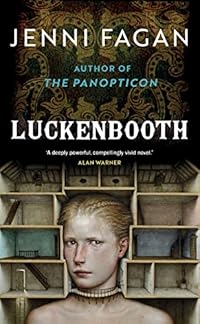

Luckenbooth by Jenni Fagan

Heinemann, 2021, 344 p.

The book examines the history of No 10 Luckenbooth Close, Edinburgh, via various of its inhabitants through the years; Jessie Macrae who lived in flat 1F1 in 1910, Flora in 2F2 in 1929, Levi in 3F3 in 1939, Ivy Proudfoot in 4F4 in 1944, Agnes Campbell in 5F5 in 1956, William Burroughs in 6F6 in 1963, Bee in 7F7 in 1977, Ivor in 8F8 in 1989, Dot in 9F9 in 1999.

Written with many short sentences, sometimes only two words long, weirdness is a characteristic from the off. Jessie is the recently deceased Devil’s daughter, sold by him to the house’s owner, Mr Udnam, to be a surrogate mother for the child his wife cannot have. On her father’s death, Jessie started to grow buds on her head and eventually sports a magnificent pair of horns – not to mention cloven hooves. This aspect of the novel is another illustration of the Scottish literary tradition of meetings with the Devil but here with an unusual twist.

Jessie’s presence haunts the house for the rest of the book – as does that of Elise, Udnam’s wife, and her five sisters, all of whom he has had killed, along with the child. Despite this Udnam is on the outside an upright citizen, rewarded by the city for his contributions to civic life.

The book is structured in three Parts. Its nine viewpoint characters each get three non-sequential chapters to him- or herself within the relevant Part of the book.

It is also a potted history of Edinburgh. Levi (a black man from the US) writes to his friend Leo, “There are two cities in Edinburgh. There is one above ground and one below, one in the centre and another on the outskirts … the Edinburgh that is presented to tourists. Then the other one, which is considered to be the real Edinburgh, to the people who live here ….. All fur coat and nae knickers,” that last a phrase the postman taught him. He adds, “ideology is sold to us as a fixed thing that everything is based upon … but they are all just based on ideas. And those ideas were created so people could find a way to control billions of other people … a way to profit, a way to order society, a way to warehouse humans,” and, “there are no different races of humans; there are only humans and we are all made from stardust every single one of us,” plus reflecting on religion, “there is no god wants murder in their name. Not a single one. Humans made that up to compensate for our own bloodlust, to sanctify it, to make it holy,” and society, “men with money pay poor men to hold guns up to other poor men or women to keep all of us in line.”

Feminist Ivy Proudfoot, who seems to believe she has been recruited to do undercover work in Occupied France, asks, “Why is it that young men who kill are heroes but a young woman who has the urge to do so is reviled?”

The William Burroughs in flat 6F6 in the 1960s is the writer; cut-ups litter his floor. He tells his Scottish lover that we are programmed by language and calls himself a word traveller, commenting on the relationship between writer and reader and what they conjure up between them. His aside about his lover’s attitude to the English, “You blame everything on them,” receives the reply, “They’ve a lot to answer for.”

Bee’s menace-dripping confrontation in 1977 with a group of Chinese gangsters is beautifully written.

The building is at one point described as a psychic vampire, it drinks human essence. Its dark secrets are revealed when it falls apart – consumed by decay and the tap, tap, tap of the death-watch beetle – on Hogmanay1999.

Luckenbooth (the word has two meanings: a lockable stall or workshop – there used to be a row of these standing opposite St Giles Cathedral in Edinburgh’s High Street – and it is also a type of brooch) is not a novel for the faint-hearted but all the characters have the stuff of life. And death. A sticky blend of horror (tipping over at times into grand guignol,) heightened realism and social history, it is likely to remain long in the memory.

Pedant’s corner:- the state of being recumbent is always rendered in the text by the words ‘lay’ or ‘lays’ (it should be ‘lie’ or ‘lies’,) “a hand jive” (in 1933?) “numbers 0 through 9” (0 to 9, please,) sat (sitting, or seated,) a character mentions tights in the context of women’s legwear (in 1944?) “Each of the girls’ heads swivel toward him” (Each … swivels.) “‘She had outdrank everyone’” (outdrunk,) “he is put in the recovery position” (in 1944?) hoofs (in my youth this plural was always ‘hooves’,) “‘Hurricane’ by Neil Young” (it was Bob Dylan I believe.) “A swarm of …. flash by” (a swarm … flashes by,) sneakers (USian, in 1977 in Scotland they would have been called training shoes,) ammonic (ammoniac,) a reference to running electrical appliances to “run the figures down” to fool the meter reader (surely that ought to be ‘run the figures up’?) “My Little Ponyies” (My Little Ponies,) “with their smug pus’s” (pus’s as in plural of pus – ie a face. Pusses is obviously wrong; puses doesn’t look right either. We’ll have to go with pus’s then.) Knifes (Knives.)

Best of 2017

Fifteen novels make it onto this year’s list of the best I’ve read in the calendar year. In order of reading they were:-

The Amazing Adventures of Kavalier and Clay by Michael Chabon
His Bloody Project by Graeme Macrae Burnet
A Man Lies Dreaming by Lavie Tidhar
The Panopticon by Jenni Fagan
The Stornoway Way by Kevin MacNeil
The Sea Road by Margaret Elphinstone
The Untouchable by John Banville
Swastika Night by Katherine Burdekin writing as Murray Constantine
Spaceman of Bohemia by Jaroslav Kalfař
The Power by Naomi Alderman
Imagined Corners by Willa Muir
This is Memorial Device by David Keenan
The Underground Railroad by Colson Whitehead
Kalpa Imperial by Angélica Gorodischer
Psychoraag by Suhayl Saadi

That’s six by women and nine by men. Six were SF or Fantasy, counting in The Underground Railroad, (seven if the Michael Chabon is included,) seven were by Scottish authors.

The Sunlight Pilgrims by Jenni Fagan

Windmill, 2016, 314 p.

 The Sunlight Pilgrims cover

Though I have some caveats about it this is a beautifully written, engaging novel touching on those three novelistic perennials love, sex and death, and peopled with sympathetic, rounded characters.

Dylan MacRae’s inheritance, an art-house cinema in London, has been forced to close with heavy debts. With his mother’s – and grandmother’s – ashes he retreats to a caravan his mother had bought in the area of Clachan Fells in Scotland. Once there he finds himself attracted to his next door neighbour, Constance, whose twelve-year old daughter, Stella, is in the process of transitioning from a boy and is the object of local curiosity and sometime bullying from her classmates. All this is occurring as the ice-caps melt, the seas in the northern hemisphere are being diluted by fresh water run-off, the North Atlantic Drift is switching off and Europe is being plunged into a deep winter. The book’s four parts are headed “November 2020, -6 degrees”; “8th December 2020, -19 degrees”; “31st January 2021, -38 degrees”; “The End Has Almost Come 19th March 2021, -56 degrees”. (I have no idea why, in the text, that last date is italicised.)

Those dates might suggest this is a work of Science Fiction but it is hard to sustain that reading. If it is actually a metaphor, which I doubt, the decreasing temperatures are not literalised in the way Science Fiction deals with such things and are not manifested in the characters’ interactions.

Fagan’s story is told through Dylan’s and Stella’s viewpoints and it is in effect one of relationships and family, one that could be told without any reference to external factors of climate or setting. There is a hint of fantasy in the appearances of Dylan’s grandmother to Stella but one of these was in a dream. In addition, Clachan Fells is described as if it is a remote location yet it is near a motorway and there is an IKEA within easy travelling distance, both of which would place it near a city. The deep freeze extends as far as North Africa – a touch unlikely I’d have thought. The metal door of a caravan is mentioned frequently. If anyone touched it at those temperatures their fingers would stick fast to it.

These are cavils and do not reflect on Fagan’s ability to conjure character. Dylan, his mother and grandmother, Constance, Stella, even local vagrant Barnacle, felt like living, breathing people. If the circumstances of, and reasons for, Dylan’s mother’s purchase of the caravan strain credulity a little it does not detract from the depiction of the characters and their relationships.

Constance mentions trick-or-treating to Dylan. The Scottish (and Northern Irish) term is guising. Fagan may have placed the USianism in Constance’s mouth when speaking to him since he grew up in London and she might have assumed he wouldn’t be familiar with it. In Stella’s thoughts, though, the activity is described as guising. This is a very subtle piece of writing by Fagan which would go over the heads of those unfamiliar with the original term.

It is somewhat ironic that the woman who has for years had ongoing relationships with the same two men, adds Dylan to the list, and has had other liaisons, is named Constance. I’ll presume Fagan intended this though.

The Sunlight Pilgrims contains excellent writing and utterly believable characters. Stella’s voice in particular is a joy. In The Panopticon Fagan has previously shown ability to get inside the head of a troubled teenager. In that book the adults were slightly less to the fore. Here all are wonderfully realised.

Pedant’s corner :- morgue (mainly USian, the British term is mortuary,) and later, mortician (the British usage is undertaker,) “a trail of empty wine glasses lead to” (a trail leads to,) “a pile of unpaid bills are stacked” (a pile is stacked,) “a stack of records have still not been put back in their sleeves” (a stack has not,) “none of these things are going to happen” (none is going to happen – after a while I gave up counting these failures of verbs to agree with their subjects,) “the wind farm’s nacelle rotate” (I doubt the plural of nacelle is irregular as in “sheep” or “aircraft”, so nacelles,) Ikea (it’s IKEA,) in the corner of her eyes (corners,) then they gone (they’re,) bended heads (I know “bent heads” would have meant something different but so does bended [compare bended knee,] bowed heads conveys the sense, though bowed is used on the next line,) a quoted news report says “there have barely been any bird sightings for weeks now. Those that are in nests have just frozen,” (no birds would have been nesting as late as November, when the freeze is said to have started.)

The Panopticon by Jenni Fagan

William Heinemann, 2012, 333 p. One of Scotland’s favourite books.

The Panopticon cover

Narrator Anais Hendricks has spent her life in care; from birth to her age now, fifteen. There was a short period when she had what was in comparison a stable home life when she was adopted by a prostitute. Unfortunately her adoptive mother was killed while Anais was in the room next door. Anais has been in and out of homes fifty-one times and in more trouble at school (which, of course, she barely attends) and with the police than you could count. She has a particular bent for stealing school minibuses then crashing them; and for fire-raising. The book, then, does not promise to be a bundle of laughs and Anais not a likely candidate for salvation. She is bright, though, and reads voraciously, has a keen sense of herself; and of injustice. As a sort of compensation she plays what she calls the birthday game, imagining all sorts of different beginnings for herself, and she dreams of a life in Paris.

We meet her when, under suspicion of having put a policewoman into a coma (of which she vehemently denies her guilt,) she is being transferred to the Panopticon of the title, a building from the centre of which the inmates are under the view of the staff at all times. A clue to her possible mental state is when she sees the stone cat at the entrance – which she dubs Malcolm – move its wings. She also thinks she is the subject of what she calls the Experiment, the project of a mysterious group which may be from another universe or dimension – and for whom the only evidence the reader has is Anais’s words – and she is being tested to destruction in the sense she thinks the Experiment wants her to commit suicide. But, despite the Experiment, she feels that, “I, the young miss Anais, understand wholly that I am just a human being that nobody is interested in.”

She has a keen sense of morality, “I’d lay (sic) down and die for someone I loved; I’d fuck up anyone who abused a kid, or messed with an old person. … I’m honest as fuck and you’ll never understand that. …. I’ve read books you’ll never look at, danced to music you couldnae appreciate, and I’ve more class, guts and soul in my wee finger than you will ever, ever have in your entire, miserable fucking life.” However she cannot reveal this to any of the care workers; not even Angus Everlen, who is the only care worker who has seen any good in her.

Her relationships with fellow inmates, Tash, Isla (a very well-drawn picture of a mother devastated that her HIV positive status has been passed on to her twin children) and Shortie are vividly realised. They become almost a surrogate family but of course cannot look out for each other as much as each of them needs.

Anais’s biological mother may have had psychotic schizophrenia, as may Anais. A man who claims to have witnessed Anais’s birth tells her she is the daughter of an Outcast Queen, who could fly (as Anais imagines she does. But, then, she does take a lot of drugs.)

A rumbling sub-plot concerning Anais’s boyfriend, who it is always apparent has used her (very few of her acquaintances don’t) but is now in prison and owes people a lot of money, comes to a hideous head, triggering Anais’s resolve.

This is a book about the lives of those who are not often represented in fiction – nor ever sympathetically in the normal way of public discourse – and so of course acts a necessary corrective.

It is not an easy read but it is so well written it was easy to read – at least I found it so. The stream of consciousness had a flow to it, logic even, though perhaps it helps to have some knowledge of the culture from which it springs. The splattering of the text with Midlothian demotic and expletives did not offend me (as it might others.) This is the way some people talk, especially those who tend to be discounted by the organs of the state. Anais has a distinct voice – even if you cannot quite be certain what to believe of what she says and it is at times perhaps a little too assured. “I’m a bit unconvinced by reality full stop. It’s fundamentally lacking in something and nobody seems bothered…” “…all the time this infinite universe surrounds us, and everyone pretends it’s not there.” The details of life as an inmate in the care system were convincing enough, though.

The symbol of a Panopticon as a metaphor for teenage existence – especially in the care system – was potentially a good one but at times became a trifle overblown and wasn’t actually entirely justified by the set up shown us in the book.

As a novel I’ll doubtless remember The Panopticon for a long time. I don’t think I’ll ever describe it as a favourite, though.

Pedant’s corner:- Anais refers to The Experiment as plural throughout, also – apart from one “lie” – she uses “lay” for being horizontal and “kosh” for cosh: all of these are direct expressions of Anais though. Otherwise; “he’s always owe them money” (owed,) take the edge of the colours (off, I think,) “‘Vive le révolution’” (Vive la révolution: the speaker is supposed to know her French, she’d get the noun’s gender right,) ditto “vive le” 3 lines later, naïvist (naïvest,) “for something I dinnae do” (didnae.)

free hit counter script