Midwinter by John Buchan
Posted in History, Reading Reviewed, Scottish Fiction at 12:00 on 9 October 2022
Certain Travellers in Old England
B&W Publishing, 265 p, plus iv p Introduction by Alan Massie.
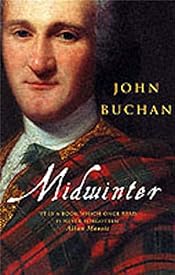
Here is another Scottish novel which scratches the 1745 Rebellion itch but unusually this one is set entirely in England. Presented as a partially incomplete found manuscript it tells the story of Alastair Maclean who had lately been in the service of the King of France but had returned to British shores in order to facilitate the rising of Charles Edward Stuart’s supporters in Wales and the West of England.
Maclean’s mission is a dangerous one; a traveller on the byways in those days was always apt to come under suspicion. With the help of the Naked Men and their leader – the Midwinter of the book’s title – he escapes from apprehension by a man charged with taking any who can not give a good account of themselves to the local magistrate, and arrives at the house of Lord Cornbury, a known Jacobite sympathiser but also one who recognises the folly of the Prince’s enterprise. From then on Midwinter’s group pop in and out of the narrative.
The company at Lord Cornbury’s is supposed to be mainly Jacobite but later it transpires there is a traitor to the cause amongst them, one who thereafter continually dogs and frustrates – given the outcome of History how could he not? – Maclean’s efforts to get to Derby with supposedly good news. Lady Mary Conbury has an unusual take on Mary Queen of Scots. “‘Her frailties were not Stuart but Tudor. Consider Harry the Eighth. He had passions like other monarchs, but instead of keeping mistresses he must marry each successive love, and as a consequence cut off the head of the last one. His craze was not for amours but for matrimony. So, too, with his sister Margaret. So, too, with his great niece Mary. …. What ruined the fortunes of my kinsfolk was not the Stuart blood but the Tudor – the itch for lawful wedlock which came in with the Welsh bourgeoisie.”
A surprise visitor arrives in the form of a tutor to a seventeen-year old girl, Claudia Grevel. This ill-clad worthy is none other than Samuel Johnson, disturbed that Claudia has run off with a Mr Norreys and seeking help to catch the pair before they can be married, a task in which he is doomed to fail. Johnson and Maclean become friendly and travel together for the latter half of the book. Johnson’s appearance in the novel allows Buchan to insert into the text some of that gentleman’s aphorisms.
At a later point the pair fall into the hands of troops loyal to King George. Their commander is a General Oglethorpe whom they met at Cornbury. He berates Maclean on why Charles will not succeed. A new breed of belief, the Methodists, had arisen in the south – “with them is the key of the new England, for they bring healing to the souls of the people. What can your fairy Prince say to the poor and hungry?”
Maclean thinks both Midwinter and Oglethorpe spoke of England like a lover to his mistress and that the country was akin to a spell on sober minds. He tells Midwinter, “You in England must keep strictly to the high road, or flee to the woods – one or the other, for there is no third way. We of the Highlands carry the woods with us to the high roads of life. We are natives of both worlds, wherefore we need renounce neither,” and indeed Midwinter spends most of his time in that mystical realm, the greenwood.
This is a tale packed with adventure, incident, betrayal and peril, but also insight. And it displays an eye for landscape which, though in this case is the English countryside, is a hallmark of Scottish writing.
Pedant’s corner:- King Louis’ service (Louis is pronounced as if it had no ‘s’ at the end; therefore Louis’ will also be so and hence to make its meaning clear its possessive must have ’s at its end: Louis’s,) bourgeoisie (was this word in use in the late eighteenth century?) “Jack Norreys’ neck” (Norreys’s,) ditto Lady Norreys’, “The forest had woke up” (woken,) “came the gypsies crazy cackle” (gypsy’s.)
