Archives » Interzone

2312

2312 cover

My latest book for review in Interzone has thumped on the doormat – and when I say thumped I mean thumped.

It weighs in at 561 pages and I’ve to review it in 650 words by July 31st for inclusion in Interzone 242.

It’s by Kim Stanley Robinson and is entitled 2312.

I fancy (and I may be taking a wild stab in the dark here) it’s probably set in, em, 2312.

Interzone 240

I see from Jim Steel’s blog that Interzone 240 is out.

This is the issue that contains my review of Mez Packer’s The Game Is Altered.

New Review: Fever

Fever cover

My latest review book for Interzone has dropped onto the doormat.

It is Fever by Lauren DeStefano.

I reviewed Ms DeStefano’s previous novel Wither for Interzone a few months ago and published that review here just last week.

Wither by Lauren DeStefano. The Chemical Garden Trilogy.

Harper Voyager, 2011, 358p.

Published in Interzone 237, Nov-Dec 2011.

A genetically based cure for cancer has left a First Generation almost immortal barring accidents. However their children and grandchildren are not so lucky as a side effect – referred to as “the virus” – kills off males at 25 and females at 20. The societal consequences include a large cohort of children of these unfortunates being brought up in orphanages or left to fend for themselves. Efforts are being made to find a cure but these are opposed – sometimes violently – by groups who think there has been too much meddling already. “Gatherers” sweep the streets for young vulnerable females to provide subjects for research or suitable wives for wealthy young aristocrats. In addition a Third World War has “demolished” all of the world, except for North America (of course.) The rest is ocean dotted with a few islands.

At the novel’s start Rhine Ellery has been kidnapped and is being transported in a darkened van with other captives. At journey’s end the girls are subjected to a selection process. Rhine’s differently coloured eyes attract the selector and, as she is whisked off in a limousine, with two others, a naïve young Cecily and a more streetwise Jenna, she hears gunshots from the van. The three girls’ fate is to become prisoners in a vast establishment in Florida run by the First Generation researcher into the virus Housemaster Vaughn and to be “sister wives” of Vaughn’s son, House Governor Linden, whose present wife is 20 and dying.

Rhine is resolved not to succumb to this (albeit pampered) existence. She strikes up a relationship with a young servant, Gabriel, and despite being officially married, allows Linden no sexual favours. Cecily, happily, and Jenna, less so, provide his distractions in that regard.

There are irresistible echoes in this scenario of “The Handmaid’s Tale” but as in that novel the background leaves a lot to be desired and fails to convince.

While orphaned adolescents live in perpetual fear and Gatherers leave discarded victims to rot at the roadside there are still business expos, televised first nights and New Year parties where those and such as those turn up to be seen. People even go to the cinema. In most respects life outside captivity in the Big Houses is depicted pretty much as in our present day. How the Himalayas, for example, could be reduced to sea level yet Florida be above the waves is something of a puzzle and though hurricanes are to be expected Florida seems very wintry here. In addition the “virus” does not behave like a virus and a cure for cancer that’s also effective against ageing is just too pat. Why the lives of girls rejected by Gatherers are worth so little remains unexplained. Surely it is more likely they would be treated as a resource not to be wasted?

All of this is unfortunate as at the level of the writing “Wither” is very good. Though she seems unaware that “none” is singular DeStefano can otherwise turn a sentence and she relates the unfolding relationships between the sister wives deftly and that of Rhine and Gabriel delicately – though Housemaster Vaughn is a bit of a cardboard villain and House Governor Linden, despite his profession as a kind of architect, is too lacking in self regard. Scions of wealthy families are not usually noted for their reticence.

The resolution, when it comes, is a bit rushed and is achieved too easily but provides ample scope for continuing Rhine’s story.

The nature of the Chemical Garden of DeStefano’s planned trilogy is a mystery; unless there is a deep plot as yet unrevealed beneath the surface of the book. It would be good to think there is. On this evidence, though, that is unlikely.

Yet DeStefano shows promise. With a bit more rigour in her backgrounding she might be one to savour.

Queen of Kings by Maria Dahvana Headley

Bantam Press, 2011. 429p plus historical note and acknowledgements.

Published in Interzone 236, Sep-Oct 2011.

US author Maria Dahvana Headley’s first novel is a historical fantasy set in the founding days of the Roman Empire. Not only Mark Antony and Cleopatra but Octavian/Augustus and Marcus Agrippa feature prominently. Even the poet Virgil pops up in one scene. The novel swiftly deviates from the accepted history as it has Cleopatra, in an attempt to frustrate her final defeat along with Antony, use a fragmentary spell to unleash the ancient Egyptian deity Sekhmet from her long incarceration by the sun god Ra. (No passing acquaintance with Egyptian, Roman or Greek mythology is required as Headley provides the requisite detail.) The partial spell, however, provides no protection for its invoker and Sekhmet enters Cleopatra’s body, allowing her to shift shape – serpent, lion and sea snake the creatures of choice. But Sekhmet’s influence also turns her into a killer and drinker of blood.

In the subsequent mayhem, Antony is revived from the dead not once but twice, albeit the second time as a shade, the action moves on to Rome where Cleopatra seeks revenge on Augustus who employs sorcerers of his own to combat her – a Norse weaver of life threads, a Psylli who has an affinity with snakes and Chrysate, a devotee of Hecate – all of whom have their own agendas. In a series of false climaxes Cleopatra almost kills Augustus, is subsequently trapped and then set free to roam through the underworld with Antony while Sekhmet looses the first of her arrows of pestilence upon the world. After the lovers return to the living world more mythological mining involving the labours of Hercules sets up the true climax.

This is all entertaining enough if you don’t like rigour but throughout we are given little to flesh out the characters who as a result never convince, being for the most part no more than plot enablers. In addition, no real flavour of life in ancient Alexandria or Rome is presented. Since Headley’s story concerns aristocrats that may be fair enough but it fails to ground the story and the fantastical elements end up becoming one damn thing after another.

The prose is a curious mixture of archaisms and modern usages and, irritatingly, the point of view within a scene sometimes changes, often more than once. There are, too, frequent instances of not quite appropriate word choices. Suspension of disbelief is also made more difficult by the fact the narrative keeps hitting a succession of wrong notes. The prologue suggests we will read the personal memoir of Nicolaus of Damascus, tutor to Cleopatra’s children, though the main text and the epilogue are both actually narrated in standard third person. There are anachronisms – in a piece of dialogue, despite Augustus barely having invented the post, the position of Emperor is held in too great a reverence, “bleachers” for open air seating is surely too modern, and at one point someone wields a bayonet. (Roman technology was advanced in all sorts of ways but even they did not have access to rifles, nor muskets even.) After Cleopatra has been transfigured her skin blisters in the sun but Headley seems to forget this for most of the novel till apparently suddenly remembering it again in the aftermath of the climactic battle. Finally, the pet endearment used – endlessly – between Antony and Cleopatra, and stated to mean, “You are mine,” is rendered as, “Vos es mei.” Vos is the plural of you (the singular is tu, but either is redundant in Latin.) Headley’s formulation – “both of you are mine” – thus makes no sense. It might have in the one scene where two Antonys appear were es not actually a singular verb form.

When belief is being stretched so much by the subject matter small details like these loom larger and annoy more than they might otherwise. If you can ignore them, do so. If not, you’ll struggle.

BSFA Awards Short Stories

Over the past few weeks I have read the short stories nominated for this year’€™s BSFA Awards. I am assuming that, as in the past couple of years, the BSFA will be producing a booklet containing them but since each has been posted on the internet (there is a link from the BSFA’s Awards page to the online versions which is how I managed to read them – though I found off a screen is not the most comfortable of ways to do so) perhaps that might not happen.

The Silver Wind by Nina Allan, from Interzone issue 233, is a kind of time-travel story mixed with parallel worlds. It tells of the encounter of a man from a fascistic future Britain with a genius who makes clocks (which he refers to as time machines.) To begin with there is too much info dumping and throughout a lot is told rather than shown. Perhaps the story needed more space to breathe but I felt the sureness of touch of an accomplished story teller was missing. There is a use of words that is not quite precise -€“ eg ‘hoping one soldier would not see me’ rather than ‘€œhoping none of the soldiers would see me’€ – and twice we are treated to the peculiar phrase, ‘€œIt was growing dusk,’€ but at least Allan knows the use of ‘€œnor’ as in, ‘€œnot for love nor money nor any of these new-fangled gadgets.’

The Copenhagen Interpretation by Paul Cornell, from Asimov’s, July2011, is set in an altered future where European monarchies strive to keep the balance of power throughout the Solar System, souls have weight that is aligned to dark matter and Newton came up with a kind of relativity theory which allows space to be folded – all amenable to a tale of espionage and derring-do admixed with betrayals of various sorts. This stretches suspension of disbelief at times but overflows with ideas and is excellently written.

Afterbirth by Kameron Hurley, from Kameron Hurley’€™s website, is about a woman in a backward-leaning religious society which is engaged in a never-ending war, whose rulers have deliberately cut it off from the stars – originally as an escape from whatever’€™s out there but now to prosecute the war better. In her forbidden astronomical observations she finds God in a torn filter laid across the night sky. Again there is a fair bit of info dumping -€“ perhaps inevitable in stories of short length.

Covehithe by China Miéville, from The Guardian, 20/4/11, features sunken oil-rigs returning to land to drill into the earth and lay – eggs? seeds? – from which smaller rigs later emerge. Atmospheric, but again info-dumpy. The human involvement in Covehithe – a father and his daughter observing one such landing -€“ doesn’€™t really overlap with the SF background. Another scenario where society has suffered extreme breakdown and the military has a strong presence.

Of Dawn by Al Robertson, from Interzone 235, has a woman whose soldier brother has been killed being inspired by his poetry, the music of a long neglected composer, an all but forgotten TV documentary and a figure from Greek myth to produce a synthesis of poetry and music by bringing all those strands together. The final part of the jigsaw is provided by a shadowy figure in a village commandeered by the army long ago, but which had inspired both poet and musician. The story contains echoes of the Green Man myth and illustrates that English fascination with the pastoral. The info dumping here is well embedded.

The futures shown by the five stories are all bleak, having in common repressive regimes of either military or religious stamp. SF is never about the future, though. These stories tell us a lot about where we are now.

As stories though, rounded works of fiction, I found most of them unsatisfying. The only truly successful one was Paul Cornell’s. If these represent the best of last year the SF short story is in a bad way.

Smallworld by Dominic Green. (Fingerpress, 2010)

Published in Interzone 234, May-June 2011.

Smallworld cover

The Smallworld of the title, known as Mount Ararat, has come about as the result of the merging of two separate planetoids under the influence of an extremely dense neutronium sphere, now at its heart. It orbits within the rings of Naphil, a Jovian world in the solar system of a red giant star, 23 Kranii. Mount Ararat has at most a few hundred inhabitants but the book concentrates on the Reborn-in-Jesus family (yes, really) and their protector, an armed robot they know as the Devil. In accord with all these biblical resonances the extended family’s children have names such as Testament, Measure, Apostle, God’s Wound, Beguiled-Of-The-Serpent, Only-God-Is-Perfect and Be-Not-Near-Unto-Man-In-Thy-Time-Of-Uncleanness. Yes. Really.

Described on the credits page as a novel, Smallworld is in fact a series of shorter pieces related only in the sense that they all feature members of the Reborn-in-Jesus family and take place in the same setting. The resultant lack of narrative flow, of an overall arc, its stop-start nature, compromises the book as a coherent whole. The five, or seven, stories (the last has three sub sections) relate the family’s encounters with various incomers whose appearances can be unexplained. The tone is kept deliberately light throughout, and thus runs into a further problem.

With very few exceptions Science Fiction and comedy do not make comfortable bedfellows. Too often the comedy unbalances the SF or else is not comic enough. The most successful mix the two seamlessly, embed them in each other, as in Eric Frank Russell’s Next of Kin, and the result can still be a cogent comment on human – or alien – affairs. The SF must also stand on its own merits and not be entirely derivative. Unfortunately, in Smallworld, Green does not always successfully manage to avoid the pitfalls inherent in the form.

The book’s fundamental lack of seriousness is deleterious. Its targets for satire are either too easy or too pat – jailbirds, space pirates, tax collectors – and its references scattershot (Santa Claus/Father Christmas and the first three of the Twelve Days of Christmas in the titles of the last story, Helen of Troy, a plethora of biblical allusions over and above the manifold Reborn-In-Jesuses as well as casual allusions to 21st century ephemera of which the inhabitants of Mount Ararat would most likely be totally ignorant – though we, of course, are not.) The ramifications for daily life of the structure of a small world as described here are for the most part unexplored.

In addition, the cosmology of the book is unconvincing, the Physics and Chemistry of dubious lineage and accuracy. (An example. Sulphur dioxide, while noxious, does not smell of rotten eggs: that is hydrogen sulphide.) Small errors such as this can fatally undermine confidence in the author and in the tales he or she is trying to tell.

At the level of the fiction, rather than experiencing background as the stories unfold, we find prodigious information dumping and paragraphs of expository dialogue. With sufficient guile this can be a strength and elsewhere has been made into a feature of the comedy (galactic encyclopaedia anyone?) but no such approach is adopted here.

There is too the lurking sense that Green has not lavished care on his characters, who are unconvincing, barely more than ciphers, present only to progress the plot(s) and voice the jokes, hence failing to engage empathy. Quite apart from the family other names can be over elaborate, some characters being known mainly by their job descriptions – Optometrist Wong, Social Correctness Officer Asahara. Others, for no obvious reason, “speak” in CAPITALS. This hostage to fortune invites invidious comparisons with a previous purveyor of comedic SF/fantasy.

If your tastes lean towards comedy with not too much rigour this may be for you. If your preference is for strongly drawn, nuanced characters reacting to and combatting life’s vicissitudes, then maybe not.

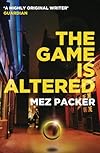
The Game Is Altered by Mez Packer

The Game Is Altered cover

Tindal Street Press, 2012.

My review of this book has been sent to Interzone, nearly three weeks before deadline!

I’ll let you all know when it’s due to be published.

Look At The Birdie by Kurt Vonnegut. (Vintage, 2010.)

Reviewed for Interzone issue 231, Nov-Dec, 2010.

Look At The Birdie cover

This is a collection of fiction plus one letter of “sententious crap” unpublished in Vonnegut’s lifetime. The stories appear to have been written for the most part in the 1950s; one even mentions King Farouk. Sparingly interspersed through the book are Vonnegut’s own illustrations in his naïve style. They too appear of 1950s vintage though their copyright dates are much later.

Throughout, Vonnegut’s tendency to name his characters strikingly is to the fore; Ernest Groper, K Hollomon Weems, Felix Karadubian. Vonnegut’s characteristic dry style is also evident. He seems to have found his voice early. Though he made his name writing SF, before later disclaiming it, most of the tales here are devoid of speculative content.

The two stories that might vaguely be called SF are “Confido” and “The Petrified Ants.” In the first an ear piece designed to make people happy is “a combination of confidant and a household pet” but whispers only the worst of others. I trust Vonnegut was aware of the Latin pun of his title. The second is set in the Erzgebirge mountains in Soviet era Czechoslovakia where some newly uncovered fossils reveal ants once behaved individualistically. The revelation of their change to collectivity is hurried, though, and stretches credibility. The story is fun but too heavy-handed in its allegorisation of Soviet society.

As to the rest of the fiction, “FUBAR” is a gentle but utterly conventional story in which a crabbed bureaucrat begins to awaken to the possibility of a different kind of life when a newly trained young secretary is assigned to him. The 1950s ambience here is revealed by the F in FUBAR standing for “fouled” rather than anything more demotic.

“Shout About it from the Housetops” examines the deleterious consequences of publishing a novel whose characters are based on barely disguised neighbours, friends and the author’s spouse.

The two-part “Ed Luby’s Key Club” deals with Harve Elliot, who, along with his wife, Claire, witnesses a murder by the local gang boss. Both are then accused of it themselves. In the second part Harve alone escapes from custody and attempts to vindicate himself. The story’s conclusion, while worthy, is perhaps a little too complacent.

“A Song for Selma” tells how people’s aspirations can be transformed, for good or ill, by their expectations of themselves as mediated through those of others.

In “Hall of Mirrors” a hypnotist uses his powers to evade the police when they come to investigate the disappearances of his wealthy women clients.

“Hello, Red” is the story of a bitter wandering sailor’s return to his home town to try to claim guardianship of the distinctively flame haired daughter he fathered before his first trip abroad, and of her reaction to him.

“Little Drops of Water” concerns the subtle strategy employed by one former conquest to gain her revenge after being dumped by a confirmed ladies’ man of fixed habits.

In “Look at the Birdie” an encounter in a bar with a disgraced former psychiatrist who insists his wife photographs the narrator leads to a demand that can’t be refused.

“King and Queen of the Universe” has a very well to do teenaged couple in the Depression era on their way home from a party come face to face with the harsher realities of less privileged lives.

“The Good Explainer” is the doctor to whom a man and wife travel from Cincinnati to Chicago in order to have the reasons for their childlessness laid bare.

While all the stories in the book are never less than readable, they do not represent Vonnegut at his best. Among other faults they are too often prefaced by a brief paragraph or two of scene setting which are told to, rather than unfolded for, us and there is a tendency to repetition of such things as job titles.

Recommended to Vonnegut completists but not as an introduction to his work.

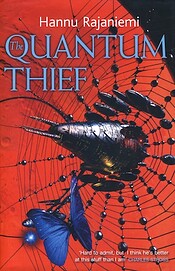
The Quantum Thief by Hannu Rajaniemi.

Gollancz, 2010. Reviewed for Interzone, issue 230, Sep-Oct, 2010.

Rajaniemi’s pacy debut novel is set in a far future where both Jupiter and Phobos have been turned into suns in the aftermath of a war between the godlike Sobornost, who control most of the inner solar system, and the Zoku, now exiled to Mars from their Saturnian home.

On Mars all off-world tech is proscribed. The city called the Oubliette is constantly on the move, built on platforms which change their relative position as it is carried across Hellas Basin on vast articulated legs. Rajaniemi does not fetishise this creation as many another author would. Far from being almost a character in its own right the city is merely an exotic backdrop for his story, not its focus.

In the Oubliette, interactions between people (and buildings) are mediated by technology known as exomemory which captures every thought, dream and action. A filtering system known as gevulot acts as a privacy screen but is opened for speech and donation of information packets called co-memories.

The city’s inhabitants all carry Watches which store the Time they use as money. When your Time runs out, death follows. Resurrection Men decant memories and implant them in a new body in which to serve the city as one of the Quiet till enough credit has been accrued to live normally again. On occasion criminals dubbed gogol pirates deliberately kill in order to steal the deceased’s memories and enslave the minds. This is anathema to anyone from the Oubliette (but philosophically it surely differs from being Quiet only in degree.) Tzadikkim, a vigilante-type group with enhanced powers, act as an informal police.

The narrative is shared between the first person account of Jean le Flambeur, the quantum thief of the title, and the third person viewpoints of an Oortian, Mieli, who kicks the novel off by springing Jean from an unusual prison round Saturn, and the somewhat too intuitive detective Isodore Beautrelet. Both Jean and Mieli have (rarely used) Sobornost enhancements. In addition, several Interludes fill in backstory and -ground.

The text can be dense at times. Rajaniemi deploys technological terminology with a flourish; qdots, ghostguns, qupting, Bose-Einstein Condensate ammunition, quantum entanglement rings, qubits, but these can be allowed to wash over any technophobic reader prepared to follow the flow.

By implication Rajaniemi emphasises the importance of memory, not only in the idea of exomemory or the uploading/decanting of personality but also as a component of individual identity. Jean le Flambeur has hidden his past from himself and has no recall of it until others restore it bit by bit via gevulot exchanges.

Rajaniemi’s Finnish origins are most revealed by some of the names he uses. Mieli’s spidership is called Perhonen – butterfly – and he slips in a Finnish expletive in the guise of an Oortian god. There are also borrowings from Japanese, Hebrew and Russian and a subtle Sherlock Holmes reference.

“The Quantum Thief” is bursting with ideas and there are sufficient action/battle scenes to slake any thirst for vicarious violence but sometimes it seems as if incidents are present in order to fill in background rather than being necessary to the plot. The motivations of some of the characters are obscure and despite the prominence of gevulot in the Oubliette, conversations and interactions seem to be more or less unaltered in comparison to our familiar world, though had Rajaniemi presented them otherwise they may have been unintelligible.

The denouement brings all the threads together satisfyingly while the final Interlude sheds additional light on the proceedings and sets up possible scenarios for sequels – for which there will likely be an avid audience.

free hit counter script