Archives » Interzone

For Interzone 257

 Beta Life cover
 Irregularity cover

My latest review book for Interzone is Beta Life: stories from an A-life future, an anthology dealing with the impact on society of new technologies in computing, which plopped onto my doormat on Hogmanay. My allotted word count this time is 1100, up from 800.

Interzone 256, with my review of Irregularity, another anthology (inspired by the history of Science,) ought to be out soon.

The First Fifteen Lives of Harry August by Claire North

Orbit, 2014, 407 p. Reviewed for Interzone 252, May-Jun 2014.
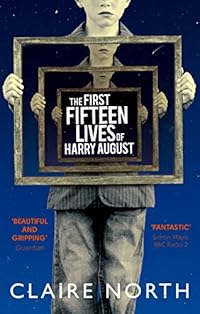
There is a potential problem with the central premise of novels broadly comparable to this. It is one which also besets any work of fiction set either in virtual reality or a computer game. To wit: if a character cannot die – or can be resurrected after death – where, then, is the jeopardy? Why ought readers invest time and energy in sympathy or empathy; why should they care? Here that problem is encapsulated by the title (and for the reviewer is exacerbated by the accompanying promotional material.) We know before the outset that Harry August has at least fifteen lives. Why, then, for example, should the grubby circumstances of his conception and initial upbringing matter to us? However, “North” – the publishers emphasise that the author is pseudonymous but has experience – neatly sidesteps the issue by beginning “her” story at the end of Harry’s eleventh life, thus making it clear that any single life journey is not of itself crucial. And the jeopardy is not to Harry alone, but to human existence. “The world is ending.”

This idiosyncratic book reads at various points as if the author could not quite decide what sort of beast it actually is, first like a literary novel, then a thriller, a historical tract, a spy story and a tale of revenge – all the while riffing on Alternative History. And, yes, it does veer (rather suddenly) into more straightforward Science Fiction about halfway through, then morphs back again before returning to SF for its dénouement. As befits a tale of someone with more than fifteen lives the narrative is not linear but skitters about, incorporating vignettes from Harry’s existences, encounters with others of his kind. Yet it does manage to come together as a more or less coherent whole.

Harry is one of the kalachakra, an ouroboran, humans whose consciousness and memories of previous lives recycle back to birth after their death. In subsequent lives these memories begin to resurface after infancy. Before the lives accumulate this can lead to madness, later there can be advantages. Perhaps even worse for Harry, he is what the kalachakra call a mnemonic: he forgets nothing. Kalachakra are few enough at any one time but are scattered throughout history, sometimes leaving messages in stone to their successors. No explanation is given for their unusual attribute; their reincarnations just happen. Their knowledge of past lives ensures that no new one is a carbon copy of a previous existence. The Cronus Club, an organisation kalachakra have set up to succour their kind, can help remove them from the boredom of a re-lived childhood. And it turns out that the circumstances of Harry’s birth do matter. Kalachkra can be excised from the world, if they are prevented from being born. Harry’s obscure origins are a shield against any such calamity.

In each of his lives the broad sweep of history is similar but it is not emphasised in the text, except where the differences are obvious, that the detail means subsequent lives cannot be lived in the original but instead take place in parallel worlds. In a stance reminiscent of Star Trek’s Prime Directive, the Cronus Club tries to ensure that kalachakra do not interfere with the course of history. Such activity has led to cataclysm at least once before.

Harry’s parallel existences have allowed him to learn many languages. His various employments take him all over the world, mainly in iterations of the 1950s, the primes of his lives, to a research establishment in the Soviet Union, the China of the Great Leap Forward, and to the USA. In one of these lives Harry is a physicist and meets the charismatic Vincent Rankis, subsequently becoming involved in Rankis’s project to build a quantum mirror – a device which will bestow a God’s perspective on the world.

While the writing is effective and for the most part reads smoothly, out of kilter phrases such as, among others, “a skill as much valued in the incompetence than the mastery,” (about punting on the Cam) might suggest that English is not actually “North”’s first language. There is also a lack of fine tuning in the last chapter where the readership to whom the narrative is addressed shifts from where it had lain up to then, the general (you and me,) to the specific. In addition the resolution comes a little too easily and strikes against the established character of Harry’s antagonist.

This book may well become an award nominee but for all its apparent ground-breaking aspirations and apocalyptic overtones The First Fifteen Lives of Harry August is in the end a rather conventional tale. But, then, in all of literature, there are said to be only seven distinct plots.

The following entries to Pedant’s Corner did not appear in the published review:-

Again I read an uncorrected proof copy so some of these may be amended in the actual book but we had Ecstacy for Ecstasy, periphery nervous system for peripheral nervous system, neckless for necklace, a human stimuli, solice for solace, “her success (in finding a very few) cannot be underestimated” (overestimated, surely?) “did not less to see the end of his dream,” (live) “where he had began,” “at which all intercourse seeks” (ceases,) “azures of wisdom,” “I had never fully understand the..,” “the sense of unity that all these hardships create,” (creates) “illustrating the momentous dead,” “passer-bys,” “we do not need hide much deeper than in plain sight,” “the single most existing time of our lives,” “points of origins,” “we would not with to inconvenience you,” “would have bought the Cronus Club tumbling down on their creator’s head,” “an vastly more effective spy,” “dot.com,” “he has been a present through my life” (presence,) “chaffed” (chafed,) “knowing full well that all these things …. it would be enough,” [not to mention that use of mnemonic.]
Interzone 254, Sep-Oct 2014

Interzone 254 cover

Marielena by Nina Allan1
Noah Wahid, an asylum seeker, while waiting for his permission to remain, spends the days in an endless round of impoverished futility and seeing the face of Marielena, the girl he left behind, in nearly everyone he meets. The story hinges on Noah’s encounter with a refugee from the future.

A Minute and a Half by Jay O’Connell2
The tale of how Evan came to be in sole charge of a two year old daughter he hadn’t known about. He’s taken programmers, which, in a very intrusive info dump, we are told are able to sculpt human wetware in accordance to user input parameters. Or are they just hallucinogens?

Bone Deep by S L Nickerson
A woman with a medical condition where her flesh is turning to bone can only access the treatment she needs by having sponsors’ logos tattooed onto her. (Don’t give the buggers ideas is what I say.)

Dark on a Darkling Earth by T R Napper
In a world of perpetual war where memory has to be stored on electronic cards or it is lost, an old man falls into the orbit of a group of soldiers.

The Faces Between Us by Julie C Day
Is set in an Oregon where ghosts live on in ashes and Larry and Amber try to find the way “through” by snorting them.

Songs Like Freight Trains by Sam J Miller
Christine no longer listens to music. Ariel, her friend from her teenage years taught her the trick of time travel via song. But Christine’s daughter yearns to dance.

1 Imposter. Narrator Noah tells us his vocal command of English is not good but uses words like annunciates. Pita bread is usually spelled pitta.
2 Cannoboloid (????) I suspect this should be cannabinoid.

Interzone 253, Jul-Aug 2014

Interzone 253 cover

My Father and the Martian Moon Maids by James van Pelt1
When the unnamed narrator was younger his father, now in the last stages of dementia, built a UFO detector. While tacking backwards and forwards to the care centre he remembers how much of an influence his father was on his tastes and interests. A tale of filial affection and loss. Apart from anything else you can only warm to a story illustrated with a picture of a red Fokker Triplane.

Flytrap by Andrew Hook 2
A story about what it means to be human. Or alien. Which is perhaps what we are.

The Golden Nose by Neil Williamson3
Felix Kapel is an expert in aromas whose trade is in decline due to the innovation of Teleroma – transmission of smells via the internet – until he purchases the legendary (to olfactorists) Golden Nose of the Habsburgs. Its use has an unfortunate side effect.

Beside the Dammed River by D J Cockburn (James White Award Winner)
In a part of Thailand parched by Chinese damming of the Mekong River one of ex-Professor of Engineering Narong’s waning days is lightened by the breakdown of a truck carrying an off-target mined asteroid out of Thailand illegally.

Chasmata by E Catherine Tobbler4
A tale of human inhabitants of Valles Marineris on Mars, who have children there and encounter Martians, or the ghosts of Martians, and rain that floods that huge chasm, or doesn’t. The narration constantly undermines itself with asides. I liked the term “moonslight.”

The Bars of Orion by Caren Gussof5
When their world was destroyed a man called Blankenship and his daughter Tibbi were mysteriously transported to “our” Seattle where the counterpart of his wife is married to someone else. (In a particularly USian response he goes to therapy sessions.)

1 Written in USian
2 bought for brought; “she speculated her future” is surely missing a preposition; human’s as the plural of human.
3 George III of England. (Of nowhere else, then?) Struggled to “breath” in. We achieve the things are hearts wish for.
4 Written in USian
5 Written in USian in which pay back for seems to mean reimburse whereas in English it means get revenge. (On a stereo, “Blankenship found a knob hat made the sound louder.”) (Eyes) “seemed to be starting off into the distance.”

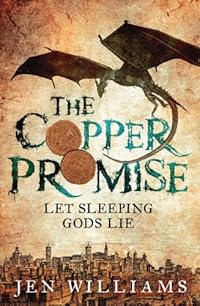
The Copper Promise by Jen Williams

Headline, 2014, 538p. Reviewed for Interzone 251, Mar-Apr 2014.

The Citadel contains within its labyrinthine caverns not only the trapped remains of the old gods (bar one) but a supposed treasure trove. By reputation no-one escapes from it alive yet it still attracts adventurers and has guards who must be bribed to allow entry. Sell-swords Wydrin of Crosshaven (the Copper Cat) and Sebastian Carverson, disgraced former Knight of Ynnsmouth, are engaged by the mutilated Lord Aaron Frith of Blackwood to penetrate its secrets. They agree somewhat off-handedly considering the apparent dangers. Amid adventures which in part are curiously reminiscent of the 1980s children’s adventure game TV show Knightmare and Indiana Jones films they succeed up to a point. Sebastian suffers a mortal wound but Frith is restored to fitness – and beyond – by immersing himself in the lake underneath the Citadel. In the process Frith acquires magical powers by which he involuntarily transports our three heroes to Blackwood in an instant when they are threatened by the old god Y’ruen, a dragon, which their foray into the Citadel has raised from its confinement. Frith’s new powers allow him to heal the wounds of both Sebastian and Wydrin.

In the Blackwood village of Pinehold, they encounter the source of Frith’s misfortunes, Fane, who is torturing the inhabitants to find the secret of the Frith family vault. While wearing a peculiar glowing helmet – which channels the influence of the demon Bezcavar, the Prince of Wounds, an enthusiastic harvester of pain – Fane is immune from harm. His equally cruel henchmen, the Children of the Fog, Enri and Roki, wear enchanted gauntlets to manifest copies of themselves which confuse and confound any opponents. With help from an old woman, Holley, and her magical glass spheres our heroes escape, cross an invisible bridge to the vault, find in it little but maps and return to free Pinehold from its oppressors. Meantime Y’ruen and her indistinguishable brood army – whose members have numbers but no names (though some of them have developed an interest in words and their own individuality) – is devastating the land of Relios.

The three then split up to pursue their own projects before being reunited for the final scenes. Wydrin returns to Crosshaven, Sebastian goes to fight the brood army. On the Hollow Isle of Whittenfarne, Frith meets Jolnir, who turns out to be O’rin, the untrapped god, and, without much protest or questioning, bestows on Frith the power to control his magic. As a by-product Frith realises that the maps describe a weapon.

This is Williams’s first novel and I’m afraid that shows. We start with a torture scene – never auspicious – from the viewpoint of a character who is not even mentioned again for about a hundred pages and is encountered in the narrative just once more – and that after she has already been killed. Chapter two introduces the Citadel and some of its menaces. Sebastian’s erstwhile friend Gallo is killed. Only in Chapter three do we meet our heroes, the two sell-swords, in a tavern, awaiting their client, the tortured party from Chapter one, Aaron Frith, whose escape from torture is dealt with exceedingly sketchily. (Not quite “with one bound he was free” – but near enough.) Descriptions of fights are leaden, we have changes of viewpoint within scenes, suggestions by a character of what to do next are followed by the sentence, “And so they did.” At various points a touch of economy with the prose would not have gone amiss. For example, who else would a cluster of people be in proximity to but each other?

There is also a curious prudishness to the proceedings. None of the characters really swears. (Williams tells us they do but no expletives save two “bloody”s appear in direct speech.) They might as well be neuter for all the sexuality we are shown. The one time even the faintest possibility of sex arises the subject is treated with absurd coyness and the opportunity is snuffed out abruptly. We infer early on, and later are told – but without description – that Sebastian is gay. He doesn’t manifest it in the text. (But he does carry a large broadsword.) Wydrin, I suspect, is intended to be a spiky young woman but instead appears rather foolhardy and unreasonably cocky. All are hauled hither and yon by the necessities of the plot. Gallo’s reappearance as one of the walking dead is a case in point. None of them come across as having agency of their own.

For all these reasons The Copper Promise fails to breathe. There is no sense in it of a life beyond the page, and little but death on it.

The following comments did not appear in Interzone.
I read an uncorrected proof copy so some of these may have been amended for final publication but (among others) there was a “sunk” count of 5, 1 span, 1 sprung, a “scrapped” for scraped, an “octopi,” one instance of vocal “chords,” “every bone felt as though they had shattered,” – one of innumerable failures of verbs to agree in number with their subject nouns; in especial an army is singular – “over take” for overtake, “very almost completely normal,” “it’s” for “its,” the “lay” of things (which wasn’t a song,) “lengths they would go to deceive each other,” “fit” for fitted etc, etc.

Interzones 254, 255 and 256

The Seventh Miss Hatfield cover
 Irregularity cover

Interzone 254 has been out for a while and includes of course my review of The Seventh Miss Hatfield by Anna Caltabiano. Jim Steel’s blog has a BIG picture of the cover. It’s a special Nina Allan issue. See here and here for my thoughts on her longer works.

My latest review book is Irregularity, a collection of short stories based around the Age of Reason. Since that has arrived I suppose it won’t be long until Interzone 255 hits the doormat.

Interzone 252, May-Jun 2014

Interzone 252 cover

The Posset Pot by Neil Williamson1
Possibly the unexpected results of a Large Hadron Collider type experiment, bubbles from elsewhere or elsewhen are intersecting the Earth, excising parts of it when they disappear. The narrator navigates the ruins of Glasgow, looking for provisions, hoping for the chance to be reunited with the lover he lost to one of the bubbles years before. An unusual apocalypse this, made more so by the familiarity (to me) of its setting.

The Mortuaries by Katharine E K Duckett2
Another apocalypse, this one based on global warming. The remaining human population lives on a gloopy foodstuff named noot. The titular mortuaries are more like mausolea. A man called Brixton invented a process which could embalm bodies and keep them fresh. Viewpoint character Tem grows up not fully understanding the world around him until he visits the “bad” mortuary. The pieces of the story didn’t quite cohere. In this world of shortage would there still be enough resources for the upkeep of the mortuaries – not to mention cars and motorbikes for people to flee the doomed last coastal city?

Diving into the Wreck by Val Nolan3
A story about the discovery of the lost Apollo 11 lunar ascent module, Eagle, crashed somewhere on the Moon, and of the necessity for mystery. I wasn’t quite convinced by the (unnamed) narrator’s final decision but this is a fine tale of what it – sometimes – means to be human.

Two Truths and a Lie by Oliver Buckram4
This describes a doomed love affair – one of whose participants may be an alien – couched as a series of short paragraphs each followed by three propositions of which the story’s title and preamble invite us to believe only two are true.

A Brief Light by Claire Humphrey5
Ghosts are appearing in everyone’s houses. Ghosts which sometimes have the attributes of birds. This causes complications in the marriage of Lauren who is contemplating a lesbian affair with Jo. The ghosts interfere in both their lives.

Sleepers by Bonnie Jo Stufflebeam6
Strange white creatures with hooves have started to appear randomly. An insomniac woman whose father is in hospital seeks one out to see if it perhaps a version of him. While the present tense narration is perhaps justified by the ending it seemed to strike a false note in the second paragraph.

1 sheered for sheared and “cookie jar.” Cookie jar? Unlikely from a Glaswegian I’d have thought.
2 Written in USian
3 A wyne of hay may be a misprint for wayne. There was also the sentence, “Here so the long culmination of selenological time.” What????
4 I had to look up “s’mores.” It’s some sort of USian confection.
5 Ditto “toonie” – a Canadian two-dollar coin.
6 Written in USian

Interzone 251, Mar–Apr 2014

Interzone 251 cover

Ghost Story by John Grant1
An interesting take on the ghost – or possibly parallel worlds – story. Nick is happily married to Dverna when he receives a phone call from the daughter of family friends who says she is pregnant and he’s the father. Except both Dverna and he know he can’t be.

Ashes by Karl Bunker2
In a world where AIs have allowed all sorts of useful developments but also the technology that drove the Dust Wars the very few humans who remain live in scattered enclaves without contact for fear they’ll kill each other. The AIs are prone to winking out of existence. Narrator Neil, accompanied by an AI, sets out to bury the ashes of a former girlfriend.

Old Bones by Greg Kurzawa3
Another post-apocalypse tale. An old man inhabits a wrecked room. He is frightened of the mummers who roam outside. One day a surgeon knocks on the door.

Fly Away Home by Suzanne Palmer4
Set on a mining asteroid run by a woman-hating theocracy which holds its workers in bondage till they pay off their debts and/or fines for misbehaviour. Fari is unique, a female miner – but she is the best – and has her own reasons for paying back credits. Things come to a head when a new Rep takes over.

A Doll is not a Dumpling by Tracie Welser5
Yopu, a robot dumpling seller, is kidnapped by activists for non-human rights (one of whom is a dogboy.) Yopu is given a bigger vocabulary and a mission.

This is How You Die by Gareth L Powell6
A very short story narrated in the second person about the effects of, and a personal response to, a devastating flu-like pandemic.

Pedant’s corner:
1 It’s androgynous not genous and any Scot I know uses either bairns or weans to describe children, but not both.
2 The two info dumping sections are intrusive and the story is written in USian.
3 Had been “sawed” apart, fit for fitted, the surgeon made no “more” to interfere (misprint for move.)
4 Written in USian.
5 Written in USian plus two instances of failure of agreement between subject and verb, epicenter, and a “lay” for lie.
6 “wet orange leaves” is ambiguous. Well, I had to read it twice to get Powell’s meaning.

Busy, Busy

I’ve been busy on and off and haven’t had much time for blogging.

Bête  cover

I’m not mentioning Saturday’s result, I’m too depressed. Just as well I didn’t make the trip. I feel I ought to turn up at Easter Road for the League Cup game though.

My latest Interzone review book has arrived. It’s Adam Roberts’s latest, Bête. (It’s not that long ago I read his Jack Glass.) The review will appear in issue 255.

I think I forgot to mention issue 253 had come out.* That one has my review of Kieran Shea’s Koko Takes a Holiday.

*Edited to add. My memory is mince. I did mention it, when I reviewed the fiction in issue 250.

Interzone 250, Jan–Feb 2014.

TTA Press

Interzone 250 cover

Interzone 253 plopped onto my doormat two weeks or so ago (complete with my review of Koko Takes a Holiday by Kieran Shea) so I thought I’d better get round to catching up with earlier issues starting with the commendable landmark number 250. Oddly the fiction in this issue seemed nearly all to be written in USian.

The Damaged by Bonnie Jo Stufflebeam
Though the author calls them robots, PlayMatez are androids, constructed from bioengineered human muscle and a patented silicone/skin blend. Our narrator is a woman who works for the manufacturer, placing wires in the bodies. She is interested in the 1% of PlayMatez who are damaged, and why that is so. So far, so atmospheric. The USian, though, I found jarring and, technically, the shift in tense of the narration in the final paragraph compared to the first makes the story incoherent. Oh, and blood tastes of iron, not copper.

Bad Times to be in the Wrong Place by David Tallerman
A man in a bickering relationship encounters strangers passing through the town. One of them tells him the world he is living in is a back-up. This story is accompanied by a great illustration of an Art Deco Diner.

The Labyrinth of Thorns by C Allegra Hawksmoor
Told in a rather distancing second person singular – a hard trick to pull off; and I’m not sure Hawksmoor does, quite – and set in a city parts of which extend out over the Atlantic, the narrator, you, has been infected with a memory by the Collective to see if you can be trusted.
Smoke doesn’t “melt” into air – even figuratively – and off of is a solecism at the best of times but it certainly ought not to be rendered as of off.

Beneath the Willow Branches by Caroline M Joachim
Takeshi is a surgeon. The story starts with him retrieving his wife’s memory unit (somewhere out of time, along its z-axis) from its attachment to her brain. She has become lost in time, looping through the same two weeks. He goes back himself to try to save her.
We’ll pass over different than as it is US usage but the text included hope for finding instead of hope of finding. And lay(ing) down for lie (lying) down – twice. Grrr. But lay down was used correctly as a past tense.

Predvestniki by Greg Kurzawa
A man accompanying his wife on her work-related trip to Moscow sees strange towers appearing in the skyline – with even stranger creatures inside them.
Miniscule (sigh) but the grammatically correct though contortedly awkward, “And whom with?”

Lilacs and Daffodils by Rebecca Campbell
A story about memory, knowledge – or the lack of it – and loss. Except that it references the Quatermass serials I’m struggling to see the fantasy or SF content, though.

Wake up, Phil by Georgina Bruce
Laura Harrison is a low-level worker for Serberus, which is in mortal competition with Callitrix, both of whose armies fight against each other in the colonies elsewhere in the Solar System. Except she also lives with Martin in the late sixties and their neighbour is Phil; writer Phil, Sci-Fi Phil. Realities overlap and entwine in this totalitarian nightmare which can also be read as an homage to one of SF’s greats.

free hit counter script