Archives » Ian McDonald

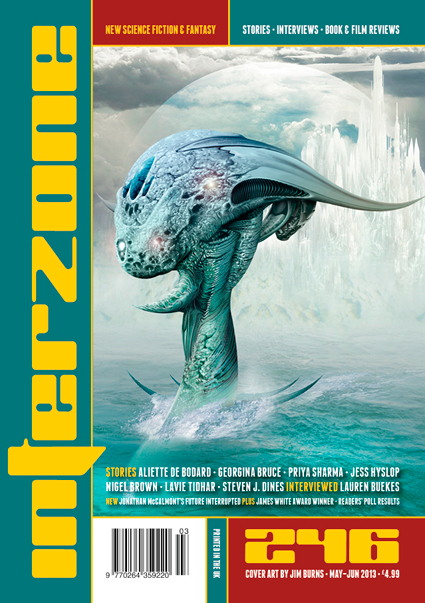
Interzone 246

This issue should be out now. It contains my review of Ian McDonald’s Planesrunner.

I’ll shortly be publishing here my review from Interzone 245 of John Scalzi’s Redshirts. It was ….. interesting.

Edited to add. I see Jim Steel has informed us the issue will be out in the next few days.

Planesrunner Update

Planesrunner cover

My review of Planesrunner by Ian McDonald has been delivered to Interzone.

A full month ahead of deadline as it happens.

It won’t see the light of day for a couple of months, though.

Latest Review Book

Planesrunner cover

Just popped onto the doormat has been my latest Interzone review book, 800 words by the end of March. It’s Ian McDonald’s Planesrunner.

It’s a departure of sorts for him as it’s a “young adult” book. I don’t believe he’s done one of those before.

It seems to be a steampunk kind of thing. The obligatory airship features on its cover anyway.

Locus 21st Century Poll

Following on from the Locus 20th century polls I posted about a few days ago this is their list for SF novels published from 2000 on.

1 Scalzi, John : Old Man’s War (2005)
2 Stephenson, Neal : Anathem (2008)
3* Bacigalupi, Paolo : The Windup Girl (2009)
4 Wilson, Robert Charles : Spin (2005)
5 Watts, Peter : Blindsight (2006)
6* Morgan, Richard : Altered Carbon (2002)
7 Collins, Suzanne : The Hunger Games (2008)
8 Gibson, William : Pattern Recognition (2003)
9* Miéville, China : The City & the City (2009)
10 Stross, Charles : Accelerando (2005)
11* Mitchell, David : Cloud Atlas (2004)
12* McDonald, Ian : River of Gods (2004)
13 McCarthy, Cormac : The Road (2006)
14* Harrison, M. John : Light (2002)
15= Willis, Connie : Black Out/All Clear (2010)
15=* Chabon, Michael : The Yiddish Policemen’s Union (2007)

7 out of 16. I’m obviously not keeping up with modern SF.

BSFA Awards

I’ve now read four of the five short-listed novels – the first time I’ve ever managed such a feat before the vote. While it is so much easier to find books in these internet days I did make a conscious effort this time. My reviews of these five are in the previous post plus here, here and here. It’s probably the one I’ve missed (Zoo City by Lauren Beukes) that will win now.

The nominations for Best Art are to my mind profoundly uninspiring except perhaps the spaceship by Andy Bigwood on the cover of Conflicts.

As to the short stories: the BSFA booklet has been devoured and here are my thoughts.

Flying In The Face Of God by Nina Allan.

The Kushnev drain is a(n unexplained) treatment that allows deep space expeditions to be undertaken more easily. Viewpoint character Anita, a film-maker whose mother was murdered in an anti-space-exploration terrorist attack when she was months old, is in love with Rachel, a recipient of the Kushnev drain who is about to set off into space. Rachel’s boyfriend, Serge, has moved on already.

The Science Fiction in this story is peripheral, being only the mentions of the Kushnev drain and space travel. Apart from that it’s … well, nothing much really.

At the level of the writing, an apparent change of viewpoint character in paragraph 1 (and 2) brought me to a shuddering stop in paragraph 3. Throughout, there is a high degree of info dumping. Tenses within the flashbacks are not precise enough making keeping track of things difficult. Anita’s grandmother features for no good plot reason that I could see. None of the characters displays much psychological depth.

As a result I found this story to be a bit incoherent. And nothing happens.

The Shipmaker by Aliette De Bodard

In a Chinese dominated future culture the shipmaker of the title is in charge of designing a spaceship – on principles that appear to relate to or derive from feng shui. The ship is to be piloted by a flesh and electronic hybrid Mind, gestated in the womb of a volunteer, the mechanics of which process are not laid out. The birth-mother turns up early and throws the delicately balanced design process into confusion. The culture is sketched efficiently and the characters’ problems are believable enough.

This is a proper story with forward movement and motivated characters but with an ending that is perhaps too glib.

The Things by Peter Watts

This story is told from the point of view of an alien, who has always heretofore been able to meld with and assimilate to other lifeforms, and is capable of warding off entropy. The creature’s offshoots have survived a crash and are trying to come to communion with the human members of an Antarctic expedition who come to realise its presence and resist it. Its gradual understanding of the singular nature of human existence, that we have brains – which it regards as a form of cancer – that we die; is well handled.

Again, this is a story, but due to its nature the humans it depicts are never more than names. The alien, however, is as real as you could wish. The last sentence is a little intense, though, not to say unsavoury.

Arrhythmia by Neil Williamson

In a Britain which is reminiscent of the early- to mid-20th century with concomitant working practices and social attitudes yet still has room for Top Of The Pops, Steve whiles away his days at the factory and yearns for the company of Sandra, who is sometimes assigned to work alongside him.

The factory runs to the tune of the Governor. Literally. The assembly line moves in time with piped music – as if Music While You Work was a control mechanism. In fact so suffused with music is this story it even begins with an anacrusis.

The key event is when Sandra gives Steve a copy of a vinyl single by the singer Arrythmia, whose iconoclastic attitude encourages rebelliousness.

As I almost said in my review of the anthology it came from, Music For Another World, this story could perhaps have been titled 1984: The Musical. Arrythmia doesn’t suffer too much by that comparison.

BSFA Mailing

The latest BSFA mailing dropped onto my doormat today.

As well as the usual review magazine, Vector, which (unusually, since I’m normally slow at catching up with the latest thing) contains reviews of three books I’ve already read – Hannu Rajaniemi’s The Quantum Thief which I reviewed for Interzone, Ken MacLeod’s The Restoration Game and Ian McDonald’s The Dervish House – the envelope also spilled forth the A4 magazine of those short stories on the ballot for the BSFA Awards for 2010 and an A5 booklet published as a memorial to Robert Holdstock.

Apart from the book reviews this edition of Vector is a special Stephen Baxter issue.

Much of my reading for March is now more or less scheduled. As well as the short stories mentioned above, I have one more of the five novels shortlisted in the BSFA Award novel category in my to be read pile. I’ve just finished Paolo Bagicalupi’s The Windup Girl – review to come. For my thoughts on Ken MacLeod’s The Restoration Game and Ian McDonald’s The Dervish House see previous posts. Tricia Sullivan’s Lightborn awaits. Only Lauren Beukes’s Zoo City will escape my attention.

In addition Interzone has sent me Dominic Green’s Smallworld to review by the end of March. Busy, busy.

This Year’s BSFA Awards

This year’s BSFA Awards shortlist has been published.

Five novels have made it this year (I’ve read one) and four short stories (ditto,) five non-fiction pieces and six art works.

I didn’t make the list with Osmotic Pressure (I doubt I was nominated by anyone) but
I’ll look forward to reading the shorts I’ve missed so far: I assume the BSFA will send them out in a booklet as in the past two years. They’ll all likely be available on the web soon I should think – if not already.

Cyberabad Days by Ian McDonald

Gollancz, 2009. 313p

Cyberabad Days

This is a collection of shorter pieces of varying length, companions to McDonald’s novel River Of Gods. Cyberabad Days extends the vision of a future India laid out in the novel into a bigger round, replete with water wars, IT wars, robots, virtual reality technology embedded in earpieces called hoeks, AIs (Indianised to aeais) and nano dust, not to mention cricket and soap opera. As in Brasyl, McDonald once again manages to dragoon football into his scenarios.

McDonald’s focus is always on the characters caught up in the events surrounding them, whether it be a woman who marries an aeai, The Djinn’s Wife, another who is destined to be the unwitting agent of final victory in an inter-family feud, The Dust Assassin, a child who is made a Dalai Lama-like goddess (and a pawn) but has that role taken from her and has to find her own way in the world, The Little Goddess, a man used as a surrogate by an aeai to further an affair, An Eligible Boy, a Western child whose life is lived in a compound and who loses his best friend – an Indian boy – after they venture outside together, Kyle Meets The River. Then there is Vishnu At The Cat Circus on which I commented here.

This is big, bold SF treating with issues of concern to the world but never losing sight of the need to tell a story and of the necessity of rounded characters. That it is set outwith the confines of the Western world view is doubly refreshing. The India McDonald has constructed here feels entirely believable – and exciting.

Consider Phlebas: Towards A Scottish Science Fiction

Throughout the 1950s, the early 1960s, through the late 60s efflorescence of the New Wave and into the 1970s and 80s a stream of English authors came to prominence in the SF field and had novels published in Britain. To my mind there was a clear distinction in the type of books all these authors were producing compared to those emanating from across the Atlantic and that certain characteristics distinguished the work emanating from either of these publication areas. While Bob Shaw was a notable Northern Irish proponent of the form during this period and Christopher Evans flew the flag for Wales from 1980 something kept nagging at me as I felt the compulsion to begin writing. Where, in all of this, were the Scottish writers of SF? And would Scottish authors produce a different kind of SF again?

Until Iain M Banks’s Consider Phlebas, 1987, contemporary Science Fiction by a Scottish author was so scarce as to be invisible. It sometimes seemed that none was being published. As far as Scottish contribution to the field went in this period only Chris Boyce, who was joint winner of a Sunday Times SF competition and released a couple of SF novels on the back of that achievement, Angus McAllister, who produced the misunderstood The Krugg Syndrome and the excellent but not SF The Canongate Strangler plus the much underrated Graham Dunstan Martin offered any profile at all but none of them could be described as prominent. And their works tended to be overlooked by the wider SF world.

There was, certainly, the success of Alasdair Gray’s Lanark in 1981 but that novel was more firmly in the Scottish tradition of fantasy and/or the supernatural rather than SF (cf David Lindsay’s A Voyage To Arcturus, 1920) and was in any case so much of a tour de force that it hardly seemed possible to emulate it; or even touch its foothills.

David Pringle noted the dearth of Scottish SF writers in his introduction to the anthology Nova Scotia where he argued that the seeming absence of Scottish SF authors was effectively an illusion. They were being published, only not in the UK. They (or their parents) had all emigrated to America. Though he has since partly resiled on that argument, it does of course invite the question. Why did this not happen to English SF writers?

It was in this relatively unpromising scenario that I conceived the utterly bizarre notion of writing not just Science Fiction but Scottish Science Fiction and in particular started to construct an SF novel that could only have been written by a Scot. Other novels may have been set in Scotland or displayed Scottish sensibilities but as far as I know I’m the only person who deliberately set out to write a novel of Scottish SF.

It could of course simply be that there was so little SF from Scotland being published because hardly anyone Scottish was writing SF or submitting it to publishers. But there were undoubtedly aspirants; to which this lack of role models might have been an off-putting factor. I myself was dubious about submitting to English publishers as they might not be wholly in tune with SF written from a Scottish perspective. I also thought Scottish publishers, apparently absorbed with urban grittiness, would look on it askance. I may have been completely wrong in these assumptions but I think them understandable given the circumstances. There is still no Scottish publisher of speculative fiction.

With Iain M Banks and Consider Phlebas the game changed. Suddenly there was a high profile Scottish SF writer; suddenly the barrier was not so daunting. And Phlebas was Space Opera, the sort of thing I was used to reading in American SF, albeit Banks had a take on it far removed from right wing puffery of the sort most Americans produced. Phlebas was also distant from most English SF – a significant proportion of which was seemingly fixated with either J G Ballard or Michael Moorcock or else communing with nature, and in general seemed reluctant to cleave the paper light years. Moreover, Banks sold SF books by the bucketload.

There was, though, the caveat that he had been published in the mainstream first and was something of a succès de scandale. (Or hype – they can both work.)

[There is, by the way, an argument to be had that all of Banks’s fiction could be classified as genre: whether the genre be SF, thriller, in the Scottish sentimental tradition, or even all three at once. It is also arguable that Banks made Space Opera viable once more for any British SF writer. Stephen Baxter’s, Peter Hamilton’s and Alastair Reynolds’s novel debuts post-date 1987.]

As luck would have it the inestimable David Garnett soon began to make encouraging noises about the short stories I was sending him, hoping to get into, at first Zenith, and then New Worlds.

I finally fully clicked with him when I sent The Face Of The Waters, whose manuscript he red-penned everywhere. By doing that, though, he nevertheless turned me into a writer overnight and the much longer rewrite was immeasurably improved. (He didn’t need to sound quite so surprised that I’d made a good job of it, though.)

That one was straightforward SF which could have been written by anyone. Next, though, he accepted This Is The Road (even if he asked me to change its title rather than use the one I had chosen) which was thematically Scottish. I also managed to sneak Closing Time into the pages of the David Pringle edited Interzone – after the most grudging acceptance letter I’ve ever had. That one was set in Glasgow though the location was not germane to the plot. The idea was to alternate Scottish SF stories with ones not so specific but that soon petered out.

The novel I had embarked on was of course A Son Of The Rock and it was David Garnett who put me in touch with Orbit. On the basis of the first half of it they showed interest.

Six months on, at the first Glasgow Worldcon,* 1995, Ken MacLeod’s Star Fraction appeared. Another Scottish SF writer. More Space Opera with a non right wing slant. A month or so later I finally finished A Son Of The Rock, sent it off and crossed my fingers. It was published eighteen months afterwards.

I think I succeeded in my aim. The Northern Irish author Ian McDonald (whose first novel Desolation Road appeared in 1988) in any case blurbed it as “a rara avis, a truly Scottish SF novel” and there is a sense in which A Son Of The Rock was actually a State Of Scotland novel disguised as SF.

Unfortunately the editor who accepted it (a man who, while English, bears the impeccably Scottish sounding name of Colin Murray) moved on and his successor wasn’t so sympathetic to my next effort – even if Who Changes Not isn’t Scottish SF in the same uncompromising way. It is only Scottish obliquely.

So; is there now a distinctive beast that can be described as Scottish Science Fiction? With the recent emergence of a wheen of Scottish writers in the speculative field there may at last be a critical mass which allows a judgement.

Banks’s Culture novels can be seen as set in a socialist utopia. Ken MacLeod has explicitly explored left wing perspectives in his SF and, moreover, used Scotland as a setting. Hal Duncan has encompassed – even transcended – all the genres of the fantastic in the two volumes of The Book Of All Hours, Alan Campbell constructed a dark fantastical nightmare of a world in The Deepgate Codex books. Gary Gibson says he writes fiction pure and simple and admits of no national characteristics to his work – but it is Space Opera – while Mike Cobley is no Scot Nat (even if The Seeds Of Earth does have “Scots in Spa-a-a-ce.”)

My answer?

Probably not, even though putative practitioners are more numerous now – especially if we include fantasy. For these are separate writers doing their separate things. I’ll leave it to others to decide whether they have over-arching themes or are in any way comparable.

PS. Curiously, on the Fantastic Fiction website, Stephen Baxter, Peter Hamilton and Alastair Reynolds are flagged as British – as are Bob Shaw, Ian McDonald, Christopher Evans and Mike Cobley – while all the other Scottish authors I’ve mentioned are labelled “Scotland.” I don’t know what this information is trying to tell us.

*For anyone who hasn’t met the term, Science Fiction Conventions are known colloquially as Cons. There are loads of these every year, most pretty small and some quite specialised. The Worldcon is the most important, an annual SF convention with attendees from all over the globe. It’s usually held in the US but has been in Britain thrice (Glasgow 2, Brighton 1) and once in Japan, to my knowledge. The big annual British SF convention is known as Eastercon because it takes place over the Easter weekend.

Edited to add (6/6/2014):- Margaret Elphinstone should be added to the list above of Scottish authors of SF. Her first SF book The Incomer appeared from the Women’s Press in 1987, the same year as Consider Phlebas, but I missed out on it then. My review is here.
See also my Scottish SF update.

Edited again to add (4/4/18) Elphinstone’s sequel to The Incomer is A Sparrow’s Flight which I reviewed here.
free hit counter script