Archives » Hugo Awards

The Obelisk Gate by N K Jemisin

Orbit, 2016, 416 p.

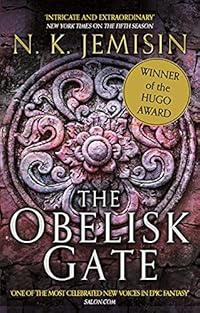
 The Obelisk Gate cover

Second books of trilogies can be difficult to negotiate – for reader and writer. Jemisin compounded this problem for herself by the triple narrative in the first book, The Fifth Season, which featured three story strands concentrating on the experiences of Damaya, Syenite and Essun whose link was only confirmed late on. The trick she pulled off there could not be repeated in the next instalment hence the narration here is slightly less involved. One – apparently second person – strand carries on the story of Essun from The Fifth Season, another focuses on her daughter, Nassun, for whom Essun was searching in the first book. Once again each chapter has an epigraph (derived from stonelore) but only at its end. There are also occasional “interludes” set in a different typeface. Nevertheless Jemisin is still doing unusual stuff with narrative viewpoint here as it becomes clear that the second person sections are not in fact being related from an outside point of view nor as if by Essun but by someone – or something – else in the overall story.

The thrust of the narrative here is of both Essun and Nassun trying to find or secure places of safety while the latest Season of uncertainty, seismic turmoil and climate calamity unfolds. Nassun’s main danger, though, comes from her father, who hates orogenes/rogga so much that he killed her younger brother Uche before stealing Nassun away and is unwilling to accept that Nassun is one – and an adept at that. Essun is still being guided by Alabaster to use her orogenic powers to nullify the prospect of Seasons ever recurring. This has something to do with Father Earth being annoyed that the Moon was removed from its orbit which in turn destabilised Earth’s geology. The Moon is due to return close to Earth and it might be possible to change its trajectory to ensure its recapture. The strange obelisks that allow orogenic power to be focused are a key to this. Throw in the mysterious stone-eaters and there is a lot of SF/fantasy meat to chew on.

According to Essun’s now failing tutor Alabaster the ancient word for the stuff of orogeny is … magic: but Essun locates it as a silvery stuff in people’s bloodstreams. Magic, she believes, derives from life – that which is alive, or was alive, or even which was “alive so many ages ago that it has turned into something else”. The orogene aspect of the whole tale is of course a commentary on prejudice. Yet in this scenario the ordinary people would be right to be wary of orogenes, who do, after all, have the power to kill – and as a reflex at that. And in The Obelisk Gate the skills Essun develops in using the obelisks means that she might as well be a God(dess.)

There was enough here to make me want to read the final book but as to whether The Obelisk Gate deserved to win the Hugo (as it did, Jemisin’s second such in consecutive years) that’s another matter.

Pedant’s corner:- No opening quote marks when a chapter begins with a piece of direct speech. “None of them pierce his body” (None pierces,) “for all intents and purposes” (it’s usually “to all intents and purposes”.) “Within the compound are a handful of” (is a handful,) naivete (choose; English naivety or French naiveté, not the mongrel naivete,) herbivarous (herbivorous.)
Harlan Ellison

Yesterday’s print edition of the Guardian contained the obituary of Harlan Ellison, one of the most influential Science Fiction writers of the 1960s and 70s.

Much of his most important work came in the form of short stories ‘Repent Harlequin!’ Said the Ticktockman, I Have No Mouth and I Must Scream and A Boy and his Dog being only three which immediately spring to mind. He also wrote an award winning Star Trek episode, The City on the Edge of Forever (but was unhappy with alterations the show’s controllers made to the script) and many other TV episodes.

He won no fewer than eight Hugo Awards plus four Nebula Awards and many more nominations.

He was also the begetter of the anthologies Dangerous Visions and Again Dangerous Visions which promoted the New Wave style of writing. A third book The Last Dangerous Visions was projected and stories sought – and submitted – but it never appeared, leading to some acrimony.

He could be hard to get along with and indulged in many quarrels. His personal behaviour was certainly far from beyond reproach raising the question as to how is it possible to separate the personality of an artist from his or her work.

But his work will linger in the memory.

Harlan Jay Ellison: 27/5/1934 – 28/6/2018. So it goes.

Kate Wilhelm

I discovered yesterday that SF author, antholgist and encourager of others through the Clarion workshops and Milford Writers’ Conference, Kate Wilhelm, died earlier this year.

She was one of the few women who published Science Fiction under her own name in those far off days of the 1960s. And she was good, nominated for many awards, winning several including the Hugo for best novel in 1977 for Where Late the Sweet Birds Sang.

The only one of her books I have featured on my blog is Somerset Dreams and Other Fictions.

Kate Wilhelm: 8/6/1928 – 8/3/2018. So it goes.

Hugo Award Nominations

As on the Locus website where the full list of nominees can be found. There’s a lot of “the usual suspects” here:-

Best Novel

The Stone Sky, N.K. Jemisin (Orbit US; Orbit UK)
Six Wakes, Mur Lafferty (Orbit US)
Provenance, Ann Leckie (Orbit US; Orbit UK)
Raven Stratagem, Yoon Ha Lee (Solaris US; Solaris UK)
New York 2140, Kim Stanley Robinson (Orbit US; Orbit UK)
The Collapsing Empire, John Scalzi (Tor US; Tor UK)

Best Novella

River of Teeth, Sarah Gailey (Tor.com Publishing)
Down Among the Sticks and Bones, Seanan McGuire (Tor.com Publishing)
Binti: Home, Nnedi Okorafor (Tor.com Publishing)
“And Then There Were (N-One)”, Sarah Pinsker (Uncanny 3-4/17)
All Systems Red, Martha Wells (Tor.com Publishing)
The Black Tides of Heaven, JY Yang (Tor.com Publishing)

Best Novelette

“Children of Thorns, Children of Water”, Aliette de Bodard (Uncanny 7-8/17)
“Extracurricular Activities”, Yoon Ha Lee (Tor.com 2/15/17)
“The Secret Life of Bots”, Suzanne Palmer (Clarkesworld 9/17)
“Wind Will Rove”, Sarah Pinsker (Asimov’s 9-10/17)
“A Series of Steaks”, Vina Jie-Min Prasad (Clarkesworld 1/17)
“Small Changes Over Long Periods of Time”, K.M. Szpara (Uncanny 5-6/17)

Best Short Story

“The Martian Obelisk”, Linda Nagata (Tor.com 7/19/17)
“Fandom for Robots”, Vina Jie-Min Prasad (Uncanny 9-10/17)
“Welcome to your Authentic Indian Experience™”, Rebecca Roanhorse (Apex 8/17)
“Sun, Moon, Dust”, Ursula Vernon (Uncanny 5-6/17)
“Clearly Lettered in a Mostly Steady Hand”, Fran Wilde (Uncanny 9-10/17)
“Carnival Nine”, Caroline M. Yoachim (Beneath Ceaseless Skies 5/17)

I’ve read two of the novels and will read the Jemisin at some point. Not so much the shorter fiction.

Ninefox Gambit by Yoon Ha Lee

Solaris, 2016, 317 p.

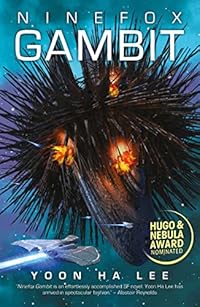
 Ninefox Gambit cover

This was on both the Clarke and Hugo Awards shortlists last year, which is why I read it. After two or so pages I wondered why I was bothering. The first chapter is a morass of information dumping and telling rather than showing with a battle described in terms that dwell on the grisly details yet are also bathetic. Plus, for an interplanetary conflict some of the weapons seem far too prosaic; bullets for instance.

We are in a milieu ruled by an all-powerful hexarchate – Shuos, Kel, Andan, Vidona, Rahal, Nirai – each of whose adherents at first seem to stick to one aspect of life (for example the Kel are soldiers whose “formation instinct” is their greatest asset) but turn out not to be quite so restricted. Some time in the past there was a heptarch (Liozh) but that tendency was expunged for calendrical heresy. Lee makes much play on this notion of keeping order by specifying time intervals. Calendrical rot is presented as a constant menace.

In Chapter One main viewpoint character Kel Cheris (Ajewen Cheris) is on a military mission to take an objective but is told to pull out as soon as she achieves it. She reflects that “Kel luck was frequently bad” – in which case why would anyone take part in it, then? Oh, of course. “Formation instinct,” (which seems more like indoctrination than instinct but is injected so must be chemical and which in any case comes over more as hidebound obedience. Yet occasionally some of the Kel do question orders so the instinct can’t actually be all that binding.) Later we are told, “It was one thing to sacrifice Kel soldiers. That was the purpose of the Kel.” Soldiers are for sacrificing are they? That might explain US military tactics down the years.

Cheris has been extracted as a possibility to lead the response to a calendrical rebellion at The Fortress of Scattered Needles. (Quite why she has been identified as a potential candidate is a mystery to this reader.) Her suggestion to resurrect the notorious, never defeated general Shuos Jedao, killer of millions in Hellspin Fortress centuries before and whose personality has been preserved in the black cradle to be trotted out from time to time when needed, is immediately accepted. His essence is implanted in her brain and off they go to challenge the rebels who are influenced by the Liozh tendency and in particular are on the way to implementing democracy, which general Jedao characterises as, “An obscure experimental form of government where citizens choose their own leaders or policies by voting on them.” Kel wonders how that could possibly work. Having Jedao in her head of course changes her by the book’s end, which sadly leaves ample scope for sequels.

The author’s apparent relish in describing body parts on the various battlefields makes his later attempts to induce sympathy or pity for victims of such extreme violence seem hollow, bordering on objectionable, while sentences such as, “It didn’t make him a mathematician, let alone one specializing in calendrical techniques, let alone one trained in this kind of evaluation,” with a phrase repeated after just four intervening words shows the lack of care in the writing (or editing.) This is only one example of many pieces of clunking prose in the book which is more or less a standard piece of military SF and not ground-breaking in any way.

Thankfully Ninefox Gambit won neither of those awards. What it was doing on the shortlists goodness only knows.

Pedant’s corner:- staunch (I prefer stanch,) “all the Kel weren’t as straightforward” (not all the Kel were as straightforward,) indictaed queries from other moth commander as well” (commanders,) “a small team of deltaform servitors were cleaning up the messes” (a team was,) practicing (practising,) “about what about what” (it doesn’t need the repeat,) “it didn’t take long for him long to respond” (either take out “long for” or “long to”,) damndest (damnedest,) a closing quote mark at the beginning of a piece of dialogue. “An infinitely brief pause.” (How can anything be infinitely brief? Infinite and brief are total opposites,) “alternately gold and bronze and silver” (successively gold and bronze and silver,) “‘They weren’t for the heretics, were they.’” (That sentence is a question; so needs a question mark not a full stop.) “‘I could care less.’” (The context is, “I couldn’t care less.”) “clear white” (there is no such thing, clear = see-through, white = opaque; so-called “white light” is actually colourless,) dodecahedrons (dodecahedra,) Nirai (the character has been called Niaad up to here – and later.)

Hugo Awards for Works from 2016

This year’s Hugo winners (for stories published last year) were announced at the Worldcon in Helsinki.

BEST NOVEL: The Obelisk Gate, by N. K. Jemisin (Orbit Books)

BEST NOVELLA: Every Heart a Doorway, by Seanan McGuire (Tor.com publishing)

BEST NOVELETTE: The Tomato Thief, by Ursula Vernon (Apex Magazine, January 2016)

BEST SHORT STORY: Seasons of Glass and Iron, by Amal El-Mohtar (The Starlit Wood: New Fairy Tales, Saga Press)

I’m afraid I’ve read none of them. How much the balloting was affected by the Sad Puppies I don’t know and can’t tell.

Hugo Awards Final Ballot 2017

From Locus via Geiorge R R Martin’s Not A Blog.

The winners will be announced at Worldcon 75 in Helsinki in August.

I’ve only read two of the nominees. (I take it most are USian.)

Best Novel

All the Birds in the Sky, Charlie Jane Anders (Tor; Titan UK)
A Closed and Common Orbit, Becky Chambers (Hodder & Stoughton; Harper Voyager US)
The Obelisk Gate, N.K. Jemisin (Orbit US; Orbit UK)
Ninefox Gambit, Yoon Ha Lee (Solaris US; Solaris UK)
Death’s End, Cixin Liu (Tor; Head of Zeus)
Too Like the Lightning, Ada Palmer (Tor)

Best Novella

Penric and the Shaman, Lois McMaster Bujold (Spectrum Literary Agency)
The Dream-Quest of Vellitt Boe, Kij Johnson (Tor.com Publishing)
The Ballad of Black Tom, Victor LaValle (Tor.com Publishing)
Every Heart a Doorway, Seanan McGuire (Tor.com Publishing)
This Census-Taker, China Miéville (Del Rey; Picador)
A Taste of Honey, Kai Ashante Wilson (Tor.com Publishing)

Best Novelette

“The Art of Space Travel”, Nina Allan (Tor.com 7/27/16)
“Touring with the Alien”, Carolyn Ives Gilman (Clarkesworld 4/16)
Alien Stripper Boned from Behind by the T-Rex, Stix Hiscock (self-published)
“The Tomato Thief”, Ursula Vernon (Apex 1/5/16)
The Jewel and Her Lapidary, Fran Wilde (Tor.com Publishing)
“You’ll Surely Drown Here If You Stay”, Alyssa Wong (Uncanny 5-6/16)

Best Short Story

“Our Talons Can Crush Galaxies”, Brooke Bolander (Uncanny 11-12/16)
“Seasons of Glass and Iron”, Amal El-Mohtar (The Starlit Wood)
“The City Born Great”, N.K. Jemisin (Tor.com 9/28/16)
“That Game We Played During the War”, Carrie Vaughn (Tor.com 3/16/16)
“A Fist of Permutations in Lightning and Wildflowers”, Alyssa Wong (Tor.com 3/2/16)
“An Unimaginable Light”, John C. Wright (God, Robot)

Best Related Work

The Princess Diarist, Carrie Fisher (Blue Rider)
Women of Harry Potter series of posts, Sarah Gailey (Tor.com)
The View from the Cheap Seats, Neil Gaiman (Morrow; Headline)
The Geek Feminist Revolution, Kameron Hurley (Tor)
Words Are My Matter: Writings About Life and Books, 2000-2016, Ursula K. Le Guin (Small Beer)
Traveler of Worlds: Conversations with Robert Silverberg, Robert Silverberg & Alvaro Zinos-Amaro (Fairwood)

Best Graphic Story

Black Panther, Volume 1: A Nation Under Our Feet, Ta-Nehisi Coates, art by Brian Stelfreeze (Marvel)
The Vision, Volume 1: Little Worse Than A Man, Tom King, art by Gabriel Hernandez Walta (Marvel)
Monstress, Volume 1: Awakening, Marjorie Liu, art by Sana Takeda (Image)
Paper Girls, Volume 1, Brian K. Vaughan, art by Cliff Chiang (Image)
Saga, Volume 6, Brian K. Vaughan, art by Fiona Staples (Image)
Ms. Marvel, Volume 5: Super Famous, G. Willow Wilson, art by Takeshi Miyazawa, Adrian Alphona & Nico Leon (Marvel)

Best Dramatic Presentation — Long

Arrival
Deadpool
Ghostbusters
Hidden Figures
Rogue One
Stranger Things, Season One

Best Dramatic Presentation — Short

Black Mirror: “San Junipero”
Doctor Who: “The Return of Doctor Mysterio”
The Expanse: “Leviathan Wakes”
Game of Thrones: “Battle of the Bastards”
Game of Thrones: “The Door”
Splendor & Misery

Hugo Awards 2016

These were announced at the 74th Worldcon, MidAmeriCon II, last Saturday.

BEST NOVEL The Fifth Season by N.K. Jemisin

BEST NOVELLA Binti by Nnedi Okorafor

BEST NOVELETTE Folding Beijing by Hao Jingfang, trans. Ken Liu

BEST SHORT STORY Cat Pictures Please by Naomi Kritzer

Of these I have read only Binti by Nnedi Okorafor, see here.

I have no idea whether any of these were Sad (or even Rabid) Puppy nominations – in the cases of Folding Beijing and Binti at least I would be inclined to doubt it – but “No Award” appeared only once in the full list this year.

David Hartwell

One of the most respected editers of the SF field, David G Hartwell has died suddenly after a fall.

He was nominated for a Hugo Award no less than 41 times for his editing work, winning on three occasions.

I met him once (at one of the Glasgow Worldcons) and he seemed a thoroughly nice man but never having sold to the US I never had contact with him in his capacity as an editor.

That number of Hugo nominations tells of the esteem in which he was held by those in the SF world. His is a sad loss.

David Geddes Hartwell: 10/7/1941 – 20/1/2016. So it goes.

Interzone Reviews

 The Three-Body Problem cover
 The Dark Forest cover

You may have noticed on my “currently reading” sidebar a few days ago the cover of The Three-Body Problem by Cixin Liu. This was the book which only made it onto the final ballot for this year’s Hugo Award for best novel as a result of Puppygate yet won the award – a first for Chinese Science Fiction.

Shortly to appear on that sidebar is the sequel to that novel, The Dark Forest, also for review in Interzone – a combined review over the two books. (I see that cover has the translator’s name as Joel Martinson. In the text it’s spelled Martinsen.)

These are the first two books in a trilogy properly known as Remembrance of Earth’s Past but popularly known in China as The Three-Body Problem.

My copy of Interzone 260 with its review of Gene Wolfe’s A Borrowed Man came through the letter box a week or so ago.

free hit counter script