Archives » Hugo Awards

Hugo Awards for 2021 Publications

These were announced at ChiCon 68, the 80th Worldcon.

I list the fiction winners below. I have read none of them.

Best Novel: A Desolation Called Peace by Arkady Martine (Tor Books)

Best Novella: A Psalm for the Wild-Built by Becky Chambers (Tordotcom Publishing)

Best Novelette: Bots of the Lost Ark by Suzanne Palmer (Clarkesworld, Jun 2021)

Best Short Story: Where Oaken Hearts Do Gather by Sarah Pinsker (Uncanny Magazine, Mar/Apr 2021)

Best Series: Wayward Children by Seanan McGuire (Tordotcom Publishing)

Best Graphic Story or Comic: Far Sector, written by N.K. Jemisin, art by Jamal Campbell (DC Comics)

Hugo Awards 2022

The list of final nominees for this year’s Hugo Awards has been published.

As far as the novels go the six are:-

A Desolation Called Peace by Arkady Martine (Tor)

The Galaxy, and the Ground Within by Becky Chambers (Harper Voyager / Hodder & Stoughton)

Light From Uncommon Stars by Ryka Aoki (Tor / St Martin’s Press)

A Master of Djinn by P. Djèlí Clark (Tordotcom / Orbit UK)

Project Hail Mary by Andy Weir (Ballantine / Del Rey)

She Who Became the Sun by Shelley Parker-Chan (Tor / Mantle)

Once again, I’ve read none of them. (Ditto for the novellas, novelettes and short stories.)

2021 Hugo Awards

The 2021 Hugo Awards have just been announced at the 79th Worldcon (DisCon III) in Washington, DC, USA.

They’re a bit late; Worldcons are usually held in August.

As far as the fiction goes the nominees were (the award winners are in bold.)

Best Novel

Black Sun, Rebecca Roanhorse (Gallery / Saga Press / Solaris)
The City We Became, N.K. Jemisin (Orbit)
Harrow the Ninth, Tamsyn Muir (Tordotcom)
WINNER: Network Effect, Martha Wells (Tordotcom)
Piranesi, Susanna Clarke (Bloomsbury)
The Relentless Moon, Mary Robinette Kowal (Tor Books / Solaris)

I read the Jemisin for Interzone and posted my review here. The Roanhorse, Kowal and Clarke novels are on my tbr pile. Judging by The Calculating Stars I wouldn’t have expected The Relentless Moon to have been on the short list.

I have read none of the below.

Best Novella

Come Tumbling Down, Seanan McGuire (Tordotcom)
WINNER: The Empress of Salt and Fortune, Nghi Vo (Tordotcom)
Finna, Nino Cipri (Tordotcom)
Ring Shout, P. Djèlí Clark (Tordotcom)
Riot Baby, Tochi Onyebuchi (Tordotcom)
Upright Women Wanted, Sarah Gailey (Tordotcom)

Best Novelette

“Burn, or the Episodic Life of Sam Wells as a Super,” A.T. Greenblatt (Uncanny Magazine, May/June 2020)
“Helicopter Story,” Isabel Fall (Clarkesworld, January 2020)
“The Inaccessibility of Heaven,” Aliette de Bodard (Uncanny Magazine, July/August 2020)
“Monster,” Naomi Kritzer (Clarkesworld, January 2020)
“The Pill,” Meg Elison (from Big Girl, (PM Press)
WINNER: “Two Truths and a Lie,” Sarah Pinsker (Tor.com)

Best Short Story

“Badass Moms in the Zombie Apocalypse,” Rae Carson (Uncanny Magazine, January/February 2020)
“A Guide for Working Breeds,” Vina Jie-Min Prasad (Made to Order: Robots and Revolution, ed. Jonathan Strahan (Solaris))
“Little Free Library,” Naomi Kritzer (Tor.com)
“The Mermaid Astronaut,” Yoon Ha Lee (Beneath Ceaseless Skies, February 2020)
WINNER: “Metal Like Blood in the Dark,” T. Kingfisher (Uncanny Magazine, September/October 2020)
“Open House on Haunted Hill,” John Wiswell (Diabolical Plots – 2020, ed. David Steffen)

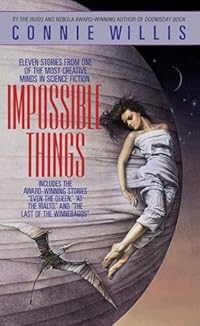
Impossible Things by Connie Willis

This is a book of short stories by the person who has won more Nebula and Hugo Awards than any other writer.

Bantam, 1994, 471 p, plus vi p Introduction by Gardner Dozois Plus vi p of Acknowledgements and lists of contents and illustrations.

The Last of the Winnebagos sees a near future where a mutated parvovirus has killed off all species of dog. Only jackals are left and even those are vanishingly rare. The Humane Society monitors and polices any animal deaths. The roads are dominated by water tankers servicing the city of Phoenix and the like and travelling very fast to blur the speed cameras. Our narrator is a photojournalist who sees a dead jackal on the road while on his way to photograph the last Winnebago, and is drawn into a web of suspicion.

Even the Queen was apparently written in response to complaints that Willis never wrote about women’s issues. (Her view is of course that there ought to be no restrictions on what a writer writes about.) In the story a device called a shunt disseminates a drug called ammenerol which prevents periods. The narrator’s daughter causes a stushie in the family when she announces she wishes to join a group called the Cyclists, who see shunts and ammenerol as instruments of the male patriarchy seeking to deprive women of their natural functions. Nevertheless, the story is played for laughs.

Schwarzschild Radius combines the theory of a star’s gravitational collapse into a black hole with the memories of a Dr Rottschieben who apparently served with Schwarzschild in the Great War. It’s beautifully written and its embedded metaphor ingenious but doesn’t really hold up under retrospective scrutiny.

Ado imagines a future (very litigious, very USian) in which everybody complains about everything and so teaching is made almost impossible. Hamlet consists of only two lines.

Spice Pogrom is Willis’s tribute to Hollywood screwball comedies but also reminded me of one of James White’s Sector General stories. Aliens called Eahrohhs have come to Earth, or, rather, to a space station called Sony which has an idiosyncratic housing policy. One of them, Mr Ohghhifoehnnahigrheeh, has promised to deliver NASA a space program (sic) and narrator Chris’s Nasa employed fiancé has billeted him/it on her and told her to allow it/him whatever it wants. There is plenty of the incidental happenings the screwball comedy enshrines to complicate the story-line. This one turns on whether Mr Ohghhifoehnnahigrheeh actually understands the English words they are all using but the story’s pay-off doesn’t really reward the time investment required by the reader.

Winter’s Tale riffs on the theory that since Shakespeare was low-born he could not have written all those magnificent plays and poems. Told as by Anne Hathaway it plays with that notion (which Willis’s foreword insists is surely incorrect,) and with the possibility that Christopher Marlowe’s murder in a Deptford Inn was faked while also providing a reason for Shakespeare’s famous bequest to Anne.

In Chance a woman has moved back to the town where she attended college (where everything is the same but everything is different) because her husband, who is interested only in career advancement, has a new job there. She starts to see the students as people she knew back in her youth and wonders on the chance happenings that change lives for the better – or worse.

In the Late Cretaceous is a satire on neologisms and academia, with the institution where it’s set also riddled with an over-officious set of traffic wardens, ticketing anything that doesn’t move. The professor of palæontology is a metaphorical dinosaur, still using chalk on blackboard. Willis’s preface to this laments what she calls political correctness, as being inimical, or at least antithetic, to comedy and moans about “every anti- (Choose one: smoking, animal research, logging, abortion, Columbus.)” Well she did include anti-abortionists, so she’s not a complete lost cause.

Time Out centres round a project to produce a “temporal oscillator” with which to manipulate “hodiechrons” (quantum units of time which Willis has presumably named from the Latin for today and the Greek for time.) An anatomy of both the quotidian routines of marriage and parenthood – the domestic detail is thoroughly true to life – the vicissitudes of not well resourced research and nostalgia for youth it suggests a mechanism for the origins of déjà vu. The whole is intricately plotted but leans a bit too heavily on light-heartedness.

Jack returns to the subject of the London Blitz which Willis explored in her short story Fire Watch and novels To Say Nothing of the Dog, Blackout and All Clear. As in those (and The Doomsday Book) it is marred for a British reader by a failure to get details of life and usages in the UK correct. The story concerns a new member of an ARP unit who shows an uncanny knack for detecting bodies buried by rubble. He also disappears sharply to his day job. The narrator develops suspicions.

At the Rialto’s title has a different meaning to Sons of the Rock of my generation compared to those who hail from elsewhere. It was the name of the local cinema. The Rialto here is a hotel in Hollywood hosting (or not) a meeting of quantum physicists. The plot revolves around a series of uncertainties.

Pedant’s corner:- flack (x3, flak,) “the Queen of England” (was of course not crowned as such but as Queen of Great Britain and Northern Ireland – and is of course Queen of many other places besides,) gladiolas (gladioli,) Russian Front (in the Great War it was called the Eastern Front,) LaGrangian points” (Lagrange points,) a missing comma before a piece of direct speech. “‘The seasons’ just started’” (season’s.) “‘Five years and no sex have made desperate’” (have made me desperate’,) “I don’t’” (I don’t,) a missing full stop, “setting her cap for you” (setting her cap at you,) liquor (the British usage is booze, or drink,) a character is said by another to be from Yorkshire but himself says he’s from Newcastle (all British people know Newcastle [either of them] isn’t in Yorkshire,) ME 109s (it’s Me 109s – and the text implies that type of plane was a bomber. It was a fighter,) bannister (banister,) oleo (the word used in the UK for this type of spreadable butter substitute is margarine,) a missing comma before a piece of direct speech, automobile jack (‘car jack’, or just ‘jack’,) row houses (terraced houses,) the Duchess of York (by this time [1941] the said woman was the Queen and was only ever referred to as ‘the Queen’,) a medal is said to have been awarded at a military HQ (investitures are [and were even during the war] held at Royal Palaces,) a recipient’s father is said to have pinned the medal on his son himself (medals are conferred by a member of the Royal family or perhaps, in extreme cases, by a representative such as a Lord Lieutenant,) the Duchess of York kissed the award recipient on both cheeks (absolutely not,) “and said he was the pride of England” (the ‘pride of Britain’ possibly, ‘England’ I very much doubt. The Queen [formerly Duchess of York] was Scottish,) an inland revenue collector (a taxman,) “had gotten married” (had got married,) the award recipient had shot down fifteen German planes so must have been in Fighter Command but is later said to be flying nightly bombing missions over Germany – a Bomber Command task.) “‘meaning’ or possible ‘information’” (or possibly.)
Hugo Awards 2021

The short lists for this year’s Hugo Awards have been announced.

The fiction nominees are:-

Novel-

Black Sun Rebecca Roanhorse (Gallery/Saga Press/Solaris)
The City We Became N.K. Jemisin (Orbit)
Harrow The Ninth Tamsyn Muir (Tor.com)
Network Effect, Martha Wells (Tor.com)
Piranesi Susanna Clarke (Bloomsbury)
The Relentless Moon Mary Robinette Kowal (Tor Books/Solaris)

I note here the crossover with the BSFA Award list as regards N K Jemisin (which I reviewed for Interzone 287 but have not yet published here) and Susanna Clarke.

Novella-

Come Tumbling Down Seanan McGuire (Tor.com)
The Empress of Salt and Fortune Nghi Vo (Tor.com)
Finna Nino Cipri (Tor.com)
Ring Shout P. Djèlí Clark (Tor.com)
Riot Baby Tochi Onyebuchi (Tor.com)
Upright Women Wanted Sarah Gailey (Tor.com)

I have read none of these.

Novelette-

Burn, or the Episodic Life of Sam Wells as a Super A T Greenblatt (Uncanny Magazine, May/June 2020)
Helicopter Story Isabel Fall (Clarkesworld, January 2020)
The Inaccessibility of Heaven Aliette de Bodard (Uncanny Magazine, July/August 2020)
Monster Naomi Kritzer (Clarkesworld, January 2020)
The Pill Meg Elison (from Big Girl, (PM Press))
Two Truths and a Lie Sarah Pinsker (Tor.com)

Ditto.

Short story-

Badass Moms in the Zombie Apocalypse Rae Carson (Uncanny Magazine, January/February 2020)
A Guide for Working Breeds Vina Jie-Min Prasad (Made to Order: Robots and Revolution, ed. Jonathan Strahan (Solaris))
Little Free Library Naomi Kritzer (Tor.com)
The Mermaid Astronaut Yoon Ha Lee (Beneath Ceaseless Skies, February 2020)
Metal Like Blood in the Dark T Kingfisher (Uncanny Magazine, September/October 2020)
Open House on Haunted Hill John Wiswell (Diabolical Plots – 2020, ed. David Steffen)

Ditto.

Series-

The Daevabad Trilogy S A Chakraborty (Harper Voyager)
The Interdependency John Scalzi (Tor Books)
The Lady Astronaut Universe Mary Robinette Kowal (Tor Books/Audible/Magazine of Fantasy and Science Fiction/Solaris)
The Murderbot Diaries Martha Wells (Tor.com)
October Daye Seanan McGuire (DAW)
The Poppy War R.F. Kuang (Harper Voyager)

Ditto.

I’m obviously not keeping up with SF from the US. (Mind you the stuff from there I have read recently hasn’t been too inspiring.)

Hugo Awards 2020

I’m a bit late with this. They were awarded on the 1st of this month.

Best Novel: A Memory Called Empire by Arkady Martine

Best Novella: This Is How You Lose the Time War by Amal El-Mohtar and Max Gladstone

Best Novelette: Emergency Skin by N.K. Jemisin

Best Short Story: “As the Last I May Know” by S.L. Huang

Best Series: The Expanse by James S. A. Corey

I’ve only read the second of these. It was very good.

2020 Hugo Awards Shortlists

The shortlists for this year’s Hugo Awards have been announced. Amazingly I have actually read some of these (the ones in bold the one also in italics as an extract only, in the BSFA Awards 2019 booklet) – partly due to Interzone, but also becasue I read Ted Chiang’s collection Exhalation towards the end of last year.

Since the Worldcon (at which these awards are presented) which was to take place in New Zealand has been cancelled for attendees I assume the ceremony will now have to be virtual, as will the con itself.

The nominations are:-

Best Novel

The City in the Middle of the Night, by Charlie Jane Anders (Tor; Titan)
Gideon the Ninth, by Tamsyn Muir (Tor.com Publishing)
The Light Brigade, by Kameron Hurley (Saga; Angry Robot UK)
A Memory Called Empire, by Arkady Martine (Tor; Tor UK)
Middlegame, by Seanan McGuire (Tor.com Publishing)
The Ten Thousand Doors of January, by Alix E. Harrow (Redhook; Orbit UK)

Best Novella

“Anxiety Is the Dizziness of Freedom”, by Ted Chiang (Exhalation (Borzoi/Alfred A. Knopf; Picador))
The Deep, by Rivers Solomon, with Daveed Diggs, William Hutson & Jonathan Snipes (Saga Press/Gallery)
The Haunting of Tram Car 015, by P. Djèlí Clark (Tor.com Publishing)
In an Absent Dream, by Seanan McGuire (Tor.com Publishing)
This Is How You Lose the Time War, by Amal El-Mohtar and Max Gladstone (Saga Press; Jo Fletcher Books)
To Be Taught, If Fortunate, by Becky Chambers (Harper Voyager; Hodder & Stoughton)

Best Novelette

“The Archronology of Love”, by Caroline M. Yoachim (Lightspeed, April 2019)
“Away With the Wolves”, by Sarah Gailey (Uncanny Magazine: Disabled People Destroy Fantasy Special Issue, September/October 2019)
“The Blur in the Corner of Your Eye”, by Sarah Pinsker (Uncanny Magazine, July-August 2019)
Emergency Skin, by N.K. Jemisin (Forward Collection (Amazon))
“For He Can Creep”, by Siobhan Carroll (Tor.com, 10 July 2019)
“Omphalos”, by Ted Chiang (Exhalation (Borzoi/Alfred A. Knopf; Picador))

Best Short Story

“And Now His Lordship Is Laughing”, by Shiv Ramdas (Strange Horizons, 9 September 2019)
“As the Last I May Know”, by S.L. Huang (Tor.com, 23 October 2019)
“Blood Is Another Word for Hunger”, by Rivers Solomon (Tor.com, 24 July 2019)
“A Catalog of Storms”, by Fran Wilde (Uncanny Magazine, January/February 2019)
“Do Not Look Back, My Lion”, by Alix E. Harrow (Beneath Ceaseless Skies, January 2019)
“Ten Excerpts from an Annotated Bibliography on the Cannibal Women of Ratnabar Island”, by Nibedita Sen (Nightmare Magazine, May 2019)

Best Series

The Expanse, by James S. A. Corey (Orbit US; Orbit UK)
InCryptid, by Seanan McGuire (DAW)
Luna, by Ian McDonald (Tor; Gollancz)
Planetfall series, by Emma Newman (Ace; Gollancz)
Winternight Trilogy, by Katherine Arden (Del Rey; Del Rey UK)
The Wormwood Trilogy, by Tade Thompson (Orbit US; Orbit UK)

Vonda N McIntyre

I was sad to read today of the death of Vonda N McIntyre.

She first came to my attention with the short story Of Mist, and Grass, and Sand – a Nebula Award winner in 1974 and which formed the first part of her later novel Dreamsnake which won the Hugo and Nebula for best novel in 1979. The story was unusual in that its protagonist was a healer rather than a fighter. It was immediately obvious McIntyre’s writing was up there with the best the genre had to offer.

Looking at my records I find I have six of her books (including one short story collection.) One of the novels, The Entropy Effect, was in the Star Trek franchise, and much better written than it probably needed to be.

I reviewed her 1986 novel Superluminal here.

In all she won three Nebulas and that Hugo.

She may not have been prolific as a writer and not so prominent latterly as she was at the turn of the 1970s/80s but she is undoubtedly one of the most noteworthy SF authors of the late twentieth century.

Vonda Neel McIntyre: 28/8/1948 – 1/4/2019. So it goes.

Review for Interzone 281

 The City in the Middle of the Night cover

You may have noticed on my sidebar that I’m currently reading The City in the Middle of the Night by Charlie Jane Anders.

This is because it’s the latest book I’ve received for review in Interzone.

Ms Anders is another author new to me. She is, though, a multiple award winner, gaining the Hugo for her novelette Six Months, Three Days in 2012 and several awards including the Nebula Award for her novel All the Birds in the Sky in 2017.

The review ought to appear in Interzone 281.

Hugo Awards for 2018

These are for works published in 2017.

I forgot they were due to be published in August.

I’ve also been having internet connection problems recently so only looked them up tonight.

The winners were:-

Best Novel:- The Stone Sky by N.K. Jemisin (Orbit.)

Best Novella:- All Systems Red by Martha Wells (Tor.com Publishing.)

Best Novelette:- The Secret Life of Bots by Suzanne Palmer (Clarkesworld, September 2017.)

Best Short Story:- Welcome to your Authentic Indian Experience™ by Rebecca Roanhorse (Apex, August 2017.)

I note N K Jemisin’s third win in a row for best novel – a record I think.

The other fiction winners were also all women. Again a first I believe.

free hit counter script