Archives » Gregory Rabassa

Innocent Eréndira and other stories by Gabriel García Márquez

Penguin, 2004, 173 p. Translated from the Spanish by Gregory Rabassa.

This is a collection of the author’s short stories most published from 1948-1953 but some from the 1960s and one from 1970. His characteristic magical realism is to the fore but so too is an emphasis on death.

Lead story The Incredible and Sad Tale of Innocent Eréndira and Her Heartless Grandmother is the longest in the book. Eréndira starts off as a young teenage girl (prone to falling asleep on her feet while going about her business) whose widowed grandmother blames her for her house burning down. In order for Eréndira to repay her for her loss the grandmother pimps her out. Various travels ensue among which she procures a certificate of purity from a bishop. Eréndira forms a relationship with Ulises, son of a native mother and a Dutch trader who smuggles diamonds grown inside oranges.
The Sea of Lost Time is a prime example of magical realism, mixing a strange smell coming off the sea with the arrival of the richest man in the world who turns up with suitcases bulging with money which he dispense to the locals who nevertheless end up in debt to him and a swim (without artificial breathing aids) to the bottom of the sea where there is a village.
The first sentence of Death Constant Beyond Love, “Senator Onésimo Sánchez had six months and eleven days to go before his death when he found the woman of his life,” (written in 1961) predates that of Márquez’s most famous novel One Hundred Years of Solitude, “Many years later, as he faced the firing squad, Colonel Aureliano Buendía was to remember that distant afternoon when his father took him to discover ice,” which I commented on here. In this story though the character mentioned in the sentence does feature strongly in the tale.
The Third Resignation tells of a child who has seemingly died but is kept alive by intravenous feeding and housed in a coffin-shaped box.
The Other Side of Death gives us the thoughts of a man whose twin brother’s dead body lies embalmed in the next room.
Eva is Inside Her Cat is the tale of a woman insomniac who imagines herself into the body of her cat.
Dialogue with the Mirror contains the thoughts of a man who sees himself in the mirror, shaving. Or is it himself?
The Bitterness for Three Sleepwalkers is that the woman who has occupied the house they sleep in has died.
Eyes of a Blue Dog are the words two people who dream of each other swear they will use in daytime to recognise each other.
The Woman who Came at Six O’Clock relates a conversation, encompassing love and murder, between a restaurant owner and the woman who always comes into his establishment at six o’clock. Except she insists that this day she was early.
Someone Has Been Disarranging These Roses seems to be narrated by a ghost, who waits for the woman who came to live in the room next door to have her Sunday siesta before moving some of the roses she sells to the knoll where his grave lies.
The Night of the Curlews features three men whose eyes have been pecked out by curlews. Though their story had been in the newspapers people don’t believe it.

Pedant’s corner:- Ulises’ mother (Ulises’s,) a bandoleer (bandolier,) martyrized (x 2, martyred,) her virtures (her virtues.)

Conversation in the Cathedral by Mario Vargas Llosa

faber and faber, 1993, 605 p. Translated from the Spanish Conversacion en la catedral by Gregory Rabassa.

This is a novel that is at the same time sprawling, covering a time in Peru when it was under the dictatorship of General Odría, yet also intimate, as it revolves round the families and interactions of two of its characters, Santiago Zavala, son of the well-off Don Fermín, and Ambrosio, once a chauffeur to Fermín but later to Cayo Bermúdez, a Minister of Government, Odría’s hardman.
When the novel starts Santiago is staring at the Avenida Tacna and wondering “At what precise moment had Peru fucked itself up?” While the novel does not provide a full account of the country’s dysfunctionality at that time it does go on to illustrate a lot of that fucked-upness. Much to the dislike of his father and mother, Santiago has been working at the newspaper La Crónica for many years. He meets a down on his luck Ambrosio working at the dog pound and they go on to have a conversation (the Cathedral of the book’s title is a bar) during which their life stories unfold.

Through it we meet examples of the highs, Don Fermín, Bermúdez, Santiago’s family, and some of the lows of Peruvian society. Bermúdez keeps a mistress, Hortensia, a former night-club singer with the stage name, the Muse, who spends his money liberally. She is friendly – more than friendly – with Queta, a (relatively) expensive prostitute at Señora Ivonne’s, with whom Ambrosio has a fascination.

Despite the dictatorship there are lingering political tensions between Odríists and Apristas – even more so between that latter group and the Communists (though at one point someone says there are only ten Communists left and they are all secret policemen.) Disturbances occur in the town of Arequipa, which lead to a softening of the regime and the fall of Bermúdez. Hortensia’s life more or less falls apart after his exile. Ambrosio is caught up in all this. Santiago’s job at La Crónica keeps him apart, though he had been arrested early on in his life as a hanger-on of an anti-Odría group known as Cahuide before resolving to stay out of trouble. “‘Capable people like you and me don’t get involved,’ Santiago said. ‘We’re content to criticise the incapable people who do.’”

Much of the text focuses on Ambrosio’s relationship with his wife Amalia, a smaller part relays how Santiago came to marry a nurse (again to his family’s discontent,) while the back-biting, manœuvring and backside-covering of the military during the Arequipa unrest are well-illustrated.

This is not a straightforward read, the narrative often alternates paragraphs from the present of the conversation with the unfolding of past events, which is initially a bit confusing though it settles down more from Part Two onwards, but it encompasses different layers of Peruvian society and illustrates the lack of agency of ordinary people caught up in events outwith their control, their struggles to get by, and contrasts them with the insouciance of the moneyed.

Note to the sensitive: the text contains the word ‘niggers’.

The Autumn of the Patriarch by Gabriel García Márquez

Penguin, 2014, 233 p. Translated from the Spanish El Otoño del Patriarca, 1975, by Gregory Rabassa.

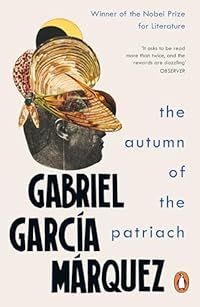
 The Autumn of the Patriarch cover

It would be difficult to review this book without considering its form and structure, which are not for the faint-hearted, demanding concentration from the reader. There are six sections in all and each one consists of but a single long paragraph containing meandering sentences ranging up to several pages or more in length. Indeed the last section had just one sentence stretching over 45 pages. Within these digressive sentences the narrative viewpoint frequently switches back and forth, neither is there dialogue in the conventional sense, only reports of speech – perhaps interspersed with a “general sir”, or other vocative interpolation, to indicate that the preceding phrase is supposed to have been spoken. But for those viewpoint changes (some of which are in the plural) the prose could almost be described as stream of consciousness – or even stream of unconsciousness as one interpretation is that it represents the patriarch’s last thoughts; his life flashing past him as it ebbs away, “he was condemned not to know life except in reverse,” imagining again the events that brought him to his lonely end.

The autumn of the title is the long period of decay during which the (unnamed and, reportedly, absurdly long-lived,) patriarch retreated into solitude and his power rested on his reputation. The litany of atrocities and sexual peccadillos is what you might expect from a man of this sort, though he is portrayed as having an affection for both his mother, Bendicíon Alvarado, and the woman, Leticia Nazareno, he plucked from being a novitiate to share his bed.

The hall of mirrors that is living under a dictatorship is illustrated by lines such as, “We knew no evidence of his death was final, because there was always another truth behind the truth,” and “a lie is more comfortable than doubt, more useful than love, more lasting than truth,” and “the belief that the less people understand the more afraid they’ll be.” These are lessons always needing to be learned it would seem. There is also an odd passage where we are told the patriarch had had “brought from Scotland eighty-two new born bulldogs …evilly taught to kill by a Scottish trainer.” I wondered why Márquez had chosen Scotland; it’s not particularly known for bulldogs.

The Autumn of the Patriarch is an exercise in form and experiment bearing few of the easy consolations of a conventional novel. It’s a tour-de-force certainly, but it’s not one for the casual reader.

A word for the translator, Gregory Rabassa. This must have been a particularly tricky book to translate and he has done a magnificent job. Rabassa was credited by Márquez of making the English translation of One Hundred Years of Solitude superior to the original Spanish. Sadly, he died in June 2016. So it goes.

And a warning for those who wish to avoid the n-word, in which case don’t read the next sentence. The phrase “nigger whorehouse” appears in the text.

Pedant’s corner:- nowthat (now that,) bureaus (I prefer bureaux,) convenience’ sake (convenience’s sake,) insignias (insignia. Is insignias USian?)

In Evil Hour by Gabriel García Márquez

Penguin, 2014, 186 p. Translated from the Spanish La Mala Hora by Gregory Rabassa. First published in Spain in 1968.

Borrowed from a threatened library.

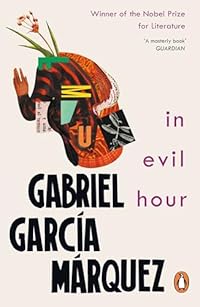
 In Evil Hour cover

In Evil Hour is a very South American tale set in a town where the inhabitants keep expecting the bad old days of summary execution to return. In amongst descriptions of various relationships in the town there are vignettes such as the local telegrapher spending his free time sending poems and novels to the lady telegrapher in another town. The church is plagued by mice and the town by the clandestine posting of scurrilous notes on its walls while it sleeps. These notes, which the text calls lampoons, contain only gossip everybody knows but have created tension which spills over when César Montero kills the local troubadour Pastor for an alleged affair with his wife. The mayor at first tries to keep things low-key but later, as the tensions rise, imposes martial law and street patrols. There is a hint at the end that despite arrests being made these measures have been ineffective. Apart from the constant threat of governmental violence/coercion the book seems to deal with the more mundane aspects of life and is not as invested with magic realism as others of Márquez’s works. It is very readable though; a testament both to Márquez and his translator, Gregory Rabassa.

Pedant’s corner:- Father Ángel is rendered once as Angel.

free hit counter script