Archives » Graeme Macrae Burnet

Benbecula by Graeme Macrae Burnet

Polygon, 2025, 145 p, plus 25 p Afterword and 1 p Acknowledgements.
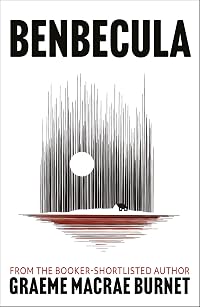
The sixth in Birlinn’s Darkland Tales series, this is the story of the murder in Liniclate on Benbecula of three members of his family by Angus McPhee. as told in retrospect by his brother, Malcolm who, with his sister Marion, was out gathering seaweed when the fatal events took place.

Angus had always been a reluctant worker on the family croft but had spent time on a neighbouring island and on return shown signs of mental problems. The local community had thereafter had such concerns at his behaviour that they had him examined for possible confinement in a lunatic asylum but family pride and a reluctance to pay for such provision precluded this.

Life in Liniclate, as in much of rural Scotland in 1857, was harsh, more or less hand-to-mouth. It provokes in Malcolm that dour attitude to life exemplified by Calvinism’s Scottish expression. “Hope serves only as a buttress to misery. It is better all round to accept one’s lot in life and not entertain notions of a less onerous existence.”

Malcolm also has a cynical view of human nature. “I do not suppose that many among you would have the least interest in the incidents I have thus far related were it not for the fact that they serve as a prelude to violence. When a tale promises bloodshed no one leaves their seat.”

The murders blighted Malcolm’s life. The remaining family was all but ostracised by the locals and Marion and youngest brother John left the island (though Marion wasn’t seen to board the ferry,) while Malcolm withdrew into himself. He harbours dark thoughts about the Mrs MacLeod who comes in weekly to see to his welfare and ensure he bathes every month or so. Such is the tone of his reflections that the reader wonders if Malcolm has not succumbed to madness himself and, indeed, if his account is reliable in any sense.

This is another well written addition to the Darklands series but its resemblances to Burnet’s earlier novel His Bloody Project make it seem less original than the others.

Pedant’s corner:- in the Afterword; “none of whom were married” (none of whom was married.)
Best of 2017

Fifteen novels make it onto this year’s list of the best I’ve read in the calendar year. In order of reading they were:-

The Amazing Adventures of Kavalier and Clay by Michael Chabon
His Bloody Project by Graeme Macrae Burnet
A Man Lies Dreaming by Lavie Tidhar
The Panopticon by Jenni Fagan
The Stornoway Way by Kevin MacNeil
The Sea Road by Margaret Elphinstone
The Untouchable by John Banville
Swastika Night by Katherine Burdekin writing as Murray Constantine
Spaceman of Bohemia by Jaroslav Kalfař
The Power by Naomi Alderman
Imagined Corners by Willa Muir
This is Memorial Device by David Keenan
The Underground Railroad by Colson Whitehead
Kalpa Imperial by Angélica Gorodischer
Psychoraag by Suhayl Saadi

That’s six by women and nine by men. Six were SF or Fantasy, counting in The Underground Railroad, (seven if the Michael Chabon is included,) seven were by Scottish authors.

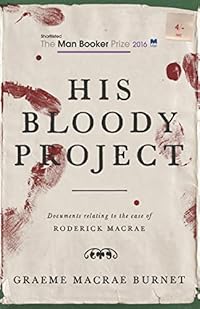
His Bloody Project by Graeme Macrae Burnet

Documents relating to the case of Roderick Macrae. Contraband, 2015, 284 p.

 His Bloody Project cover

This novel caused a fair buzz when first published, and made the Booker Prize short list last year. It is a variation on the found manuscript tale, partly set in the Applecross peninsula in Wester Ross in 1869, describing the circumstances leading up to a brutal triple murder. However, that takes up only half the book, which in fact begins with an authorial preface (wherein we find the first set of a number of footnotes which bolster the manuscript conceit,) goes on to witness statements supposedly collected at the time of the murder then we have the manuscript itself, a glossary of Scots words used in it, medical reports on the victims, an extract from a work on psychiatry by the resident Surgeon at Perth Prison – an “acknowledged authority” on crime and psychology – and subsequently describes the resultant trial in Inverness plus the verdict, supposedly drawn from newspaper accounts and a book published in 1869.

The manuscript’s narrator, Roderick Macrae, had lost his mother to childbirth some years previously and the family had since fallen into depression; a circumstance not helped by the fact his father, Black John, was free with his fists within the family and was having difficulty keeping the croft going. This last was made progressively worse by the new occupant of the post of factor’s constable, Lachlan Mackenzie, who had a long-lasting mutual antipathy with Black John, carrying out a vendetta against him. (The reasons for this antipathy may be surmised from a single cryptic remark Lachlan makes to Roddy after Roddy sees him forcing himself on Roddy’s sister, Jetta.) The witness statements and the testimonies at the trial inevitably throw doubt on the reliability of Roddy’s account. In this regard the Minister is as severe and uncompassionate as any of his breed, mindful only of the spiritual and not bodily welfare of his parishioners. About the only two people who have a good word to say about Roddy are the local schoolmaster who thought he had a good chance of bettering himself, and his lawyer, who strives to prove Roddy is insane.

It’s all exquisitely written. Burnet is a master, inhabiting the various voices within the book expertly, adroitly taking us into the life and times of his characters but I’m afraid I wasn’t convinced by the manuscript section as a found artefact. I know it’s an odd thing to say, all found manuscript tales are made up but there were too many obviously novelistic touches here, incidents too neatly aligned to the arc of the story.

It’s an outstanding example in the use of different narrative forms to tell a story, though; which makes His Bloody Project a fine work of fiction. It’ll be in my books of the year to be sure.

Pedant’s corner:- [The found manuscript is described as being altered only in respect of punctuation and paragraphing but “true to the original”, I have therefore mostly ignored any odd punctuation in that portion of the book.] Otherwise; “children were instructed in Latin, Greek and science” (why no capital for science? or for mathematics and french later on.) “The factor furrowed his brow and look at my father” (looked,) a gavel (3 mentions of the trial judge employing this implement. It is never used in Scottish – or English, Welsh or Northern Irish – courts,) “he had put her hands upon her” (his hands,) indispensible (indispensable.)

free hit counter script