Creation Node by Stephen Baxter
Posted in My ParSec reviews, Reviews published in ParSec, Science Fiction at 12:00 on 8 May 2024
Gollancz, 2023, 443 p, including 3 p Afterword. Reviewed for ParSec 9.
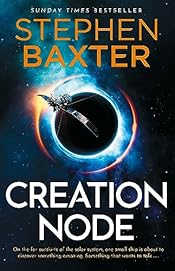 In 2255 humanity has recovered from the ravages of climate change on Earth and extended into the Solar System. Earth is dominant, with a stranglehold on the Lunar Consortium’s expansionary plans and its helium-3 extraction exports via control of the supply of nitrogen needed as a buffer gas. However, schemes are in hand for Earth to mine the gas giants for helium-3 to fuel a nuclear fusion engine which will cut journey times across the Solar System from decades to years. A third group called Conservers does not wish to deplete the Solar System’s resources but has sent out the Shadow, a ship powered by solar sails, to the Oort Cloud to investigate the possibility of Planet Nine orbiting there.
Planet Nine, as found, could fall into the venerable SF category of Big Dumb Object, except it’s not big – it’s an apparent black hole, ten times Earth-mass – and it’s not dumb. Salma, a teenager born on the voyage, discovers its Hawking radiation harbours patterns. It is sending out a message. As soon as the Shadow’s crew echoes the signal back, the Hawking radiation changes form and the galaxy’s central core simultaneously turns red from a quasar emanation. As coincidences go this would be an almighty one but how could a signal sent in the here and now cause an event to have occurred thousands of years ago so many light years away? The quasar’s red light bathes the whole Solar System and starts to increase the temperatures of every orbiting body within it, slowly but inexorably. This, however, is a challenge which is nothing but background for most of the book.
Standing off some distance away, the Shadow’s crew then sends the second pattern back to the object. It expands immediately to a larger size and forms a surface with one Earth standard gravity. And on that surface lies a cylindrical container. The three crew members sent down to the surface find it has an alien inside, an alien which resembles a bird but with human resemblances. This is swiftly dubbed Feathers. Creation Node is not just a BDO novel, then, but also a first contact one. Communication with Feathers is almost impossible except by gesture so who, or what, she is, is a mystery. Both the Earth authorities and the Lunar Consortium decide it is imperative to send missions to Shadow’s location as soon as possible.
A lot of the earlier part of the book (sometimes spoiled by information dumping of the ‘she knew’ variety and intermittent references to several of the characters wearing black pendants; a decorative choice never fully explained) is taken up with Earth’s preparations of its fusion powered ship, Cronus, to launch from Saturn orbit and the Lunar Consortium’s unannounced mission to join it. This is something of a drag on the ongoing story in the Oort cloud (albeit with a set piece collision in space to be described.) We could charitably interpret this longueur as Baxter trying to convey the time scale involved. Even with the new drive the joint mission to the changed black hole takes eleven years.
The climax of the novel is almost literally (but not quite, since Baxter tips us the wink to its existence in earlier short chapters) a deus ex machina, the manifestation of a creature with god-like powers which can move both itself and our humans between universes and across space and time. Both Planet Nine and the quasar are under its control, the details of which I’ll leave to the reader to discover. It presents a dilemma to the humans at the site, though.
Baxter’s immersion in SF shines through, Creation Node contains more than a few nods to Arthur C Clarke – sunjammers, space elevators, an enigmatic object that eventually provides a path to elsewhere in the universe – to please longstanding SF buffs. Its invocations of other universes and the vastness of time tickle the sense of wonder but the humans its tale is fashioned around are not its primary focus. Ideas are the thing here. This is good old SF for the good old SF reader.
Pedant’s corner:- “to the second. Hawking set” (has no need of that full stop,) Feathers’ (several times; Feathers’s) “‘when we first found here’” (found her makes more sense,) “had managed to assemble of fair-sized heaps of the stuff” (doesn’t need the ‘of’ before fair-sized,) “desertification was increasing such places as the Sahel” (was increasing in such places,) “seemed to rise to a crescendo” (the crescendo is the rise, not its climax,) “nothing remained to be sucked out” (it wasn’t sucked out, it was pushed out into a vacuum – which Baxter implicitly acknowledges two lines later with “after the initial plume of lost air had pushed stuff out into space,) a missing open quote mark before a piece of direct speech, “‘these are all stones are deep black’” (either ‘these are all stones which are deep black’ or these stones are all deep black’,) “twenty thousand years of emitted a galaxy core heat” (doesn’t need that ‘a’.)