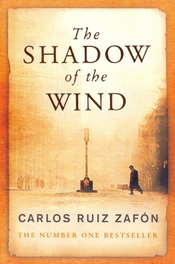
The Angel’s Game by Carlos Ruiz Zafón
Posted in Other fiction, Reading Reviewed at 12:00 on 13 May 2026
Phoenix, 2010, 508 p. Translated from the Spanish El Juego del Angél (Editorial Planeta SA 2008) by Lucia Graves.

In this (sort of) prequel to The Shadow of the Wind, David Martín is a struggling writer just about scraping by, writing potboilers set in his home city of Barcelona in the 1920s. A hint of fantasy intrudes when he has a sexually charged encounter with a woman called Chloe – the name of his heroine – in a seedy establishment which he later finds has been abandoned for years. He comes under the influence of better-known writer Pedro Vidal to whose chauffeur’s daughter Cristina he is attracted and in the guise of editing Vidal’s manuscript rewrites his latest novel much for the better.
The proprietor of Sempere and Sons booksellers gives him a copy of Dickens’s Great Expectations, a book with which Martín is much taken, and introduces him to The Cemetery of Forgotten Books (familiar from The Shadow of the Wind, where Sempere’s son Daniel has a prominent part.) Great Expectations seems to be a kind of template here for Zafón but the parallels are by no means exact.
Out of the blue a French publisher Andreas Corelli asks Martín to write a book inventing a new religion. In return for one hundred thousand francs.
Corelli describes religion as “a moral code expressed through legends, myths, or any type of literary device, in order to establish a system of beliefs, values and rules with which to regulate a culture or society.”
He also has a jaundiced view of humanity, saying, “‘The incompetent always present themselves as experts, the cruel as pious, sinners as excessively devout, usurers as benefactors, the small-minded as patriots, the arrogant as humble, the vulgar as elegant and the feeble-minded as intellectual.’”
His thoughts on what motivates people to act badly have resonance. “‘When we feel like victims, all our actions and beliefs are legitimised, however questionable they may be. Our opponents, or simply our neighbours, stop sharing common ground with us and become our enemies. We stop being aggressors and become defenders. The envy, greed or resentment that motivates us becomes sanctified, because we tell ourselves we are acting in self-defence. Evil, menace, those are always the preserve of the other. The first step towards believing passionately is fear. Fear of losing our identity, our life, our status or our beliefs. Fear is the gunpowder and hatred is the fuse. Dogma, the final ingredient, is only a lighted match.’”
After his researches into religion Martín opines, “‘The main pillar of every organized religion, with few exceptions, is the subjugation, repression, even the annulment of women in the group. Woman must accept the role of an ethereal, passive and maternal presence, never of authority or independence, or she will have to take the consequences. She might have a place of honour in the symbolism, but not in the hierarchy.’”
Martín moves into an old mansion which once belonged to Diego Marlasca – a man with a mysterious death whose ramifications will dog Martín’s future. (There are echoes here of a similar building in The Shadow of the Wind.)
In the meantime Martín has become plagued by Isabella, a fan of his writing, and come to the attention of Police Inspector Grandes as suspect in a mysterious fire at his former publisher not to mention the disappearance of Cristina.
He is saddened by Sempere’s decline in health and vigour. The bookseller complains that, “‘At my age, eroticism is reduced to enjoying caramel custard and looking at widows’ necks.’”
What could have been an insight into the importance of books in the lives of bibliophiles, however, degenerates in its latter stages into an overdose of unlikely happenings more akin to a thriller. Again, as in The Shadow of the Wind, Zafón flatters to deceive.
Pedant’s corner:- “my father took me El Indio” (took me to El Indio,) shrunk (shrank.) “‘You don’t looked convinced’” (You don’t look convinced.)
 This is a striking novel. It is told from the viewpoint of an unborn child (though as if being remembered from enough years later for that child to be able to write.) Any objections to such an unlikely story teller are forestalled by the sentence, “It’s precisely because I didn’t see it that I can imagine it much better than you.” (Imagining it is, after all, what novelists do all the time.) Scenes and times shift abruptly but always comprehensibly. Later events (even those subsequent to the narrative) are treated proleptically, but then again, to the narrator they will already have taken place. There are conversations – envisioned or hallucinated – between characters who have not met, the contents of which are not given quotation marks.
 In a prefatory note Márquez tells us this tale was inspired by his first journalistic assignment – to cover the emptying of the crypts of the old Clarissan convent dedicated to Santa Clara where from one of the tombs tumbled a mass of copper coloured hair, attached to the skull of whom the name on the tomb said was Sierva María de Todos Los Ánǵeles. This reminded Márquez of a story told by his grandmother of a young girl with hair that trailed behind her like a bridal train who had died after being bitten by a rabid dog many years before.
 This is a novel that is at the same time sprawling, covering a time in Peru when it was under the dictatorship of General Odría, yet also intimate, as it revolves round the families and interactions of two of its characters, Santiago Zavala, son of the well-off Don Fermín, and Ambrosio, once a chauffeur to Fermín but later to Cayo Bermúdez, a Minister of Government, Odría’s hardman.