Archives » Fantasy

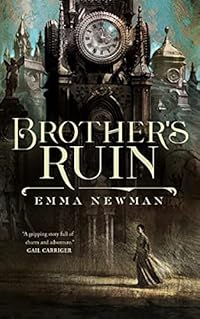
Brother’s Ruin by Emma Newman

Tor.com, 2017, 195 p.

This is a fantasy story with a steampunk vibe, as it is set in pseudo-Victorian times. Charlotte Gunn is an artist with a recent success in selling illustrations for a book. She has to keep this success secret from her family for fear of undermining her father’s breadwinning status and from her fiancé for similar reasons. Her biggest secret though is that she is an unregistered magus. (I feel that in her case it should really be spelled ‘maga’.)

The Royal Society of the Esoteric Arts is an all-powerful organisation protecting Queen and Empire through the magical powers of the magi. The earliest scene in the book sees Charlotte and brother Ben witness the tracking down of a baker’s son by the Society’s Enforcers using a magical implement known as the gauntlet which detects clandestine magical ability. Since untrained magi are said to be a danger to the Crown (and public) it is an offence to conceal such abilities. Adepts are routinely taken from their families (who are compensated for their loss on a sliding scale of talent) and trained up as servants of the Crown, though forbidden to marry. Those who conceal adepts are prosecuted. Charlotte feels her situation keenly but Ben’s faint traces of magical talent give her a possibility of masking her own from the investigators when her father calls them in to test Ben as due to a slight error on Charlotte’s part he perceives evidence of magic activity in the house.

Ben is in poor health, and it turns out their father took out a loan to allow Ben to go to University, from which his illness forced him to return. The calling in of the loan leads Charlotte to investigate the lender and thereby to knowledge of a conspiracy against the Society. Magus Thomas Hopkins, one of Ben’s testers, the most beautiful man Charlotte has ever seen, enlists her help to thwart the conspirators.

The tone of all this suggests an intended YA audience. There’s nothing to frighten the horses nor ground-breaking here but it’s entertaining enough, if a little slight.

Pedant’s corner:- span (spun,) “Archie’s hold tightened” (both before and after this no Archie is ever mentioned, but her brother is described as Archie on the book’s back cover,) “but that wouldn’t be for months and now, and Father had only days” (has one ‘and’ too many,) “she returned to Ben’s side who had lit the candle” (this phrase has its syntax severely awry,) bannister (banister,) a missing comma at end of a piece of direct speech where the sentence continued, “the most handsome man Charlotte had even seen” (‘had ever seen’, surely?) sprung (sprang,) “she hadn’t fully taken what he was doing in” (doesn’t need the second ‘in’.)


Feather Stroke by Sydney J van Scyoc

Avon, 1989, 266 p.

Scyoc’s default setting seems to be an agrarian/mediæval social organisation. Feather Stroke shares this with her previous novels but has an added dimension.

Dara is the daughter of a headsman of a village of smallpeople in a society where a generation or so ago people emigrated to a different continent to escape both the influence and domination of the powerful priesthood of the Sun God Tith and the associated suffocating social hierarchies. Local indigenous inhabitants called Ilijhari make occasional trading visits in the form of a man called Te-kia who is always closely accompanied by an eagle-like bird known as a quirri. Since Dara has strange dreams in which she inhabits the bodies of birds we know this to be significant.

Dara’s life is changed when Kels Rinari, an important, self-made trader from the city of Port Calibe, comes mob-handed with uniformed, armed men and a damen-kest to demand the hand in marriage of her sister Mirina in return for “protection.” This assertion of the renounced continent’s privileges is an unwanted harbinger of the old ways coming to the new home. Mirina can either accept the offer, refuse it, or take the third traditional option, suicide, which last would leave Dara to become the object of Rinari’s designs.

Mirina’s suicide leaves their father to take the news of her death to Rinari. On the way he persuades Dara to go to the Ilijhari for safety. Her journey is fraught but she meets and is befriended by Kentith, a renegade priest from the other continent.

Among the Ilijhari she finds she is descended from them, her true mother died in child-birth and she was given to the smallpeople to bring up since one of the village mothers had had a stillbirth around the time. It is with the Ilijhari that Dara’s affinity with birds is confirmed, her ability to inhabit their consciousnesses.

In a sequence which resonates with the history of the Americas in our world, Te-kia tells her, “The land was here, sweet and rich. And there were men and women appointed to guard the land. Wisely, they treated it as a thing of soul, living and aware, to be respected, to be preserved. …. They called themselves its children, but they understood they were its guardians as well. But after a while, others came from far shores who were stronger than the guarding peoples. The intruders were greedy and full of destructive powers. They had stolen from the earth itself and from its surrounding sphere, and they thought that whatever they chose to inflict upon the living earth and its creatures was only their right.”

On finding her father has not returned from Port Calibe Dara resolves to go there and confront Kels Rinari, relying on her Ilijhari nature to put him off marrying her. Kentith, despite the dangers involved for him demands to accompany her. The priests of Tith are anxious to capture him but in any case can bring down fire from the sun and use him as a vessel for that. Mpreover his distinctive priestly eyes make him a target for suspicious locals .

Once in Port Calibe, Dara finds Rinari to be a more complicated character than she had initially assumed and all three determine to undertake the business of combating the influence of Tith’s priests.

Feather Stroke is a pleasing enough fantasy not too demanding on the reader.

Pedant’s corner:- “‘I was only waiting for to ask’” (for you to ask,) “at it center,” (at its center.) “Perhaps the orchard was in some was as much a manifestation” (in some way as much a manifestation,) “two year later” (years,) “before Dara could calm him, before she should orient herself” (before she could orient herself.) “Finally she saw that it would surely dash itself against the walls – and not so harmlessly as Ti-ri-ki had done” (the opposite is the case: the smaller a creature the less likely it is to be damaged in a collision; Newton’s second law, F = ma.)

The Rosewater Redemption by Tade Thompson

Orbit, 2019, 380 p.

This finishes off Thompson Rosewater trilogy (I reviewed the previous instalments here and here) and features many of the characters from before – Kaaro, Femi Alaagomeji, Aminat, Jack Jacques, Oyin Da (the Bicycle Girl,) Lora the construct.

There is still antipathy between Rosewater, the city which grew up around the alien dome which had translated itself from London, and Nigeria, from which the city had gained independence. Here the alien city has begun to move slowly towards the sea. Those unfortunates called reanimates, dead humans whose bodies have been revived by the city’s healing powers, are now found to still have residual consciousness, a fact that causes conflict between Jack Jacques, Rosewater’s mayor, and his wife Hannah, a lawyer who represents the reanimates.

A lot of the scenes though again take place in the xenosphere, that mysterious, hallucinatory realm by which the alien Homians remain in contact with their own planet and the individuals waiting there for Earth to be made suitable for their transfer. That contact is cut off and the plot thereafter more or less revolves around the need to make sure Earth is not further invaded.

Thompson’s grasp of human emotions and motivations and his ability to display them are not in doubt but the multiplicity of character viewpoints, as in the two previous books of the trilogy, again renders this concluding volume bitty. As an imaginatory SF/Fantasy vision the Rosewater trilogy is successful in those terms but the tenuous nature of reality in the xenosphere bears the inherent sense of the unsatisfactory of any setting in which the impossible can happen.

Pedant’s corner:- “there are a multitude of footpaths” (there is a multitude,) Nostradamus’ (Nostradamus’s,) Jack Jacques’ (several times, Jaques’s.) “A series of notifications arrive” (A series … arrives,) “the sole benefactor of Mr Tanmola’s estate” (sole beneficiary,) “building to a crescendo” (no. The crescendo is the build, not its climax,) “when I sprung him from jail” (sprang him.) “A small knot of humans follow her” (A small knot … follows her.) “The family seem to have” (The family seems to have.) “None of my actions are part of that” (None … is part,) “a series of graphs appear” (a series … appears,) “will do in a pinch” (will do at a pinch,) “with some of the aliens perpetuating mass shootings” (perpetrating mass shootings,) “the hoi polloi” (I know this is commonly used but ‘hoi’ means ‘the’ so the phrase ought to be rendered as ‘hoi polloi’, or ‘the polloi’,) “begin to rise to a crescendo” (see comment above,) “washeed up” (washed up.)

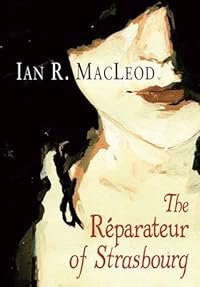
The Réparateur of Strasbourg by Ian R MacLeod

PS Publishing, 2013, 46 p

This is a novella but it packs in a lot in its 44 reasonably small print pages.

Ezekiel Morel is a réparateur, a restorer of paintings, mainly ecclesiastical, in Strasbourg in the late 18th century. On the odd occasion, to cover a space which has been effaced or on a piece of wood which has had to be replaced, he puts in creations of his own. Father Charbonneau recognises his talents and sends work his way. His reasonably comfortable existence leads him gratefully to a wife and a family.

One night in his garret a strange but beautiful woman calling herself Ariadne commissions him to paint her portrait – but as she would appear in twenty years’ time. He accepts and she sits for him but not on the night of a new Moon. He keeps the money but does not spend it.

Twenty years later she appears again and repeats her request. She is still beautiful but this will make the image harsh and repulsive. In the meantime Morel’s son Roland has displayed no tendency to hard work and taken himself off to Paris where revolution is in the air.

The disintegration of French society occasioned by that first overthrow of the existing French state, the shift in attitudes, the upending of the social order are well handled by MacLeod as is Morel’s character and that of his ungrateful, on the make son. Since this is a novella most of the other characters do not have enough space to be fleshed out but are sketched in economically enough. Ariadne is, in all senses, a shadowy figure – suitably enough as she is a creature of the night – but a necessary prop for the story to unfold.

Morel’s closeness to the Church becomes a danger as does his last painting of Ariadne, used to discredit him as the final confrontation with Roland – returned to Strasbourg as a big wheel in revolutionary circles – plays out. It all ends in blood, as revolutions tend to, the collateral damage to individual lives an adjunct to history.

The Réparateur of Strasbourg is atmospheric and evocative. You almost feel you are there in the dark streets of the city and amidst the paraphernalia of an artist’s life, reeling out to its crux.

Pedant’s corner:- “on earth” (Earth,) “higher that ever” (than,) “inside cathedral” (inside the cathedral.) “Her eyebrows her high and arched” (that ‘her’ ought to be a verb of some sort,) “on that that concise” (only one ‘that’ needed,) “the combination of shade with matched her skin” (which matched,) “the shape of those lips, the deep gaze of those well-like eyes, was always close” (surely ‘were always close’?) “didn’t hesitate strike him hard” (to strike him hard,) sat (x 2, seated, or, sitting,) “back to they way they were” (the way they were,) sunk (sank,) “eventually loose their value” (lose,) “were thee seemingly changes” (seeming changes,) “left to loose” (lose,) alter (many times, altar. There was one page where alter and altar, erm, alternated several times over,) “that deface the city” (rest of sentence was in past tense, ‘defaced’,) tumbrel (usually tumbril,) “visions of this family” (his family.) “But she sensed that she knew” (he sensed that she knew,) “like bad genie” (like a bad genie,) “all they found were two tiny indentations” (strictly ‘all’ is singular,) “was ruined mess” (was a ruined mess,) “a world were the light of reason” (where the light,) “what had once been chancel door” (the chancel door,) “‘the men we are expected to down to’” (to bow down to,) grabbled (grabbed,) “all that he held in his arms were a few scraps” (was a few scraps.)

Skyward Inn by Aliya Whiteley

Flipped Eye, 2021, 252 p.

Skyward Inn lies towards the edge of the Western Protectorate with a view over the Bristol Channel to Swansea from where the rocket ships rise from the Kissing Gate to make their way into space. The Kissing Gate was discovered fifty years before the events in the novel. The Coalition used it to travel to Qita, but the Western Protectorate disagreed with this action, and with the use of technology inside people’s heads, and so separated themselves from the rest of the world. The Coaliton’s take-over of Qita was complete but odd, as there was little resistance. “Why just move over and let us take it? No battle. No military. Not one voice raised – at least, not theirs.”

Jemima had in the past left her son, Fosse, to travel to Qita where an implant called Coach “bound us altogether in our heads” but now, in the inn, she dispenses Jarrowbrew, which her Qitan partner Isley, (with whom it is not possible for her to have a physical relationship,) prepares in the basement. Fosse has become something of a loner, who seeks solace among the buildings of an abandoned farm.

One day another Qitan, Won, turns up having travelled to Earth alone, but her suit needs a replacement device without which it will not restart. In an attempted bargain with a band of smugglers Jem and Isley lose the Jarrowbrew they had brought as payment for the device and nearly their lives. Meanwhile Fosse has been disturbed at the farm by three incomers who say they are taking it over. After an odd confrontation with the three where their flesh appears to meld together Fosse kills the man and flees to Swansea and takes the Kissing Gate to Qita.

So far, so SF, so good.

But things get stranger. Soil in the local graveyard begins to liquefy and the contagion spreads. Isley and Won get closer – literally. Fosse is taken on a cross-Qitan journey by a local during which he encounters its oddness. Through bodily contact with Isley, Jem is able to access Fosse’s mind but the Inn’s basement is soon filled with locals joining with Isley and Fosse (again literally) at which point SF ceases and we are in fantasy territory. The true nature of Jarrowbrew is revealed. It seems that Qita may not have been conquered after all but is taking revenge of sorts.

As a wordsmith and portrayer of character Whiteley is absolutely fine and presumably the way she takes her story is where she wanted it to go. But the journey, a little like Fosse’s on Qita, takes on an aspect which strays too far from the entirely believable. Sf/fantasy crossovers have a long history in the linked genre (A Voyage to Arcturus springs to mind) but in Skyward Inn I thought the two did not gel at all comfortably.

Pedant’s corner:- “neither of us move” (neither of us moves,) “they were not been welcoming to him” (‘being welcoming to him’ makes more sense,) Klaus’ (x2, Klaus’s.) “at he found he wanted the axe again” (‘and he found he wanted the axe again,) “their shoulder hunched” (shoulders, surely?) a missing full stop, Fosse (x 2, when Isley was meant.) “Every customer forces their laughs and drinks too fast and none of them want to say why” (wants,) “the questions he had been asked about it by his workmates was one of the reasons why he’d kept to himself” (questions is plural so needs were as its verb [though I can see why it would sit awkwardly with ‘one of the reasons’.) “He would not be charge after all.” (in charge?) “when Fosse looked up from the task from negotiating path” (task of negotiating a path.) “‘Let get on it.’” (‘Let’s get on it’.) “He glances at my hands at the sleeve pulled low” (sleeves,) “mowed grass” (mown grass,) “facing him with it arms raised” (its arms,) “to bomb the entire of the Protectorate” (yes it was in dialogue but ‘entire’ should still have been ‘entirety’,) miniscule (minuscule,) “and her saw her hand” (and he saw her hand.)

The Magazine of Fantasy and Science Fiction, November 1962

Edited by Avram Davidson, British Edition, Atlas Publishing and Distribution by arrangement with Mercury Press, 112 p.

Note: the cover painting shown right is the one on my copy but the contents differ from those listed on the image which was for the US edition for April 1962. The British editions obviously did not match the US ones.


In those days the magazine had no Editorial column nor was the text of its stories – except the title page for Uncle Arly here – laid out in two columns as it would be in later years.

Isaac Asimov’s SCIENCE column was going strong. Here in Hot Stuffa he considers the highest* temperature possible in the universe (the interior of a star about to go supernova.)

Saturn Rising by Arthur C Clarke.1 A veteran of the first two trips to Saturn on a lecture tour is buttonholed by the hotel owner, an enthusiast for that planet, eager for commercial opportunity.

Brown Robert by Terry Carr2 is both SF and a horror story. Arthur Leacock assists young Robert Ernsohn, brown Robert, to make the first trip through time. This is one of the few SF stories to deal with the fact that time travel must also involve space travel.

My Dear Emily by Joanna Russ is a vampire story set in 1880s San Francisco. As well as the Emily of the title another of its characters is named Charlotte; two names obviously chosen to invoke thoughts of the Brontë sisters. Yet the overall effect is far from that template.

The Man Without a Planet by Kate Wilhelm.3 The titular man carried on with a space voyage despite that meaning the death of his companions. The sympathies of the story’s narrator are somewhat like the protagonist of Robert Silverberg’s To See the Invisible Man.

Darfgarth by Vance Aandahl. The titular character is a wandering minstrel whose mandolin has a magical effect on the locals he stops to serenade. Until he goes too far.

Stanley Toothbrush by Carl Brandon.4 One morning, while shaving, viewpoint character Herbert thinks the word ‘shelf’ is ridiculous and all his shelves disappear. Later his girtlfriend teases him about a (non-existent) new boyfriend and he turns up on her doorstep. The have great problems with him – till she imagines him away.

In Uncle Arly by Ron Goulart5 the uncle of an ex-girlfriend has begun to haunt Tim Barnum’s television set, every Tuesday evening for half an hour. He also pops up on the radio.

Subcommittee by Zenna Henderson.6 Talks to end the war between humans and the alien Linjeni are going nowhere. Serena’s husband Thorn is on the talks committee. Their son Splinter finds a way through the fence between the two communities and makes friends with Doovie, a Linjeni child. The rest of the story more or less writes itself but 60 years on it is striking how the cultural assumptions of the time were entrenched even in SF: the Linjeni females in this story are as bound to their families as human women were in those days. Of course it may not have been possible to get anything else past a male editor.

*as known then.

Pedant’s corner:- awave length (now is one word, wavelength.) Centigrade (that unit of temperature is now designated Celsius,) “56 hydrogen nuclei … are converted into 1 helium nuclei” (the nuclei is plural, so the ‘1’ is wrong. Context and the subsequent text suggests ‘14 helium nuclei’.) Later we have 19 helium nuclei where again 14 makes more sense.
1Ingalls’ (Ingalls’s,) “It took me awhile” (a while.) 2Mr Lewis’ assistant (x 2, Lewis’s.) 3zombi-like (zombie-like.) 4focussing (focusing,) “‘An what do you mean’” (And,) a miising full stop at the end of a sentence, a double quote mark at the beginning of a piece of direct speech when elsewhere there are only single ones. 5 “and pointing at the fat man on the set who was singing again. ‘And who’s this guy?’” (is missing a ‘said’ before ‘And who’s this guy?’) “before go to the bank” (before I go to the bank.) “Jean left them” (elsewhere she is Jeanne.) 6 “and felt of the knitting” (and felt the knitting.)

The Bloody Chamber by Angela Carter

The Bloody Chamber and other stories, King Penguin, 1983, 124 p.

The author had previously translated the fairy stories of Charles Perrault and clearly knew the byways of her subject. In this collection she gives us ten reworkings of fairy tales bringing to light the usually buried sexual admonitions embedded within them. All are written with an extreme literary sensibility, each verb is carefully chosen, each simile precise. This collection presents fantasy as high art.

The Bloody Chamber begins with the fretful wedding night train journey to his tidal island castle of a seventeen-year old ingenue just married to a much older man who has gone through three wives already, with the pair in adjoining compartments. Once home he conveys her to a mirror-lined bedchamber filled with lilies, that staining flower, and undresses her like a sacrifice. But the deed is not to be done just yet. “Anticipation is the greater part of pleasure, my little love.” Later, she quotes her husband’s favourite poet, “‘There is a striking resemblance between the act of love and the ministrations of a torturer.’” The next morning before leaving on a business trip he entrusts her with his keys – including one to a room she must not enter. This story implies that it is not just marriage but sex itself that is a bloody chamber.

The Courtship of Mr Lyon is a reworking of Beauty and the Beast as a kind of Sleeping Beauty in reverse.

The Tiger’s Bride also reimagines Beauty and the Beast. Beauty is lost to the Beast by her father in a game of cards and at first refuses the Beast’s single request of her, but in the end she strikes a different bargain.

Puss-in-Boots is narrated by the eponymous cat, all-seeing, all-knowing, conniving to ensure his impecunious and lustful master secures the love of his life, the beautiful, young, but closely cloistered, wife of an impotent grasper, fleetingly glimpsed one day as she goes to Mass. In its telling it has a central European quality to it, as befits the darker folk tale.

The Erl-King by contrast has an English feel with its evocations of woodland flora and fauna although it does contain an embedded reference to Little Red Riding Hood. It reads as a warning against the immolating snares of sexual attraction – until its dénouement.

The Snow Child is barely a page long. Out riding with his wife a Count meets the girl of his dreams, skin white as snow, mouth red as blood, hair black as ravens’ feathers. Responding to the Countess’s requests made in order to be rid of her, the girl picks a rose, is pricked and dies. Pricked again by the Count, she melts away, leaving only a bloodstain and the rose, to prick again.

The Lady of the House of Love is Nosferatu’s daughter, the last in a long line of vampires, dressed, like Miss Havisham, in a bridal gown, laying out her Tarot cards in her decaying château in a deserted Transylvanian village. An innocent young Englishman travelling on a bicycle causes her usual ritual to misfire. Early allusions to The Sleeping Beauty are deliberately misleading.

The Werewolf begins, “It is a northern country; they have cold weather, they have cold hearts.” In climes like these the supernatural is taken for granted – and easily found in untimely ripened cheeses, a friendly cat, or the marks on an old woman’s skin. The tale that follows can be read as one of a granddaughter discovering her grandmother has been a werewolf all her life or else that Little Red Riding Hood was a conniving little minx scheming to come into her inheritance much earlier than she should.

The more blatant reworking of Little Red Riding Hood, the award winning The Company of Wolves, contains the information, “Before he can become a wolf, the lycanthrope strips stark naked. If you spy a naked man among the pines, you must run as if the Devil were after you.” That second sentence is good advice at any time. As to the wolf, “Carnivore incarnate, only immaculate flesh appeases him.”

Wolf-Alice was abandoned by her mother in the woods as a new-born and suckled by wolves. When she is finally discovered by humans she is feral and, the nuns who first looked after her despairing of the task of civilising her, she is handed over to the care of the local Duke, himself a nocturnal cannibal who scavenges the local graveyards.

Pedant’s corner:- sunk (sank,) Missus’ (x 2, Missus’s, annoyingly rendered as such in a later instance, so no excuse,) rhuematicks (may have been a deliberate ‘olde worlde’ spelling but; rheumatics,) “none of her features exhibit any of those touching imperfections” (none .. exhibits,) a missing full stop. “Give me two spheres and a straight line and I will show you how far I can take them.” (This was said of a bicycle. Very rarely do these have two spheres. Two circles at a pinch, but more likely two thin cylinders as the wheels do have a measurable cross-section,) “gestured him to begone” (to be gone,) “night and the forest has come into the kitchen” (is either missing a comma after ‘night’ or else requires the plural verb form ‘have’.) “This dazzling, she combed out her hair with her fingers” (needs some sort of expansion.)

Binti: The Night Masquerade by Nnedi Okorafor

Tor.com, 2018, 228 p.

When a first person narrator (here the titular Binti) dies halfway through the text it presents something of a problem for the author. How do you carry on? How can the story not finish then and there? Okorafor’s solution here is to switch to third person – at least till the end of the chapter, when Binti comes alive again, (with a bit of authorial hand-waving. Microbes, she is told by her alien companion Okwu, “blended with your genes and repaired you,” in a breathing chamber in a young spaceship called New Fish.) I would submit that this aspect of the book (though there are others too) makes it more of a Fantasy than Science Fiction. Or is that just me being purist? Still, it makes for an interesting read.

Once more (see here for my previous experience of this scenario) her ever dwindling supply of the skin-covering paste called otjize is a constant source of concern for Binti, without it she feels naked and again she makes extensive use of her edan. Her Meduse okuoko (blue tentacles on her head instead of hair) mark her out, though.

There is still a war going on between humans called the Khoush and the alien Meduse. Binti has moved on from Oomza Uni, the first of her Himba people to go there, the first to leave Earth. Now part Meduse, she has an affinity with and ability to use mathematics, calling up currents to “tree”. When stressed she repeats the word “five” to calm herself. She also has a connection to the Enyi Zinariya, twenty-foot-tall slender beings who seemed to be made of molten gold. Accompanied by Mwinyi, a zinariya, she is going back to her homeland to try to broker a peace between the Khoush and the Meduse. Her family produced astrolabes, devices which carry the full record of your entire life. Hers and her father’s were the best in the business. In times of crisis Himba turn inward. Her family did so (into the Root where they lived) when their village was threatened by the Khoush and their Root was burned so Binti thinks they are all dead.

In the run up to the peace meeting she sees once again The Night Masquerade, a spirit previously only appearing to males (but which we later find is not a spirit,) thereby confirming her unique status. During the negotiations something goes wrong (a minion on one side did not like the prospect and opened fire) and Binti gets shot. Her body is taken on board the New Fish and taken to the rings of Saturn about which she had had a premonition. She reflects, “It was so unlike Earth, where wars were fought over and because of differences and most couldn’t relate to anyone unless they were similar.”

It all makes sense in context and Binti is an engaging companion. It is also still refreshing to read SF from beyond the familiar Anglophile template.

Pedant’s corner:- “Time interval later” ~(or equivalent) count, 8. Otherwise; zinairya (elsewhere zinariya,) spit (spat,) sunk (several times; sank,) shrunk (shrank.) “Astrolabes were the only object that… (objects,) shined (several times; shone.) “None around me were beathing” (was breathing,) “the feel of the numbers … were such a relief” (the feel … was such a relief.) “I didn’t want to go with.” (I didn’t want to go with him,) accidently (accidentally,) a missing quote mark at the end of a piece of direct speech, “their skin and hair was nearly free of otjize” (were nearly free,) “presented the dress she’s sewn for” (the rest of the sentence was in past tense, ‘she’d sewn’,) “the Roots defenses” (Root’s, [defences],) “off of” (just ‘off’,) “as Mwinyi and Okwu moved went New Fish’s walkway” (I have no idea why that ‘went’ is there. The ‘moved’ is a bit iffy too,) “the far side of the doom” (dome,) two full stops at the end of one sentence.

The Rental Heart and other fairy tales by Kirsty Logan

Salt, 2014, 153 p.

Within this collection are twenty stories of varying length but none could be said to outstay their welcome. Logan’s inspiration here is clearly derived from fairy tales; but only one of them, the last, begins with “Once upon a time.” Apart from the usual admonitory accounts, some are celebratory and some have tints of magic realism. In general Logan’s writing here is more satisfactory and tighter than in her two novels The Gracekeepers and The Gloaming. Then again it ought to be. In a short story no word should be wasted.

The Rental Heart revolves around the renting of clockwork hearts easily returned to the rental place when they get broken, as hearts always do.
Underskirts has no fewer than ten narrators in its eleven pages each adding their own perspective to the tale of the local Lady who has a taste for young girls from the neighbourhood.
In A Skulk of Saints Lauren works as a medic “peering at the insides of people” in a hospital under the gaze of representations of saints, while in her personal life negotiating her relationship with heavily pregnant partner Hope.
The Last 3,600 Seconds is the stream of consciousness of a woman whose memories crowd in on her during the last ever 3,600 seconds of the universe.
The Broken West is the story of two unusually close brothers searching for their father through a series of dead-beat US towns.
Bibliophagy features a man struggling to conceal from his family his addiction to eating words, words which, like an alcoholic with booze, he hides in various locations.
Coin-Operated Boys are clockwork male escorts hired out from a shop called A Man for All Seasons. Set in Paris, the story has a fin-de-siècle feel.
Girl #18 is the latest to offer sympathy after our narrator’s sister has died.
In Una and Coll are not Friends the pair are put in a room separate from their peers to sit a maths test. Una is distracted by Coll’s tail. She herself has antlers.
In a water-drowned world The Gracekeeper tends to her charges, the Graces of the title, kept in cages. Logan expanded this tale into her first novel.
Sleeping Beauty is a taut tale of sexual assault; told backwards.
In Witch a young girl goes into the woods to spook her friend and meets BabaYaga.
Barely over a page long, All the Better to Eat You With is a kind of Little Red Riding Hood in reverse, a warning to look out for yourself.
The Man from the Circus rather literalises the metaphor of taking a leap into the unknown. A girl allows herself to be picked up by a man from the circus, a trapeze artist.
Feeding is set in the Australian outback where a couple have set up home, soon after they have lost an expected child. The woman spends her time obsessively in the garden but in the drought conditions nothing will grow.
Momma Grows a Diamond is written as one fragment each from the life of a girl at age ten, eleven, twelve and thirteen, as she becomes a woman. Her mother, who provides services for wounded soldiers, tries to turn her into a diamond so that she will not be broken by men.
Less than a page long, The Light Eater has a titular character who begins to consume light bulbs as a means to guide a lost lover back home.
Matryoshka riffs on Cinderella. Its narrator is the prince’s sister, who loves her servant Matryoshka, the one who sees to her whims day and night and sews her slippers for the great ball.
In Origami a woman whose partner works on the rigs assuages her loneliness by making a man out of folded paper.
Tiger Palace explicitly plays with the conventions of story telling as a (female) traveller works her way through the “impenetrable” forest to the Empress’s palace and finds there no crocodiles disguised as stepping stones for crossing the moat and no tigers inside the palace. Both characters refuse their allotted roles.

Pedant’s corner:- The title page reads “The Rental Heart and other stories” (The book cover has ‘The Rental Heart and other fairy tales’.) More than a few Usian usages. “Before the Resting party arrive” (arrives,) fit (fitted.)

Glister by John Burnside

Jonathan Cape, 2008, 263 p.

Begin with a warning. In a prefatory chapter, someone, who has passed through the Glister, is remembering the story of his life, again. In that story his name is Leonard and he remembers John the librarian saying to him, “When it comes to reliability, it’s not the narrator we should be worried about, it’s the author,” but Leonard himself tells us it’s not the author either; it’s the story that is unreliable.

Be that as it may, it is Leonard’s recollections which take up the bulk of the book. He grew up in a coastal town somewhat cut off from the rest of the world – outside influences do intrude, there is a Spar shop and references to television (curiously to Dr Kildare and Richard Chamberlain, which seems a bit out of time with the rest of the narrative) – a town once home to a chemical plant, whose contamination blights the lives of those who worked there, and perhaps even those who stray or rummage onto its former grounds or into the so-called poisoned wood, but people stay and put up with it all. (Not Leonard’s mum, though, who, unable to cope with her situation, pissed off when his father took ill leaving Leonard to take care of his dad.) But the town has a bigger problem. There have been disappearances of children, teenage boys, over the years, unexplained disappearances which cast a pall over everyday life.

Leonard lived in the Innertown, the most deprived and blighted area, distinguished from the Outertown where the big houses are. The Innertown has the same claustrophobic feel as the village in Burnside’s earlier novel The Devil’s Footprints and the hellish residue of the plant bears echoes of the Corby he described in Living Nowhere. Leonard’s story is given in the first person but other sections are written in the third and describe incidents to which he was not a witness. (These may still be him writing from an omniscient viewpoint, however; remember the unreliability of story.) They include Morrison, the local policeman, who seems to have got his position without in any way training for it, the local big man Bryan Smith (who levered Morrison into his job so as to have a hold over him,) Morrison’s alcoholic wife, Alice, recluse Andrew Rivers, and Leonard’s girlfriend, the precociously sexually adventurous Elspeth.

Morrison is conflicted by his knowledge of finding the dead body of the first boy to disappear, his enthralment to Bryan Smith (who got his henchman Jenner to deal with it) and his duty as a policeman. Towards the end he reflects that “the soul is wet and dark, a creature that takes up residence in the human body and feeds on it …. possessed of an unhuman joy that cares nothing for its host, but lives, as it must live, in perpetual, disfigured longing.” Alice senses her husband’s confusion but is mired in her own difficulties. Rivers has kept all the reminders of his dead father and is alert to the possibilities his behaviour has of being misunderstood. Elspeth is a spark of life but seems to be perpetually randy. The mysterious outsider Leonard calls the Moth Man, supposedly conducting a survey of the flying insect population of the contaminated area but also taking the opportunity to explore the nooks and crannies of the disused chemical plant and possibly with a darker involvement in events, with a hint of the supernatural, flits in and out of Leonard’s story while occasionally providing him with brews of a strange tea. Of his non-exclusive, on both sides, relationship with Elspeth, Leonard muses that romance is for older people, not adolescents.

Despite the realistic depiction of Leonard’s encounters with John, Elspeth, the Moth Man and the members of the small teenage gang led by Elspeth’s ex-boyfriend Jimmy van Doren, there is an overhanging feel of Science Fiction or fantasy to proceedings. This prefigures the ending, the manifestation of the Glister, which, while possibly explaining the disappearances does not do so fully but is nonetheless satisfactory.

At one point Leonard tells us of “the sense I have of a story all disjointed and out of sequence.” The novel is not like this at all. Burnside writes supremely well. I wasn’t overly satisfied by the ending even though it is in accord with what preceded it, but in all other respects Glister is gold.

Pedant’s corner:- “maybe ony a few minutes” (maybe only a few,) cargos (this plural used to be spelled ‘cargoes’,) unimagin-able (not at a line break, unimaginable,) ditto “separ-ate” (separate.) “It has to with Leonard” (It has to do with Leonard.) None of the others see me go (sees me go,), Rivers’ (Rivers’s,) “when she come across” (comes across,) a missing start quotation mark.

free hit counter script