The Réparateur of Strasbourg by Ian R MacLeod
Posted in Fantasy, Reading Reviewed at 12:00 on 9 March 2022
PS Publishing, 2013, 46 p
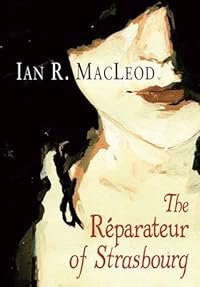
This is a novella but it packs in a lot in its 44 reasonably small print pages.
Ezekiel Morel is a réparateur, a restorer of paintings, mainly ecclesiastical, in Strasbourg in the late 18th century. On the odd occasion, to cover a space which has been effaced or on a piece of wood which has had to be replaced, he puts in creations of his own. Father Charbonneau recognises his talents and sends work his way. His reasonably comfortable existence leads him gratefully to a wife and a family.
One night in his garret a strange but beautiful woman calling herself Ariadne commissions him to paint her portrait – but as she would appear in twenty years’ time. He accepts and she sits for him but not on the night of a new Moon. He keeps the money but does not spend it.
Twenty years later she appears again and repeats her request. She is still beautiful but this will make the image harsh and repulsive. In the meantime Morel’s son Roland has displayed no tendency to hard work and taken himself off to Paris where revolution is in the air.
The disintegration of French society occasioned by that first overthrow of the existing French state, the shift in attitudes, the upending of the social order are well handled by MacLeod as is Morel’s character and that of his ungrateful, on the make son. Since this is a novella most of the other characters do not have enough space to be fleshed out but are sketched in economically enough. Ariadne is, in all senses, a shadowy figure – suitably enough as she is a creature of the night – but a necessary prop for the story to unfold.
Morel’s closeness to the Church becomes a danger as does his last painting of Ariadne, used to discredit him as the final confrontation with Roland – returned to Strasbourg as a big wheel in revolutionary circles – plays out. It all ends in blood, as revolutions tend to, the collateral damage to individual lives an adjunct to history.
The Réparateur of Strasbourg is atmospheric and evocative. You almost feel you are there in the dark streets of the city and amidst the paraphernalia of an artist’s life, reeling out to its crux.
Pedant’s corner:- “on earth” (Earth,) “higher that ever” (than,) “inside cathedral” (inside the cathedral.) “Her eyebrows her high and arched” (that ‘her’ ought to be a verb of some sort,) “on that that concise” (only one ‘that’ needed,) “the combination of shade with matched her skin” (which matched,) “the shape of those lips, the deep gaze of those well-like eyes, was always close” (surely ‘were always close’?) “didn’t hesitate strike him hard” (to strike him hard,) sat (x 2, seated, or, sitting,) “back to they way they were” (the way they were,) sunk (sank,) “eventually loose their value” (lose,) “were thee seemingly changes” (seeming changes,) “left to loose” (lose,) alter (many times, altar. There was one page where alter and altar, erm, alternated several times over,) “that deface the city” (rest of sentence was in past tense, ‘defaced’,) tumbrel (usually tumbril,) “visions of this family” (his family.) “But she sensed that she knew” (he sensed that she knew,) “like bad genie” (like a bad genie,) “all they found were two tiny indentations” (strictly ‘all’ is singular,) “was ruined mess” (was a ruined mess,) “a world were the light of reason” (where the light,) “what had once been chancel door” (the chancel door,) “‘the men we are expected to down to’” (to bow down to,) grabbled (grabbed,) “all that he held in his arms were a few scraps” (was a few scraps.)
