Archives » F Scott Fitzgerald

David Golder by Irène Némirovsky

Vintage, 2007, 159 p plus xii p Introduction. Translated from the French (Éditions Bernard Grasset, 1929) by Sandra Smith.

David Golder cover

This was Némirovsky’s second novel and in it she was to some extent finding her feet but it still exhibits some of the concerns and influences which were to dominate her work.

David Golder is a financier born into poverty in the Russian Empire but who now lives in France. He has a wife, Gloria, who, despite him lifting her out of the same poverty as his, wants his money but nothing else, indeed is unsatisfied with all he has provided for her. They have an indulged flibbertigibbet of a daughter, Joyce, who also only sees Golder as a source of funds. The crisis of the book begins when his business partner Simon Marcus – whom Golder is tired of bailing out – commits suicide after Golder refuses to help him out of financial trouble again. There was something about this that somehow brought to mind the beginning of Dickens’s A Christmas Carol. Némirovsky’s intent is very different to that of Dickens, though.

There are some similarities to the work of F Scott Fitzgerald as the book is set in a milieu which presents a far from attractive face. Némirovsky demonstrates well the unthinking lack of proportion which comes with affluence apparently easily gained. Both Gloria and Joyce seem to think Golder has not had to make any effort to garner the largesse they squander so profligately on their gold-digging boyfriends and vacuous pursuits.

For against appearances Golder’s financial times are hard. When he suffers a heart attack his wife conspires with the doctor who attends to conceal it from him so as he will not stop work and the money will continue to flow. His crash comes anyway and wife and daughter both leave him.

In one sense it is not surprising that Némirovsky makes Golder Jewish. It was her inheritance after all and Golder’s family bears some resemblance to hers – though we can assume not the vacuous daughter. In another author’s hands it might have tended only to reinforce the stereotype that many French held of Jews. At the time of writing the Dreyfus Affair, though partially obscured by the legacy of the Great War, still hung over Némirovsky’s adopted country. But Golder has a weak spot, Joyce, whom he continues to indulge even at the risk of his life. We find his driving force towards the end of the book, the crushing poverty and anti-Semitism he had endured in his childhood on the shores of the Black Sea.

David Golder isn’t Némirovsky at her peak but it is still worth reading. Once again it is best to leave the introduction (by Patrick Markham) to the end as it discusses features of the plot and of Golder’s character.

Pedant’s corner:- predelictions (the word is spelled predilections,) “now there’s one enemy less” (“one enemy fewer” sounds more natural to me,) “his entire body felt wracked” (racked, it felt crushed, not wrecked,) “‘Once he’d paid for something, he watches over it,’” (either, “once he’s paid for something”, or else, “he’d watch over it”,) “a newspaper that was laying on the table,” (how can a newspaper lay anything? It was lying on the table,) “in the Ukraine” (in dialogue, but the speaker came from there so most likely would have said “in Ukraine.”)

A Man Lies Dreaming by Lavie Tidhar

Hodder, 2014, 268 p, plus 5 p Historical Notes, 9 p Endnotes and 1p Acknowledgements
 A Man Lies Dreaming cover

Before we plunge into the first chapter there is a framing device, “In another time and place, a man lies dreaming.” Then we enter the diary, from November 1939, of a private investigator who calls himself Wolf, a refugee to London from Germany after an event he describes as the Fall, before a passage in the third person relating ongoing events not described in Wolf’s diary. It very soon is apparent Wolf is a Nazi. “I don’t work for Jews,” he tells the woman who wishes to be his client. Moreover he once had an affair with his neice, Geli (who killed herself with his gun,) and then took up with “sweet, good-natured” Eva. This, in other words is Adolf Hitler, fallen on hard times. (That name though, does not appear on the page till very late in the book.) The woman is Isabella Rubenstein who wants to know the whereabouts of her sister Judith, supposedly smuggled out of a Germany led by the Communist Ernst Thälmann after the 1933 elections, but since disappeared. Altered history territory, then.

Except, it isn’t. The chapter ends with the framing device and the dreaming man is named as Shomer. The book continues with the noir thriller elements alternating Wolf’s diary entries with third person elements and every so often the framing device being reasserted. In this we learn Shomer was a writer of shund (a kind of pulp fiction) and the place he is dreaming in is Auschwitz, the real Auschwitz. So it appears it is Shomer who is telling Wolf’s tale, an exquisite revenge presumably since he inflicts pain on Wolf through the various beatings he receives throughout the thriller. Shomer also hallucinates a companion, Yenkl, partly, it seems, to give him some comfort.

It can also be considered a kind of revenge by Tidhar, who is an Israeli, and whose maternal grandparents were both Auschwitz survivors. (The rest of their families were not so fortunate.) This is the sort of subject matter which a non-Jew would have to treat with circumspection, if not avoid altogether. Tidhar has more licence in that regard.

Hitler has been treated before in SF of course, but not usually so directly – except perhaps for Fritz Leiber’s short story Catch That Zeppelin! and Norman Spinrad’s The Iron Dream part of which purports to be a novel written by a Hitler who emigrated to the US in 1919. The crazed nature of that narrative is not quite emulated here. If anything Wolf is relatively restrained in his ravings. That may be due to the necessity for a viewpoint character to be, at least, coherent.

An altered history would not be worthy of the name did we not meet the famous within and here – as well as Hitler – we duly encounter Oswald Mosley – soon to be a British Union of Fascists Prime Minister in Wolf’s world – his wife, Diana (Mitford,) and her sister Unity, whom Wolf knows as Valkyrie and has the hots for him. Various other Nazis pepper the plot, Rudolf Hess, Josef Kramer, Ilse Koch, Joseph and Magda Goebbels. Literary Brits pop up including Ian Fleming, Tolkien and Evelyn Waugh. Tidhar’s tendency to gild the lily was exemplified here at a publisher’s party (the publisher concerned had, of course, turned down My Struggle,) when Wolf re-encounters Leni Riefenstahl, now working in the US, and she relates to him a plot – to be written by F Scott Fitzgerald as a sequel to The Great Gatsby – for a projected film starring Humphrey Bogart as Gatsby, owner of a bar in North Africa when Daisy Buchanan walks back into his life. The film is to be called Tangier, though, not Casablanca.

There is, too, a Constable Keech. I wondered mildly if Tidhar was aware of what this word signifies for Scots. For myself, I could not avoid the inference.

A Wilfred Owen reference occurs in Wolf’s Great War reminiscences of being blinded and I must confess I liked the conflation, “It is a truth universally acknowledged, that once a detective acquires two concurrent cases, the two must be in some way related,” but I’m not sure about the odd scene where Wolf dreams he is in what is obviously, to us, Auschwitz. Then again, he tells the Chief Inspector who had interrogated him about the murders of prostitutes outside his office, “‘You Jews spend far too much time in your own imagination.’”

This could have been powerful stuff but there is something unbalanced about it all. The scenes in Auschwitz are compelling (but did they still require Sonderkommando to dig graves after the ovens came into operation?) and moving. However, they occupy far too few pages. It is Wolf’s tale which dominates. And that is too trifling to carry the weight thrust upon it by the overall concept.

Pedant’s corner:- USianisms abound. For a story mainly set in late 1930s London that is an added barrier to suspension of disbelief. We had purse for handbag, down-at-the-heels for down at heel, nightstand for bedside table, inside of for inside, ruckus for racket, nightstick – in the 1930s British policemen had truncheons, whiskey (whisky,) airplanes (aeroplanes,) bums used by an Englishwoman as a term for a ne’erdowell (not a chance,) beat-up (beaten-up,) the car’s hood (the car’s bonnet.)

Otherwise there was maw (it’s a stomach not a mouth,) “‘What are you looking at,’ he said’” (ought to have a question mark after at,) Mosleys’s (x2, the correct Mosleys’ was used once,) “the past was …. threatening to catch up to him” (to catch up with him,) tenements (does London have tenements?) sunk (sank,) “none … were” (none was,) “one table was covered in vegetarian dishes from an Indian-style curry to Italian lasagne and British shepherd’s pie” (lasagne and shepherd’s pie would never be vegetarian in the 1930s,) “and sat two tables away from Goodman. He tried to listen to their conversation” (his conversation surely?) ears perked (ears pricked is more usual.) “Her bosoms were immense” (no-one has more than one bosom.) “They put me in a cell again.” (They’d,) “‘Are you,’ I said,” (question mark, not comma, after “you”, “and he gives him with a cursory glance and his diagnosis,” (and he gives him with a cursory glance his diagnosis,) “before immigration out of Germany became impossible” (you cannot immigrate out of a country,) Goebbels misspelled once as Goebbles, “the back of my hands” (technically that would be backs, then,) detached of space and time (detached from,) a red phone box (what other colour would it be? He wasn’t in Hull,) fireworks (on 22nd November? (They were apparently to celebrate the General Election. Not in Britain.) Mosley declares victory on the stroke of midnight of election day. The votes would not all have been counted by then; probably not till the next day back then. He uses the phrase nineteen hundred hours, a military one, not one a politician would employ when addressing a crowd. His first act as the new Prime Minister is to declare war – because Germany has invaded Poland – then martial law (I doubt that last could have been done so readily.) Imposter (impostor.) Wolf describes Charlie Chaplin as “that vile man,” (his lampooning of Hitler did not come till 1940 in our world and would perhaps not have been necessary in Wolf’s.) “The sound the drawer had made … sounded very loud to him” (“the sound sounded” is inelegant, use a different noun; rattle? scrape? noise?) the limelight (of a spotlight, which could be moved? Limelights were fixed in position,) “he always had much respect for the German soldiers,” (lots of respect,) a row work (a row works,) exodii (used in the context of people making an exodus. Is this an invention by Tidhar?)

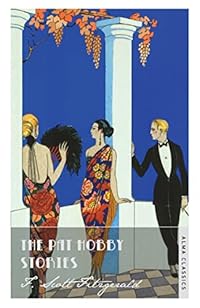
The Pat Hobby Stories by F Scott Fitzgerald

Alma Classics, 2014, 192 p, including x p biography of Fitzgerald and v p bibliography and summary of his work.

 The Pat Hobby Stories cover

I was drawn to this by the Art Deco feel of its cover but that turned out a bit misleading as there is nothing in the book dealing with the Jazz Age. All the stories are set in 1939/40.

Pat Hobby is a more or less washed-up writer, whose last screen credits were in the silent era over a decade ago, now hovering around the fringes of Hollywood studios trying to hustle a job, any job, to restore his fortunes. As such it reflects Fitzgerald’s own later life, glory days long gone, fantastic pay days well in the past. The 17 stories tend to follow the same pattern with Hobby being frustrated in his endeavours by the vicissitudes of his ill-thought through scams and badly timed interventions, relying on crumbs dispensed through the pity of others or their willingness to use him for their own ends. Since they were written for magazine publication (in Esquire) there tends to be a lot of repetition of information from one story to the next (Hobby’s red-rimmed eyes – due to his alcohol consumption – a particular recurrence) which is of course more noticeable when they are read in quick succession.

Entertaining enough but not really substantial.

Pedant’s corner:- with a sinky feeling (sinking is more usual,) sat reading (seated; or sitting,) with no avail (to no avail,) trucking shots (tracking shots?) “a small but alert band of …. were” (a small band was,) “You damn right I can talk” (You’re?) “the gang who were” (the gang which was,) “in no slightest danger” (in not the slightest?) “a battery of cameras were getting into position” (a battery was,) “there were a number of ladies” (there was a number,) Athaletic Superintendent (athletic? – I suppose though this may have been the name of a sports team or organisation.)

Save Me the Waltz by Zelda Fitzgerald

The idea was the good lady and I would read both this book and Tender is the Night (written of course by Zelda’s husband F Scott) in order to compare and contrast.

Save me the Waltz cover

There are similarities between the two novels, both feed on the relationship between the spouses and their lives, both have dialogue that is full of non-sequiturs, both can be irritating.

Save Me the Waltz is perhaps more explicitly autobiographical, the protagonist Alabama Beggs is the youngest of three sisters and marries David Knight during the Great War. Subsequently the Knights have a daughter.

The first part of the novel describes Alabama’s young life before marriage and is much the best part of the book. The main narrative takes place after the war when the family is living in France. About halfway through the novel Alabama decides to take up ballet dancing – despite the fact that she is really too old. After hard work she eventually makes a fist of it and is offered a part in a ballet in Naples. This is only after we are treated to interminable, tedious descriptions of her lessons with Madame. This is of course detrimental to the marriage. I still found Save me the Waltz more readable than Tender is the Night, though.

Shrunk count 1, plus a “use to.”

Tender is the Night by F Scott Fitzgerald

Penguin, 2000, 333 p + xlvi p of introduction and select bibliography, 10 p of Notes on the Text and 9 p of Variants in different editions. First published 1934.

Tender is the Night cover

Maybe it was due to my impending house removal but I just couldn’t get into this one at all. Alternatively it may be because initially I found the characters flighty and tedious, the dialogue curious. The novel is structured into three books and that too was part of the problem. Book 1 is set on the French Riviera where Dick Diver and his wealthy wife Nicole play host to a succession of vapid individuals. Their idyll is interrupted when nascent film star Rosemary Hoyt turns up at the resort with her mother and Dick is taken with her. In this section a duel between minor characters occurs – for no good reason I could see – and a body is found in a hotel bedroom with no apparent consequences.

However, things picked up in Book II where the narration flashed back to the first meeting of Dick and Nicole when he was a psychologist and she a patient. It immediately occurred to me that this would have been a better place to start the book as the situation and the characters are more interesting. In the notes at the end I discovered this was a revision that Fitzgerald had intended to make for future editions before his death and from 1948 till this Penguin edition the novel did appear with that altered structure.

By Book III the Divers’ marriage disintegrates as Dick takes to drink and Nicole becomes more and more independent.

There were a few bon mots. “A man is vulnerable only in his pride, but delicate as Humpty Dumpty once that is meddled with.” “Doctors, chauffeurs, and Protestant clergymen could never smell of liquor.” “Women marry all their husband’s talents and naturally afterwards are not so impressed with them as they keep up the pretence of being.”

The book’s provenance in the 1920s was apparent in the use of the words negro and nigger and there was a reference to a “gone coon” whatever that was. (A dead duck according to Wikipedia.)

At one point another character says to Dick, “But remember what George the Third said, that if Grant was drunk he wished he would bite the other generals.” Wouldn’t it have been Lincoln who said that? Fitzgerald has also given a band with a Scottish pianist the name The Ragtime College Jazzes of Edinboro. I think not. The repetition in the sentence, “Their fortunes had something to do with a bank in Milan that had something to do with the Warren fortunes,” struck me as clumsy. There was also filagree for filigree.

I did not read the (46 page!) introduction till after the novel and am glad of that as it gave away much of the novel’s driving force. It was also very Marxist in its interpretation, stating that the book was actually about a shift in economic structure from accumulation to reproduction.

Wiki says the Modern Library ranked Tender is the Night as 28th in its hundred best English language novels of the early twentieth century. Evidently there’s something in there but I’m afraid it passed me by.

free hit counter script