Archives » Donna Scott

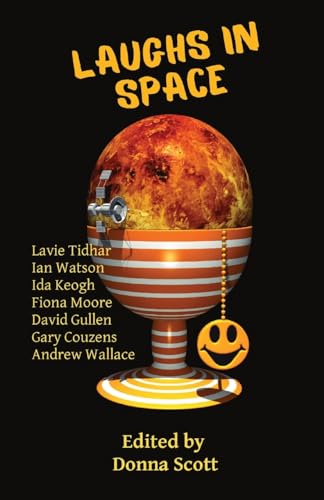
Laughs in Space. Edited by Donna Scott 

The Slab, 2024, 354 p. (No price given.) Reviewed for ParSec 12.

Notwithstanding the success of The Hitch-Hikers Guide to the Galaxy and the Discworld series (both of which editor Donna Scott mentions in her introduction) I have never found Science Fiction and humour to be easy bedfellows, though I do admit to having a few guffaws when reading Eric Frank Russell’s Next of Kin many (many) moons ago. Indeed, I read the first few Discworld books and was only amused once – by an outrageous pun. (In Equal Rites in particular I thought there was a more serious book struggling to emerge from under its surrounding baggage.)

But we all need a good laugh in these disturbing times. So, with a will, to the contents.

As with all anthologies the quality and execution vary but in one with a premise like this it is inevitable that the tone of each story tends towards being similar.

One story that certainly hits the spot is Sundog 4 by Alice Dryden. A homage to the corpus of Gerry and Sylvia Anderson – familiarity with that œuvre may be required for a full appreciation – its plot has the breathless yet carboard quality of the different puppet series (and of the ones with actors whose dialogue might as well have been uttered by puppets) while slipping in direct references to those many shows. Very enjoyable. One might even say FAB.

Elsewhere we have a marriage broker on a Venus where every inhabitant – even the tentacled ones – seems to be Jewish, struggling to find a match for his client. A man signs up for an Intergalactic Cultural Exchange Plan with predictable unlooked for results. There is a warning about the implications of (mis)using an up to four-dimensional photocopier, particularly as regards photocopying arses – or ex-girlfriends. A minor convict set to do community work in an old people’s home is surprised by the inhabitants’ behaviour. A bored spaceship Captain leaves an AI in charge of his ship while he goes into cold sleep: after a 60 year delay in waking due to a meteorite strike he finds the ship’s bots have gone rogue. A robot cobbled together from spare parts by an aged Professor to commit burglaries for him fails in its final attempt; but he doesn’t. A bunch of Spiderbots battles against Mandroids® and Robosapiens® to try to save the human world. A family finds their virtual holiday goes wrong; for a start they’re not all on the same one. A scenario where every living thing has its own type of Grim Reaper, De’Swine, De’Fungi etc, and they have a philosophical problem with the big one, De’Ath. On a world plagued by sand an experienced, not to say old, female drug smuggler has to negotiate yet another double cross. Would-be students of a Present Studies course are encouraged to kill Hitler via time travel while their attempts are monitored by a course tutor who knows those attempts will fail. Dating Apps are beyond old hat when 4C (foresee; get it?) comes along to show users a trailer of how any relationship will evolve: a situation itself not beyond manipulation. In a future depression where eggs have become horribly expensive a banjo player makes his money by his seeming ability to make chickens lay freely; but he’s really selling something else. A mad scientist invents a process rendering his body incorporeal seemingly only in order to torment his stepson (who is savvier than he thought.) Aliens attracted by Earth’s radio and TV emanations abduct a woman to explain it all: they remain baffled; she puts the experience down to a spiked drink. People who shuffle through existence after the bombs fall cope by going to open mic nights. A religious woman who dies in undignified circumstances – though not anything like as shameful as her husband’s demise – gets a surprise in the afterlife. An explanation of the history, and future, of humans’ fear of spiders. A waitress in an Australian restaurant discovers the menu’s ‘kangaroo in orange sauce’ option is a manifestation of an alien invasion. The malfunctioning of a teleportation device poses an ethical dilemma for the duplicates it spews out every twenty minutes. To pep up an ageing lothario from a long line of such with an affinity for ginger, his doctor arranges for him to attend a Ginger Girls Gala, a convocation of those delightful lovelies. A transcript of a Prime Ministerial Press conference where it is repeatedly denied that time travellers have come back from the year 2345 to interfere in the present day, and where the questions spiral into more and more bizarre territory. A report outlining the genesis and results of five failed experiments in eugenics. A newly married man buys the naming rights of a star for his wife: twenty years (and an impending divorce later) they find themselves transported to that star’s system, where they are being worshipped as gods. A rich man’s attempt to remove any influence of trade unions on business practice, by travelling back in time to have a law passed, has unexpected consequences: not least for him.

Comedic fiction can be hit or miss in the eye of the beholder. Laughs in Space has more than enough hits to satisfy the jaundiced reviewer.


The following did not appear in the published review.

Pedant’s corner:- Two stories’ titles are missing from the contents page – though they follow the starting title Random Selection. There are some uneven paragraph indentations. Otherwise; “‘He’s brain in a jar!’” (He’s a brain in a jar!) ambiance (ambience,) “then the girl up and asked” (upped and asked,) a piece of direct speech opened with a single quotation mark but ended with a double one, “a cut-and-dry case” (the phrase is ‘cut-and-dried’,) “and laid back” (and lay back.) “A horde of Flergians were spread out in the garden” (a horde … was spread out,) antennas (antennae [as used elsewhere],) “yelled to the top of his lungs” (yelled at the top of his lungs,) Jims’ (x2, Jims’s,) “the skin on her arms not as taught” (not as taut,) slipperier (what’s wrong with ‘more slippy’?) smidgeon (smidgin or smidgen but definitely not smidgeon,) “off of” (just ‘off’. Please?) “a per centage” (a percentage,) Professors’ (Professor’s,) Professors (Professor’s,) epicentre (centre,) “a trail of bone-white husks litter the highway” (a trail … litters the highway,) “none of them … have a clue” (none of them … has a clue,) miniscule (minuscule,) “Woward meister” (Meister,) “of a film … of a bean growing, its roots uncurling,” (its shoots surely?) “but he’s no idea” (but he’d no idea.) “‘Who’s Wendy,’ Candy asked’” (‘Who’s Wendy?’ Candy asked,) “the image pixilated (pixelated; pixilated means drunk.) “‘It was just figure of speech’” (just a figure,) D’Apes (elsewhere De’Apes,) “lay a … hand on” (laid a … hand on,) “into De’Apes face” (into De’Apes’s face.) Mortallity (Mortality – spelled correctly one line later,) “looked pointedly looked downwards” (only one ‘looked’ needed,) “steadied themselves” (x 2, in both cases this was an individual; steadied themself?) “‘And who come for them?’” (comes.) Gavrilo Principe (Gavrilo Princip,) “had lain the table” (had laid the table,) “Dai lay down the hammer” (laid down,) “‘I can say with them for good’” (I can stay with them for good,) “when you know fully well” (the idiom is ‘know full well’,) “the rest of the room are hanging on his every couplet” (the rest of the room is hanging on… ,) “from whence they came” (whence = from where, from whence then = from from where, just ‘whence they came,) a full stop after the closing quotation mark of a quote instead of before it, “it as too real” (it was too real,) “for six and a half decade” (decades,) in one story though not in others the convention of a repeated opening quotation mark on a new paragraph within an extended piece of dialogue was not followed (x 2,)  a missing full stop, “before fished them out” (before I fished them out,) “ginger nut biscuits and ginger snaps” (aren’t they the same type of biscuit) bikkies (x 6, this affectionate term for biscuits is usually spelled biccies.) Games of Thrones (the author probably intended the plural of Game,) “‘since record began’” (records,) “the committe were somewhat mollified” (the committee was…,) two out of five of one story’s subheadings were italicised when the first three were not, “seven hundred ninety two” (seven hundred and ninety two,) “taught and impressive muscles” (that’ll be ‘taut’, then,) “were stood” (were standing,) “were sat” (x 2, were sitting,) “it had taken her taken her quite a long time” (remove one ‘taken her’,) “‘this the leader of our army’” (this is the leader,) “barring Pilates’ way” (Pilates’s way,) “‘Ready!’ came Pilates reply’” (Pilates’s.) “Stood at either end of the generator they each pulled a leaver” (Standing at either end of the generator they each pulled a lever.)
Laughs? In Space?

Hard on the heels of me finishing Nordic Visions for review for ParSec along comes an anthology of (supposedly*) humorous SF works for my delight – or otherwise.
This is Laughs in Space edited by Donna Scott.

To be reviewed for ParSec 12.

*I say supposedly because in my experience humour and SF can be uncomfortable bedfellows.

We’ll see.

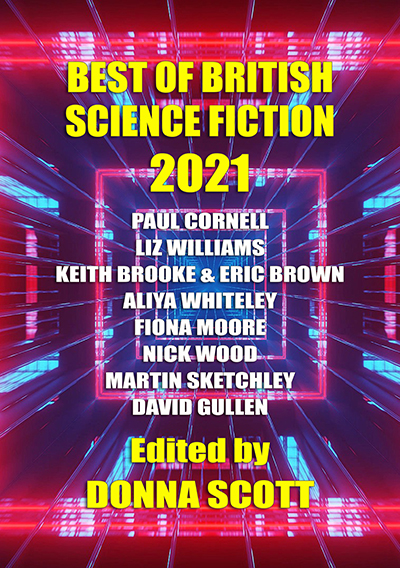
Best of British Science Fiction 2021 Edited by Donna Scott  

NewCon Press, 2022, p. Reviewed for ParSec 5.

In her introduction to this collection of twenty-three stories taken from various sources, editor Donna Scott wonders about the shadow the Covid pandemic will cast over Science Fiction. Though few of the submissions to her had addressed it directly she sees its influence as being present in subtler ways – isolation being one of the themes. The book’s contents cover a relatively wide spectrum of SF tropes (the generation starship seems to be making a comeback, though time travel continues to be somewhat out of vogue.)
As to the stories themselves….

In ‘Distribution’ by Paul Cornell a local authority operative investigates a man who has divided his consciousness among parts of himself that he now keeps in tubes.

‘Stealthcare’ by Liz Williams focuses on an insurance assessor investigating possible fraud in a future where health is expensively monitored by interactive wrist band.

‘Down and Out Under the Tannhauser Gate’ by David Gullen centres on an old soldier eking out her existence by the interstellar gate where she was the only human survivor of the last battle and waiting for her chance to pass through to its imagined delights.

The superbly written ‘Me Two’ by Keith Brooke and Eric Brown is a poignant tale relating the connection, from first awareness(es) to death, of a consciousness switching daily between Danny Madison in London and Cristina Velásquez in Barcelona.

In Tim Major’s ‘The Andraiad,’ Martin is the andraiad replacement for a man who committed a violent crime, and is determined to be a better person than his predecessor.

The action of ‘Bloodbirds’ by Martin Sketchley occurs after the Qall have come, used humanity as humans had used other animals, and then gone again, leaving inside people cells which will form Qall embryos, emerge with little warning, and devastate their erstwhile host. Nikki is an Angel, part of the Vanguard who hunt down these surrogates. Then she meets a possible surrogate man who treats her kindly.

In ‘Going Home’ by Martin Westlake a Russian scientist is in effect conscripted to investigate mysterious fragments found in the area where Tunguska was struck by a meteorite              . Or was the devastation there caused by a conflict between angels?

Spookily atmospheric, ‘Okamoto’s Lens’ by A N Myers centres on the eponymous lens which acts a bit like Bob Shaw’s slow glass, only in reverse. It can capture images of the future.

Set in Leith, ‘Love in the Age of Operator Errors’ by Ryan Vance explores the illicit use of memory technology to access the experiences of the narrator’s lost boyfriend.

‘Stone of Sorrow’ by Peter Sutton combines two new technologies, an experimental system for regenerating farm soil and a top secret army transportation system in a story whose focus doesn’t stray from concern for its characters.

Bearing some tonal resemblances to Daniel Keyes’s Flowers for Algernon, ‘Henrietta’ by T H Dray features a retired plastic-eating artificial life-form which wants to see a sunrise.

The light-hearted ‘A History of Food Additives in 22nd Century Britain’ by Emma Levin does what its title promises. The entry for 2150 is especially sardonic.

‘The Trip’ by Michael Crouch has a professor and a newly qualified former student undertake an archaeological expedition on a new planet, where they make a mind-expanding discovery.

‘The Ghosts of Trees’ by Fiona Moore. A plant researcher working in the Nevada desert on plants suitable for use on Mars sees the ghosts of trees, specifically the trees in the footage of 1950s nuclear test explosions.

Russell Hemmell’s ‘The Opaque Mirror of Your Face’ is narrated by a faceless cyborg, part of a human spinal fluid harvesting team, who steals – down to the seventh dermal level – the face of a young woman to use as his own. Her revenge is not what you might expect.

Aliya Whiteley’s ‘More Sea Creatures to See’ features aliens who, unbeknownst to humans, are slowly replacing them in order to turn Earth into a theme park.

Remarkably effective at evoking memories for those of a certain age, ‘The End of All Exploring’ by Gary Couzens is a hymn both to all those unrecorded 1960s TV moments forever lost to the ether and to the man who comes back in time to record them.

David Cleden’s ‘How Does My Garden Grow?’ is set on a generation starship whose occupants are obsessed with keeping the recycling ratio as high as possible.

‘Girls’ Night Out’ by Teika Marija Smits relates an experience of “bottled” memories by hybrids who are used to do the unpleasant jobs necessary for wider society to function.

‘Bar Hopping for Astronauts’ by Leo X Robertson finds a former astronaut who has been locked into his space suit for twenty years having to come to terms with the modern world.

‘In Aeturnus’ by Phillip Irving sees a man trapped in a never-ending cycle of regeneration and disposal.

Emma Johanna Puranen’s ‘A Spark in a Flask’ is set in a moonbase abandoned to robot caretakers supervising a series of experiments set up to engender life. The protocols are not set to cater for the project’s success.

A tale about the survivor of an airlock accident having to overcome her fears, the elegantly allusively titled ‘A Pall of Moondust’ by Nick Wood references other SF stories set on the Moon as well as the Arthur C Clarke story its title echoes.

In summary, there is nothing remarkably new here but all are good examples of the genre, many illustrating what it is best suited to explore, the human condition under stress.

Pedant’s corner:- In the Introduction: Smits’ (Smits’s,)  Myers’ (Myers’s.) Otherwise; “its” (it’s,) “steps back down them with he sees Shan hasn’t followed” (when he sees Shan hasn’t,) WID (elsewhere WIS, for Wehlberg’s Inflammatory Syndrome,) missing start quotation marks. “‘She said she’d always has this one’” (always had this one.) ‘I thought about it. “some women too.”’ (either; no full stop but a comma; or; ‘Some women too’,) ‘Dumass” brigade’ (Dumas’s brigade,) ;the aliens” stillness’ (the aliens’ stillness,) no capital letters on a new piece of direct speech (x 2,) “you ‘ve done it” (you’ve done it,) “as they set of up the steps” (set off,) “I ‘ll come back” (I’ll come back,) “three Cytheran” (Cytherans,) Louis’ (x 3, Louis’s.) “The nine on the lower deck” (in the previous paragraph we are told there had been sixteen on the lower deck, nine on the upper,) unfocussed (unfocused,) whiskey (x 2. This is set in Birmingham [and not the one in Alabama]: whisky,then,) camelia (x 2, camellia,) Chris’ (Chris’s,) “leaving for her sisters’” (her sister’s.) “The receptionist clicks their tongue” (the receptionist had previously been described as a man; so; ‘clicks his tongue’,) “set him at odds to” (at odds with,) whiskey (in Leith it’s whisky,) “the civil war” (Civil War,) span (x 2, spun,) “porch swing” (for a story set in England a farm having a porch swing is unlikely.) “I acknowledge that the growing inefficiency of my mouth-parts, gut and legs necessitate precautionary measures” (the growing inefficiency ….. necessitates precautionary measures,) McVities’ (McVitie’s,) “meeting up with the one that got away after twenty years ago” (either ‘the one got away after twenty years’ or, ‘the one got away twenty years ago.) “‘That is what you we’re thinking’” (you were thinking,) a paragraph break in the middle of a sentence (x 2.) “The only thing I can seem to see in sharp focus are little bursts of light” (the only thing …. is little bursts.) “There are a mix of colours” (there is a mix,) “the cushioning effect of mycelial layers on the floor become more apparent” (the cushioning effect … becomes more apparent.) “Fungi can eat rock and absorb the mineral content into its own being” (fungi is a plural word; so; ‘into their own being’,) “eager to see what else lay beyond” (the rest of the paragraph is in present tense; ‘what lies beyond’,) “into the gaping maw of the passage entrance” (a maw is a stomach, not a mouth,) “neither of us were in a state” (neither of us was,) “Hangar is just passed the check point” (just past.) “Whatever ripe human muscles a human body owns is at risk” (ripe human muscles …. are at risk.) “‘Healthy for what I can see from a superficial reading’” (Healthy from what I can see,) “he began (rest is in present tense; begins,) “concentrated in listening to” (concentrated on,) “it has the excitement of the novelty” (of the novel,) “as he has done a while ago” (as he had done,) “or we careful avoid developing one” (carefully,) “I’m incapable to get rid of both” (it’s not ‘incapable to’ it’s ‘incapable of’; incapable of getting rid.) “I have to be contented in touching her lips” (contented with touching,) “for what it’s going to happen” (what is going to happen.) “‘Since the first time you’ve screwed me’” (the first time you screwed me,) Woolworth’s (Woolworths,) “<em>TV Time</em>” (<em>TV Times</em>; correctly titled lower down the same page,) “whom I met once I week” (once a week.) “I could day more” (say more?) “He turned to face m.” (to face me.) “I was furious at have been lied to” (at having been.) “I hurried down the stars” (stairs.) “‘I’m the one they’ve come from’” (they’ve come for,) “‘has involved us with us in this matter’” (no need for that ‘with us’,) “photograph if a bride and groom standing hand in hand” (of a bride and groom,) “the fading purple of chive flowers are hung with melancholy” (has something syntactically wrong about it. ‘The fading purple … is hung with melancholy’ is more grammatical but odd. ‘The fading purple chive flowers are hung with melancholy’ just about works,) smartglass’ (smartglass’s,) “open doorways loom dark like maws” (maws are stomachs, not mouths,) descendent (descendant,) “wide as a monster’s maw” (it’s a stomach, not a mouth.) “‘Do we need to titrate your medication and increase your dose?’” (titrate is not the correct verb here,) Baines’ (x 2, Baines’s,) knobkierie (Afrikaans spelling of knobkerrie.)


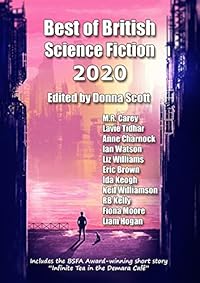
Best of British Science Fiction 2020 edited by Donna Scott

NewCon Press, 2021, 276 p. Reviewed for ParSec 2.

This summation of British SF published last year contains 26 stories, some very short and none even approaching novella length. They are culled from a wide variety of sources, range from jeus d’esprit to more serious endeavours and cover a wide variety of SF tropes. Reasons of space preclude in-depth consideration of individual works but these are all highly readable.

Donna Scott’s Introduction reflects on a Science-Fictional year as regards Covid and its lockdown scenario but that in 2020 SF writers did not concern themselves overly with that subject. Given the usual long lead time between writing and publication that isn’t too surprising. One story here that does confront disease, though, is Infectious by Liz Williams, which features the type of inversion of which SF writers are so fond. Here, infection is the latest forbidden thing to become desirably cool.
2020’s BSFA Award winning short story, Infinite Tea in the Demara Café by Ida Keogh where a man finds himself being propelled between the same café in parallel worlds incorporates a nice pun in its title. Fellow nominee Anne Charnock’s All I Asked For explores an early ramification of the artificial wombs, which Charnock dubs baby-bags, whose consequences she elaborated in her novel Dreams Before the Start of Time.
The book’s opener, War Crimes by M R Carey, deals with the effects of a time-bomb which was detonated in London. The army unit designated to deal those forever held in stasis in its aftermath does not dispose of bombs.
Blue and Blue and Blue and Pink by Lavie Tidhar is a little bit ho-hum, its tale of smuggling over a mysterious line curiously familiar.
The Savages by David Gullen is set on an alien planet where children are ‘they’ till their parents choose what sex they will be. The act of reproduction on this world lives up to the story’s title.
Lazarus, Unbound by Liam Hogan utilises AI controlled freezer cabinets for interstellar travel to extra-terrestrial colonies; or not as the case may be.
In The Cyclops by Teika Marija Smits the narrator can see wavelengths of light beyond the visible. The story’s style is reminiscent of Flowers for Algernon but Stephen Oram’s Chimmy and Chris, the narrative of the development of a human brain organoid, lies much closer to that template.
Brave New World by Oscar Wilde by Ian Watson describes a time travel expedition to scoop up Oscar Wilde from 1897 to take him to 2050 to write his masterpiece Brave New World.
Neil Williamson inundates a near future Glasgow where forced recycling is the basis of everyday life in Mudlarking.
Cofiwch Aberystwyth by Val Nolan, where that town has been devastated by a nuclear blast and the narrator is forced to come to terms with his past, must be one of the few SF stories to feature Welsh words. Each section’s title is in that language.
In Panspermia High by the ever reliable Eric Brown, a bufotoxin from outer space which has spent ten thousand years inhabiting cane toads conjoins with an Australian druggie.
The very short Exhibit E by L P Melling sees the Moon used as a canvas for an art work warning of environmental catastrophe.
A battle tank goes unusually rogue in Fiona Moore’s The Lori.
Wilson Dreams of Peacocks by Melanie Smith is set in a far future where Earth is long dead, humans’ bodies have evolved, and a woman uses a somnus kit to read the dreams of the eponymous Wilson.
Variations on Heisenberg’s Third Concerto by Eleanor R Wood has a neat premise; a physicist brings back the manuscript of said Concerto from a parallel world. Every time the piece is played, the score changes. And so do the worlds.
The World is on Fire and You’re Out of Milk by Rhiannon Grist is from the staring moodily at a can of baked beans school of narration. In a heat-scarred world, going shopping requires an all-but armour-plated expedition.
The last remaining wind turbine is the only power source remaining to the characters in James Rowland’s The Turbine at the End of the World, so must be kept in operation.
The remembrance of the number 70 is the key to enabling time travel in What Happened to 70 by C R Berry.
Rings Around Saturn by Rosie Oliver is an example of the kind of solid tale of Solar System exploration which had gone somewhat out of fashion. A near-bankrupt salvage operator has to brave the canyons of the rings of Saturn to gain her fortune.
London, the city, narrates The Good Shepherd by Stewart Hotson – or rather its controlling AI does. It fears it has been hacked but in tracking down the hacker comes to know itself.
Pineapples are not the Only Bromeliad by R B Kelly is a reworking of Romeo and Juliet. Two bots programmed to please humans find themselves irresistibly attracted to each other.
Like Clocks Work by Andi C Buchanan features a (not)generation starship, whose AI is slowly growing flesh, becoming human. Clocks are a symbol of the past to be remembered.
The only thing that makes SF out of ghost story Watershed by John Gilbey is its virtual setting. It is effective though.
Here Today by Geoff Nelder has an alien lifeform crash on Earth and transfer to the nearest consciousness.
From this evidence it would seem the British SF short story is in fairly rude health.

Pedant’s corner:- In the Introduction; “green grocer’s” (not of a grocer who was green; of a greengrocer.) In “About the Authors”; “in such places Dark Matter Magazine (in such places as Dark Matter Magazine, NewCon Press’ (NewCon Press’s.) Otherwise; focussed (focused.) “The team are still baffled” (the team is still baffled,) focussing (x 3, focusing,) “NASA want me to go” (NASA wants me to go,) “unimaginable in 1890s” (in the 1890s.) “Mum’s generation are blinded by …” (OK it’s a noun of multitude but ‘Mum’s generation is blinded by …’ still makes sense.) “Everything from … are dwindling resources” (Everything usually takes a verb in the singular; everything from …. is a dwindling resource?) “bad land left return to wilderness” (left to return,) from what they what they” (only one ‘what they’ needed,) “that had been left fall” (left to fall,) “she soon she fell” (she soon fell,) “I stepped placed a hand on her shoulder” (is missing a word – or three,) “a lose line” (a loose line?) “Nothing to edit out so.” (Again is missing words to make sense of it,) sprung (sprang,) Sun Tze (Sun Tzu?) “to deliver on their promise” (the promise was by a business; so, ‘on its promise’,) snuck (sneaked,) but “no way he was going to leave” (but no way was he going to leave.) “And then I laid down next to him” (then I lay down next to him,) “spilled out and span away” (spun away.) “The room span and pitched” (spun,) non-descript (nondescript.) “Down at the wall by the local shop, a man hunkers” (no need for the coma,) “she might have saw” (seen.) “She laid there in perfect stillness” (she lay there,) “army officers” (the ‘officers’ concerned were doing sentry duty. Army officers don’t do such menial tasks,) “decided to go see him” (to go to see him.) “Provium was an isotope of voron” (if they are isotopes their names would be the same. Isotopes are atoms of the same element, their separate identities are indicated by their different mass number, carbon-12/carbon-14 etc. But this is an altered universe, so…) “All missing page 70s” (Each would only have had one such page, so, ‘All missing page 70’,) “where a little bit of difference early on makes a hell of a lot of difference later on” (‘makes a hell of a difference later’ is more economical,) “‘I got you out jail’” (out of jail,) “of giant shark’s mouth” (of a giant shark’s mouth,) “and let it attach to emergency backpack” (to the emergency backpack, “last known position up the screen” (up on the screen.) “‘Looks like the stuff thinning is out there’” (‘Looks like the stuff is thinning out there’ makes more sense,) “the thinning ice and dust becomes shower of arcs” (either ‘a shower of arcs’, or, ‘showers of arcs’,) “pointing along line of least density” (along the line of least density.) “‘Any idea of our orientation the spaceship is with respect to…’” (of the orientation the ship is …) “latch onto” (latch on to,) focussed (focused,) donut (x 4, doughnut,) “the way the water and fuels slopes” (slope,) “will get to satellite” (to the satellite,) “to be picked up by another spaceship other than Miroslav’s” (by another spaceship apart from Miroslav’s is less clunky.) “There are an extremely large number of” (there is an extremely large number,) “who’s only recourse” (Good grief! ‘Who is only recourse?’ Does no-one understand the difference between a contraction and a possessive pronoun any more? – ‘whose only recourse’.) “|None of us like to admit our fallibilities” (none of us likes to admit,) “it had to the be the” (it had to be the,) “in a shell of hard calcium” (actually calcium carbonate,) focussed (again; focused,) “half a dozen of the little AI” (AIs,) “ended up wondering uncertsainly up Granville Place” (wandering,) one sentence implies pineapples are citrus flavoured; they are not. “In a just a few short weeks” (remove first ‘a’.) “Tinan might be taller on average” (taller than average.)

One more for ParSec

Best of British SF 2021 cover

Another gift from Parsec digital SF magazine has landed on my doormat; Best of British Science Fiction 2021 edited by Donna Scott.

I reviewed Best of British Science Fiction 2020, also edited by Donna Scott, for ParSec 2 and will be posting that review here soon.

ParSec 2

ParSec 2 cover

The second issue of digital SF mag Parsec was published on Christmas Eve, shortly before midnight.

You can buy it here.

I have three reviews in this one:-

Best of British Science Fiction 2020 edited by Donna Scott.

Three Twins at the Crater School by Chaz Brenchley and

The Second Rebel, Linden A Lewis’s follow-up to The First Sister which I reviewed for Parsec 1.

New Review Books

Via Parsec (see here) I’ve received two more books for review.

These are Best of British Science Fiction 2020 edited by Donna Scott, which I hope will live up to its title, and Three Twins at the Crater School by Chaz Brenchley. This last seems to be the first in a series of “English girls’ boarding school stories. On Mars,” based I assume on the Chalet School books by Elinor M Brent-Dyer, an author whose œuvre I do not remember ever sampling.

free hit counter script