Archives » detective fiction

The Adventures of Sherlock Holmes by Sir Arthur Conan Doyle

Headline Review, 2006, 352 p. First published in 1892. One of Scotland’s favourite books.
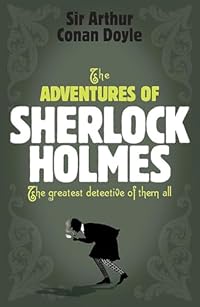
 The Adventures of Sherlock Holmes cover

Being not much of a fan of crime novels I would not normally have picked this up but it is on that list – it even made the top ten – of Scotland’s favourite books (see link above) of which, having recently ticked off Willa Muir’s Imagined Corners – which is separately among the 100 best Scottish books while this is not – I have worked through all but four now. But it was available at a local Library.

So: how to account for the perennial attraction of these Sherlock Holmes stories? While they are easy to read they are not particularly well-written, being prone to exposition and, taken as a whole, remarkably repetitive in form. Nor are they particularly diverse. Not less than three of the ones here hinge on attempts to thwart possible inheritances. Moreover, our narrator, Dr Watson, is usually not present at the crucial points of an investigation, only for the reveal. And quite often the criminal – or malfeasant, there is not always a crime involved – ends up not being punished.

As to the stories themselves: A Scandal in Bohemia isn’t; either a scandal or set in Bohemia. The Red-headed League is an invented body whose advert is intended to attract applicants for the purposes of diversion from a crime. The perpetrator of the misdemeanour in A Case of Identity is obvious from the moment of its description by the victim. So too from early on is the murderer in The Boscombe Valley Mystery. The Five Orange Pips are the Ku Klux Klan’s equivalent of Treasure Island’s black spot while The Man with the Twisted Lip turns on an ingenious way to make a comfortable living. The Blue Carbuncle is a stolen diamond that ends up in the crop of a Christmas goose. The Speckled Band is a tale of murder by unusual means. The Engineer’s Thumb is barely a mystery at all. The Noble Bachelor’s bride does a bunk almost as soon as the wedding ceremony is over but Holmes soon divines why. The Beryl Coronet is a piece of jewellery entrusted to a banker as security for a loan and part of which is subsequently stolen while in his care. The banker’s dissolute son is given the blame until Holmes gets on the case. Once again the true perpetrator (or at least one of them) is not hard to pick out. The Copper Beeches is the house to which a governess is invited to work but there are odd conditions attached to the post.

Well, I can now say I’ve read Doyle’s Holmes (two years ago I reviewed for Interzone one of James Lovegrove’s homages) but I can’t say I’m keen to repeat the experience. The Hound of the Baskervilles, though, is on that 100 best list. I suppose I can always hope Doyle is better at novel length.

Pedant’s corner:- hurrah for encyclopædias! Otherwise – The King of Scandinavia (there is no such person; but I suppose Conan Doyle did not wish to name actual royalty.) “‘The form do so when the security is good,’” (ought to be “does so” but it was in direct speech,) shrunk (shrank.)

The Book of Souls by James Oswald

Penguin, 2013, 441 p including a short story, The Final Reel, which is rather abrupt.

The Book of Souls cover

This is the second of Oswald’s Inspector MacLean novels which he first electronically self-published before gaining a book contract at Penguin.

In a disturbing echo of the “Christmas Killer” murders whose perpetrator Inspector Tony McLean was instrumental in catching several years before, a succession of women is being found naked, with their throats cut, staked out under bridges over running water. A local journalist with a new book on the previous killings is suggesting the police got the wrong man, McLean’s superior Inspector Duguid keeps taking officers away from his investigation and McLean himself is forced to endure counselling. In addition to the murders McLean has a series of mysterious fires destroying old industrial premises around Edinburgh on his caseload.

The book is certainly readable if with some workmanlike prose at times – but then I’m not overly familiar with the modern crime novel so this may be what’s expected. I also felt that Oswald over-eggs the pudding a bit with the identity of the last potential murder victim.

As with Oswald’s first McLean book, Natural Causes, there is a tinge of the supernatural to the proceedings. The Liber animorum, the Book of Souls of the title, is said to weigh souls – and take over those found wanting. (My hang-up I know, but as an explanation for human depravity I have always found the supernatural a total cop-out.)

Pedant’s corner:-
One count of “sunk” for “sank”. “Ploiped” appears to be a coinage of Oswald’s but may only be a typo for “plopped.” “A half a dozen” has one “a” too many. “Happy Christmas.” (Where I’m from the greeting is “Merry Christmas.”) A judge bangs a gavel – not in a British court I’m afraid.

Jack Glass by Adam Roberts

Gollancz, 2012, 373 p.

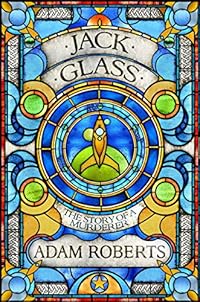
 Jack Glass cover

Well, this is a tricksy one. The prologue informs us we are about to read about three murders, a prison story, a regular (regular? I think Roberts meant traditional rather than occurring at intervals) whodunnit and a locked room mystery – or perhaps each is all three at once – and tells us who committed them, yet still promises surprises. The coda provides a rationale (in as much as any fiction can) for the fact that we’re reading this at all. All three stories are set in a Solar System run under the strict Lex Ulanova; a set of laws instituted by the ruling Ulanovs in the wake of the Merchant Wars.

The first section, titled In the Box, has seven criminals interned in an asteroid, with limited means and apparatus, eating only ghunk they can grow themselves from the surrounding rock and a pitiful light source; forced to work out their term of eleven years, effectively mining it for the Gongsi corporation which has the contract for their imprisonment. It’s also about economics; the decreasing value of humans as a resource. The tensions are neatly delineated as the story slowly morphs from a wide overview to the viewpoint of Jac, who has urgent reasons to escape his confinement.

From prison to the overclass. The second story, The FTL Murders, concerns Diana and Eva, heirs apparent to the Argent MOHfamily, second in importance to the Ulanovs. Eva, older by a few years, is on her sixth Ph D, investigating the phenomenon of Champagne Supernovæ – a name which Roberts endows with bitter irony with the connections he makes. Diana’s hobby is solving murder mysteries, which she sets to in real life when one of their servants is killed soon after they descend to Earth from their normal space habitat. This gives Roberts the chance to reference various fictional detectives but is mere background to his ongoing story arc, where even the idea of a faster than light technology is enough to threaten the Ulanovs.

The third instalment, The Impossible Gun, takes us briefly into the Sump, the agglomeration of shanty globes scattered across the Solar System where the Sumpolloi live lives of brute insensitivity again eating mainly ghunk, before it settles on a very definitely locked–room mystery. Jack Glass is on the verge of being taken into custody when Bar-le-duc, the detective chasing him, is killed in sudden inexplicable fashion. No spoiler here, or if there is it is Roberts’s, as the chapter title for this scene is The End of Bar-le-duc. The death, though, does blow a hole in the logic of Glass’s later fixation with the RACdroid which witnessed his immediately prior agreement to be being arrested.

There is one neat apercu, “Death is another name for doubt. Death is what inflects the immoral certainty of the universe’s processes with uncertainty,” and an interesting comparison, “The median point between the mass of a proton and the mass of the entire universe is the mass of the average human female.” We are also told of a torture technique called vacuumboarding. For goodness sake don’t give the buggers ideas!

The structures of the second and third stories are awkward, too much playing of fictional games for the sake of it, though Roberts does show the maturation of Diana, as her life of privilege is blown apart and she has to grow up fast, very well. Whether the overall novel lives up to the aspirations set out for it in the prologue or in Roberts’s apparent intention to write a novel which merged Golden Age SF with Golden Age detective fiction is doubtful.

In the acknowledgements Roberts mentions Margery Allingham, Ngaio Marsh, Doroth L Sayers and Michael Innes as influences (via his mother to whom the book is dedicated.) The essence of the traditional detective story is cosiness. Jack Glass is far from cosy, however.

I’m at a loss as to why this won the BSFA Award for best novel of 2012. To my mind there were better books on the short list.

Pedant’s corner: Span count 2, Roberts uses schute where chute would be perfectly adequate and we had “let along” for “let alone” plus the sentence, “Sunlight epilected between trees.” I can’t find epilected in any dictionary.

free hit counter script