The Thousand Autumns of Jacob de Zoet by David Mitchell
Posted in Other fiction, Reading Reviewed, Science Fiction at 12:00 on 26 February 2015
Sceptre, 2011, 564 p.

This novel has been described in a quote on the back cover as a tour de force and I must say it is likely to remain in my mind for a long time. It will certainly figure in my best of the year even if this is still only February.
The Jacob de Zoet of the title is a Dutchman who, in order to prove his worthiness to marry his sweetheart Anna, is out to make his fortune in the Dutch trading mission on the island of Dejima off Nagasaki at the turn of the eighteenth and nineteenth centuries (CE) – during the Tokugawa Shogunate, when all other European contacts were banned, as was travel abroad for Japanese. The present tense narration is in the third person, save for a single chapter in first person from the point of view of a slave in the Dutch trading post. Woven into the tale is the history of relations between Japan and the outside world up to that point. While the novel is roughly based on incidents that took place on Dejima around that time I would hazard that the part of the plot involving the Lord Abbot Enomoto is not.
The first part of the novel outlines de Zoet’s endeavours in exposing the various corruptions of previous Chiefs of the post and his interactions with Japanese translators. Reading about the difficulties of translation between Japanese and Dutch in a third language – English – is a bit surreal. The very first chapter, however, introduces us to Aibagawa Orito, the disfigured daughter of a samurai, who is learning to be a midwife under the tutelage of the Dutch doctor at Dejima. Her path and de Zoet’s cross and, despite feelings of guilt at betraying Anna, Jacob becomes attracted to Orito. His hopes in affairs of the heart and commerce are both soon dashed. In the second section, where Aibagawa Orito has been taken away to the religious institution run by the Lord Abbot, the novel takes a sudden left turn as this middle part of the book deals solely with her plight and the efforts of her Japanese admirer, the interpreter, Ogawa Uzaemon, to free her. The third and concluding part of the novel returns us to Dejima as well as on to the British frigate which arrives to attempt to take advantage of the fall of the Netherlands to Napoleon’s armies.
The book is unusual in that it contains a number of illustrations, mostly anatomical but also two townscapes – well, one townscape and a shrinescape – plus some of “de Zoet’s” sketches of Origo.
While reading I was struck by certain parallels with Science Fiction. There is a type of SF story which also has an isolated trading/diplomatic post many months (or years) travel from home, dealing with and trying to understand a different culture. In Origo’s captivity we have different SF parallels but they are even more marked, as the Sheranui Shrine is a closed society with its own rules and a menace at its heart.
The characters, especially the Japanese, impress. Care and detail is lavished both on them and on the background. Even the minor ones have the ring of truth. That short first person chapter includes a meditation on the internal autonomy of slaves. One member of the Dutch mission tells de Zoet, “Tain’t good intentions that pave the road to hell; it’s self-justifyin’s.” There is also towards the end a very rhythmic paragraph listing the lives/occupations of the inhabitants of Nagasaki which is reminiscent of Auden’s The Night Mail in its metre and rhyming. Then there was the almost impenetrable phrase, “A smoke-dried Dane makes Finn’s Cock of a tangled Vang,” which seems to entangle nautical terms with the history of the times.
A tour de force? It was certainly fascinating and absorbing throughout, likely to remain with me for a long time.
Pedant’s corner:- “A well-travelled round of Edam and sour apples are divided,” (a round is singular;) snonky appears to be a coinage by Mitchell; wistaria (apparently a variant of the more usual wisteria) was repeated several times; “the pair enjoys,” (again; a pair is singular) guarding this natural revile (revile here is in the sense of ravine but I can’t find such a definition anywhere.)

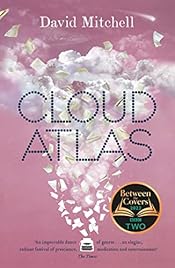 Cloud Atlas has an unusual structure consisting of six separate narratives all in different styles – journal, epistolary, thriller, realist (for want of a better term,) interrogation transcript and memoir, wrapped round each other in a way which the author compares at one point to a matrioshka (what in my youth was called a Russian) doll and another as a successive series of interrupted musical phrases which are recapitulated and developed – in order – later. The second is a more accurate comparison as the tales are not truly enveloped one within the other. I would rather say they are ensleeved. (Or even enleaved: as in a book.)