Archives » Covenanters

Ringan Gilhaize by John Galt

Or, The Covenanters.

Edited by Patricia J Wilson. Scottish Academic Press, 1984, 375 p (including 33p Notes on the Text and 10 p Glossary) plus xii p Introduction ii p Notes, ii p Acknowledgements and iii p Note on the Text. Originally published in 1823.

Ringan Gilhaize cover

Compared to the lost cause of the Jacobites, endlessly retrodden by Scottish (and other) writers, the rise and defence of Calvinism in Scotland has been relatively neglected in the Scottish tradition. James Hogg’s The Brownie of Bodsbeck is an exception, as is Scott’s Old Mortality whose unsympathetic treatment of the Covenanting cause impelled Galt to write this riposte, and much more recently James Robertson gave us The Fanatic. The relevant events are seen through the eyes of the Gilhaize family but only in so far as any of its members were directly involved in them. The book is narrated by the titular Ringan Gilhaize and its first section tells of his grandfather’s activities during the Scottish Reformation, which in later life he endlessly recounted to the family round the fireside, and features his encounters with, among others, John Knox and James Stuart (the illegitimate half-brother of Mary Queen of Scots and whom on taking up the throne on her return from France she made Earl of Moray. A confirmed reformer, after Mary’s exile to England he became Regent of Scotland.) This time period was when the groundwork for the stern Calvinistic bent of Scottish Presbyterianism was laid and the text contains many examples of invective against prelacy, papistical idolaters and the Whore of Babylon.

The latter two sections deal with Ringan’s own life and times when, first Charles I, and later his son Charles II, tried to reintroduce elements of episcopacy into Scottish religious observance. This led in the former’s time to the signing of the National Covenant and a few years later the Solemn League and Covenant, which latter was essentially an anti-royal but certainly anti-Catholic agreement between Scottish Protestants and the English Parliament for Presbyterianiam to become the established religion south of the border. (These two Covenants are sometimes rolled into one in people’s minds but it was from them that the Covenanters – in that word’s pronunciation the emphasis is placed on the third syllable – gained their name.) The Covenanter’s insistence on the view that no king could interfere between a man’s conscience and God and that rebellion against any king who attempted to do so was justified, effectively made the Covenanters heirs to the Declaration of Arbroath and holders of the Scottish conscience.

The text of “Gilhaize’s” account is mainly in English larded with Scots words and forms of speech but has that wordiness that is characteristic of novels of its time and of course is reflecting the language of between two and three hundred years earlier than when Galt was writing. The dialogue, moreover, tends to be in very broad Scots indeed.

The novel is in part a history lesson since “Gilhaize” has to provide the background to the events he himself took part in. He therefore mentions the protests in St Giles Cathedral against the prayers in Charles I’s new Prayer Book as supposedly started by Janet (aka Jenny) Geddes (though her name does not appear in contemporary accounts,) a defiance of authority which led to open rebellion and the Wars of the Three Kingdoms. (For a long time these were known as the English Civil War despite the fact that they were precipitated by the necessity for Charles I to recall the English Parliament to provide money to suppress his Scottish religious rebels.)

After the Restoration of the Stuarts, fierce resentment resulted from Charles II’s apostasy in the matter of the Covenant which he had signed essentially in bad faith in what would now probably be called an act of real politique to bring the Scots Parliament onto his side in his war against Cromwell – a hopeless endeavour given the outcome of the Battle of Worcester. To the Covenanters signing was a sacred and binding act. Reneging on that could not be forgiven.

Galt’s focus on the affairs of one family allows him to illustrate the build up of both the petty and the major injustices of the anti-Covenanter legislation as well as Covenanters’ hatred of the favourite General of both the latter Stuart kings, James Graham of Claverhouse, whom the Covenanters dubbed “Bloody Clavers” for his enthusiastic prosecution of the sequestrations, fines, imprisonments and hangings which feed into the slow descent by Ringan into a haze of self-righteousness and moral zeal. A minor drawback of this is that most of the battles mentioned in the book take place off-stage since neither his grandfather nor Ringan himself were present at them. (Exceptions are Drumclog, Rullion Green in the Pentlands, and Killiecrankie, in all of which Ringan took part.)

The final vindication of the Covenanting resistance was the outcome of the “Glorious Revolution” of 1688 – here Galt has Gilhaize believe in the false propaganda that a man child was palmed off on the nation as the lawful son of James VII (and II,) known to Covenanters as “the Tyrant,” and his papistical wife – which secured the Protestant ascendancy in the form of William and Mary.

Two hundred year-old fiction is problematic for the modern reader at any time – patterns of language have changed, writers no longer need to pad out stories to reach a required word count, sentences tend to be less laboriously constructed – but the remoteness here is compounded by the dense nature of the history, the numbers of historical figures, the intensity of the religious discourse. Throughout, the book rings with Biblical imagery and allusions.

Though in their particulars its concerns have now passed into history in Scotland (except for their remnants being attached to a certain football rivalry) Ringan Gilhaize, as an examination of the mindset of the religious zealot, the firm believer in a higher calling, is salutary, and still has resonance for the present day. I’m glad I read it even if the prose does not always flow as smoothly as I might have wished.

Pedant’s corner:- In the Introduction; “worthy the attention” (worthy of the attention, or, worth the attention.) Otherwise: “the Earl of Angus’ house” (Angus’s,) St Giles’ kirkyard (St Giles’s,) her Highness’ presence (Highness’s.) “When she heard the voice or anyone talking in the street” (the voice of anyone talking,) juncutre (juncture,) a capital letter in the middle of a sentence (this may have been to signify a spoken phrase immediately after it; but that was followed by an opening quotation mark to signal the speech’s continuation,) thougt (thought.) In the Notes; divive (divine.)

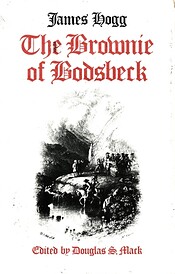
The Brownie of Bodsbeck by James Hogg

Edited by Douglas S Mack, Scottish Academic Press, 1976, 170 p; plus i p Acknowledgements, xi p Introduction, viii p Notes on the Text, x p Appendices, i p Select Bibliography, xvi p Explanatory and Textual Notes and xvii p Glossary. First published 1818.

 The Brownie of Bodsbeck  cover

The novel is set in Hogg’s country of southwest Scotland, the Dumfries and Galloway of Covenanting times, some years after the Battle of Bothwell Bridge. The defeated Covenanters were forced to scatter and hide, holding their prayer meetings in conventicles and taking cover where they might, in danger of being chased down by Government trooops. At times the air was filled with the eerie sound of their singing as if some unnatural creature were haunting the hills.

Despite not being of their persuasion and of the concomitant danger of arrest and execution, Walter Laidlaw, a farmer at Chapelhope, takes to giving some of the fugitives succour and shelter. As a result of her ministrations in this regard his daughter Katharine is in danger of being thought – even by her mother – a witch, and of consorting with the Brownie of Bodsbeck, a deformed supernatural creature believed to haunt Chapelhope. In the glossary a brownie is defined as a “benevolent household sprite, usually shaggy and of peculiar shape, who haunted houses, particularly farmhouses, and, if the servants treated him well, performed many tasks of drudgery for them while they were asleep.” (I mentioned this definition to the good lady who immediately reflected on how this assignation of drudgery to the name conformed with the junior arm of the Girl Guides.) The brownie is alternatively described as a goblin or evil spirit.

The plot gears up when soldiers under the commend of John Graham of Claverhouse, Viscount (“Bonnie”) Dundee, come to the area. Laidlaw is arrested, barely escapes being shot and is taken to Edinburgh for trial. In the meantime a local minister convinces Katharine’s mother to allow him to spend the night with the girl in the farm’s outshot to exorcise the evil she is thought to embody and not to open the door no matter what she might hear. (The only evil truly at hand is the minister’s intention of forcing himself on Katharine.) Katharine persuades him to hold off for a few hours and is rescued by apparitions coming out of the dark.

The behaviour and attitude of Claverhouse as shown here place him in a harsh, unforgiving light, a point over which he clashed with Walter Scott, but are in accord with Hogg’s memories of the stories told to him in his youth about the time.

The text is in the main in English but Hogg’s characters speak broad Scots, laden with the dialect of that area of the Borders. A difficulty in comprehension some may find is that a Highland sergeant’s soft sibilants are represented as in “pe” (for “be,”) “poy” (for “boy”) and “petween” (for “between”) plus the typical aspirations of his vowels are delightfully captured as in “couhnsel” for “counsel” and “tisgrhace” for disgrace.

The glossary is worth perusing on its own. Old Scots was a language very much concerned with agriculture and the land. I had heard of the dog breed whose name is derived from the fictional character in Scott’s Guy Mannering but hadn’t realised before reading it here that a dinmont is a castrated ram between the first and second shearing. (I later found a similar definition – but without the castrated bit – in my Chambers’ Dictionary.)

Hogg’s greatest literary accomplishment was The Private Memoirs and Confessions of a Justified Sinner, which is perhaps the finest ever Scottish novel, the progenitor of so many since. It would be hard for this book – any book – to hold a candle to that.

However, The Brownie of Bodsbeck is entertaining enough – one of those Scots novels that illuminate the past – and refreshing in that it does not focus on the usual suspect of Jacobitism. At times, though, it feels like two stories jammed together. Laidlaw’s tribulations are distinct from those of Katharine and the Brownie and the two don’t really mesh.

Pedant’s corner:- Clavers’ (Clavers’s,) wofully (old spelling but later rendered as woefully,) “the family were crowded round” (the family was.) In the glossary: an opened parenthesis never closed.

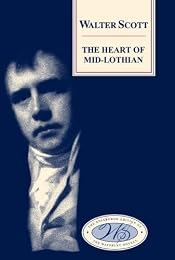
The Heart of Mid-Lothian by Walter Scott

The Edinburgh Edition of the Waverley Novels, Edinburgh University Press, 2011, 470 p plus 59 p Essay on the Text, 50 p Emendation list, 2 p list of end-of-line “hard” hyphens, 40 p Historical Note, 120 p Explanatory Notes, 50 p Glossary, 2p maps of Edinburgh, iv p General Introduction to the Edinburgh Edition, and iii p Acknowledgements. One of the Herald’s “100” best Scottish Fiction Books.

The Edinburgh Edition has sought to produce the nearest approximation to what Scott intended by using as base texts the first publications and Scott’s manuscripts of the relevant novels. The Heart of Mid-Lothian – the novel which, by way of a dance hall, provided the name for a Scottish Football Club – was seemingly the work which suffered most in the hands of such intermediaries as copyists, typesetters and editors. The length of the emendation list here attests to this. In this edition the explanatory notes work out at an average of four for every page of text! To consult them with this frequency would have interrupted the flow of reading so for the most part I left them till I had finished the novel, only consulting them during its course when absolutely necessary.

The Heart of Mid-Lothian cover

The story is supposedly set down by one Jedidiah Cleishbotham as one of his Tales of My Landlord, Peter Pattieson, only he had it from conversations in an inn with three gentlemen he had helped rescue from deposition in a river by an upturned coach, two of whom were lawyers and the other once jailed through indebtedness. This is of course merely a framing device to introduce a story whose beginnings lie in the Edinburgh tolbooth (the gaol situated at the Heart of Mid-Lothian) and the Porteous riots of 1736 where a commander of the city guard was lynched after being pardoned for killing innocent civilians during a disturbance at an earlier public hanging. The story places in the tolbooth at the time Effie Deans, awaiting trial for concealment of her pregnancy, a crime taken to be evidence of intent to murder the child when it was born. Her lover, it turns out, was involved with instigating the riots and had immediately before the birth placed Effie and hence their son into the hands of old acquaintances of his who were less than reliable. Effie’s post-partum indisposition due to puerperal fever renders her incapable of accounting for her son’s whereabouts.

Effie is the daughter of David Deans, a staunch Presbyterian of the old school, a former Covenanter still unreconciled to the modern practices of the Church of Scotland and its accommodation with the State. Effie’s half-sister, Jeanie, has it in her power to prevent Effie’s conviction but due to her conscience and strict upbringing will not swear falsely that Effie informed her of her condition. As a result, Effie is found guilty and sentenced to death. Jeanie resolves to walk to London to enlist the help of the Duke of Argyle to petition the King for a pardon. While her encounters en route make for a novel whose parts are an interconnected artistic whole they do seem a little implausible. However, if you like loose ends to be successfully tied up you won’t be disappointed.

As with Rob Roy Scott’s wordiness can be wearing at first, but I soon accommodated myself to it.

While Jeanie is the undoubted heroine of the book the whole may also be seen as an exploration of the ramifications of an unjust law. From the perspective of two hundred years on Effie’s predicament exemplifies a pronounced tendency among religions to make women the gatekeepers to male sexuality and to punish them rather than their equally (in many cases more) culpable partner for any transgressions. I suppose women were and are easier to identify as culprits since the evidence of “sin” becomes all too readily apparent. It nevertheless reflects the not yet eradicated widespread misogyny (itself an expression of fear of women’s capabilities and of rejection; a manifestation of deep seated insecurity) prevalent throughout history.

There is, though, a reading in which The Heart of Mid-Lothian is actually a chronicle of the life of David Deans, his steadfastness and surety, and also a marking of the beginnings of the long, slow fading of the Covenanting mindset, still not quite extinguished.

Pedant’s corner:- As in Rob Roy; stupified, plus sunk, shrunk, sprung, sung, rung, run for sank, shrank, sprang, sang, rang, ran. These are Scottish usages at the time Scott was writing and still survive in some everyday speech. We also had wrang for wrung (once, but elsewhere wrung appeared) and flang for flung. The editors do say that Scott would add flourishes to certain instances of the letter “u” which may have led to some of these. Despite the care which the editors have taken we also had whichshould (which should,) ofhabitual (of habitual,) the hangman is designated the Doomster on page 217 (twice) but on page 218 is referred to as the Dempster, whisht (as I noted on Keith Roberts’s The Lordly Ones this is nowadays usually spelled wheesht but obviously Scott did not,) the text has Dumbartonshire – or shires – but the emendation list mentions one instance where Scott’s manuscript has Dunbarton Shires. I believe the spelling has altered through time, reverting to Dunbartonshire for the county by 1914. In the historical note: Presbbytery (Presbytery.) In the explanatory notes: “is a now an obsolete usage” (has one too many indefinite articles,) Galations (Galatians.)

free hit counter script