Agnes Grey by Anne Brontë
Posted in Other fiction, Reading Reviewed at 12:00 on 31 August 2020
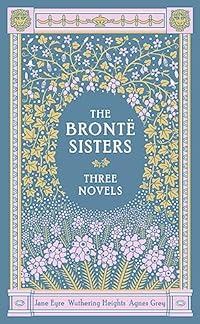
In “The Brontë Sisters: Three Novels,” Barnes and Noble, 2012, 164 p (plus iii p Introduction to the three novels.) Agnes Grey was first published 1847.
Narrator Agnes Grey is the daughter of a poor-ish clergyman on whose infirmity she decides to find work as a governess to help out her family financially, albeit in a small way. The novel is a more or less straightforward account of her experiences first of all in a family where the children fail to do as they are asked, over-indulged as they are by their parents, a thankless endeavour not soon enough brought to an end, then in another – the Murrays – where she is in charge of two much older daughters, both of whom are headstrong in various degrees. The influence of Brontë’s own life in providing a milieu for her heroine is therefore obvious.
Agnes Grey is God-fearing, thoughtful and mindful of her place in the scheme of things and of her obligations to be compassionate. That others of higher social standing than herself may not be so minded, is something she becomes acutely aware of.
The hypocritical minister, the more truly Christian curate, the calculating mother prepared to sacrifice her daughter’s future happiness to a title, the scheming young girl callously set on snaring a man’s heart while never intending to gratify that desire, all make an appearance here. This fits neatly into the template of the Georgian or Victorian novel. It is all over rather quickly and it is relatively obvious from the moment of the appearance of the curate, Mr Weston, in Agnes Grey’s life where it will end. Everything seemed rather rushed, though, more like sketches for a novel than the complete article.
Pedant’s corner:- In the Introduction; a repeated full stop. Otherwise; no start quote mark when a chapter begins with a piece of dialogue, “it would be with different, feelings” (why the comma?) opportunityl (opportunity,) visiter(s) (several instances, visitor(s),) by-the-bye (previously – on the same page! – by-the-by.) “‘What do your mean, sir?’” (you,) secresy (an old spelling?) “None of the Murrays were disposed to….” (None … was disposed to,) visa versa (nowadays always vice versa,) wofully, woful (now spelled woefully, woeful,) “the congregation were departing” (the congregation was departing,) “not to shabby or mean” (not to appear shabby or mean,) worky-day (now spelled workaday,) “said be” (said he.)

