Orbit, 2014, 407 p. Reviewed for Interzone 252, May-Jun 2014.
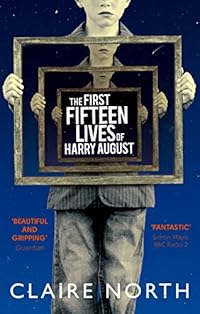
There is a potential problem with the central premise of novels broadly comparable to this. It is one which also besets any work of fiction set either in virtual reality or a computer game. To wit: if a character cannot die – or can be resurrected after death – where, then, is the jeopardy? Why ought readers invest time and energy in sympathy or empathy; why should they care? Here that problem is encapsulated by the title (and for the reviewer is exacerbated by the accompanying promotional material.) We know before the outset that Harry August has at least fifteen lives. Why, then, for example, should the grubby circumstances of his conception and initial upbringing matter to us? However, “North” – the publishers emphasise that the author is pseudonymous but has experience – neatly sidesteps the issue by beginning “her” story at the end of Harry’s eleventh life, thus making it clear that any single life journey is not of itself crucial. And the jeopardy is not to Harry alone, but to human existence. “The world is ending.”
This idiosyncratic book reads at various points as if the author could not quite decide what sort of beast it actually is, first like a literary novel, then a thriller, a historical tract, a spy story and a tale of revenge – all the while riffing on Alternative History. And, yes, it does veer (rather suddenly) into more straightforward Science Fiction about halfway through, then morphs back again before returning to SF for its dénouement. As befits a tale of someone with more than fifteen lives the narrative is not linear but skitters about, incorporating vignettes from Harry’s existences, encounters with others of his kind. Yet it does manage to come together as a more or less coherent whole.
Harry is one of the kalachakra, an ouroboran, humans whose consciousness and memories of previous lives recycle back to birth after their death. In subsequent lives these memories begin to resurface after infancy. Before the lives accumulate this can lead to madness, later there can be advantages. Perhaps even worse for Harry, he is what the kalachakra call a mnemonic: he forgets nothing. Kalachakra are few enough at any one time but are scattered throughout history, sometimes leaving messages in stone to their successors. No explanation is given for their unusual attribute; their reincarnations just happen. Their knowledge of past lives ensures that no new one is a carbon copy of a previous existence. The Cronus Club, an organisation kalachakra have set up to succour their kind, can help remove them from the boredom of a re-lived childhood. And it turns out that the circumstances of Harry’s birth do matter. Kalachkra can be excised from the world, if they are prevented from being born. Harry’s obscure origins are a shield against any such calamity.
In each of his lives the broad sweep of history is similar but it is not emphasised in the text, except where the differences are obvious, that the detail means subsequent lives cannot be lived in the original but instead take place in parallel worlds. In a stance reminiscent of Star Trek’s Prime Directive, the Cronus Club tries to ensure that kalachakra do not interfere with the course of history. Such activity has led to cataclysm at least once before.
Harry’s parallel existences have allowed him to learn many languages. His various employments take him all over the world, mainly in iterations of the 1950s, the primes of his lives, to a research establishment in the Soviet Union, the China of the Great Leap Forward, and to the USA. In one of these lives Harry is a physicist and meets the charismatic Vincent Rankis, subsequently becoming involved in Rankis’s project to build a quantum mirror – a device which will bestow a God’s perspective on the world.
While the writing is effective and for the most part reads smoothly, out of kilter phrases such as, among others, “a skill as much valued in the incompetence than the mastery,” (about punting on the Cam) might suggest that English is not actually “North”’s first language. There is also a lack of fine tuning in the last chapter where the readership to whom the narrative is addressed shifts from where it had lain up to then, the general (you and me,) to the specific. In addition the resolution comes a little too easily and strikes against the established character of Harry’s antagonist.
This book may well become an award nominee but for all its apparent ground-breaking aspirations and apocalyptic overtones The First Fifteen Lives of Harry August is in the end a rather conventional tale. But, then, in all of literature, there are said to be only seven distinct plots.
The following entries to Pedant’s Corner did not appear in the published review:-
Again I read an uncorrected proof copy so some of these may be amended in the actual book but we had Ecstacy for Ecstasy, periphery nervous system for peripheral nervous system, neckless for necklace, a human stimuli, solice for solace, “her success (in finding a very few) cannot be underestimated” (overestimated, surely?) “did not less to see the end of his dream,” (live) “where he had began,” “at which all intercourse seeks” (ceases,) “azures of wisdom,” “I had never fully understand the..,” “the sense of unity that all these hardships create,” (creates) “illustrating the momentous dead,” “passer-bys,” “we do not need hide much deeper than in plain sight,” “the single most existing time of our lives,” “points of origins,” “we would not with to inconvenience you,” “would have bought the Cronus Club tumbling down on their creator’s head,” “an vastly more effective spy,” “dot.com,” “he has been a present through my life” (presence,) “chaffed” (chafed,) “knowing full well that all these things …. it would be enough,” [not to mention that use of mnemonic.]