Archives » Brechin

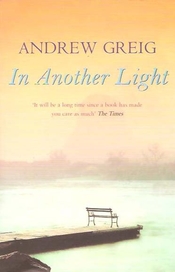
In Another Light by Andrew Greig

Pheonix, 2004, 510 p.

In Another Light cover

Love, sex and death again; but literature’s subject matter doesn’t get any bigger. And Greig deals with them superbly.

In In Another Light it is death which is the early preoccupation of Eddie Mackay, though love and sex do get a look in. Prior to the immediate events of the novel Eddie suffered from hydrocephalus as a result of a colloid cyst which meant fluid built up in his brain. He therefore feels the imminence of extinction everywhere, “‘Because I was nearly dead once and I’m trying to live with that.’” During his recovery from having a shunt fitted to drain the fluid from his brain to his stomach Eddie experiences the presence of his dead father, who according to Eddie’s mother had, long before she met him, been sent home in disgrace from Malaya after an affair with his superior’s wife. Eddie doubts the truth of this but sets out to find as much as he can about his father’s time in the colony. Eddie is working for a tidal generation project whose headquarters overlook Scapa Flow in Orkney. The jungle drums and the tangled relationships of Stromness become a running theme in the book. Of comments about his liaison with Mica Moar, another of Greig’s complicated female characters (a bit – but only a bit – like Kim Russell in Electric Brae) he says, “‘In my experience there’s only one way to keep a secret in a wee town’ … ‘Plant the sapling of truth in a forest of rumours.’”

This strand of the book, delivered in a first person past tense looking back over the path which brought Eddie to the final scene, with occasional present tense interludes setting that scene, is intertwined with a third person present tense narration of the voyage of his father Sandy, as he was then known, to Penang in Malaya and his brief sojourn there. Medical graduate Sandy hopes to improve the birth survival rates in Penang’s maternity hospital. The boat out is a hotbed of illicit goings on of which deeply moral Sandy is mildly contemptuous. The acquaintances he makes on the trip, US citizen Alan Hayman and the two Simpson sisters, Ann and Adele, “both beautiful, one a gazelle” the elder of whom, Adele, is married and chaperoning the younger, are fateful. A further sister, Emily, also on the boat, is still a child. Each chapter contains several sequences from both stories, generally alternating. The greeting, “‘Oh, there you are,’” bounces around the two narratives. Both strands are thick with metaphor. The descriptions of Orkney and Penang make them almost characters in themselves – particularly Orkney. Certain images also resonate between the two locations.

The text is seasoned with sly critiques of Scottish attitudes, “I was in joyous life-affirming Scottish mode that morning and no mistake.” “Scotland’s a place where everyone explains what is not possible, that it’ll all end in tears, we’re here to make the best of a bad job then die and get a good rest till we’re woken up to be informed we’re damned.” To Sandy’s traditional toast “‘Here’s tae us, wha’s like us? Gey few – and they’re aa deid’” Hayman says, “‘You guys, you can’t even celebrate without bringing death into it.’”

Eddie’s thoughts occasionally stray back to the subject of death. He raises with us the question of “How are we to live in the face of the sure and certain knowledge we will lose parents, friends, lover, the whole shebang and caboodle?” only to answer it immediately with, “Wholeheartedly. Of this one thing I am sure.” Later he tells us, “It’s such a simple and shallow thing, death, only there’s no bottom to it and no way across.”

He reflects that maturity is, “knowing you’ve more or less arrived at yourself and the world will keep changing but you won’t much, and then living with that,” while, “Pure lust, I’d noticed, eventually collapses under the weight of its own contradictions – rather like capitalism, but much quicker.” However, “We need meaning, I thought. The world might not have any, but we need it,” and, “Meaning is something we have to make.”

Greig’s numerous characters are all well drawn, their behaviour sometimes unexpected and contrary. I wouldn’t go quite so far as the cover quote (from The Times) “It will be a long time since a book has made you care as much.” Not for me. At least not since the same author’s Fair Helen. He seems to have a gift for it. Add in computer programmes for generating music from tidal movements, the compromises of secret service work in the colonies, a thoroughly worked through plot (which admittedly may be a little too neatly tied in,) the perennial failure of true love (or lust) to run smooth and the whole thing’s a delight.

Pedant’s corner:- “‘I’d left my [gas] mask back in the Mess’” (the Mess? In the trenches in WW1?) Brechin Pier (does Brechin have a pier?) “for a while neither of them speak” (neither speaks.) “Stacked alongside the reference books are a series of different coloured hardback files” (is a series,) baragraphs (barographs,) the phrase, “he was sad under his funny,” (seems to be missing a final word,) furlough (is more a USian usage,) “The Moonlight Band play foxtrots” (plays,) “a think about what the heck’s he’s getting into,” (what the heck,) sub-periphrenaic abscess (a google search for sub-periphrenaic yields only a quote from In Another Light: Andrew Greig,) whigmalerie (spelling of Scots words can be variable but this is usually whigmaleerie,) murmers (murmurs,) Theramin Dr Who electronic music (Theremin: also Dr Who’s electronic instrument wasn’t a theremin which as an instrument should be lower case,) “he scooped more peanuts down his maw” (I suppose it could mean stomach here,) “a group of macaque monkeys come running” (a group comes,) “He’s stares” (He stares,) whispy (context suggests wispy,) tweaked it it (one it is enough,) an assortment of … appear (an assortment appears,) Siouxie and the Banshees (doesn’t she spell it Siouxsie?) vocal chords (it’s cords,) Arshak Sarkies’ (Sarkies’s,) for completeness’ sake (completeness’s,) light defraction (diffraction? refraction? or is this a portmanteau word Greig has invented?) became (in a present tense narration this should be becomes.)

Flemington by Violet Jacob

In Flemington and Tales from Angus, Canongate, 2013, 291 p, including 16 p introduction, 1 p each Acknowledgements, Note on the Text and Author’s Note, 14 p Notes and 6 p Glossary.

Another from the 100 Best Scottish books list. Again from a local (well, 9 miles away) library. The novel was first published in 1911.

 Flemington and Tales from Angus cover

As soon as the years in which this is set, 1745-6, are discovered certain expectations might arise, a focus on Bonnie Prince Charlie or his entourage, following the rising tide of his fortunes from the standard raising at Glenfinnan through his initial triumphs to Edinburgh and on down to England before the fatal loss of nerve at Derby and thence to his downfall. Jacob, however, is more subtle than this. The events of that last Jacobite rebellion are present here, to be sure, (the Battle of Prestonpans – here rendered as Preston Pans – the advance to and retreat from Derby, the Battles of Falkirk and of Drummossie Moor, otherwise known as Culloden, the bloody and vengeful aftermath of that final battle on British soil) but they occur offstage. Jacob’s focus is relentlessly on individuals, not the broad sweep of history or “great events”. Though the Duke of Cumberland does appear in Flemington’s pages as a character (and not in a flattering portrait) the Young Chevalier never does, except as the driving force for the dilemma into which our titular protagonist falls. The action takes place exclusively in the county of Angus and specifically in the area linking the towns of Forfar, Brechin and Montrose. It is in Montrose harbour that the sole military engagement described in the book – a fictionalisation of a very minor naval incident in the ’45 rebellion – takes place.

To prevent his mother compromising Prince Charlie, protagonist Archibald Flemington’s father was badly used by the Old Pretender in exile at St Germain. Archie was subsequently orphaned and put in the care of his grandmother who, due to those earlier experiences, is now a full supporter of the Hanoverian dynasty. Flemington is a painter but also a government spy trying to discern the plans of the rebel James Logie; to which end he turns up at the door of Logie’s brother, a retired judge. While Flemington is still undercover Logie reveals to him a personal confidence – unrelated to any Jacobite sympathies. This engenders in Flemington a sympathy for Logie which he will not thereafter compromise and so the central tragedy of the story unfolds.

The novel is full of well-drawn and memorable characters: Flemington; his grandmother; Skirlin’ Wattie, the no-legged bagpiper who travels about on a cart drawn by dogs; Callander, the Government Army officer who is dutiful to a fault. Despite his confidence granted to Flemington, James Logie is a shadowier character, though his brother Balnillo is portrayed in all his preposterousness. Wattie is the only one who speaks broad Scots. The context provides clarity enough but the glossary is there if needed.

One chapter begins, “April is slow in Scotland, distrustful of her own identity, timid of her own powers. Half dazed from the long winter sleep, she is often bewildered, and cannot remember whether she belongs to winter or to spring.” How true – especially redolent when reading it in Scotland, in April, and the passage is characteristic of Jacob’s writing which is especially strong on landscape description.

Flemington is an illustration on an individual human scale of the dislocations and traumas, the disruptions, which a Civil War brings in its train and of how character can both resist circumstances and be a victim of them.

I took the precaution of not reading the introduction before the story. Wisely, as the usual spoilers in such things were present.

Pedant’s corner:- I found the reference to English parents strange in a passage contrasting the thoughts of a Scots woman who had spent a long time in France with those who hadn’t. Also mentioned were English dragoons at Culloden. (I haven’t checked. Any dragoons may have been English, though certainly a large part of Cumberland’s army was Scots.) Dulness with one ‘l’?

Dumbarton 2-0 Albion Rovers

Scottish League Cup*, The Rock, 4/8/12.

A win and a clean sheet. It took us some time last season to achieve either of those – and this was a cup match, where our record has been none too strong for too many seasons now.

Still, this was against lower league opposition and we didn’t look that much better than them. I suspect the Wee Rovers will struggle in Div 2 as they didn’t look to have much of a cutting edge. We will struggle in Div 1, ditto.

We started off well but didn’t create much in the way of clear-cut chances then let them into it and they had a fair bit of possession in the first half. Our midfield seemed non-existent at times. Perhaps we’re making too much of Jim Lister’s ability with the high ball. The opener just before half time came from a corner, Brian Prunty reacting to the knockdown in the box – which may have come off their keeper or a defender (it was up the other end and difficult to make out.)

We were more in control in the second half. Jim Lister was one on one with the keeper after a horrible defensive mistake but shot it straight at him. Rovers have one of the smallest goalkeepers I can remember but he made a brilliant reaction save from Prunty a few minutes before we scored again. Another defensive mistake was pounced on by sub Mark Gilhaney (Scott Agnew had had a poor game before being hoiked) who squared it into Jim Lister’s path for a nice controlled finish.

Jamie Lyden was given the right back berth. He had an encouraging start last season at Brechin and East Fife, scoring in both games before losing his way and not featuring again. His confidence looked low to begin with here but I thought he came onto a game.

Andy Graham and Alan Lithgow were more solid at centre-back than last week but will be tested more severely when the league starts.

On to the real stuff next week.

*Okay: it’s the Scottish Communities League Cup now.

Spike

I noticed from my blog stats that I had had a spike in visitors a few days ago. The main search term was Glebe Park, Brechin.

Now why would people be searching for that?

It took me no time at all to realise, of course. And this link explains it further.

I suppose all these bemused punters were searching for information because they’d never been to Brechin before. Welcome to the lower leagues!

free hit counter script