Archives » Barcelona

Terry Venables

I was sad to hear of the death of Terry Venables, former footballer and England manager, with many strings to his bow.

Not least was that he became manager of Barcelona, whom he led to their first La Liga title in 11 years and to a first European Cup Final in 25 years. Soon nicknamed El Tel he had endeared himself to the fans just after his appointment by addressing them  in Catalan.

His interests outside football were less inspiring, with question marks over his business affairs.

More to his credit though was that along with Gordon Williams he was the co-creator of Hazell, a fictional TV detective. The pair also wrote a football based book together They Used to Play on Grass as well as several other novels featuring Hazell.

It is for his footballing legacy that he will be remember longest though.

Terence Frederick Venables: 6/1/1943 – 25/11/2023. So it goes.


Jim McLean

I’ve just seen a report of the death of Jim McLean, the man who led Dundee United to the greatest successes in their history (bar a Scottish Cup win.)

Following two earlier League Cup wins (themselves the club’s first major trophies,) in 1983 his stewardship found them winning the League and becoming champions of Scotland. With hindsight that seems even more remarkable than it did at the time. As I recall (but don’t quote me) they achieved that using no more than 15 players in total over the whole season.

The next season saw an even more incredible achievement, a European Cup semi-final (matching the effort of their city rivals, Dundee, from 1963.) Then there was a UEFA Cup final appearance (thereby eclipsing their neighbours) in 1987. The most astonishing statistic of the club’s European games under McLean’s leadership is their two wins against Barcelona (OK, they were not the force at the that time they were to become but it was still a huge scalp) in that EUFA Cup run. Curiously the club had also beaten Barcelona home and away in the equivalent competition, the Inter Cities Fairs Cup, in 1966.

Some controversy surrounded McLena’s treatment of players, especially as regards the details of their contracts, but he nurtured many who went on to forge big careers in the game. His relationships with members of the press were not always rosy though. He was a personality, no doubt.

As a pure manager, though, his record is nothing short of amazing.

James Yuille (Jim) McLean: 2/12/1937 – 26/12/2020. So it goes.

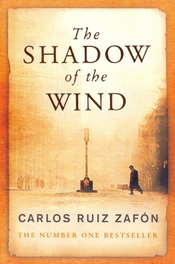
The Shadow of the Wind by Carlos Ruiz Zafón

Phoenix, 2005, 506 p, plus i p summary, i p about the author, ii p “For discussion”, x p “A walk in the footsteps of The Shadow in the Wind” including ii p maps. Translated by Lucia Graves from the Spanish La sombra del viento, Editorial Planeta, 2002.

The Shadow of the Wind cover

Well, this all started out promisingly enough with ten year old Daniel Sempere being taken by his father to the secret Cemetery of Forgotten Books to pick one out for himself, to keep it alive. This conceit hinted that the novel would be one of those books about books and the importance of the word like The Name of the Rose, especially since Daniel is told, “Every time a book changes hands, every time someone runs his eyes down its pages, its spirit grows and strengthens,” but the novel soon veers off into more conventional unravelling a mystery territory.

The book Daniel picks is titled The Shadow of the Wind by one Julián Carax. Daniel reads it and is enthralled, wishing to find out more about its author and any other books he may have written. But Carax is an elusive creature. Very few of his books (most of which sold in pitifully small numbers) survive. In addition a mysterious man going under the name Lain Coubert, a character in Carax’s Shadow of the Wind, is going around buying them up – in order to burn them. Already we are in a recursive situation, a loop which is in essence claustrophobic. Too many of the characters in the book are bound up either with Daniel, Carax or both.

Daniel’s first infatuation is with the blind Clara, quite a few years his senior. Their (necessarily) chaste relationship – and her entanglement with her piano teacher – is somewhat reminiscent of Gabriel García Márquez but as if off-key, though paradoxically, given Marquez’s magic realism, none of this aspect of Zafón’s novel feels natural. It appears forced, occurring only at Zafón’s will. Other backstories read like information dumping and there are too many parallels between Carax’s life and Daniel’s; between his friend Tomás Aguilar and Carax’s, Jorge Aldaya, between his first lover Beatriz Aguilar and Carax’s, Penélope Aldaya.

As an example of an authorial misstep Zafón has Daniel tell Bea about Carax’s The Shadow of the Wind that, “This was a story about lonely people, about absence and loss, and that that was why I had taken refuge in it until it became confused with my own life,” inviting us to draw a parallel that had been obvious long before. Yes, Daniel’s friend, Fermín Romero de Torres, is a memorable character but the villain of the piece, Inspector Francisco Javier Fumero, tends to the cartoonish, his obsession with Carax insufficiently founded – at least to me. There are, too, frequent recapitulations of the story to other characters. The Aldaya mansion on the Avenida del Tibidabo, though, is a gothic enough creation, along with the statues in its grounds.

Attempts at background verisimilitude also fall down at times. An old quack’s “sole remaining wish was for Barcelona’s football team to win the league, once and for all, so that he could die in peace.” This is an odd observation for someone to make in 1954 as Barcelona had most recently won La Liga in season 1952-3 and also the one before. Again in 1954 a restaurant manager apologises for poor service by saying, “‘But s’afternoon, it being the European Cup semi-final, we’ve had a lot of customers. Great game.’” The first European Cup semi-finals did not take place till 1956. Similarly there is a mention of the League Cup – but the La Liga Cup did not start till 1984 (and only lasted four years.) Did Zafón perhaps have the Copa del Rey in mind?

Still, “‘Mysteries must be solved, one must find out what they hide,’” and I suppose this is what keeps us reading but while it may be true that, “People tend to complicate their own lives, as if living weren’t complicated enough,” I’m not sure I agree with the assertion, “‘When we stand in front of a coffin, we only see what is good, or what we want to see.’”

Set where and when it is The Shadow of the Wind could not avoid touching on the fallout of the Spanish Civil War but it does so only tangentially. It is eminently readable but in the end it doesn’t manage to achieve the stature that the author is clearly striving for. Quite simply in this book Zafón is trying too hard.

Pedant’s corner:- “a couple of nuns …. mumbling under their breath” (ought really to be breaths,) polanaises (polonaises; this correct form is used later in the book,) “froze the blood in my veins” (really? Especially when followed on the next page by “my blood froze,”) the Barcelós apartment (Barceló’s,) for goodness’ sake (goodness’s,) automatons (okay it’s acceptable in English – as well as automata, the plural from the Greek,) “none of the drawings were more than rough sketches” (none was more than a rough sketch,) faggotry (a USianism,) “‘It’s my fault,’ I said. I should have said something…’” (missing open quote mark after “I said.”) “An act of charity or friendship on behalf of an ailing lady” (‘on the part of’ is meant,) “which violated at least five of six recognized mortal sins,” (shouldn’t that be “five or six”? – and violated here seems to mean committed,) morgue (mortuary,) with sudden heartfelt hug (with a sudden,) catlike smile the smile of a mischievous child (a missing comma after the first smile,) garoted (garrotted,) Jacintaʻs vision (has a backward, and upside down, apostrophe,) “so that he can have a brain scan” (a brain scan? In 1954?) Barnarda (her name everywhere else in the novel is Bernarda,) passion (passion,) a benzine lighter (the term used in English is cigarette lighter,) “and whose specialty was Latin, trigonometry, and gymnastics, in that order,” (that’s three specialties.)
Plus points for “not all was lost”.
Sólo otro club

In one of the least unpredictable transfers of this summer Liverpool’s troubled (and troubling – the guy clearly needs help) star striker Luis Suarez has moved to Barcelona, no doubt to the benefit of his bank balance. The only question was over his destination. As he made no secret he wished to play in Spain the other option would have been Real Madrid.

Barcelona’s motto, emblazoned on the seats in their stadium, the Camp Nou, is “més que un club” (more than a club.) Such a claim to moral high ground is somewhat undermined by their acquisition of a serial perpetrator of assaults; assaults which if carried out in any other walk of life might have seen their author up before a magistrate.

Suarez’s gifts as a footballer clearly outweigh any consideration of propriety (or indeed of the player’s inner well-being: he is not going to change his behaviour when it is rewarded like this.)

It seems Barcelona is sólo otro club (just another club) after all.

Chelsea 1-0 Barcelona

Champions (sic) League (sic) Semi-Final, first leg. Stamford Bridge, 18/4/12.

Paint drying.

(I only watched the second half, but still.)

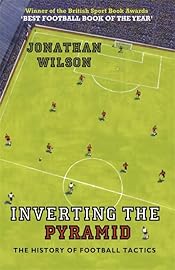
Inverting The Pyramid by Jonathan Wilson

The History of Football Tactics, Orion, 2008, 356p.

This book does exactly what it sets out to, describing the evolution of football tactics from their formless beginnings when everybody on the pitch, apart from the goalkeeper, dribbled towards the opponents’€™ goal with team mates ‘€œbacking up’€ in case the ball was lost, through the invention of passing (or, as it was delightfully phrased, combination play; I like that, let’€™s bring it back) in Scotland, the first real formation of 2-3-5 – one of whose pioneers was my beloved Dumbarton – mentioned on page 23 but not, alas, in the index – in winning their sole Scottish Cup in 1800 and long time ago, 1883 to be precise: its gradual stalemating till the offside law was changed in the 1920s to allow only two defenders between ball and goal line which in turn led to the withdrawal of the centre half into the back line of a 3-2-5 and the ‘€œclassic’€ three defender, two half back, two inside forward, plus centre forward line-up of the W-M or W-W. The later adaptations of this formation (in some cases, as in Great Britain, very much later) via the diagonal, through the deep lying centre forward, 4-2-4, 4-4-2, 4-3-3 and 3-5-2, by which time the pyramid of the book’€™s title had been inverted, leading on to 4-5-1, even 4-6-0, plus the variations of all of these and the pressing game, are given their place and their innovators due recognition.

In particular the histories of football in various countries, Brazil, Argentina, Italy, Austria, Hungary, the USSR, the Netherlands, England, even a foray into the Scandinavian experience, and the life histories of the various coaches concerned, are admirably laid out as is the tension between attack and defence, creativity and negativity, craft and effort. Through it all the importance of system is a given. A well-organised and drilled side will always beat a disorganised one, or one following too rigid a previous template, provided the system is understood and adhered to.

The tendency for any innovations to be imitated at first mainly in a defensive sense is noted and in passing the notions of Charles Reep and Charles Hughes of direct football being particularly effective is knocked on the head, even on statistical grounds. In some cases it can be, as can any system, but against good players who can keep possession directness will fall down.

Whether football’s evolution has ended is a moot point but in the modern world with global TV coverage and worldwide scouting it is unlikely any team will be able to spring a truly revolutionary tactical surprise. But then again before that offside law alteration there had been little or no tactical change for around thirty years. In Britain, the W-M then held sway for another forty or so.

But the centre half disappeared as a half back, wingers disappeared, full backs became wing backs, wing halves and inside forwards turned into central defenders or midfielders, who evolved into holding players or playmakers; and the playmaker has all but disappeared. The centre forward may go the same way. (I would say that, arguably, with Barcelona, he already has. Messi is not a centre forward, Villa and Pedro tend not to play up the middle.)

In modern football flexibility within a system is a key ingredient, and fluidity. Modern players at the top level are no longer specialists in the way they were. Everyone is an attacker and defender at the same time. (However some will always remain more gifted and more general than others. At the level I watch football the demarcation of roles is still pronounced. I doubt that will change soon.) Football is actually a game played with space – or denying it – and not really with the ball. But, as Barcelona demonstrate, possession, keeping it and regaining it, certainly helps.

The book has occasional infelicities of the sprung for sprang type and a few typos but for all those interested in football and how it came to be the way it is this is a wonderful, informative and illuminating read. I thank my younger son for lending it to me.

It’s Not Just Me, Then

I see from The Guardian that Jamie Jackson too has doubts about the desirability for Cesc Fabregas’s playing future of a return to Barcelona.

You read it here first.

Don’t Do It, Cesc

Can anyone understand why Arsenal’s Cesc Fabregas would want to sign for Barcelona?

OK they were his boyhood team, but Everton were Wayne Rooney’s and he soon enough shook their dust off his feet.

Then again Everton were unlikely to win anything (in the short term) and I suppose Arsenal don’t look like doing that either. They certainly won’t if Fabregas leaves – and Nasri along with him. Barcelona regularly win competitions; for the moment.

But Rooney was a certainty to play for Manchester United – still is (if he can bring himself to do what his manager tells him, anyway.)

That would be far from the case if Fabregas returned to the Camp Nou.

Consider. He is a midfielder: and he wants to join the club with the best midfield in the world? To get a game he would have to supplant either of Xavi Hernandez or Andrés Iniesta both of whom are at the top of their game and unlikely to retire any time soon. The lure of playing alongside these luminaries – not to mention Lionel Messi – is of course strong and he would be returning to a club and a culture with which he grew up and is familiar. But he would be a small fish in a big pond, used most often as a substitute (if at all) whereas at Arsenal he is the main man, the team’s fulcrum, and much respected.

Be careful what you wish for, Cesc. The grass may not be greener back home.

Rep. Ireland 1-0 Scotland

Carling Nations Cup, Aviva Stadium, Dublin, 29/5/11

It was almost inevitable the Republic would win this. They were at home after all.

Again I’ve missed the goal, but I’ve heard this game was dire – not even a patch on the English League 1 play-off between Peterborough and Huddersfield. People just lumping the ball forward; no passing, no Barcelona style passing anyway.

In that case neither of these two sides will trouble the 2012 European Championships.

El Non-Clasico: Real Madrid 0-2 Barcelona

UEFA Champions League (sic) semi-final, first leg, Santiago Bernabeu Stadium, Madrid, 27/4/11

This season’s quarter-finals notwithstanding, matches in the so-called Champions League are frequently sterile affairs with teams tending to cancel each other out. There is perhaps too much at stake for the football to be anything but efficient and relatively unimaginative.

This exemplified the trend. This was unedifying watching at best, ugly at worst. A petty, ill-tempered, niggly, fractious affair. A playground tiff interrupted by flashes of football. The residue of too many games between these two in the recent past I suppose.

The play-acting was reprehensible and the questioning of the referee’s decisions went too far; not to mention him being mobbed at times. And as for players asking officials to show cards – red or yellow – to opponents, well it’s about time this was made an offence in itself. If I was a ref I’d be tempted to treat it as dissent and act accordingly. But then I suppose a ref who did this would not stay a ref for long.

In the end we got three sendings off – one of a player who, due to a fight among the subs at half time, never even set foot on the pitch!

The home side played defensively – and still lost. They might also have lost if they had tried to attack but the spectacle would have been more bearable. Whether the imbalance of numbers made the telling difference to the result is of course difficult to assess.

As it was Jose Mourinho’s tactics were far from what the name of Real Madrid is supposed to stand for, a betrayal of the club’s attacking traditions.

The beautiful game this was not.

Except for one flash of genius which wasn’t enough to redeem what had gone before.

free hit counter script