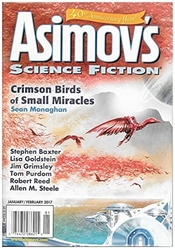
Asimov’s Science Fiction January/February 2017
Posted in Reading Reviewed, Robert Silverberg, Science Fiction at 10:00 on 22 March 2017
Dell Magazines
Sheila Williams’s Editorial hails Asimov’s 40th year of publication, Robert Silverberg’s Reflections solicits two cheers for Piltdown Man, James Patrick Kelly’s On the Net: Ask Me Anything compares various digital assistants, in On Books1 Paul di Filippo reviews eight books (including one I have reviewed for Interzone.) I was under the impression that Lavie Tidhar’s Central Station was a fix-up novel. di Filippo writes about it as if unaware of this.
As to the fiction. In Crimson Birds of Small Miracles2 by Sean Monaghan the father of a daughter with a terminal brain disease takes her and her sister to see Shilinka Switalla’s artwork, a flock of robot birds doing murmurations, as these excursions seem to help her. This story had an illustration of a strange attitude to wealth. The father has a good business, can afford increasingly complex prosthetics for his sick daughter, can take his children to various different planets but reckons he could never be rich in the monetary sense. Yet he quite clearly is.
Tagging Bruno3 by Allen Steele. On Coyote, a moon in the system 47-Uma, a former soldier is roped in to act as guide on a project to tag an indigenous bird-like species (boids) dangerous to humans but under threat of extinction due to human hunting activity. It goes quite well till the expedition encounters a flock which turns the tables on them.
Still Life with Abyss by Jim Grimsley is set in a project researching the only individual in all the multiple universes who has never caused a fork in time.
In Fatherbond by Tom Purdow, new arrivals on a colony planet begin to work against the entity which seeks to restrict their actions. (It’s tempting to read this as a metaphor for the pre-Revolutionary government of North America which forbade expansion westwards, the desire to overthrow which ban -rather than the confected protest about taxation – being the true reason for the War of Independence.)
Winter Timeshare4 by Ray Nayler shows us the annual meeting of two people who inhabit bodies (dubbed blanks) for their one holiday each year which is always in Istanbul, whose surrounding hills are the location for sending volunteers on a one-way trip to space. Despite their purchasing power blanks are resented by the “normal” locals. For a reason not particularly obvious the job of one of our protagonists involves simulating the Peloponnesian War.
Two young girls in the LA area in Lisa Goldstein’s The Catastrophe of Cities investigate strange houses wherein they glimpse oddly shaped people and passageways lead elsewhere. They drift apart on puberty, one seemingly dropping out of existence. In much later life the other seeks her out.
Robert R Chase’s Pieces of Ourselves5 is the tale of a survivor of a terrorist attack on a moon base who may have assimilated character traits as a result of her experience.
Jack Skillingstead’s Destination6 features a man who has not been outside the confines of his gated work community since being plucked from his childhood home after displaying high aptitude being told by his bosses to take part in the game Destination, essentially a mystery tour by taxi. Outside is not what he thought.
The Meiosis of Cells and Exile by Octavia Cade is structured around the life of Soviet biochemist and neuroscientist Lina Stern. On a train to exile in Dzhambul her body buds sequentially (or else she hallucinates) three of her former selves, the Academician, the Child, and the Scientist. Each is equated with a function of the blood-brain barrier.
Starphone by Stephen Baxter is set in a post ocean-rise world where flood refugees are kept inside domes. Some teenagers plan a short escape to test the Fermi Paradox by making an Allen Array with their mobile phones.
In Blow Winds, and Crack Your Cheeks7 by John Alfred Taylor a couple celebrates the last time it will be safe to witness a storm at their island home. The damage it causes is still substantial even though the hurricane’s eye passes thirty miles out from shore.
Robert Reed’s The Speed of Belief8 is a tale of three entities, two immortals with bioceramic brains, one normal human, on their way to a planet where the rivers are sentient. I really couldn’t make much of this. Perhaps I was too tired when I read it.
Pedant’s corner:- 1 again di Filippo uses stefnal for science-fictional – it still looks odd to me, “compare that man to somewhat callow fellow” (to the somewhat callow fellow.) 2a dark red button-front jumper (a dark red cardigan, then?) base reliefs (bas-reliefs, I think,) 378.2 inches (how can you decimalise a non-metric unit?) “a small red crosshairs” (a implies singular, crosshairs is surely plural; there was “a green crosshairs” later,) “Carbon testing of boid skeletons had shown they could live as long as thirty-five years” (leaving aside the question of whether 14C would exist on this world at all, unless the carbon testing is somewhat different from on Earth it could do no such thing; 14C dating only yields the time elapsed since death,) a missing end quote mark, sole causality (casualty.) 4Bosporus (I only ever saw Bosphorus when I was young,) causal (casual was intended.) 5 “started at her intently” (stared.) 6 “an approved media” (it was one of the social media; so medium.) 7grille (grill, used earlier in the story.) 8 “with every sort of creatures” (creature.) “But the dense native air was heavily oxygenated, and the bedrock had been scorched clean of its forests and soil.” (This is stated to have been done by wildfires. The oxygen would have to be remnant then as there will be nothing to replenish it,) “carefully tailored frame: The long body” (no capital at “the”.) “Mere notice what was different” (noticed,) forbad (the usual form is forbade.)
 Sarah Pinsker’s Guest Editorial That’s Far Out, So You Read it Too? muses on the connections, and the similarities, between SF and music. Robert Silverberg’s Reflections examines the possibility and desirability of resurrecting the Dodo genetically. Peter Heck’s On Books1 discusses novels by Lois McMaster Bujold, Charles Stross, Pierce Brown, Tim Powers, Indra Das and Lavie Tidhar.
 Editorial: Our Slightly Spooky Issue Asimov’s1 by Sheila Williams reminisces about all the issues of Asimov’s tinged with the uncanny which she has published around Halloween time.