Arbroath Abbey (ii)
Posted in Trips at 14:00 on 12 July 2025
Information board:-

More of Abbey ruins:-


Part of tower:-

External gateway:-

Reverse view of Gateway:-

Posted in Trips at 14:00 on 12 July 2025
Information board:-
More of Abbey ruins:-
Part of tower:-
External gateway:-
Reverse view of Gateway:-
Posted in Trips at 19:00 on 10 July 2025
It wasn’t just William the Lion’s grave I photographed at Arbroath Abbey.
Model of the Abbey in its heyday (in visitor centre):-

Other view:-

Information board:-

Ruins from visitor centre:-

Looking back to visitor centre:-

Part of Abbey:-


Posted in History, Scotland at 12:00 on 8 July 2025
We had meant to visit Arbroath Abbey for some time but did not actually do so till last year. (We had tried the year before but the Abbey was undergoing some restoration work so access was limited and we decided against it.)
William the Lion was the longest reigning king of Scotland before the 1603 Union of the Crowns. He was the first Scottish king to arrange an alliance with France. His epithet ‘the lion’ did not relate to military prowess but rather to his banner the red lion rampant on a yellow background, still the banner of Scottish monarchs though frequently used as a symbol of Scotland itself and often brandished at sporting events.
Domestically his reign saw legal and local government reforms but disputes with English kings and his attempts to regain the Kingdom of Northumbria were not so successful.
William is credited with founding the Abbey at Arbroath, so to find his grave there is not surprising.

Posted in James Robertson, Reading Reviewed, Scottish Fiction at 23:30 on 21 August 2012
Penguin, 2011, 671p.
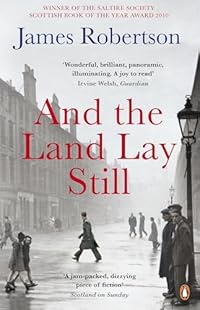
This is an ambitious novel which attempts to encapsulate the Scottish experience from the Second World War till the aftermath of devolution – an endeavour in which it succeeds admirably. As such it can be at times something of a history lesson but the outlaying of political events is almost incidental, the focus is always on the characters and their relationships both with each other and the nation as a whole.
Set mainly in and around the fictional Central Scotland towns/villages of Wharryburn and Drumkirk but never fearing to venture further afield, there is a multiplicity of narrative viewpoints. We have photographer Michael Pendreich, son of his fellow photographer father Angus; Don Lennie and his friend, a troubled former Far East PoW Jack Gordon; the original Mr Bond, an employee of the Secret Service, who is given the job of monitoring nationalist sentiment in Scotland; journalist Ellen Imlach; Tory MP David Eddelstane and not a few others. The plot hangs around an exhibition of his late father’s work which Michael is arranging. The various characters’ stories are intertwined and overlapped, elaborated and refined; all against the unfolding backdrop of the ups and downs of the campaign for an independent Scotland from the removal of the Stone of Destiny from Westminster Abbey in 1950 and its return in Arbroath Abbey onwards. Along the way Robertson allows some of his characters to express that socialist viewpoint and analysis of affairs which is rarely heard nowadays but was at one time so common. The book illustrates how much has changed in such a relatively short time.
At once nostalgic and elegiac, at times verging on the mystical, And The Land Lay Still is nevertheless somehow right. To anyone who lived through the latter half of the twentieth century in Scotland, the background events will strike resonances and evoke memories (even of things all but forgotten.) There is, too, a sense of roads not taken, of unfinished business, of resolutions to be made.
The writing is measured, assured, agreeably subtle and, despite the page length, economical.
For anyone interested in the recent Scottish experience or in Scottish literature in general this is a novel that should not be missed.
