Archives » Science Fiction

Farewell Earth’s Bliss by D G Compton

Tandem, 1971, 187 p. Originally published in 1966.

The story starts on the annual ship carrying the latest deportees to a penal colony on Mars. They have been given false names to hide their identities and their food has been drugged to calm them. Nevertheless, there is still room for conflict on board, as exemplified when “Jacob,” (sensitivity warning) is called a nigger. The text also uses the word negro about him and later he is even addressed in dialogue as “Sambo.”

On arrival they are treated summarily by the previous deportees. Their remaining food is confiscated supposedly to be redistributed to the colony. Even though all on Mars are criminals (whether actual or perhaps political) this is a strict system run by the Governor, assisted by his henchmen. There is too an emphasis on religious observance, with partly misremembered prayers/texts since few books are ever brought on the one way trip.

The Mars presented here is not quite as we know it these days. There is an atmosphere of sorts (but still deadly if exposed to it,) there is an indigenous wild life food source, dubbed rabbits, and a moss which they eat and which is also edible by though not really palatable to humans.

The newcomers are in effect on probation in their new environment, having to fit into the customs which have evolved in the colony with any transgressions being treated harshly.

Jacob is taken on by the “rabbit” hunting group who one day witness what could be interpreted as a miracle like the burning bush, but which one of them rationalises as an escape of natural gas.

The governor is keen to exploit this phenomenon but at one point has an odd thought about his secret lover’s “female lack of the ability to let things ride. The lack that was her greatest strength.”

The attitudes depicted here are homophobic as well as being racist. I suppose for a book published in 1966 that’s not too surprising.

Compton was reasonably well regarded in his time. This isn’t one of his best, though.

Pedant’s corner:-  “had been found inacceptable” (inacceptable is archaic; modern usage is ‘unacceptable’,) a missing full stop at the end of a sentence. “On earth” (On Earth,) ditto “‘But we aren’t on earth.’” A missing comma before a piece of direct speech, “photo-synthetiser” (nowadays this would be ‘photo-synthesiser’,) “hread-like” (thread-like,) “ a ryme of red dust”(rime,) Phobus (Phobos,) “‘Shadrak, Meshak, Abednego’” (Shadrach, Meshach, Abednego.) “‘That a euphemism’” (That’s a euphemism’,) “insistant hunger” (insistent,) Daimos (Deimos,) “‘The though. makes me’” (The thought makes me,) “illegally horded” (hoarded,) “could never have born the skin against his skin” (never have borne.) “Three of Dickens’ novels” (Dickens’s,) “‘it dosn’t mean’” (it doesn’t mean,) fidgetted (fidgeted.)

Darkome by Hannu Rajaniemi

Gollancz, 2024, 252 p. Reviewed for ParSec 12.

The book is set in the near future, after a series of disasters known as the Decade of Plagues. Most people now have an ASPIS chip, a miniature mRNA factory capable of immunising against viruses as they appear. The price is your bodily chemistry, and anything that affects it, is known to the authorities. Another apparently universally used technology is a device known as Eyes, a sort of superannuated smart phone, head worn – but can also be hand held – goggles of a sort, allowing internet contact, and blink-activated. These are treated as unremarkable, everyday objects.

Our protagonist Inara has been living in The Harbour, one of a number of Darkome villages, a network of conscientious objectors to the big-tech likes of ASPIS, where people live off-grid and construct their own anti-viruses. Like all women in her extended family Inara has the rare Li-Fraumeni syndrome. Her body lacks the crucial protein named p53, which guards against damage to DNA and kills mutated cells. As a result, she is a tumour hotbed. At seventeen she has fought cancer twice and bears the scars to prove it. Her mother had been trying to find a cure but failed and died of a brain tumour. Inara is trying to carry on the work using her mother’s cells as test subjects.

This youthful not-quite idyll comes to an end when her father manoeuvres her into enrolling in an ASPIS trial called PROSPERITY-A, which can detect pre-cancerous mutations and target them, therefore nullifying her lack of p53. Inara’s decision to comply means she has to leave The Harbour, and boyfriend Jerome.

Some while later, living in rented accommodation which she can’t afford, she discovers a lump in her breast, a lump which ought not to be there if her aspis is working properly. Somewhat unseriously, both on Rajaniemi’s and her parts, this malignancy is referred to as the Heffalump. The replacement aspis she requests also quickly malfunctions and she slowly realises that the Heffalump’s cells have the ability to hypermutate, and may be able to take over the aspis. Not that she knows quite how that works. Nevertheless this is an ability Darkome has been looking for, the capability of an aspis-jailbreak.

Her discovery kicks the story into thriller mode as Inara seeks to alert Darkome and bargain with ASPIS. Stepping into the lion’s den of ASPIS headquarters she finds all sorts of skulduggery occurring and mayhem arising.

The text is full of biochemical terminology which in a story like this is necessary though may be off-putting to some. But if it is, just plough through it. No harm done.

Inara is an amply engaging protagonist in a ‘it’s me against the world’ kind of way – lone hero(in)es have of course long been an SF staple. (Not so much the heroines, to be fair, at least until recently.) However, other characters can at times feel as if they are there only for her to react against. But this is in the end a thriller. The form demands that sort of thing.

Normally the presence at a book’s end of the phrase TO BE CONTINUED (in those capitals) might have felt something of a let-down. Inara’s story and situation are, though, intriguing enough to welcome the thought of being reacquainted.

The following did not appear in the published review.

Pedant’s corner:- “in vitro” (possibly an uncopy-edited authorial instruction to italicise. In the old days before word-processors, underlining took that function. in vitro, then, which did appear later,) “there was no way for two Aspises fail on me in a row” (for two Aspises to fail on me,) “a mRNA drug” (since the letter ‘m’ is pronounced as beginning with a vowel this would more naturally be spoken as ‘an mRNA drug’,) “‘to cover these, ,’ he said” (no need for the extra space and comma.)  “‘Aaaand there is’” (no idea why this is represented as an extended ‘ah’ sound,) “Ca2+ channels” (Ca2+,) zmey (elsewhere zmey,) “drivers’ licences” (driving licences, please.)


Clarke Award Shortlist 2025

This year’s nominees are:-

Private Rites by Julia Armfield (Fourth Estate)

The Ministry of Time by Kaliane Bradley (Sceptre)

Extremophile by Ian Green (Ad Astra)

Annie Bot by Sierra Greer (The Borough)

Service Model by Adrian Tchaikovsky (Tor UK)

Thirteen Ways to Kill Lulabelle Rock by Maud Woolf (Angry Robot)


I’ve read none of them.

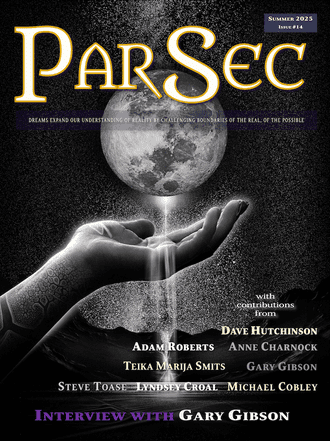
ParSec 14

Issue no 14 of ParSec magazine is now available.

Among its other goodies this one has my reviews of:-

If the Stars are Lit by Sara K Ellis

Orphan Planet by Madeehah Reza

The Hamlet by Joanna Corrance

Dark Crescent by Lyndsey Croal


And a ParSec Review Comes Round Again

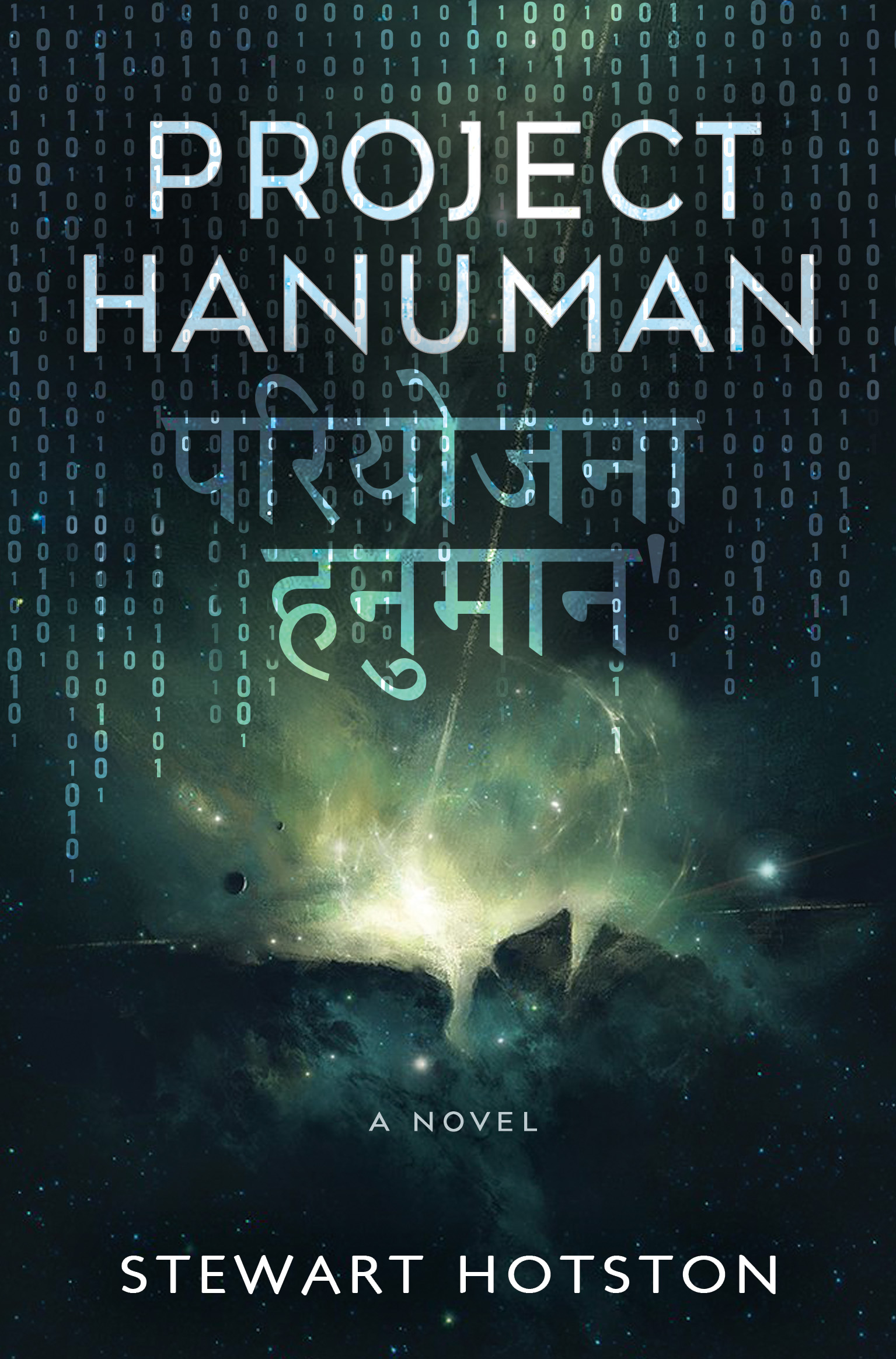
This one is called Project Hanuman and it’s by Stewart Hotston.

I’ve not read anything by Hotston but the blurb for this sounds like it’s Science Fiction. Huzzah!

It also seems like it’s inspired in part by Indian mythology.

Another Review

Yes, they come thick and fast. This one will be for ParSec 15.


It’s The History of the World by Simon Morden. I can’t find a cover for it at the moment, though.


Amazingly it’s actually Science Fiction. Sometimes recently  it has seemed as if the publishing of SF had dried up.

Aliens for Neighbours by Clifford Simak

Four Square, 1963, 157 p.

This is a collection of Simak’s stories from the 1950s, with one from 1960, and they show their age. The connecting thread of the book is that each story features aliens of one sort or another.

In Dusty Zebra things start disappearing from narrator Joe’s desk and other things appear. Joe ends up trading with the unknown entity on the other side of what it seems is an interdimensional portal. All goes well; until it doesn’t.

Honourable Opponent sees a military delegation from Earth’s Galactic Confederacy awaiting the arrival of their counterparts from a species known as the Fivers, whose weapons have been overwhelmingly devastating, to oversee a prisoner exchange. There is a twist to the meeting when it comes.

Idiot’s Crusade has a village idiot suddenly comprehending things he had not until his mind was infiltrated by an alien; but the alien finds the experience less than congenial.

Operation Stinky occurs in the aftermath of a skunk-like animal (later dubbed Stinky) befriending a farmer whose life has been disrupted by the building of a nearby air-force base. When the air-force colonel discovers Stinky has the ability to improve machinery the secret operation of the title is started up. Stinky has its own agenda, however.

A group of interstellar scavengers searches for the Jackpot of the second last story’s title and finds it in a comprehensive library with an immersive access experience. The process changes them. One of the group justifies their activities by citing historical precedent for exploitation, “They didn’t worry much about the law or ethics of it and no-one blamed them for it. They found it and they took it and that was the end of it.”

In Neighbour a newcomer arrives in a small farming area and has sustained success on the farm he and his family have taken over. His machines work by themselves and he has rain and sun when required. His benign influence gradually extends to the neighbourhood as a whole. It is eventually noticed elsewhere. The text displays that mistrust of government embedded in much of US society – especially the rural US.


Pedant’s corner:- swop (swap,) “Alf Adams’ place” (Adams’s,) “and and could find none” (only one ‘and’ needed,) “how I’d lay awake at night (how I’d lie awake,) “when one of the new ones up and moves away (ups and moves away.)

Birdwatching at the End of the World by G W Dexter

NewCon Press, 2024, 213 p. Reviewed for ParSec 12.

The pitch for this post-apocalypse novel must have written itself. “Lord of the Flies – with girls.” Job done. Don’t you want to read it now? (No matter what I say.)

Nevertheless, a reviewer must review.

The story is set in an alternative 1975 on the largest of the Near Islands, an entirely fictional small archipelago located fifteen miles from Aberdeen. The girls are survivors of a nuclear attack on that city in what becomes obvious must have been a world-wide war. Most of the school’s pupils and teachers were away on a trip when the bombs fell.

The tale is narrated in retrospect (of a few years later) by the only boy, Stephen Ballantyne, son of the headmistress who took advantage of the convention that such children attend their parent’s school. All but one of the girls plus Stephen survive but his mother dies in the second blast.

A classic children’s story arrangement, then, with the parents out of the way and no other adults at hand. But these are not youngsters. They are fourteen- or fifteen-year-olds on the cusp of adulthood forced to rely on their own resources, albeit with a well-stocked library at hand. It helps the island is well-endowed with rabbits and sea-birds – not all of them palatable though.

The writing style is more irreverent than you might expect, with stabs at levity (one running joke in particular) and occasional addresses to the reader. It is at times consciously alliterative. In Dexter’s outlining of his scenario he has narrator Stephen tell us one girl’s name evokes “the milky mystery of midnight mosques.” And he eschews describing foul-mouthed language, “This is, after all, an adventure story set on a desert island.” Stephen also claims his greatest fault is self-effacement.

Step forward Pearl Wyss, “the smallest and mousiest-looking of the girls,” who had previously shown her mettle on a trip to a farm on the mainland for a demonstration of artificial insemination and, invited to repeat the farmer’s no doubt spitefully given information, does so flawlessly. Pearl becomes the driving force behind the rump school’s efforts to ensure survival, steering their debates and swaying (most of) the girls with her arguments.

Her awareness of the treatment of women by men down the ages colours her approach: watches to be set for any encroachment from the mainland, the building of a stockade and later a wall, the reconstruction of the curriculum to be more useful in their straitened circumstances, the manufacture of bows and training in shooting arrows.

The first man to arrive – on a rowing boat – only confirms her fears when he attempts to rape one of the girls. He is thereafter caged and ostracised.

Not all the girls agree with her. Some of their worries, such as wanting to get married in due course, a future Pearl’s prescriptions would seem to deny them, exemplify attitudes of the time where it is set. But her answer to that problem of course lies in front of them all the time. She is willing to be ruthless in defending the school against incursion by men no matter how inoffensive they may appear to be or even if they’re accompanied by women. Towards the book’s climax she says, “We make war because we hate war.” Turning into her enemy? All through the book Stephen acquiesces in her designs but in the final paragraphs he lets his air of self-effacement slip.

In an enterprise such as this it does not do to become bogged down on the details, the scenario is all. But two A-bombs dropped on Aberdeen? One would surely be enough. And how likely was it that a single mother in the 1970s would have become a headmistress; particularly of a girls’ school? Plus radiation sickness would most likely have been more prevalent than is presented here.

These are nit-picking, though. This may be no Lord of the Flies but it is still a well written, solid piece of work. In its essence it is not concerned about girls or women or whether they behave better or worse in any given situation. It is really about the nature of men and whether that nature will ever change.

The following did not appear in the published review.

Pedant’s corner:- H2O (H2O,) knit (knitted,) rowboat (several times; rowing boat,) E=mc2 (E = mc2,) focussed/unfocussed (x 2 each; focused/unfocussed,) airplanes (aeroplanes,) Benn Gunn (Ben Gunn,) “a saree” (a sari,) a sentence framed as a question but lacking its question mark, row-boat (x 2; elsewhere rowboat but in any case ‘rowing boat’,) “‘any who disagree this choice’” (who disagree with this choice.)


Hammajang Luck by Makana Yamamoto

Gollancz, 2024, proof copy unpaginated. £22.99. Reviewed for ParSec 13.

AT THE REQUEST OF THE BOOK’S PUBLISHER MY REVIEW OF THIS NOVEL WAS WITHDRAWN FROM ParSec 13. I felt under no obligation to refrain from publishing my review here.  As a result of that request, though, I have made an amendment to the original withdrawn review; the two words highlighted in bold below.

We meet Edie (Edith, but she doesn’t like it) Morikawa as she is about to be released on unexpectedly early parole after eight years in prison. The last person she imagined would meet her is Angel Huang, her former associate whom she assumes grassed on her to ensure her own freedom. On the way up to Kepler Space Station, which orbits the Rock, the planet where the prison is located and seems to be otherwise uninhabited, Angel offers her a place on a team to carry out a robbery with a potentially stupendous pay-off. Edie refuses since she desires to go straight in order to help her sister Andrea, who has two children, Casey and Paige, and another on the way, courtesy of useless partner Tyler. Paige has cancer and needs gene therapy, but there is no money to pay for that.

(I note here a failure in imagination. Perhaps that’s the way the world will go, but even in a supposedly distant future, light years from Earth, a more equitable health care system, or indeed social system, than that which exists in the USA of the present day seems to be inconceivable to the author. But I suppose it gives the author a lever to manipulate their heroine.)

Staying on the straight and narrow will require Edie to find a job, helping Andie out at the shop where she works won’t do. But Edie has been blacklisted by Atlas Industries, which seems to control everything on Kepler. Its head and founder, Joyce Atlas, (a man despite the forename) was the intended target of Angel’s planned sting. Angel’s offer is the one thing that promises anything hopeful. When the reader finds out Angel is Atlas’s chief of security s/he is well ahead of the narrative in knowing exactly who did the blacklisting.

A curiosity of this novel is that most of the main characters are of Hawaiian heritage and occasionally speak in Hawaiian patois. (The blurb describes the book as a love letter to Hawai’i.) No matter. SF readers are used to the odd unfamiliar word or phrase, such as the one used in the title. Hammajang is a Hawaiian pidgin word meaning in a disorderly or chaotic state; messed up. Mention is also made of a Korean heritage area of Kepler. Oddly, there seems to be little attempt to assimilate there.

We are shown as much of Kepler as is needed for the plot, which runs along the lines expected from its set up. The space station must be quite large what with Atlas Industries and the different environmental and maintenance levels described. SF elements to the book are fairly incidental though; not much has gone into fleshing out this future scenario. While Kepler has an artificial sun and a simulated night sky, there is the usual layering of habitats, the lower levels grimy and dim, the upper airy and bright. In Angel’s gang Cy has a cybernetic arm and Tatiana has mods. Atlas Industries is developing a method of accessing people’s memories, provided they have a mod. However, Joyce Atlas does not come over as the sort of person to accrue a fortune as a business head – and, if he was, he would surely not succumb to the sting as presented.

Parts of this scenario strike as being very old-fashioned. There is a railway station (and presumably others) on Kepler, plus buses and a monorail. It has the feel of a city on Earth in the late twentieth century rather than a future space habitat light-years away. People – well, Edie – smoke cigarettes.

It’s easy enough reading, and totally undemanding, but there is no particular reason why this novel has to be SF. It’s a crime novel with a few SF trappings.


Pedant’s corner:- I read an ARC (proof,) so some or all of these may have been altered for final publication. The spelling ‘jewellery’, though the text was in USian, “florescent lights” (fluorescent; used later,) “under Joyce Atlas’ watch” (lots of instances of Atlas’ for Atlas’s, of which latter there was one example,) “as a I left” (that ‘a’ is superfluous,) “savouring our respective vises” (I know vise is USian for the clamping device. Do they also use it for character flaws?) “no one would risk cross risking Atlas” (no one would risk crossing Atlas,) “grew into hotspot” (into a hotspot,) “Morris’ deal” (Morris’s,) “part of tWard 2” (of Ward 2.) “I creeped back” (I crept back.) “I was surprised by Tatiana’s alas to go after Solstice” (desire makes more sense,) “an empty k3rb” (kerb, though curb for kerb was on the previous page, so why the shift?) “of thieve’s self-esteem” (either thief’s or thieves’,) “from the keb” (from the kerb.) “‘Every one of his devices have backdoor accessibility’” (every one … has … accessibility,) “the hotel staff was clearing the breakfast table” (was there only one of them?) “Even professionals had their soft spots” (as a generalisation this surely requires present tense; have their soft spots,) “lined with dim white lights that lead to” (that led to.) “It’s jaws were closing” (Its jaws,) jerry-rigged (it’s jury-rigged,) “a conversation pitwhile Cy went to” (pit while.) “She took to naturally” (She took to it naturally,) “‘but that time will eventually.’” (will eventually what? [run out, presumably but the sentence just stopped],) “and made groaned” (and groaned,) “each of us were in…” (each of us was in,) “‘you weren’t going to come with, I didn’t want you to feel left out’” (to come with us, I didn’t,) “cold yet still – crunchy katsu” (cold – yet still crunchy – katsu.) “I       watched         her      go.       ‘Shoots.’” (why the spacing? And the ‘Shoots’ seems extraneous.) “I wish it didn’t. I wish I could have let her go” (the narrative is in past tense; therefore: wished, x 2,) “while Andie and Tyler talking” (while Andie and Tyler were talking,) “I grit my teeth” (I know USians use fit for fitted but grit for gritted?) “‘To no end’ Duke growled” (to no end does not mean – as was implied here –  without end [that is just ‘no end,’] but instead it means ‘without purpose’,) “now he was surroundedone of the guards” (surrounded. One of the guards,) ‘incentive payments‘ (‘incentive payments’.) “I felt my heart’s quicken” (heartbeat quicken?)

Laughs in Space. Edited by Donna Scott 

The Slab, 2024, 354 p. (No price given.) Reviewed for ParSec 12.

Notwithstanding the success of The Hitch-Hikers Guide to the Galaxy and the Discworld series (both of which editor Donna Scott mentions in her introduction) I have never found Science Fiction and humour to be easy bedfellows, though I do admit to having a few guffaws when reading Eric Frank Russell’s Next of Kin many (many) moons ago. Indeed, I read the first few Discworld books and was only amused once – by an outrageous pun. (In Equal Rites in particular I thought there was a more serious book struggling to emerge from under its surrounding baggage.)

But we all need a good laugh in these disturbing times. So, with a will, to the contents.

As with all anthologies the quality and execution vary but in one with a premise like this it is inevitable that the tone of each story tends towards being similar.

One story that certainly hits the spot is Sundog 4 by Alice Dryden. A homage to the corpus of Gerry and Sylvia Anderson – familiarity with that œuvre may be required for a full appreciation – its plot has the breathless yet carboard quality of the different puppet series (and of the ones with actors whose dialogue might as well have been uttered by puppets) while slipping in direct references to those many shows. Very enjoyable. One might even say FAB.

Elsewhere we have a marriage broker on a Venus where every inhabitant – even the tentacled ones – seems to be Jewish, struggling to find a match for his client. A man signs up for an Intergalactic Cultural Exchange Plan with predictable unlooked for results. There is a warning about the implications of (mis)using an up to four-dimensional photocopier, particularly as regards photocopying arses – or ex-girlfriends. A minor convict set to do community work in an old people’s home is surprised by the inhabitants’ behaviour. A bored spaceship Captain leaves an AI in charge of his ship while he goes into cold sleep: after a 60 year delay in waking due to a meteorite strike he finds the ship’s bots have gone rogue. A robot cobbled together from spare parts by an aged Professor to commit burglaries for him fails in its final attempt; but he doesn’t. A bunch of Spiderbots battles against Mandroids® and Robosapiens® to try to save the human world. A family finds their virtual holiday goes wrong; for a start they’re not all on the same one. A scenario where every living thing has its own type of Grim Reaper, De’Swine, De’Fungi etc, and they have a philosophical problem with the big one, De’Ath. On a world plagued by sand an experienced, not to say old, female drug smuggler has to negotiate yet another double cross. Would-be students of a Present Studies course are encouraged to kill Hitler via time travel while their attempts are monitored by a course tutor who knows those attempts will fail. Dating Apps are beyond old hat when 4C (foresee; get it?) comes along to show users a trailer of how any relationship will evolve: a situation itself not beyond manipulation. In a future depression where eggs have become horribly expensive a banjo player makes his money by his seeming ability to make chickens lay freely; but he’s really selling something else. A mad scientist invents a process rendering his body incorporeal seemingly only in order to torment his stepson (who is savvier than he thought.) Aliens attracted by Earth’s radio and TV emanations abduct a woman to explain it all: they remain baffled; she puts the experience down to a spiked drink. People who shuffle through existence after the bombs fall cope by going to open mic nights. A religious woman who dies in undignified circumstances – though not anything like as shameful as her husband’s demise – gets a surprise in the afterlife. An explanation of the history, and future, of humans’ fear of spiders. A waitress in an Australian restaurant discovers the menu’s ‘kangaroo in orange sauce’ option is a manifestation of an alien invasion. The malfunctioning of a teleportation device poses an ethical dilemma for the duplicates it spews out every twenty minutes. To pep up an ageing lothario from a long line of such with an affinity for ginger, his doctor arranges for him to attend a Ginger Girls Gala, a convocation of those delightful lovelies. A transcript of a Prime Ministerial Press conference where it is repeatedly denied that time travellers have come back from the year 2345 to interfere in the present day, and where the questions spiral into more and more bizarre territory. A report outlining the genesis and results of five failed experiments in eugenics. A newly married man buys the naming rights of a star for his wife: twenty years (and an impending divorce later) they find themselves transported to that star’s system, where they are being worshipped as gods. A rich man’s attempt to remove any influence of trade unions on business practice, by travelling back in time to have a law passed, has unexpected consequences: not least for him.

Comedic fiction can be hit or miss in the eye of the beholder. Laughs in Space has more than enough hits to satisfy the jaundiced reviewer.


The following did not appear in the published review.

Pedant’s corner:- Two stories’ titles are missing from the contents page – though they follow the starting title Random Selection. There are some uneven paragraph indentations. Otherwise; “‘He’s brain in a jar!’” (He’s a brain in a jar!) ambiance (ambience,) “then the girl up and asked” (upped and asked,) a piece of direct speech opened with a single quotation mark but ended with a double one, “a cut-and-dry case” (the phrase is ‘cut-and-dried’,) “and laid back” (and lay back.) “A horde of Flergians were spread out in the garden” (a horde … was spread out,) antennas (antennae [as used elsewhere],) “yelled to the top of his lungs” (yelled at the top of his lungs,) Jims’ (x2, Jims’s,) “the skin on her arms not as taught” (not as taut,) slipperier (what’s wrong with ‘more slippy’?) smidgeon (smidgin or smidgen but definitely not smidgeon,) “off of” (just ‘off’. Please?) “a per centage” (a percentage,) Professors’ (Professor’s,) Professors (Professor’s,) epicentre (centre,) “a trail of bone-white husks litter the highway” (a trail … litters the highway,) “none of them … have a clue” (none of them … has a clue,) miniscule (minuscule,) “Woward meister” (Meister,) “of a film … of a bean growing, its roots uncurling,” (its shoots surely?) “but he’s no idea” (but he’d no idea.) “‘Who’s Wendy,’ Candy asked’” (‘Who’s Wendy?’ Candy asked,) “the image pixilated (pixelated; pixilated means drunk.) “‘It was just figure of speech’” (just a figure,) D’Apes (elsewhere De’Apes,) “lay a … hand on” (laid a … hand on,) “into De’Apes face” (into De’Apes’s face.) Mortallity (Mortality – spelled correctly one line later,) “looked pointedly looked downwards” (only one ‘looked’ needed,) “steadied themselves” (x 2, in both cases this was an individual; steadied themself?) “‘And who come for them?’” (comes.) Gavrilo Principe (Gavrilo Princip,) “had lain the table” (had laid the table,) “Dai lay down the hammer” (laid down,) “‘I can say with them for good’” (I can stay with them for good,) “when you know fully well” (the idiom is ‘know full well’,) “the rest of the room are hanging on his every couplet” (the rest of the room is hanging on… ,) “from whence they came” (whence = from where, from whence then = from from where, just ‘whence they came,) a full stop after the closing quotation mark of a quote instead of before it, “it as too real” (it was too real,) “for six and a half decade” (decades,) in one story though not in others the convention of a repeated opening quotation mark on a new paragraph within an extended piece of dialogue was not followed (x 2,)  a missing full stop, “before fished them out” (before I fished them out,) “ginger nut biscuits and ginger snaps” (aren’t they the same type of biscuit) bikkies (x 6, this affectionate term for biscuits is usually spelled biccies.) Games of Thrones (the author probably intended the plural of Game,) “‘since record began’” (records,) “the committe were somewhat mollified” (the committee was…,) two out of five of one story’s subheadings were italicised when the first three were not, “seven hundred ninety two” (seven hundred and ninety two,) “taught and impressive muscles” (that’ll be ‘taut’, then,) “were stood” (were standing,) “were sat” (x 2, were sitting,) “it had taken her taken her quite a long time” (remove one ‘taken her’,) “‘this the leader of our army’” (this is the leader,) “barring Pilates’ way” (Pilates’s way,) “‘Ready!’ came Pilates reply’” (Pilates’s.) “Stood at either end of the generator they each pulled a leaver” (Standing at either end of the generator they each pulled a lever.)

free hit counter script