Archives » Chris Beckett

Daughter of Eden by Chris Beckett

Corvus, 2016, 398 p

 Daughter of Eden cover

The narrator here is Angie Redlantern, childhood friend of Starlight, the protagonist of the previous novel in Beckett’s Dark Eden sequence, Mother of Eden, but long since struck out on her own from Knee Tree Grounds and living among the Davidfolk in Veeklehouse on the near side of Worldpool. Angie is a batface, one of the many such in Eden as a consequence of the inbreeding unavoidable in the scenario. She had for a long time been companion to Mary, a shadowspeaker faithful to the cult of Gela but was rejected by her after failing to hear Gela’s voice in the sacred Circle of Stones. The novel kicks off when Angie’s daughter, Candy, is the first to notice the men in metal masks coming across Worldpool in wave after wave of boats. Soon Angie’s family is heading out over Snowy Dark to Circle Valley to escape this invasion. There, in a strange left turn that falls outside the narrative pattern of the trilogy so far, the event that marks Angie’s life occurs. To reveal it would be a spoiler of sorts.

Beckett is of course examining origin myths and belief systems and here explicitly the question of what happens when evidence arises that directly contradicts the stories you have heard all your life, stories which that life revolves around, especially if they are stories on which your self-esteem and means of living depend. Well, belief is a stubborn beast. If you truly believe, you just rationalise that evidence away.

Beckett’s depiction of the evolution and entrenchment of social hierarchies is not an especially optimistic view of humanity. Perhaps all Edens are dark. Within it, however, while he shows us humans bickering and fighting, we also find loving and caring; so there is hope. Readable as always, Beckett involves us fully in Angie’s world, and presents us with characters who behave in the way we know they would. I’m still not sure about that life-marking event though.

Pedant’s corner:- sprung (sprang,) when when (this is not one of those instances where Eden folk use repetition of an adjective to express the comparative, a habit Beckett expands on later; just one “when” needed here,) me and her had fallen out (the English ought to be I and she or she and I but of course Angie is writing in Edenic,) me and Mary (I and Mary; Mary and I, ditto.) “Their bones, those that were left unpulverized, would be twice as old as the cave paintings at Lascaux” (twice as old as the cave paintings at Lascaux? Those cave paintings [being older than the bones] would themselves be three times as old as the ones referred to by the time concerned. “Twice as old as the cave paintings at Lascaux are now” would make more sense.) “Come Tree Road” (this corruption of the song Country Road is elsewhere “Come Tree Row”,) Johnfollk (Johnfolk,) a new kind of, story (kind of story.)

Review Delivered

The Peacock Cloak cover

My review of Deathless by Catherine M Valente has now been sent to Interzone.

It will appear in the Sep-Oct edition, issue 248.

Issue 247, with my review of Chris Beckett’s collection The Peacock Cloak ought to be available soon, if not already.

Dark Eden by Chris Beckett

Corvus, 2012, 404p. This is the novel that has recently won the Clarke Award.

Family (there is only one, hence no qualifying article is required) lives in Circle Valley on Eden, a planet with no external light source save that of the faint Starry Swirl in the sky. The forbidding mountainous surroundings are known as Snowy Dark and no-one has ever climbed over them – nor wanted to. From the founding pair Tommy and Angela, marooned when their companions took the Landing Veekle up to the damaged spaceship Defiant to try to get back to Earth and help, Family has grown to over 500 members. Respect for tradition and its Oldest keep Family’s way of life as it has always been. But life is a continuing struggle. John Redlantern has realised that someday the food will run out. The novel describes the consequences of his actions in breaking Family tradition.

This reworking of the Adam and Eve story could have been a disaster (it is one of the hoariest clichés in SF) and there is a certain inevitability about John’s behaviour; we know it must be so to drive the plot. We also know that someone will eventually climb over Snowy Dark.

However, Beckett has peopled his novel with some compelling characters – not only John Redlantern, but also Tina Spiketree and clever, clawfooted Jeff, who is given to saying, “We are here. We really are here.” (Apart from claw feet the main genetic consequence of the inbreeding unavoidable in Family’s situation is in severe hare-lips, “batfaces.”) Moreover at the conclusion the plot also delivers a twist so that we and the characters are forced to reappraise their situation. And a nice touch is the reworking of the old phrase about Tom, Dick and Harry into a Family profanity.

The main viewpoint narrators are John and Tina but others also have the odd chapter. The frustrations John and his fellow youngsters feel at the restrictions and boredom of the AnyVirsies and Strornies where Family’s past is mythologised (mentions of telly vision, kee boards and lecky-trickity serve only to confuse the youngsters) or where disputes are resolved, are well articulated and so is the point of view of the adults who cling to what they know. The young count in wombtimes rather than years and are upbraided for it. The transition of the matriarchal, consensual, more or less cohesive Family life where even the concept of rape is unknown – there is nevertheless a lot of relatively guilt free sex – to a more confrontational, male dominated future of strife, of events allowing the domineering to take over, is a key one.

Beckett’s story-telling brio overcomes any nagging doubts at the scenario. (There can be no photosynthesis here, so what kind of carbohydrates would be available? Would the local flora and fauna really be compatible with humans? Would they be comprised of the same amino acids as on Earth, allowing them to be eaten successfully? Would the necessary vitamins be present? Who is this story being told to? These have to be discounted, for without these conditions there would be no story for us to read – and the last applies to any work of fiction.)

While the characters frequently repeat adjectives for emphasis – cold, cold; dark, dark etc – the issues of inadequate proofreading which slightly marred the readability of Beckett’s previous novels Marcher and The Holy Machine are more notable by their absence here.

Whether read as Science Fiction or simply as fiction Dark Eden is good stuff, well worth its Clarke Award. I suspect it will stay with me a long time.

Clarke Award Winner

Congratulations to Chris Beckett whose Dark Eden has won the Clarke Award. It’s reasonably unusual for a book firmly within the SF genre to win the Clarke so double congratulations for that. (I have just started to read the book and so far I’m impressed.)

For review in Interzone I have been also reading Chris’s collection The Peacock Cloak. This was in tandem with reading The Blue Book (now finished) and Dark Eden. The review of The Peacock Cloak will be with Interzone soon.

Chris Beckett

The Peacock Cloak cover

Chris has recently been placed on the short list for the Clarke Award for his novel Dark Eden which I was on the point of reading.

However, I have now received from Interzone his latest collection of short stories, The Peacock Cloak, so I may postpone embarking on Dark Eden for a while.

Another option would be to read the two books in tandem, which might be interesting.

Clarke Award Shortlist

Last year it was Chris Priest who incited controversy over the Clarke Award, this year it seems to be the judges themselves – for not including a book by a woman on their shortlist.

The contending books are:-

Nod by Adrian Barnes (Bluemoose)
Dark Eden by Chris Beckett (Corvus)*
Angelmaker by Nick Harkaway (William Heinemann)
The Dog Stars by Peter Heller (Headline)
Intrusion by Ken MacLeod (Orbit)*
2312 by Kim Stanley Robinson (Orbit)*

I’ve read the last two of these and Dark Eden is on the TBR pile.

The overlap with this year’s BSFA Awards novel short list is strong (asterisked titles) but only 2312 is also up for the Hugo.

I’m a bit surprised that M John Harrison’s Empty Space didn’t make the list, it’s the sort of book that Clarke Award juries tend to like.

Marcher by Chris Beckett

Cosmos Books, 2008, 304 p.

A drug called slip allows people, shifters, to move between parallel universes – which are arranged in a tree shape. Charles Bowen is an immigration officer in a universe (not ours) where his main job is to deal with shifters in an effort to eradicate the problem they represent. Here the poor and unemployed are kept in sink estates known as Social Inclusion Zones from which it is difficult to break free. Unusually, and all the more welcome for it, the main setting for the novel is the Bristol area. Bowen likes to think of himself as a guardian of the borders – between universes in his case – the “Marcher” of the title. He is himself attracted to shifting without at first quite knowing why.

Shifters are treated as criminals because they can do what they like and then evade capture by shifting. To be fair some of them follow the cult of Dunner, based on Norse mythology, and are dedicated to mayhem. These misfits commit a massacre in Clifton which allows the government to crack down hard on Social Inclusion Zones and any shifters – cultees or not – who are captured.

In the chapters written (in first person) from Bowen’s viewpoint his relationship with a social worker called Jazamine and his part in her shifting are treated as haunting him but the relationship itself is only portrayed at its beginning, its end (her shift) and otherwise in snapshots. Other sections are written in third person but as narrated by Bowen.

The proof-reading is at times inadequate. At various points a word required to make complete sense of the sentence is missing, “He was (a) decent man,” “He looked as if he’d (be) more comfortable,” “But (it) was hard to turn away,” and there are places where the author has clearly changed one part of a phrase or sentence but not another where sense requires it, “I’ve never understand this bit,” “Carl that he had always known that acts of courage would lead to something new,” “he had been moved him to another high security unit.”

Beckett’s previous book The Holy Machine was a treat despite suffering from the same issue with words missing. Marcher is less focused and also has too much telling rather than showing plus some not too well integrated info-dumping. His latest novel, Dark Eden, has been nominated for this year’s BSFA Award.

BSFA Awards 2012

The BSFA Award shortlist for stories published in 2012 has been announced.

For best novel we have:-

Dark Eden by Chris Beckett (Corvus)

Empty Space: a Haunting by M. John Harrison (Gollancz)

Intrusion by Ken MacLeod (Orbit)

Jack Glass by Adam Roberts (Gollancz)

2312 by Kim Stanley Robinson (Orbit.)

Unusually I have read three out of the five already, two of those courtesy of Interzone and its kind reviews editor. Thank you, Jim.

My views on 2312 I posted on this blog only two days ago. Those on Empty Space will be forthcoming.

Intrusion I reviewed here.

As for the short stories I have read only one of them so far, the last on this list; and very good it was too.

Three others, though, are available to read on the net. Doubtless the BSFA will be producing its usual booklet.

Immersion by Aliette de Bodard (Clarkesworld no. 69)

The Flight of the Ravens by Chris Butler (Immersion Press)

Song of the body Cartographer by Rochita Loenen-Ruiz (Phillipines Genre Stories)

Limited Edition by Tim Maughan (1.3, Arc Magazine)

Three Moments of an Explosion by China Miéville (Rejectamentalist Manifesto)

Adrift on the Sea of Rains by Ian Sales (Whippleshield Books)

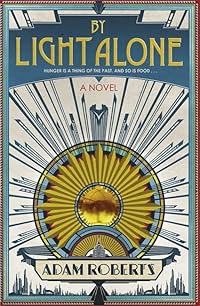
By Light Alone by Adam Roberts

Gollancz, 2011, 407p

 By Light Alone cover

I recently read Roberts’s Stone and was fairly impressed but have so far missed out on his more recent BSFA award nominated novel Yellow Blue Tibia and the earlier quite well received New Model Army. When By Light Alone popped up on this year’s BSFA Awards novel list I decided it was time to sample more.

In By Light Alone global warming has raised sea levels to the extent that a portion of “our” world has been submerged. A wall shields New York from the raised waters. More importantly the Neocles bug has enabled humans to photosynthesise, to be capable of producing blood sugars merely by breathing and drinking water. “Proper” food is scarce, a luxury available only to the rich, who take great care not to be inoculated and differentiate themselves as much as possible form the poor underclass “longhairs” – now kept jobless as there is no need to pay them. These spend hours exposing their fanned hair to the sun for sustenance.

A rich New York family on a skiing holiday in the Caucasus region has their daughter kidnapped. It is nearly a year before she is returned, changed. The novel explores the effects of the kidnapping on all involved. It is divided into four sections, each with a different viewpoint character.

The first and third parts are seen respectively through the thoughts of George Denoone, the father, and Marie Lewinski, the mother. (They are married but she has kept her own name.) The treatment in these two sections is more like a “mainstream” novel than SF. They reveal the pair and their acquaintances to be thoroughly tedious and self-regarding people, and hence fail to engage the reader’s sympathy. Of course they are meant to be aloof, being rich, and to be unwittingly treating their servants with disregard, but crucially we are not made to feel their emotions. It is as if we are seeing them all through a veil. George in particular is an extremely passive and unthinking character, annoyingly so. Indeed so disengaged is he that, in what is effectively an info dump, another character has to explain to him the ramifications of the Neocles bug.

The second section gives us the returned daughter’s viewpoint, which is more immediate and engaging. It is not until the fourth section, though, (pg 261!) that the novel starts to pick up. The focus here is on Issa, a longhair in the Caucasus. Some of this part of the book reminded me in its tonal qualities of Chris Beckett’s The Holy Machine (which is a much better novel.) Even though this section is explicitly tied into the rest at the end – by a connection fairly obvious from the off – overall By Light Alone does not fully cohere, feeling disjointed and unbalanced. It is really four shorter stories juxtaposed; not a unified whole.

I also had some problems with the scenario. Roberts does recognise the need of pregnant women for nutrition beyond mere sugars; indeed he makes this almost a plot point as they take jobs to gain the necessary food to bear a child. The males are presented as useless, not even drones. However, trace elements are necessary for everyone; not just the pregnant. The odd insect or soil which longhairs are said to eat at times would not suffice to assuage this. He also has the longhairs quickly lack energy in the absence of sunlight. Were the process in fact so inefficient it would not be worthwhile. After all plants survive throughout the hours of darkness quite well, their cells respire just as animal cells do. Indeed plants produce surplus sugars – and build them into starch.

Roberts plays on the fact that throughout human history the default state is that of poverty. The plight of the jobless longhairs is presented as an extension of this. (It is hardly Roberts’s fault but a reminder that “the poor are always with us” is not the most uplifting message to be hearing in a time of recession/austerity.)

In addition more attention could have been paid to minor detail. A character named Ysabella has her name spelled in four different ways inside the first twelve pages, though admittedly two of these are diminutives.

Roberts’s explicit referencing, twice, of a certain Arthur C Clarke phrase is a nod to the SF constituency but the SF elements of the book tend towards the perfunctory. While I am all for bringing more rigour in characterisation and the like to the SF novel By Light Alone might perhaps be falling between two stools. I really cannot see it being among the five best SF novels of last year.

Pickerel Meeting

On one of our two nights in Cambridge I had agreed to meet up with Eric Brown who lives nearby.

He arranged for other SF writers from the area to join us. They were Chris Beckett, Una McCormack, Philip Vine, BSFA chairman Ian Whates and Rebecca Payne, most of whom I had not met before. The six of them have semi-regular meetings in the Pickerel Inn in Cambridge.

The good lady and I had a meal in the Pickerel before everyone else arrived. Our plates groaned. So many peas were heaped on them we must have been served about half a kilogram between us.

I had meant to take some pictures of the gathering but such a good time was had by all that I forgot.

(No. I wasn’t drunk. I had to drive back to the hotel.)

free hit counter script