Saltire Society Book of the Year 2016
Posted in Poetry, Scottish Literature at 22:52 on 22 December 2016
This year’s award winner is for poetry. Kathleen Jamie’s The Bonniest Companie.
Posted in Poetry, Scottish Literature at 22:52 on 22 December 2016
This year’s award winner is for poetry. Kathleen Jamie’s The Bonniest Companie.
Posted in Poetry, Reading Reviewed at 20:00 on 17 December 2016
faber and faber, 1997, 59 p.
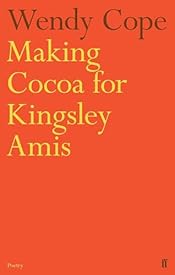
This exceedingly slim volume – 59 pages, some of which are blank – exhibits the problem with poetry as a profession in the modern age. How can anyone possibly make a living at it?
Cope’s forte seems to be satire. Many of the poems here have that intent. In the opener, Engineers’ Corner, she laments the poet’s lot of worldly success in contrast to that of the downtrodden engineer, even if the latter doesn’t get memorials in Westminster Abbey. She also rewrites nursery rhymes in the styles of poets such as Wordsworth or Eliot and frequently inhabits the persona of one Jason Strugnell, a slightly unreconstructed figure from whose viewpoint many of the poems herein are written.
A flavour of her style is given by the first verse of Rondeau Redoublé
“There are so many kinds of awful men-/One can’t avoid them all. She often said/She’d never make the same mistake again:/She always made a new mistake instead.”
On the evidence of this collection Cope presents a fondness for iambic pentameter, and rhyme. The book’s overall title is also that of the final poem and sounds like a euphemism but the poem itself is a throwaway, apparently arising from a dream, and shows the danger of rhyme, as without care its results can tend to the McGonagallesque.
Pedant’s corner:- whiskey (whisky, unless you’re Irish,) primeval (I prefer primaeval.)
Posted in Poetry, Scottish Literature, Sculpture at 12:00 on 14 August 2016
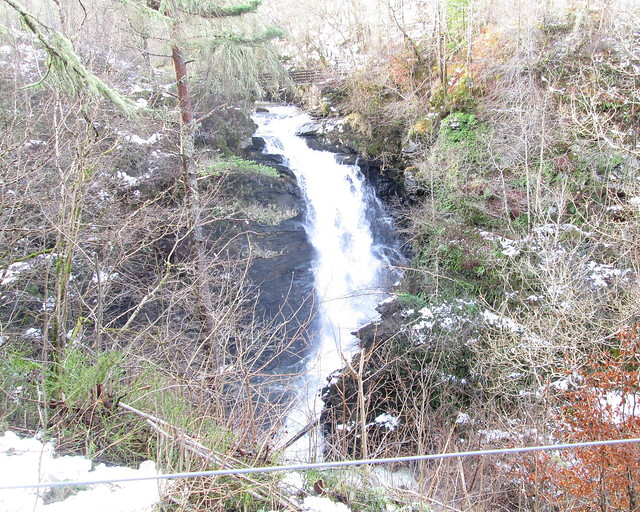
The Birks (birches) of Aberfeldy is a local beauty spot lying just outside that Perthsire town encompassing the Falls of Moness.
They inspired Scotland’s national bard, Robert Burns, to write a poem/song called The Birks of Aberfeldy.
We dondered up there in February. The path is steep in places and there was snow and ice lying at the time.
The Falls of Moness:-
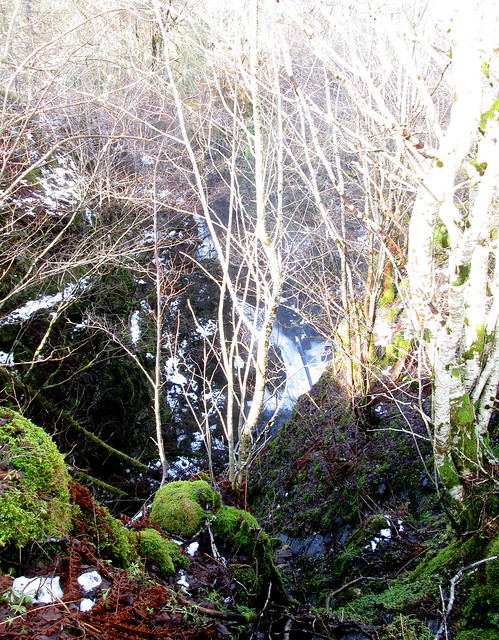
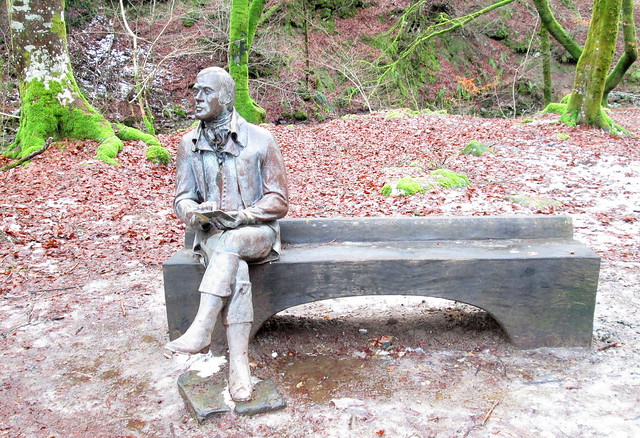
A statue of a seated Burns has been situated at the spot where he is supposed to have derived inspiration. I doubt it’s much of a likeness:-
And this is said view:-
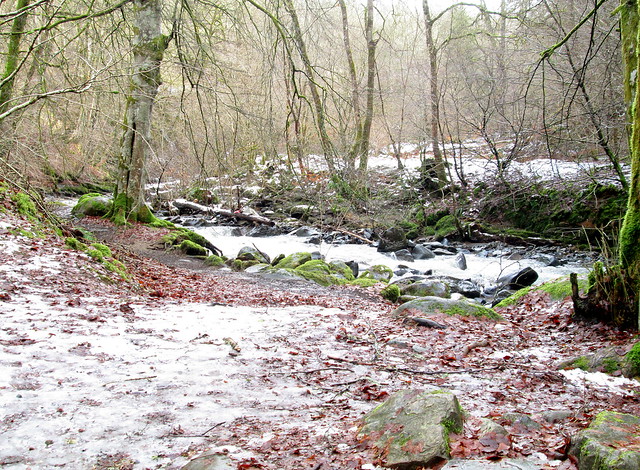
More falls:-
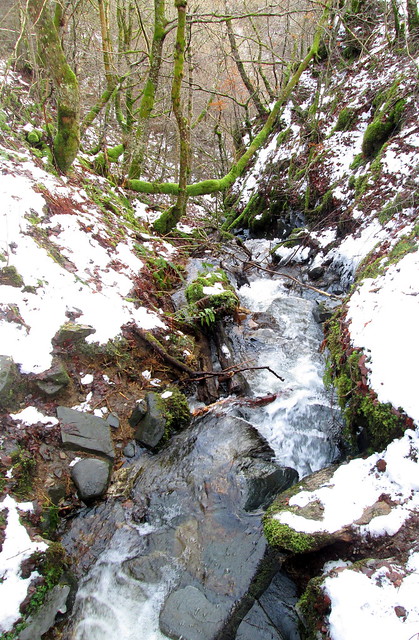
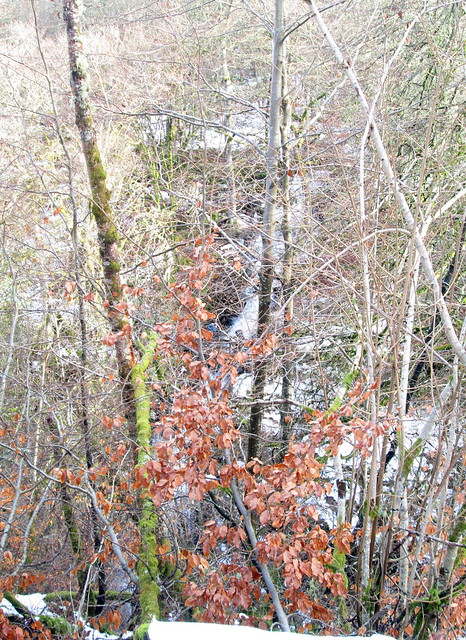
Posted in Poetry, Scottish Literature at 10:00 on 7 April 2016
Picador, 2011, 76 p.
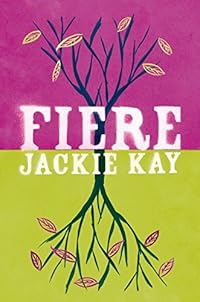
I borrowed this from a doomed library the day before Kay was announced as Scotland’s latest Makar.
Once again it shows that poetry – or modern poetry – is not my thing. The poems herein are interesting enough but none of them really grabbed me. Some of them deal with Kay’s visit to Nigeria (from where her birth father originated; her mother was Scottish and she was adopted by a Scottish couple.) In Nigeria she discovers she is regarded as a white woman. The reference to, and quotes from, MacDiarmid in “from A Drunk Woman Looks at her Nipple” (that titling suggests an extract but it doesn’t seem to be) were diverting though.
Pedant’s corner:- In Road to Amaudo (the village of peace in Igbo) the word is spelled like that twice before Amadou is used, again twice, later on. It is possible that Amadou is a different place, as on its second appearance it is followed by “the road to my heart”.
Posted in Events dear boy. Events, Poetry, Scottish Fiction, Scottish Literature at 20:00 on 5 December 2015
I was so sad to hear today of the death of William McIlvanney, whose Docherty is one of the 100 best Scottish Books, but really any one of his novels could be placed in that list.
He wasn’t only a novelist but wrote journalistic pieces as well. some of which were printed as Surviving the Shipwreck, which I reviewed here. Not content with that he also published poetry.
As a chronicler of the West of Scotland working class tradition, its intellectual complexity, he was superb; but whatever he turned his writing hand to the result always showed a humane sensibility.
This obituary from The Spectator says it better than I could.
William McIlvanney:- 25/11/1936 – 5/12/2015. So it goes.
Posted in Poetry, Scottish Literature at 12:00 on 29 November 2015
Selected Poems Polygon, 2011, 103 p. Borrowed from a threatened library.
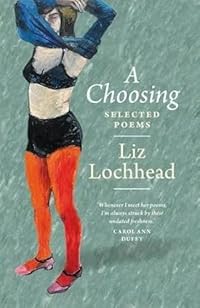
Lochhead, a poet and playwright, is Scotland’s second Makar, which is to say national poet. This book shows she is capable of not only a perfect standard sonnet such as Epithalamium but of a wide range of poems, though mostly not with formal structures.
View of Scotland/Love Poem articulates the experience of Hogmanay, After the War the material changes that happened in a short lifetime, Sorting Through the loose ends that still remain after a parent dies, Social History the differences in attitudes to sex of different generations, The Choosing the unseen/unfelt pressures that determine lives, Kidspoem/Bairnsang the dichotomy between the formal English of school and the felt experience of Scottishness, My Rival’s House the enmities between a mother and the woman who will take away her son, Poets Need Not the sense that for a poet a completed poem is its own reward.
Worth a read, whether you’re into poetry or not.
Pedant’s corner:- on its second appearance Hogmanay was rendered Hogmany.
Posted in Poetry, Scottish Literature at 12:00 on 15 November 2015
Smokestack Books, 2012, 68 p.
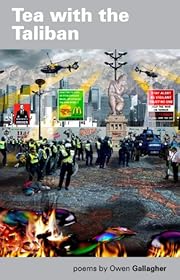
Another book I noticed while scanning a (threatened) local library’s poetry shelf.
Gallagher was born in Glasgow of Irish parents. A fair few of the poems here, as in Tea with the Taliban, deal with servicemen’s experiences in Afghanistan while Fitness Test ponders the only suitable employment for an ex-soldier. Parable excoriates a priest who denounced striking workers from the pulpit and there is bitter satire in Capitalism Has To Be Applauded.
Pedant’s corner:- Everyone were (everyone was,) there was six minutes to go (minutes is plural; so there were six minutes.)
Posted in Poetry at 11:00 on 11 November 2015
faber and faber, 2003, 188 p including v p introduction. Borrowed from a threatened library.

As far as poetry goes this is more what I am used to – from a long time ago at school. All the usual suspects are here, Brooke, Sassoon, Owen, Rosenberg, Yeats, Hardy, Kipling, but Motion includes more from Ivor Gurney than other compilations have and he has also chosen post war and modern poems from MacDiarmid, Larkin, Hughes and Heaney. Normally omitted from such collections, a feature here is poetry about the war written by women; mainly expressing their experience of loss, imminently in Helen Mackay’s Train, after the fact in Margaret Postgate Cole’s Praematuri and underlined by the powerful last line of Eleanor Farjeon’s Easter Monday (In Memoriam E T, “There are three letters which you will not get,”) but note in the extract from Rose Macaulay’s Picnic how quotidian the distant war would become.
New to me (I think) were Charles Hamilton Sorley notably ‘When you see millions…’ and Edward Thomas (In Memoriam (Easter 1915) and The Cherry Trees.) I also do not remember reading Edmund Blunden’s Concert Party: Busseboom before.
Unlike most such collections, we get here, too, the common soldiers’ demotic expression of their lot in, for example, Song, “Do your balls hang low? …. Can you sling them on your shoulder/like a lousy fucking soldier?” and Tiddleywinks, Old Man (“Find a woman if you can”) which leads on to “You’ll never get your bollocks in a corn-beef can,” plus the bitter irony of The Old Battalion “hanging on the old barbed wire.”
Posted in Poetry, Scottish Literature at 11:00 on 2 November 2015
Borrowed from a threatened library.
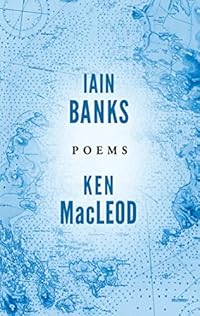
Poetry is not really my comfort zone but I felt I had to read this for completeness as it would mean I have now read all of Banks’s published works (and I think all of MacLeod’s.) Before he became aware of his final illness Banks had suggested to MacLeod that they publish a book of their (separately written) poems. The idea was that each might provide cover for the other. MacLeod initially demurred but bowed to Banks’s insistence. This collection is the result.
The Banks poems feature first and show a considerable fondness for wordplay, always likely to endear itself to me. (Indeed, the line, ‘I suspect the boy has hidden shallows’ – from I to I – contains an example I have used myself in conversation but was liable to occur to anyone whose mind runs along similar lines.) “The truth is just a lie/that corresponds to the facts” from Revue is a more contentious inversion. Check out, though, the sentiments in A Word to the Wise.
MacLeod’s poems tend to have less wordplay (but it is not entirely absent) and he is more willing to essay poems containing the demands of a rhyme scheme – with its attendant danger of descent into doggerel; a danger which he rises effortlessly above. Macleod’s poems have perhaps a greater tendency to express left wing sentiments than those of Banks. The opening line “I cannae write in Scots” from Scots Poet, Not where he appears to lament his parents’ decision only to speak English to him as a child, also struck a chord with me, as my mother’s parents both came up from England before they met in Glasgow and Scots therefore didn’t form a large part of my background.
Pedant’s corner:- math (maths, please,) Fom (From.)
Posted in Poetry, Scottish Literature at 12:00 on 28 September 2015
Poems for the early days of a better nation.
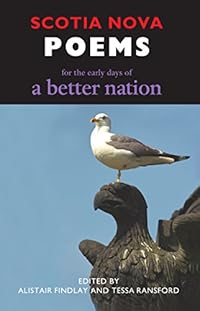
I was searching the poetry shelves of one of the threatened libraries when this collection’s title intrigued me – mainly due to its inversion of Nova Scotia the anthology to which I contributed my story Dusk. I used to read poetry back when I was a lad, but it’s not my usual habitat. Nevertheless I borrowed it.
The book contains poems solicited from January-March 2014 regarding the possibility of a better Scotland, across every aspect of life. Timed, as this call was, for before the Independence Referendum, many of the poems reflect the choice Scotland faced. Others do not. Here are poems in English, Scots, Gaelic – even in Arabic. (For the Gaelic and Arabic ones an English version is also provided.) Aonghas MacNeacail’s Saorsa/Freedom/Freedome appears in Gaelic, English and Scots.
The ordering of the poems is strange, being mostly alphabetically according to the poet’s surname. The exceptions are few, even for those with two poems in the collection their second ones follow a similar order to their first. It is remarkable how many of the poets have had books published by Luath (but it was to these that invitations to contribute went in the first instance). On that evidence Scottish poetry seems to be in rude health.
Donald Adamson’s In Thir Haunds was notable for a similarity to Is there for Honest Poverty? (aka A Man’s a Man for a’ That) – but others also alluded to Burns’s works – and I appreciated the classical sonnet form of William Hershaw’s Aye but especially its denunciation of Calvinism.
The poems in Scots beg to be spoken aloud. The sound of the leid (language) is just so earthy and vigorous.
