Archives » Kirkcaldy

Kirkcaldy’s Art Deco Heritage 11c. High Street: Second Addendum

Walking along the High Street recently the good lady asked if I thought this was deco. I said I thought not but she thought the keystone on the arched window is. Decide for yourselves.

Looking at the window outlines as I checked the posting – especially as delineated by the wire leading up to the street lamp – there is perhaps a hint of deco.

Whatever, it’s now the premises of Holland and Barrett.

Holland and Barrett, High Street, Kirkcaldy

Kirkcaldy’s Art Deco Heritage 19. Park Place

I don’t often go along Park Place and so hadn’t really noticed the deco style of these two buildings. They’re not high deco, but the roof lines and the strong horizontals and verticals are suggestive.

Deco Styling Park Place, Kirkcaldy

Close up on the taller one; its windows are replacements, but still appears deco:-
Close-up Park Place, Kirkcaldy

The square chimney is redolent of deco:-
Park Place Deco Chimney

Kirkcaldy Promenade Update

Tide in, dull grey day. Dreich even. Taken on Oct 3rd.

Kirkcaldy Promenade Works 8

Below is the view ca 180o from my previous photo. Rocks have been placed against the sea-wall here too as well as further out.

Kirkcaldy Promenade Works 9

It doesn’t seem to have stopped the waves crashing over the wall though. (But these were taken of the wall a wee bit further down.)

Waves Breaking over Kirkcaldy Promenade

Waves over Kirkcaldy Promenade

Waves, Kirkcaldy Promenade

There’s also an interesting effect when the waves rebound from the wall and hit incoming ones.

Waves Rebounding from Kirkcaldy Sea Wall

Seals Near Kirkcaldy

On a rock between Kirkcaldy and Seafield Tower:-

Seals near Kirkcaldy 1

The seals were very quiet, we didn’t notice them for some time. Below shows a slightly different angle:-
Seals near Kirkcaldy 2

And this is further round again:-
Seals near Kirkcaldy 3

Kirkcaldy Promenade Improvements

Work started about a month ago to improve Kirkcaldy Promenade – partly to stop the sea-wall falling down and partly to develop it I think. The whole south end is now out of bounds to pedestrians. I started taking photos on Sep 21st. This is the nearer of the works to the town centre. Rocks have been dumped onto the sand here.

Kirkcaldy Promenade Improvements

Three days later, more dumped rocks, this time a bit further out:-
Kirkcaldy Promenade Works 1

After a gap the line is extended futher north:-
Kirkcaldy Promenade Works 2

JCB at work moving rocks into a dump truck:-
Kirkcaldy Promenade Works 3

Dump truck moving sandwards:-
Kirkcaldy Promenade Works 4

Dump truck negotiating already dumped rocks:-
Kirkcaldy Promenade Works 5

Dump truck dumping rocks onto the sand:-
Kirkcaldy Promenade Works 6

Three more days later. Rocks up against sea-wall. There seems to have been a shallow trench dug first:-
Kirkcaldy Promenade Works 7

The People’s Pick and John Henry Lorimer

Kirkcaldy Museum and Art Gallery has a very good collection of paintings, many of them donated by Michael Portillo’s grandfather on his mother’s side, John W Blyth (his father was a Republican refugee from the Spanish Civil War.)

The Gallery’s pictures include quite a few by the Scottish Colourists particularly S J Peploe but also J D Fergusson, the wonderfully named Francis Campbell Boileau Cadell and Leslie Hunter. These counterpart earlier paintings by William MacTaggart and later ones including some by the mysteriously popular Jack Vettriano (sub-Hopper cartoonish efforts though they may be.)

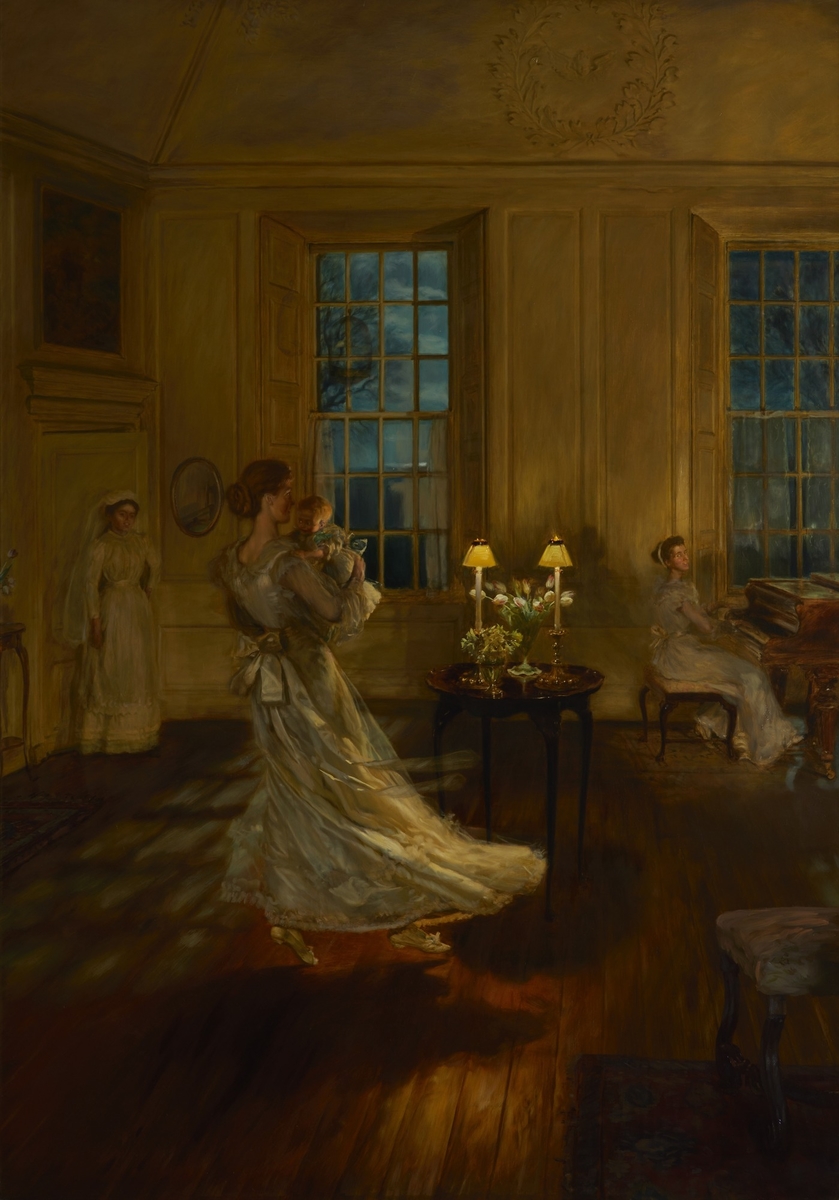
My favourite however has always been Spring Moonlight by John Henry Lorimer, painted in 1896.
Spring Moonlight

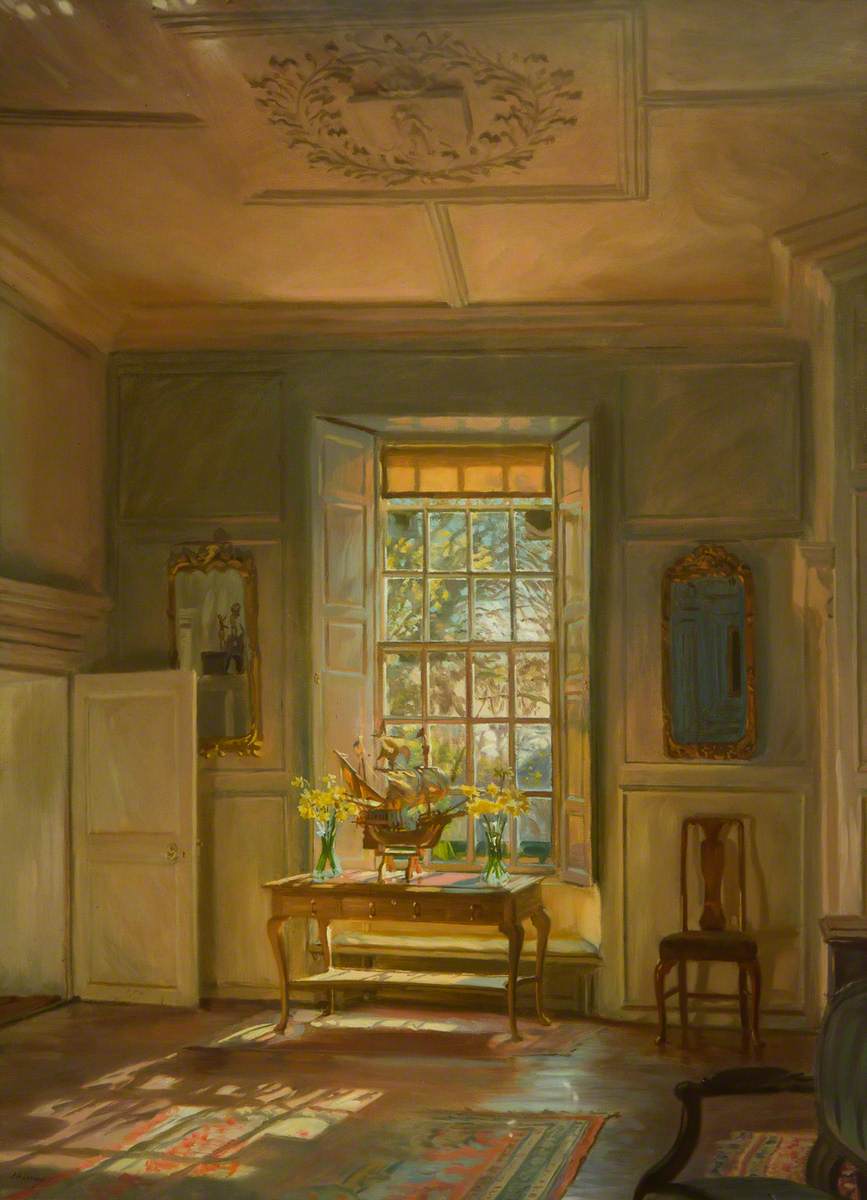
The above is not a very good reproduction; it doesn’t reflect the quality of his depiction of light. Lorimer’s faces aren’t the best but he captures the swirl of the woman’s gown very well and in the flesh so to speak you could swear that the canvas contains two yellow sources of illumination emanating from the table lamps. It is a startling effect and the artist’s style is distinctive – even if it doesn’t come through so strongly in his portraits. On visiting Kellie Castle last summer I immediately recognised the painting below as being by the same hand.

Sunlight in the South Room

Both pictures from BBC Your Paintings

The Museum and Art Gallery reopened in June after refurbishment. Its first exhibition was The People’s Pick – paintings from the collection as voted for by readers of the local newspaper The Fife Free Press.

When I was going round I was dreading the revelation of the most popular painting fearing it might be a Vettriano.

Imagine my surprise when I discovered No. 1. was….

Spring Moonlight by John Henry Lorimer!

My taste in art is obviously less highbrow than I might have hoped.

Kirkcaldy Museum and Art Gallery

The Museum and Art Gallery was gifted to the town by linoleum manufacturer John Nairn as part of the Memorial to the dead of the Great War. The building also houses Kirkcaldy Library.

The building lies behind the memorial here:-

Kirkcaldy Museum and Art Gallery

From right:-
Kirkcaldy Museum and Art Galleryfrom right

The old entrance to the Museum and Art Gallery is to the left of the building. The Great War Memorial cenotaph structure obscures that entrance here:-
ld Entrance to Kirkcaldy Museum and Art Gallery

This entrance (previously the Library entrance only) now serves for both the Library and the Art Gallery and Museum:-

Kirkcaldy Museum and Art Gallery, New Entrance

Dedication inscription on Kirkcaldy Museum and Art Gallery building (between the two entrances):-
Kirkcaldy Museum and Art Gallery Wording

Kirkcaldy Film Festival

It’s the first ever Kirkcaldy Film Festival this weekend and as a result I was at a film premiere yesterday. (The Scottish premiere.)

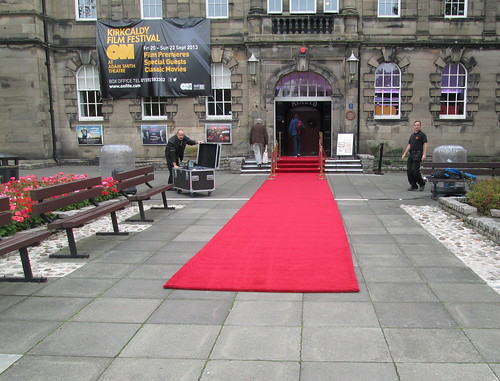
The red carpet was still outside the Adam Smith Theatre this morning when we went back there for a library book sale.

Red Carpet for Kirkcaldy Film Festival

I assume the carpet will be out the whole weekend. (At least the forecast is not for rain.)

The film, Austenland, wasn’t really my thing, being a romcom based on the works of Jane Austen, but the good lady enjoyed it.

The film’s colour palette was curiously pale, as if filmed through a red absorbing filter, rendering the picture almost shiny at times.

The plot has an Austen obsessed US woman, unlucky in love naturally, deciding to blow her savings on a trip to an Austen themed experience in an English Country House, final ball and all. Cue the usual misconstruings. While it was played a lot for laughs there was a sense of straining for the joke at times. I suppose it was perfectly fine if you like that sort of thing but the best bit was during the end credits where the characters, in period dress, mimed to a rap track (something to do with it being “hot in here, so let’s take off our clothes.”)

Cygnets Again

(Not to mention several ducks.) In Beveridge Park, Kirkcaldy, 22/7/2013.

We hadn’t seen all five cygnets the previous twice we’d been to the park before I took this photo so were pleased to see there wasn’t one missing this time.

They’re showing some adult plumage now.

5 grown cygnets

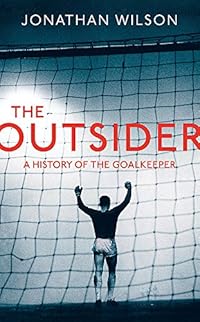
The Outsider: A History of the Goalkeeper by Jonathan Wilson

Orion, 2012, 351 p

If football is symbolic, if the ball is a substitute sun requiring to be buried (in the goal) to ensure fertility, what then are we to make of the one player in the team whose primary object is to prevent that desirable consummation? Such is the question with which Wilson starts his history of the goalkeeper, who in this context can be seen as the outsider, an anti-footballer.

While not denying the goalkeeper’s essential difference I immediately started thinking, what about the stopper centre half, the holding midfielder, the midfield destroyer? Aren’t their roles equally anti-football in that sense? Of course these players may advance into the opponents’ half, even score the odd goal or two, but the goalkeeper generally isn’t expected/permitted even to do that. Except what, then, to make of the Paraguayan great, Jose Luis Chilavert, who took penalties and free-kicks and scored 62 goals, 8 of them for Paraguay and all while playing as a goalkeeper? (Brazil’s Rogério Ceni has since overtaken Chilavert as the highest scoring keeper.) The South American attitude to goalkeepers has tended to be less restrictive, though. In Europe keepers generally only charge upfield in desperate circumstances.

In any case Wilson’s title partly goes against the thrust of the history. When football was first codified it started with all players able to handle the ball in certain circumstances. That dispensation quickly became restricted to the designated one, who was detached from the team – and made to stand out by virtue of wearing a different coloured jersey/shirt. A gradual process of goalkeepers playing beyond the penalty area – the change of rules in 1912 which forbade handling outside the box (up till then they had been allowed to anywhere in their own half) delayed this process – by intervening with their feet or initiating attacks has reduced this difference. Arguably the keeper’s reintegration into the team was finally more or less institutionalised by the back pass rule. (Even before that, though, the custodian was not totally estranged, was a vital component of retaining possession. I remember reading elsewhere that Liverpool’s long domination of the European Cup was predicated on passing the ball back to Bruce Grobbelaar as much as possible during away legs. The sweeper-keeper had evolved even prior to this, though.) In Jose Luis Chilavert’s case the reintegration of keeper with team was surely at its most complete.

Wilson mentions that the first ‘Prince of Goalkeepers’ was Dumbarton’s James McAulay. Another Sons keeper to be mentioned in the text is Joshua Wilkinson, whose father was convinced his death from peritonitis in 1921 was due to a blow he’d received in a game against Rangers the previous Saturday.

In the very early days it had been almost open season on goalkeepers. The famous William ‘Fatty’ Foulke – reputedly 28st (179 kilograms) when he played for Chelsea – often took his revenge on physical forwards, turning them upside down and depositing them on their heads. Despite the obvious dangers – Celtic’s John Thomson (to whom a section of Kirkcaldy’s newly refurbished museum is dedicated – he came from nearby Cardenden – there was also a tribute to him there before the modernisation) received an accidental but fatal knee to the head in 1931 also against Rangers; Sunderland’s Jim Thorpe died in 1936 after several blows in a physical game in 1936 prompted a reccurence of a diabetic condition – it was not until after Bert Trautman’s broken neck and several other injuries to keepers in FA Cup finals in the 1950s, though, that British goalkeepers began to receive extended protection from referees.

Goalkeeping is not, in the end, a simple business. He/she is not necessarily only a shot stopper; there is a difference between the reactive keeper and the proactive. The former expects to make saves (spectacular or mundane) the latter’s best game is the one in which she/he has no saves to make at all, because the way he/she has organised the defence ensures, in an ideal world, that no danger occurs.

There are even national differences in approach. Both Brazilian and Italian defences tend to play deeply and so breed reactive keepers. In other countries a higher line is adopted, a goalkeeper’s play has to be more attuned to that. In Russia, Soviet Russia in particular, goalkeepers have been the subject of a reverence that borders on love.

Africa is represented here by the Cameroonians Tommy Nkono (who inspired Gianluigi Buffon) and Joseph-Antoine Bell, the Spanish, German, Italian, English, Brazilian, Scottish and US traditions are covered in detail. From Asia only Ali Al-Habsi gets a mention and that in passing. Oceanian custodians escape Wilson’s purview completely. Maybe no notable keepers have as yet been bred there.

So many great goalkeepers seem to have had unfortunate debuts, on the end of drubbings of various sorts. What distinguishes them all is that they are liable to be remembered, their careers defined, not for their great performances but for one, or – in the case of David Seaman – two mistakes. (My abiding memory of Ray Clemence is of him allowing a soft one from Kenny Dalglish to evade him in a Scotland-England game at Hampden. Proof if any were needed that there is no national tendency to persistently outstanding goalkeeping.) Poor Moacyr Barbosa of Brazil was forever blighted by conceding the winning goal in the 1950 World Cup final. In 1970 a woman in a shop said to her young son, “Look! There’s the man who made all Brazil cry.” Barbosa himself later complained that in Brazil, “the maximum sentence is 30 years. My imprisonment has been for 50.” That loss to Uruguay was perhaps, though, the single most traumatic moment in Brazil’s history as a nation. It was only founded in 1889 and has never fought a war.* Brazilians apparently are not really football fans. It is winning they like.

Wilson makes the point that the existence of a highly proficient one or two goalkeepers from one country at one time is not evidence of strength in depth, nor any guarantee of continued excellence. The apparent decline of English goalkeeping is a case in point.

The author certainly knows his football history – there is even a digression into the treatments of the sport in literature and film, most of which lean heavily on the goalkeeper; a further nice touch is that the book’s back cover is decorated with a “1” – and he thinks deeply about the game. Having read the book I’ll observe goalkeeping in a different light.

One final note. Even if a book is about football it might be thought a touch insensitive to describe the Spanish Civil War as “perhaps the clásico to end them all” – even more insensitive when Wilson observes that Real Madrid didn’t become Franco’s team till the 1940s.

*Edited to add. I have since found out that this is only true of the Brazilian Republic and not of the Empire which preceded it.


free hit counter script