Archives » Ron Butlin

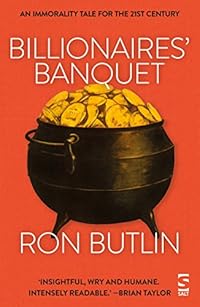
Billionaires’ Banquet: an immorality tale for the 21st century by Ron Butlin

Salt, 2017, p.

The story is split between 1985, when its main characters first meet as residents at Barclay Towers in Edinburgh, and events surrounding the Occupy protests of 2005. In 1985 Hume is drifting, waiting to find a job after his University degree. His more or less girlfriend Cat’s thoughts are ruled by mathematics. Ex-theology student St Francis is obsessed with finding the proper arrangement of his furniture. One night they are joined in the flat by DD (Diana the Damned as she calls herself) who accompanies Hume to a party. Soon Cat has taken herself off and Hume is in a long-term relationship with DD. St Francis befriends Megan, who had been begging on the streets – a new, shocking, thing in Thatcher’s Britain. Hume’s efforts to begin to make money lead to a role providing butling services to the middle classes.

Twenty years later Hume has made it and has conceived the idea for a Billionaires’ Banquet where the rich will consume only rice and water for the evening – at enormous cost – for charity. Hume’s embroilment with the activities of Melville, an Edinburgh gangster, will lead to complications for Hume, DD – now an addict on happy pills – St Francis, Megan, who has her head screwed on as far as Melville’s likely reactions to Hume’s decision to go it alone are concerned, and Cat, returned from her professorship in Australia for a conference only to get caught up unwillingly in the Occupy protests.

This precis sounds like the book is a thriller but it really isn’t. It’s an examination of youthful naivety and the compromises people make when finding their place in the world. It’s also a between the lines commentary on the change in public mores brought on by the Thatcher years. The characters are entirely believable (though DD’s later reliance on drugs for her to function is a bit overdone. Then again, it has a plot purpose.) However, the leap of twenty years between the two halves of the story jars a little. Butlin’s writing has some sharp observations and is never less than engaging.

Pedant’s corner:- “a dice” (dice is plural, one of them is a die,) “to get off his ass” (arse,) Spanis (Spanish,) paus (pause,) “ordinary men and woman” (women.)

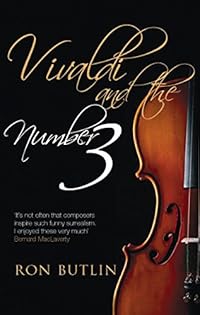
Vivaldi and the Number 3 by Ron Butlin

Illustrated by John Sibbald. Serpent’s Tail, 2004, 210 p, including 14 p Notes about the composers and philosophers. Plus vi p of Acknowledgements and lists of contents and illustrations.

This is a collection of 26 short stories, none of which is longer then twelve pages and even that includes one of the illustrations. Their tenses shift from past to present and back again. Trappings of the present day irrupt into the past or vice versa, modern day phenomena like pizza deliveries precede composing by candlelight with quill pens. Within the context, though, it all makes a surreal heightened sense. Unlike a lot of Scottish fiction the writing is laced with humour. Seventeen of the stories are listed under the heading “The lives,” four under, “The letters,” three are “The thoughts,” and, finally, one is “The last word.”

All of it is delightful stuff.

The lives:-
Sheep being scarce in Venice would-be priest Antonio Vivaldi – familiar with McDonald’s, TV and spaghetti westerns – tries to sleep by counting cardinals jumping off the papal balcony, one of whom brings to him both God and music via the number 3. 500 concerti later Vivaldi tries to go on holiday but is caught up in a war. A later incarnation learns to walk on water by channelling his anger at a Stravinsky comment that he always writes the same concerto.
In the glass box of her marriage Alma Mahler writes down the notes of the string quartet she is composing only for them to disappear from the paper as soon as she’s finished. Bach, who in his youth had aspired to be a professional footballer until a retired player suggested his true vocation, struggles to respond to the deluge of parcels he receives following the publication of an article titled ‘If Only Bach Had a computer’ in the previous month’s Digital Digest. Beethoven anticipates the benefits due to flow to him from a pyramid scheme while striding the mean streets of Edinburgh till he comes to “the Zone-of-Everything-and-Nothingness” that is South Bridge, which always defeats him. A Hamburg perpetually mist-bound and stuck at 4.45 in the afternoon due to the composer’s previous failures waits for Brahms to complete his first symphony: a fantastic interlude brings resolution. Antonin Dvořák finds his knowledge of Science Fiction and fairy-tale useful while stalking the Bohemian wilds for musical inspiration. Fresh from an invitation onto The Jerry Springer Show, Haydn hears a voice telling him just how many trios he still has to compose. Enthused by a cable channel film noir series, Mozart decides on a new career as a private investigator in a story which also features him bicycling through the air like the ident scene at the start of a Dreamworks© film. Schubert glides through the streets of 1828 Vienna on his skateboard before being given a magic business card. In a manifestation which may be an indication of Schumann’s state of mind Liepzig morphs its architecture daily: then he takes the underground to Herr Wieck’s flat where he meets Clara. An aged Sibelius is in his last hours invited to join the circus by three clowns. Richard Strauss and Amenhotep IV share their dreams of finessing Nazi racial policies and building pyramids respectively. Tchaikovsky laments the madness of his marriage as he considers a last ballet. Georg Telemann writes his best-selling concertos amongst the mountain of mail order goods he has requested (or not) while his agent adopts his identity. One of the Mighty Handful of Russian composers who form a five-a-side football team conceives the idea of introducing passing to their game; their results get worse.

The letters:-
Composer Q makes a compact with the Mr Sinclair who turns up at his door: thereafter the music flows and Q’s domestic life becomes blissful. There is a catch of course. Composer X’s career creating music for films has given him all the trappings of success – girls, glamour and real estate. He flees the Calvinistic persecutions of messages in the Edinburgh sky to Tenerife only to find the stars have rearranged themselves into a message in Spanish. Composer Y labours under the affliction of coming between “the celebrated X and the no less renowned Z” (perhaps due to his fondness for the double-bass) till one day the world pauses and the sky becomes a Tiepolo-style ceiling of angels; suddenly he is in constant demand. Composer Z gazes from his window into the vista beyond the end of the alphabet through the large plate-glass window installed for just that purpose. In one universe the glass becomes insubstantial and he is pulled through. (This story contains a comparison between Scottish midges and the dead in Hades – both are summoned by human blood.)

The thoughts:-
A drunken David Hume cosies up to a woman “who had come so close to freezing to death on the pavement outside the Caledonian Hotel she had never warmed up again” before he is, in a phrase which could summarise this whole book, “stranded in this makeshift world put together from the sweepings of history.” Nietzsche tries to break free from monetisation at the hands of his University by keeping chickens. Seneca settles on Edinburgh’s Southside as the perfect place to prove Stoicism firmly as number one of all the world’s philosophies. Socrates attends the opening of Greece’s first supermarket, ‘Zealous Hellas’.

The last word:-
On her death bed Nadia Boulanger is visited by other female composers – her sister Lili, Hildegard von Bingen, Elisabeth-Claude Jacquet de la Guerre, Fanny Mendelssohn and Clara Schumann.

Pedant’s corner:- “Time interval later” and “within seconds” count; substantial – a few had gone by before I noticed the prevalence but they soon become extremely intrusive. Otherwise; crochets (crotchets,) manoeuvering (manoeuvring,) vermillions (vermilions,) “a set of garden furniture say with no memory of ever having ordered them” (ordered it,) extendible” (extendable,) the text implies the great Real Madrid team of 1959 had invented the passing game (they didn’t. It was the mighty Sons of the Rock in the 1880s/90s who did that,) “Puskas, Di Stefano, Santa Maria … [were] … to secure the European Cup for Real Madrid three years in a row” (Real won that cup five years in a row, the first five of its existence; those three players may not have been present for all five, of course.) “A few second’s later” (seconds,) “duvetted by straw and feathers” (should the spelling be ‘duveted’?) An unindented paragraph, Socrates’ (Socrates’s.)
Ghost Moon by Ron Butlin

Salt, 2014, 246 p.

 Ghost Moon  cover

Curiously that’s two books in quick succession where the main character has been named Maggie. Here it is one Maggie Davies, though in the care home where she endures her declining months she is known as Maggie Stewart.

The story is told in interleaved sections. Those which recount from his point of view the visits of Maggie’s son Tom to his uncomprehending, dementia suffering mother, are always headed Sunday (though, one, on Maggie’s birthday actually occurs on a Monday,) and other, longer, numbered chapters tell the story of the life which led her there; a life not exactly flashing before her eyes but recollected in non-tranquillity. The final chapter, titled Sunday Afternoon, interweaves paragraphs from the two time-lines as the end nears.

Maggie spent the post-Second World War years seeing her twenties fade into thirty without attracting an admirer and fell prey to the dubious charms of the first man who gave her some attention only to be promptly dumped. When the inevitable happened, her parents threw her out. She travelled to Lewis to the home of family acquaintances but, forewarned, they also treat her with disdain and contempt. Only in a guest-house does she encounter any warmth, when she and the landlady’s war-blinded son, Michael, fall for each other. Lewis is a small place, though, and her secret causes her to be thrown out from there too. Returning to Edinburgh, it is only her sister-in-law, Jean, who shows her any compassion or sympathy. She struggles to find a job in her unmarried condition and she is little better treated at Woodstock House where she contracts to be confined and for her child to be looked after until she can get on her feet. Butlin really brings out the utter callousness of “polite” society at this time towards those who had made a mistake or been too innocent – or both. Only her correspondence with Michael, carried out via his best friend, and her visits to Woodstock House to see Tom give her any comfort. When Michael contrives to travel to Edinburgh it seems a happy ending might be in store – but we know from the ‘Sunday’ sections this will not be forthcoming.

This is a wonderfully written slice of an aspect of social history and a blazing indictment of those blinded to compassion and consideration by self-righteousness.

Pedant’s corner:- Jenners doorway – later Jenners’ doorway (Jenners’s,) Queens Crescent (Queen’s Crescent – used later,) Mrs Saunders’ (Saunders’s,) “that the woman’s heart being turned over” (that the woman’s heart was being turned over,) Miss Davies’ (Davies’s.) “The Forth Road Bridge was a cat’s cradle of red” (the Road Bridge has never been red and wasn’t built till the early 1960s: this part of the novel was set in 1950. The Forth Bridge – the rail bridge, which requires no such distinguishing adjective and was completed in 189o – was meant,) “to start to paying Jean back” (to start paying Jean back,) “would would stop her” (only one ‘would’ needed,) an opening quote mark which wasn’t necessary as it was a descriptive passage, not dialogue, “in her wellingtons boots” either, ‘in her Wellingtons’, or, ‘in her wellington boots’.)

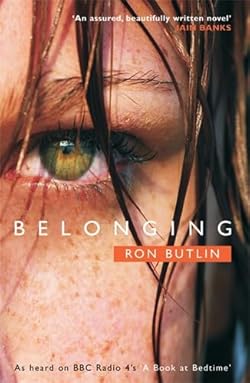
Belonging by Ron Butlin

Belonging cover

Serpent’s Tail, 2006, 241p.

At the start of Belonging Jack McCall is a janitor come handy-man at a remote set of luxury flats in the Swiss Alps. One day in the middle of winter a middle aged male resident arrives with a young woman called Thérèse. The next morning the man is dead, having slipped on the balcony during a snowstorm which has cut the site off. Jack has to help deal with the body and he and his girlfriend Anna look after Thérèse till the police arrive.

Due to a disturbed childhood and regular psychoanalysis Anna over-interprets things and constantly questions Jack about the reasons for his actions. She also desires to settle down. Three months after the incident she persuades him to go back home to Edinburgh to get married. En route, at the Gare Du Nord in Paris, Jack has cold feet, slips off the train and seeks out Thérèse. He takes up with her and finds she is a child of divorce. The dead man was in fact her estranged father whom she had only just sought out. She blames herself, through her revelation of their true relationship, for her father’s death. Jack and Thérèse subsequently travel to a remote location in Spain where a small group of people live a very basic life in not much more than huts. At this point the novel loses its way a little as the motivations of the various characters are obscure.

All of this is played out to an occasional backdrop of overheard news of the Iraq War and the July 7th and Madrid bombings which is not germane to the plot and does no more than locate the story in time.

Unlike Butlin’s earlier The Sound of my Voice or Night Visits, both of which employed second person narration – wholly or in part – Belonging is a thoroughly conventional first person tale, narrated from Jack’s viewpoint. Both of those earlier novels were more tightly focused, with fewer characters. Though Anna is displayed in all her annoying smugness, Thérèse’s motivations remain opaque – her parents’ divorce and mother’s remarriage aren’t really sufficient to explain her malaises – and some of the bit players are not as well delineated as might be hoped for. The climactic event was certainly unexpected but the novel seems to dribble away afterwards, taking what felt to me to be a wrong turning as Jack’s life reassembles.

Belonging is nevertheless finely written, just not as satisfying and meaty as Butlin’s previous novels.

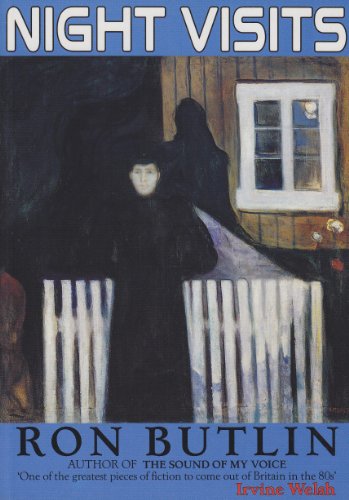
Night Visits by Ron Butlin

Scottish Cultural Press, 1997. 115p.

Night Visits cover

Ten year old Malcolm witnesses his father’s death at home in bed. His coping mechanism is to try to keep everything outside, so that there will be no pain. After the funeral he and his mother go to live with his Aunt Fiona who runs a care home for the elderly. Aunt Fiona is a disturbed, overbearing type, with strong religious convictions and a misunderstanding of children but also the urge to enter Mrs Goldfire’s room at night, where she tries in vain to restrain her wicked urges. Malcolm’s embroilment in this one-sided and slightly physically abusive relationship – Mrs Goldfire is asleep most of the time and incapable of much movement in any case – is intermingled with his and Aunt Fiona’s complicity in a mutual fascination, which acquires sexual overtones.

The narrative is multi stranded. The first two sections are strict third person, from an authorial perspective; thereafter narration is shared between Malcolm and Aunt Fiona. Malcolm’s passages are in the second person, a reflection of his estrangement from the world. Those from Aunt Fiona are in third. Butlin seems fond of second person narration; his earlier novel The Sound Of My Voice employed it throughout, though with the flow and ebb of Malcolm’s detachment it is not adhered to strictly here.

Night Visits is not as compelling as Butlin’s The Sound Of My Voice (see my review here) but is still an insightful study of obsession, loss and coming to terms with grief.

The Sound Of My Voice by Ron Butlin

Black Ace, 1994, 143p.

The Sound Of My Voice

Butlin had made a reputation as a poet but this was his first novel* and an unusual debut it was. Presented from the viewpoint of Morris Magellan, a married man with two children he refers to as “the accusations” it is an absorbing study of an alcoholic and his descent into self-disgrace.

What marks The Sound Of My Voice out as especially bold is the use of the second person to carry the narrative. Second person novels are rare; successful ones are rarer still. That Butlin carries the conceit off is a tribute to his writing skill. It helps that in its opening the novel concentrates on Magellan’s childhood where his remote father is presented as a major (negative) influence on his subsequent life.

Using the second person could have been an invitation to the reader to be complicit in Magellan’s woes but it is not merely a literary trick, the voice is there for a purpose – which I shall not spoil even though the introduction, by Randall Stevenson, does. (Or would have had I not taken the precaution of avoiding reading it till after I’d finished the novel.)

This is a short book but all the better for it.

*Published in 1987 by Canongate. This Black Ace edition is described as definitive; corrected and revised by the author.

free hit counter script