Belonging by Ron Butlin
Posted in Reading Reviewed, Scottish Fiction at 13:00 on 16 November 2011
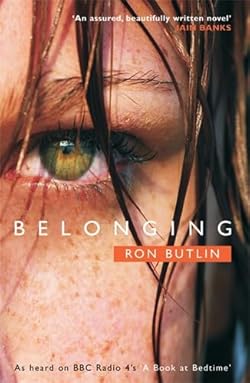
Serpent’s Tail, 2006, 241p.
At the start of Belonging Jack McCall is a janitor come handy-man at a remote set of luxury flats in the Swiss Alps. One day in the middle of winter a middle aged male resident arrives with a young woman called Thérèse. The next morning the man is dead, having slipped on the balcony during a snowstorm which has cut the site off. Jack has to help deal with the body and he and his girlfriend Anna look after Thérèse till the police arrive.
Due to a disturbed childhood and regular psychoanalysis Anna over-interprets things and constantly questions Jack about the reasons for his actions. She also desires to settle down. Three months after the incident she persuades him to go back home to Edinburgh to get married. En route, at the Gare Du Nord in Paris, Jack has cold feet, slips off the train and seeks out Thérèse. He takes up with her and finds she is a child of divorce. The dead man was in fact her estranged father whom she had only just sought out. She blames herself, through her revelation of their true relationship, for her father’s death. Jack and Thérèse subsequently travel to a remote location in Spain where a small group of people live a very basic life in not much more than huts. At this point the novel loses its way a little as the motivations of the various characters are obscure.
All of this is played out to an occasional backdrop of overheard news of the Iraq War and the July 7th and Madrid bombings which is not germane to the plot and does no more than locate the story in time.
Unlike Butlin’s earlier The Sound of my Voice or Night Visits, both of which employed second person narration – wholly or in part – Belonging is a thoroughly conventional first person tale, narrated from Jack’s viewpoint. Both of those earlier novels were more tightly focused, with fewer characters. Though Anna is displayed in all her annoying smugness, Thérèse’s motivations remain opaque – her parents’ divorce and mother’s remarriage aren’t really sufficient to explain her malaises – and some of the bit players are not as well delineated as might be hoped for. The climactic event was certainly unexpected but the novel seems to dribble away afterwards, taking what felt to me to be a wrong turning as Jack’s life reassembles.
Belonging is nevertheless finely written, just not as satisfying and meaty as Butlin’s previous novels.
Tags: Belonging, Night Visits, Other fiction, Ron Butlin, Scottish Fiction, The Sound of my Voice
