Archives » Paul Johnston

The Bone Yard by Paul Johnston

NEL, 2003, 316 p. First published 1998.
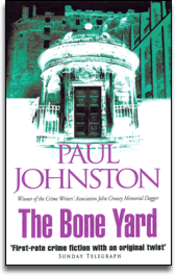
 The Bone Yard cover

Being the renewed adventures of Quintilian Dalrymple (after Body Politic) in an independent Edinburgh in 2020 where the inhabitants lead circumscribed lives ruled over by a Council and guardians while tourists to the year-round Festival are afforded every luxury.

Two people are found with their throats bitten out, tongues and genitals removed, and a cassette lodged in the wounds, in each case with a blues song (the Blues are banned in this Edinburgh) on the tape. When the first body is found Dalrymple is assigned the case due to his success in solving earlier murders. The usual conflicts with his nominal overseers ensue. Along the way we find out what the mysterious Bone Yard is, plus its connection to both the mothballed Torness Nuclear Power Station and pills dubbed Electric Blues – which are potentially fatal to those with weak hearts. We, Dalrymple, and his sidekick Davie, also make re-acquaintance with Quint’s love interest from Body Politic, Katharine Kirkwood. Her experiences outside Edinburgh in the interim, as recounted to Quint, have been grim (and a touch gratuitous) but provide a link to the killer.

The voice in which Johnston describes Quint and his attitudes is of the usual couldn’t-give-a-toss, rule-bending, I’ll-go-where-the-leads-take-me, would-be irreverent maverick type. While it seemed bright and almost fresh in Body Politic, here the similes and metaphors are either strained or overcooked.

Johnston has certainly hit on an unusual situation in which to set a crime novel. The speculative aspects are only trappings though. This is first and foremost a crime novel. A good enough one at that. But he’s since written five more Dalrymple books (plus eleven others.) This one didn’t much encourage me to look out the rest.

Pedant’s corner:- “the temperature swapped a minus for a plus reading” (the temperature went down, so a plus was swapped for a minus,) “didn’t use to turn up” (didn’t used to.) “Tonight was the only night of the year when the curfew isn’t enforced.” (conflict of tenses; wasn’t enforced is more natural,) had a accident (an accident,) bunsen burner (Bunsen burner,) e-string (E-string surely?) span (spun,) “a clear liquid” (colourless I think,) ouside (outside.) “Even though the numbers of Moslem tourists has fallen” (either ‘number of’ or else ‘have fallen’,) the Forth Rail Bridge (aka the Forth Bridge: since it’s the original only any others need a qualifying description,) a missing re-opening quote mark when a piece of dialogue resumed. Asshole, ass and smartass (this is Edinburgh; even there they put the “r” in. Arsehole, arse and smartarse,) “didn’t use to be like this” (used to be.)
Body Politic by Paul Johnston

NEL, 2003, 349 p

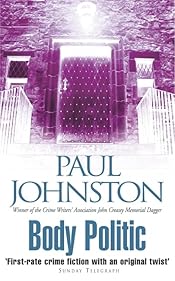
The Body Politic cover

The first publication of this novel was in 1997 when the date in which it is set, 2020, was a considerable time away. That makes it read a bit oddly in 2016.

Edinburgh – like many other parts of the UK – is independent, home to a never-ending tourist drawing festival, from which the city derives most of its income. It is run by the Enlightenment Council of City Guardians, which comes across as a sort of muted cross between a local Council, the Committee of Public Safety and a Kirk Session. The city’s citizens lead a circumscribed existence, unruly beards are obligatory, television, private cars and crime are banned, as is blues music – a problem for former city guardian Quintilian Dalrymple who at the novel’s start is asked by Katharine Kirkwood to find her missing brother. Before long however, a body is discovered whose murder bears remarkable similarities to those of the Ear, Nose and Throat Man from several years before. Dalrymple, as the expert on the previous crimes (and instrumental in their ceasing,) is roped back in to the Enlightenment’s police force (called guardians) to investigate. What follows is the usual tale of corruption, red-herringry and interconnectedness; though carried off with great skill. The crime element is pretty standard fare (as far as my reading of the genre goes) the bureaucratic hassles associated with the policeman’s/policewoman’s lot lent an air of strangeness by the unusual background. Various villains are unmasked, the murderer not whom you might expect. Kirkwood’s brother’s disappearance is peripheral to that aspect of the plot and only really exists to provide Dalrymple with a love interest.

Despite its (altered) future setting this cannot really be considered Science Fiction. In form and content it is more of a crime novel than anything else, there is no speculation involved. Quite why it appeared on the Herald’s list of “100” best Scottish Fiction Books, I’m not sure. I can only think that the Enlightenment might be supposed to be a peculiarly Scottish conception. It has Calvinistic undertones but the things it tolerates – encourages even – have traditionally been frowned upon at best and more usually excoriated.

Somewhat prophetically there is the line, “The USA had reverted to the self-obsession that’s a hallmark of their history.”

Pedant’s corner:- “didn’t use to mind” (didn’t used to,) had lead to (led to,) reponse (response,) “I wanted to sit down badly” (how can anyone sit down badly? – I think Johnston meant “I badly wanted to sit down,”) Mary, Queen of Scots’ (Mary, Queen of Scots is singular so; Mary, Queen of Scots’s,) “The USA had reverted to the self-obsession that’s a hallmark of their history,” (its history; unless you’re talking pre-American Civil War when the United States were referred to in the plural.)

free hit counter script