Archives » Nan Shepherd

Wild Geese

A Collection of Nan Shepherd’s Writing. Galileo Publishers, 2018, 146 p, plus i p Contents, vii p Introduction by Charlotte Peacock, ii p List of works in the order printed here, and ii p Notes.
The book contains a story of novella length, some of Shepherd’s landscape/natural world writing, poems, literary appreciation, and fragments from life. In all of these Shepherd’s writing is crisp, clear and insightful.

Part I Descent From the Cross: The story of a man who was hung up by his wrists in the Courland Forest as a POW during the Great War and who returns to Scotland in a poor state. Betsy determines to marry him convinced he will write a classic but his weakness means that is a forlorn hope. Even though she had always been capable of providing for herself he is racked by guilt that he cannot support her.

Part II The Deeside Field Writings: Four pieces focusing on Deeside.
Colours of Deeside describes all of the colours, natural and man-made, Shepherd discerned in her explorations of the area; the many blues and hot colours, the varied green, the white and the black, the colour of water under different conditions, the intrusion of human influence into the landscape. James McGregor and the Downies of Braemar outlines the sojourn of one family in the highest croft in Scotland and the legacy which James McGregor managed to fashion out of uncompromising Colours of Deeside. Wild Geese in Glen Callater is an observation of migrating geese manœuvring to change course in the teeth of a gale. The Lupin Island was colonised by those plants from seeds deposited by the river’s flow before being stripped bare by a deluge. Many years later, courtesy of efforts to repair a bridge, a newer island formed and the Lupins returned.

Part III Poems: contains 12 of Shepherd’s poems Those written between 1918 and 1938 are classic sonnets, the later ones more free form though all employ rhyme.

Part IV Poets: In this section Shepherd discusses The Poetry of Hugh MacDiarmid (in whom, despite his detractors, she states she is a believer– in particular she notes the two main criticisms, of his politics and his vocabulary – the work of Marion Angus (whose lyricism sings) and Charles Murray (rooted in the Aberdeenshire landscape.) The latter is “especially good on winter” but Shepherd then adds, “as what Scottish poet is not?” Winter, she says, releases our (ie that of Scots) perceptiveness.

Part V Prose Pieces: Smuts – not the South African General, sadly but not unsurprisingly – is a homage to those smudges or blots which enable perfection to be appreciated, Pixies and Or’nary Peoples is how a child divides up for the author the world of stories, On Noises in the Night emphasises that it is the fact they happen in the night that makes such noises so significant, Schools and Schoolmistresses eulogises those women whom Shepherd taught at Aberdeen College of Education and who went to the furthest wildest places in pursuit of their calling, The Old Wives celebrates the idiosyncrasies and worth of the older woman, Things I Shall Never Know is a series of vignettes from Shepherd’s life each of which left her wondering.

Historical note: A couple of times Shepherd refers to “the pink of asbestos roofing” on sheds and such. I do hope that’s all been removed now.

Pedant’s corner:- “what that truth was he could ever quite discern” (never makes more sense,) “trying to sell him things he either needed nor wanted” (neither needed nor wanted,) outcastes (usually outcasts, but outcastes might be suitable in India,) “a plainness of white that at present is staring” (startling?) “-Kincardine, O’Neill” (the village’s name is Kincardine O’Neill, which appeared correctly a page or so later, and that ‘–’ ought to have had a space after it,) thoct (usually thocht – as it is rendered elsewhere,) “the mother fo” (mother of,) divins (divines,) “at the me who abrogate” (at the men who,) a sentence that is a question but missing the appropriate question mark, Bagdad (nowadays spelled Baghdad.) “All schools are not so big as the High School” (In English this would be better as ‘Not all schools are so big’ but this may be a Grampian idiom.) “Yet there a hundred things besides” (Yet there are a hundred things,) “on Tuesday’s, another on Wednesdays” (the comma is misplaced, it should come after ‘another’.)
The Living Mountain by Nan Shepherd

A Celebration of the Cairngorm Mountains of Scotland

In The Grampian Quartet, Canongate, 1996, 88 p, plus 2 p Author’s Foreword, 1 p Contents and v p Introduction by Roderick Watson.

 The Grampian Quartet cover

One of the hallmarks of Scottish writing (or I should say good Scottish writing) is its facility for landscape description. In The Living Mountain, a non-fiction work of virtually nothing but description, Nan Shepherd elevates this to an outstanding degree. Here is the Cairngorm plateau in all its glory, beauty and menace; its prominences, its rocks, its shifting hues, its changing moods, its sparkling waters, its light and air, its sudden vistas and deceptive perspectives, its capricious – and dangerous – weather, its plants, birds and deer, its people, its effect on the senses, its being. If Shepherd had set out to write a love letter to the Cairngorms she could not have succeeded better. Her immersion in and knowledge of the landscape is profound. That it did not find a publisher on being written towards the end of World War 2 is amazing. It did not see the light of day till Aberdeen University Press published it in 1977. Shepherd’s foreword to that edition refers to the changes that have occurred in the Highlands during the interim. But her feelings about the mountains remained the same. They are where she seemed to be most at home, at one with herself and the world.

Pedant’s corner:- In the Introduction; a closing bracket without a previous opening one. Otherwise; “Its waters are white” (if they were tumbling over rocks, yes; but this is in a passage about clarity. The last thing an utterly transparent medium is is white. You can not see through white. Try looking through a piece of paper,) acclimitisation (acclimatisation,) felspar (feldspar.) “In December an open heather” (in open heather.)

A Pass in the Grampians by Nan Shepherd

Part of “The Grampian Quartet,” Canongate, 1996, 120 p, plus vi p Introduction by Roderick Watson. First published in 1933.

 The Grampian Quartet cover

The village of Boggiewalls lies in the lee of the Grampians; beneath a pass through which various military commanders have travelled on their transitorily important campaigns. It is one of those deceptively sleepy communities wherein lie universal human dilemmas and dramas, hidden or otherwise.

From it the Kilgour family had spawned scholars. His three brothers had all gone off to University and made a place for themselves in the world but Andrew Kilgour had preferred to stay on the farm. The impact of two deaths, his wife’s and his son’s (in the Great War) had led his daughter Mary first to give up her ambition to follow in her uncles’ footsteps until the second provided the chance for the widow, Milly, to come, with her daughter Jenny, to tend to the house – allowing Mary to fulfil her desires, and eventually set up a typing school in London. Jenny is the apple of Andrew’s eye but, now she has grown, her friendship with elderly local shepherd, Durno, who lives with his spinster sister Alison, is seen as no longer seemly.

But now the return of well-known singer Dorabel Cassidy, the one-time Bella Cassie, whose mother Peggy had fallen to her death from a hayrick in Andrew’s farmyard and whose welfare he had seen to by taking her in as part of the family – leading to the inevitable gossip – before she took off to make her way in the wider world, her building a modern house within sight of the Kilgour farm, her unconventional behaviour, all threaten the delicate balance of the relationships in the village. Dorabel has a capacity to enthrall others. She has an artist, Barney, in tow, on a string, obedient to her every whim and Jenny, too, falls under her spell. Andrew Kilgour is less enamoured.

There is an awful lot packed into these 120 pages, a network of complications, obligations and acceptances. A whole existence of self-abnegation is summed up in a phrase relating to Milly’s “eternal grey jersey – this year’s, last year’s, sometime’s.” We all know uncomplaining women like this. And it is conveyed in just eight words.

Shepherd’s usual eye for landscape description is demonstrated and the economy with which the plot unfolds, we find the true reasons for Peggy’s death, and the real identity of Bella’s father is exemplary.

There is an aside on good Scots stories, “For salt and subtlety these ….. were unmatched, and, at their best, great art, in which, as in a perfect lyric, not a word could be altered.” You could say the same for Shepherd’s writing.

Pedant’s corner:- a missing comma before a piece of direct speech.

A Month in the Country by J L Carr

Penguin, 2000, 89 p, plus vii p Introduction by Penelope Fitzgerald and i p Foreword by the author. First published 1980.

A Month in the Country cover

In the aftermath of the Great War, Tom Birkin, a veteran with a facial twitch as a result of it, takes on the task of uncovering a mediæval mural from the wall of a church in the village of Oxgodby in Yorkshire. The first person narrative of this slim but well-formed volume is in the form of recollections by Birkin in his old age and relates his interactions with the family of the Wesleyan local station master, the vicar Rev Leach (not at all keen on the disturbance and the potential effect on his flock of a vibrant painting on the wall of his church,) Leach’s wife, and a fellow war veteran Mr Moon, an archæologist hired to try to find the tomb of a mediæval ancestor of the Miss Hebron who has funded both projects via a bequest. As he works on uncovering the mural and gets to know the locals Tom attains a kind of contentment.

A Month in the Country is no more than a novella but Carr packs a lot into it. Like Nan Shepherd’s, it is something of a quiet work, no pyrotechnics, no big issues addressed (except the aftermath of war.) It is also an addition to the literature of the ‘path not taken’.

Pedant’s corner:- As noted in the Introduction the local minister Arthur Leach is also referred to as Revd J G Leach – but Carr admitted to being a reckless proofreader. Elsewhere: mugsfull (mugsful?) a missing comma before a piece of direct speech, “‘Low, He comes with clouds descending.’” (Lo! He comes with…,) Mr moon (Mr Moon.)

The Weatherhouse by Nan Shepherd

Canongate, 2017, 211 p, including 3 p Glossary: plus ii p Dramatis Personae and vi p Introduction. First published 1930.

 The Weatherhouse cover

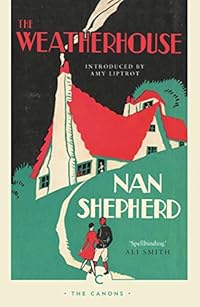
I don’t normally pick up a book according to its cover but I did in this case. It helped that the novel was by Nan Shepherd whose The Quarry Wood I enjoyed a year or so ago. Yet I was also attracted by the illustration which is almost in the style of a 1930s railway poster – a very Art Deco form – even down to the lettering. The house shown is actually wrong though; in two ways. It is much more of an English type of building rather than Scottish and it bears no relation at all to the hexagonal construction described in the text. Pretty, just the same.

That titular Weatherhouse is the home in Fetter-Rothnie of the Craigmyle family, which consists of matriarch Lang Leeb plus her daughters Annie, Theresa and the widowed Ellen. The story though, is more to do with how Garry Forbes, the intended of Lindsay Lorimer, in turn the daughter of Andrew, Lang Leeb’s cousin, came to become a proverb in Fetter-Rothnie.

The former Minister’s daughter, Louie Morgan, claimed after Forbes’s friend David Grey had died in the Great War that she and Grey had been secretly betrothed and carries Grey’s mother’s ring about her neck as proof. Forbes, home from the war as a convalescent, is convinced that can not be the case. He attempts, first to bring the falseness of Louie’s claim to the attention of the Kirk Session (which upsets Lindsay) and then to prevent his knowledge of Louie’s theft of the ring becoming more widely apprehended.

Despite what appears to be a focus on small matters The Weatherhouse nevertheless has a wider resonance, and has some humorous observations. The incidental mention of the man who, because of his brother, waited twenty years to wed his fiancée (who nevertheless brought him children “as a wedding gift”) shows life in those times was not entirely as straight-laced as might perhaps be thought.

Human dilemmas and emotions occur in all places and at all times. Shepherd shows us the humanity of her characters, in all their complexity. This is a fine companion piece to The Quarry Wood. Both these novels bear some similarities to Lewis Grassic Gibbon’s Sunset Song and Cloud Howe but don’t quite have the sweep of the first of those.

Pedant’s corner:- Amy Liptrot’s introduction says Shepherd’s writing is very localised to the foothills of the Grampian mountains and quotes two of the words she uses, stravaigin and collieshangie as being specific to that area. Stravaigin certainly has no such specificity.
In the glossary: keeing (keeking,) snored (smored.) Otherwise: “you’re as light ’s a feather” (light’s,) knit (knitted,) chose (choose,) “a moment before made up on her sister on the road” (before she made up,) a missing comma before a start quote mark.

free hit counter script