Archives » Literary Fiction

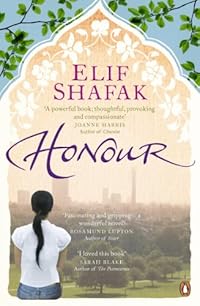
Honour by Elif Shafak

Penguin, 2013, 349 p.

When you start to read a book written by someone raised in a Muslim country and its title is Honour, you will most likely have a certain expectation of what will be in store. That expectation isn’t disappointed here. But this novel is written by Elif Shafak. Things are a bit more nuanced.

The novel does not have a linear structure. It starts in 1992, well after the main event it is concerned with exploring, before flipping back to a village near the River Euphrates in 1945, where the twin Kurdish girls Pink Destiny (Pembe) and Enough Beauty (Jamila) are born to a family already overburdened with daughters but still striving for a son. Its succeeding chapters stray unchronologically over the times in between those dates. Most of the scenes are rendered in third person past tense but there is a first-person account by Esma, Pembe’s daughter, and a journal written by her brother – “He a murderer” as Esma tells us in Chapter One, so not a spoiler – Iskender/Askander (the Kurdish and Turkish renderings of the name equivalent to Alexander) as he serves time in Shrewsbury Prison for that murder.

The plot gets in train when a man called Adem visits relatives in the Euphrates village and falls for Jamila. Unfortunately, she had been kidnapped in a dispute some while before and held hostage so her purity is in doubt. In such a place, “Men – even schoolboys – had honour. Women did not have honour. Instead they had shame.” Whether that is warranted or not.

Knowing his family would therefore not agree to a union with Jamila, Adem agrees to marry Pembe instead, eventually taking her to London while Jamila stays and becomes a sought-after midwife. Unsurprisingly Adem’s and Pembe’s marriage is not overly happy. When he leaves home to take up with an exotic dancer their eldest son Iskender takes on himself the mantle of protector of the family’s honour. However, Esma and younger brother Yunus are more liberal in their outlook. Pembe meanwhile muses on the way in which British people say of something minor, “It’s a shame.” To her, shame is a burning thing; not to be thought of as anything trivial.

Like Adem’s brother, Tafiq, Iskender is heavily under the influence of his traditional past. A Muslim known as the Orator tells a gathering Iskender has arranged that, “The two major industries in the West are the machine of war and the machine of beauty. With the machine of war they attack, imprison, torture and kill. But the machine of beauty is no less evil. All those glittery dresses, fashion magazines, androgynous men and butch women. Everything is blurred. The machine of beauty is controlling your minds.” Maybe so, but it illustrates the Orator’s blind spot. It doesn’t seem to occur to him that the machine of religion also does that – usually far more effectively.

Tafiq reflects that, “Their honour was all some men had in this world.” For the rich it didn’t matter as they could buy influence. But; “the less means a man had, the higher was the worth of his honour.” His hint to Iskender that Pembe might be seeing another man (innocently enough, but Tafiq and Iskender don’t know that) sets the central tragedy in motion.

Honour is inflected with magic realism, but with a light touch. The twist towards the end which alters the perspective is signalled in the book’s first sentence and inherent in the plot, which is elegantly constructed with incidents and relationships which are seemingly peripheral turning out to be carefully inserted.

Shafak displays empathy with her characters, not condemnation. Despite the act of violence around which it revolves Honour is an intricate and ultimately humane read.

Pedant’s corner:- “The undeveloped baby had remained joined to her twin” (the undeveloped baby was previously described as a boy; so ‘had remained joined to his twin’.)
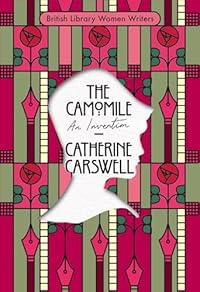
The Camomile: An Invention by Catherine Carswell

British Library, 2024, 203 p, plus i p Contents, ii p The 1920s, ii p about Catherine Carswell, ii p Preface by Helen Vincent, i p Publisher’s Note and vii p Afterword by Simon Thomas. First published 1922.

This is structured mainly as the journal entries of Ellen Carstairs, along with some letters – all addressed to her friend Ruby in Germany where Ellen spent some years studying music. Ellen lives with her brother and fiercely religious Aunt Harry in Glasgow. For income Ellen has taken pupils for piano lessons but she really wants to be a writer. Indeed, one of her schoolteachers is so disappointed that she has not so far pursued her true vocation that she refers to Ellen (publicly) as a prostitute for neglecting her talents. Not a description to be welcomed in the 1920s – or I suppose anytime.

In a prefiguring of Virginia Woolf’s famous essay Ellen is much delighted by renting a room where she can receive pupils and write. “I have a Room!” she tells Ruby. “A room all to myself and away from home.” Not that it is in any way salubrious. But she has the right to refuse any one entry. And it is an escape from Aunt Harry.

Ellen’s imagination is fired by meeting in the Mitchell Library an older man whom she calls Don John. His knowledge of literature and London publishers will provide her with a potential route into writing professionally.

It is he who recites to her the quote from Shakespeare that gives the book its title, “The camomile, the more it is trodden on, the faster it grows.” He is referring to Ellen’s writing but the sentence could also apply to Ellen herself.

Despite his learning and apparent gentility Don John turns out to be poor and prone to lapses into drink.

Ellen reflects on writing novels that, “It is hardly ever from likely touches, nearly always from unlikely ones, that the reader gets that sudden piercing sense of life in a good book. Yet at the same time it must never be an unlikeliness that is contrary to nature.”

The book is peppered with Ellen’s thoughts on women’s place in life and their likely prospects. She wonders about marriage and children but defers that expectation to the future. However, she betrays attitudes of the time – or perhaps in a preemptive strike against possible dismissal of her worth – with the thought, “when I’m reading anything serious, to know that the author is a woman who sat in her petticoats and her hairpins, leaving life aside to put words on paper, puts me off like anything.”

After returning from a trip to London, she tells Ruby (and us) she is engaged to a man named Duncan, home on a break from his civil service position in India. She toys with the idea of consummation but shies away from it despite thinking relations between the sexes ought to be freer. Duncan professes to admire her frame of mind but gradually it becomes clear that the conformities of life in India are uppermost in his thoughts, giving Ellen pause.

Though it starts falteringly, this reads like an accurate portrait of middle-class life in Scotland in the early part of the twentieth century.

Pedant’s corner:- “the Miss Clarks” (the Misses Clark,) a missing comma before a piece of direct speech, “the Miss McFies” (the Misses McFie,) “the Trosachs” (Trossachs.)


The General of the Dead Army by Ismail Kadare

Harvill Press, 2000, 268 p. Translated by Derek Coltman from the French Le Générale de l’armée mort, itself translated from the Albanian, Gjenerali i ushtrisë së vdekur, first published in Albania in 1963.

Twenty years after the Second World War an Italian general is sent to Albania to retrieve for repatriation the bodies of soldiers who had been killed in the conflict there. He is accompanied by a priest. They are working with lists of the dead containing their particulars – height, dentition and so on, plus the probable location of the grave – provided by the Italian Government. The actual exhumations are largely carried out by local Albanians of course.

Prior to the expedition the general had been visited by various relatives of the deceased with specific requests and information about the individuals concerned. Foremost in his mind though, is finding the remains of Colonel Z of the infamous “Blue Battalion,” whose wife the general finds still attractive but suspects may have some sort of relationship with the priest.

The whole situation is awkward for the general; though their tradition is one of hospitality, the locals are in many ways suspicious, the expedition’s presence triggering unpleasant memories and resentments – and the task is arduous. The difficulties of working in such an environment, the sensibilities to be navigated are beyond him. The discovery of the particulars of Colonel Z’s fate (and of his bones) arise from this disparity.

This is the sort of novel – and subject matter – which I suspect no Anglophone writer would contemplate. I know the circumstances surrounding the undertakings would be less problematic but can you, for example, imagine an extended fictional narrative – or even a short story – about the work of the Commonweath War Graves Commission? A non-fiction book, yes; but never a novel.

That Kadare was working under the Stalinist regime of Enver Hoxha makes the fact that he could examine any aspect of Albanian society remarkable. It was subtle of him to choose such an oblique angle to do so.

There were occasional points at which the language of the text seemed a bit strained – possibly due to the fact that the book has undergone successive translations – but this did not impact on its readability.

Pedant’s corner:- “withlittle” (with little,) “the generalasked” (the general asked,) “even asemblance” (even a semblance,) “bothvery” (both very,) a missing full stop at the end of a piece of dialogue, a misplaced line break, “anylonger” (any longer.) “Those are the sort of things” (Those are the sorts of things,) “dark,gentle eyes” (dark, gentle eyes,) a missing comma at the end of a piece of direct speech where the sentence it was embedded in continued, a missing comma in a list, “would all departin various directions” (would all depart in,) span (spun.) “Then,fighting free” (Then, fighting free.) “Six or seven oundsat the most” (Six or seven pounds at the most.) “There were a number of” (There was a number of.)  “‘You wantto be able’” (want to.)

Two Days in Aragon by M J Farrell

In Virago Omnibus II, Virago, 1987, 279 p, plus xi p Introduction by Polly Devlin. First published in 1941.

Last night I dreamt I went to Aragon again.

Oops. Sorry. Wrong book.

Yet, despite being not like it at all (well, apart from the fire,) there was something about this which kept reminding me of Daphne Du Maurier’s Rebecca.

Maybe it was the looming presence of the house itself – the author is lavish in her descriptions of it and its grounds – or the emotional investment in it the characters have, especially its housekeeper Nan O’Neill, who feels herself its custodian all the more strongly since her intimate connection to it came from her sire (on the wrong side of the blanket) being from the present owner’s previous generation but one.

Aragon is what in Scotland used to called a big house, that is where the local landowner lived and lorded it over the general populace. The novel is an illustration of how the Anglo-Irish gentry (who thought of themselves as Irish) considered their Catholic servants and employees as being somehow empathetic with them. It is 1920, though, and events, dear boy, events, will be inevitable, though the gear change when this manifests itself is a little jarring since the story starts off as looking to be one of unsuitable love across the class divide.

Aragon has belonged to the Foxes for centuries. Like many such houses it has its secrets – not least a long neglected, indeed all but forgotten, room full of S&M paraphernalia.

Its head is Mrs Viola Fox, whose husband is long dead, but it is Nan O’Neill who runs things. Of Viola’s two daughters, Sylvia, the eldest, is level-headed but Grania, barely sixteen, is a deluded naïve, imagining herself to be in love with Nan O’Neill’s son, Foley, the local horse master – and sometimes dodgy horse trader. Foley is, of course, not even toying with Grania’s affections but, instead, exploiting her inexperience.

Symptom of Nan’s control is her treatment of Miss Pigeon, an elderly Fox aunt, whom she all but starves and occasionally locks in her room. Yet Nan is in many ways the heroine of the book when, in order to exonerate Foley, who stands accused of complicity in the abduction, she steps in to confront the IRA men who have kidnapped two British officers, one of whom is the object of Sylvia’s affections.

Sensitivity notes; “a black plaster nigger,” “that cup of tea in moments of crisis, whether disastrous or happy, is to the peasant Irish what his opium is to the Chinaman.”

Pedant’s corner:- in the Introduction “rhymster” (rhymester.) “Startled though she was, to discover” (ought not to have that comma,) “and is therefore a cousin” (not a cousin; an aunt,) devotion (devotion.) In the text: “the Fox’s” (many times employed here as a plural for Fox. This should, of course be ‘Foxes’, which was used once,) “six Miss Foxs” (Foxes, but the phrase ought to be ‘six Misses Fox’, ‘two Misses Fox’ appeared later,) “slipped off her rings and settle down” (settled down,) “unbrindled confidence” (unbridled,) goulish (ghoulish,) “octopus like quality” (octopus-like.) “Everyone on the place” (in the place,) “how would it effect and disgrace her?) (how would it affect and…,) “‘what happened Doatie?’” (what happened to Doatie?) “‘your Sunday afternoon’s off’” (afternoons.) “‘How could you be, poor child.’” (Is a question, so needs a question mark,) “into it’s socket” (its socket,) “some silly christian demur” (Christian,) “‘Captain Purvis’ name on it’” (Purvis’s.) “‘If anything happens them’” (happens to them,) “‘what happens Mr Foley’” (what happens to Mr Foley,) “more awful stalactites reached up” (if they’re reaching up then they’re not stalactites; they’re stalagmites,) “a quite insolence” (quiet insolence,) “meeting each the others branches” (the other’s branches.)


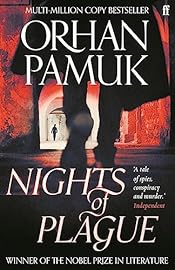
Nights of Plague by Orhan Pamuk

Faber and Faber, 2023, p. Translated from the Turkish, Veba Geceleri, by Rekin Oklap.

This is not a typical Pamuk novel. For a start it’s not set in Istanbul which has been pretty much a major character in most of his books. Instead, it deals with the fictional Mediterranean island of Mingheria during a 1901 outbreak of bubonic plague which provided the opportunity for its revolt against Ottoman rule. Also, unlike most Pamuk novels. it’s largely told rather than shown. Part of this is that the narration is couched partly as a historical record of the revolution.

Mingheria is supposedly located somewhere northeast of Crete. Its main city, Arkaz, is dominated by a castle on a hill at one side of the harbour entrance but there isn’t adequate anchorage for large modern ships and landfall has to be made by rowing boat.

The present Ottoman Sultan, Abdul Hamid, who was installed as Sultan by a palace coup in which he replaced his brother Murad V, has sent Bonkowski Pasha to combat the outbreak. On the same ship but en route to China as envoys are Murad’s daughter (and therefore Abdul Hamid’s niece) Princess Pakize, until recently kept in seclusion in Istanbul until she married the husband Abdul Hamid procured for her, Doctor Nuri. Hence Nuri is often referred to in the text as “the Doctor and Prince Consort.”

A few days later, after Bonkowski Pasha is murdered having inadvisedly gone walkabout, Princess Pakize and Doctor Nuri are ordered back to Mingheria to investigate his death using the methods of Sherlock Holmes. (Abdul Hamid is an avid consumer of detective fiction.)

Many locals, especially devout Muslims, resist the attempts by the authorities to enforce quarantine. The ensuing confusion allows a Major Kâmil to institute a revolution which overthrows Ottoman rule. The Major (soon Commander) becomes the first leader of independent Mingheria.

Much of the supposed history here is said to be taken from the letters of Princess Pakize to her sister Princess Hatice back in Istanbul, letters which she wrote daily even when the postal service had been suspended. An emphasis on the relationships between Princess Hatice and Nuri and Major Kâmil and his wife Zeynep (nostalgic legends in Mingheria) are a corollary to this.

Several narratorial interpolations reveal that this retrospective history of the founding of the Mingherian state has been written by a descendant of Princess Hatice and Nuri. The final chapter is an envoi from that point of view.

The means by which a new state establishes itself and the myths it comes to believe are subtly portrayed (as are the parallels with the decline of the Ottoman state,) but like most revolutions the Mingherian one soon begins to eat itself. In short order Kâmil and Zeynep are dead due to plague; his successor, the Muslim sect leader and quarantine opposer Sheik Hamdullah, also succumbs to the disease; Princess Hatice is made Mingheria’s Queen but pushed into the background by Nimetullah Effendi with the felt hat; and so on. Relations with the Great Powers, who blockade the island to prevent the plague reaching Europe, are critical to Mingheria’s future.

Pamuk is consummate and always in control but to my mind in Nights of Plague, though there is plenty of story (you could almost say too much) some of the rewards of reading fiction are missing. There is not much here to allow the exploration of character, most of whom are sketched rather than fleshed out, or indeed character development. It is certainly unusually structured for a novel. It is however an exemplary way of writing a critique of Turkish society without going at it head-on; an approach arguably necessary for a writer from a state sensitive to any hint of criticism.

Since he started writing this book in 2016 it is also unlikely to be a reflection on the Covid pandemic, though of course that does now hang over any reading.

Mention of football (albeit only in one sentence) and of the author Orhan Pamuk as being an acquaintance of the narrator – both are museum enthusiasts – are typical Pamuk touches.

It is of course essential reading for Pamuk completists but has enough to recommend it to the merely curious.


Pedant’s corner:- Translated into USian. “the hoi polloi” (hoi means ‘the’; it’s just ‘hoi polloi’, then, no ‘the’,) enormity (employed here to mean ‘hugeness’. It doesn’t; it means ‘monstrousness’,) “off of” (no ‘of’, just ‘off’,) “a particularly tough contingent who was known to mistrust” (a particularly tough contingent which was known to mistrust,) “that he was going be punished” (going to be punished,) a chapter beginning with a sentence of dialogue with no starting quotation mark (I know this is a publisher’s convention but it annoys me,) “the Halifiye sect were being goaded” (the Halifiye sect was being goaded,) “landscapes …. that Sami Pasha had hanged on the walls” (I doubt this meant they were executed: ‘had hung on the walls’,) “arrival to the island” (arrival on the island,) Cretian (Cretan,) “moored to the docks” (moored at the docks,) “was I was finally” (the second ‘was’ is superfluous.)

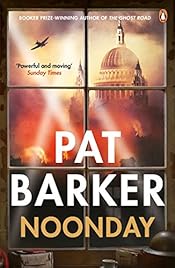
Noonday by Pat Barker 

Penguin, 2016, 263 p.

This is the final book in Barker’s Brooke family trilogy which started with Life Class and continued in Toby’s Room. In this one we have moved on to World War 2, Elinor Brooke and Paul Tarrant are long married and volunteering during the London Blitz; she as an ambulance driver, he as an ARP warden. Their lives are still entwined with that of Kit Neville who is also a volunteer. All three still paint whenever they can.

Paul wishes Elinor to remain in the country in her childhood home where the family has taken in an evacuee called Kenny who keeps getting let down by his mother’s failures to visit. Elinor’s mother is on her death bed but still has enough recall to reveal she knew how close Elinor and brother Toby had been. Kenny eventually disappears off back to London where his family is bombed out and finds shelter in a school, which is later the scene of a tragedy underreported for morale reasons. Paul bears a residual guilt about guiding them there.

The scenes of danger during bombing raids in London and their aftermaths of damage and destruction are well described, if a little familiar from documentaries and histories. Throughout we track the gradual erosion of Elinor and Paul’s marriage.

A curious interpolation is that of a medium (I nearly typed fraudulent medium; as if there were any other kind) – named somewhat oddly as Bertha Mason and who, like the first Mrs Rochester, lives in an attic – but who doesn’t seem to fulfil any narrative purpose apart from to discomfit Paul.

Elinor is asked by Kenneth Clark, head of the War Artists’ Advisory Committee, to contribute to its collection, but only with portrayals of women and children. Elinor has other ideas but suspects they won’t be accepted.

As a conclusion to the trilogy this lacks the impact which the Great War had on the characters’ lives in the previous books and stands in contrast to it. It is, though, a reminder that in the midst of war people’s lives still carry on, with all their imperfections and resiliences. Plus it ends on a slightly hopeful note.

Pedant’s corner:- “just now give her” (just now gave her,) “stood there” (standing there.) “She was sat” (she was sitting,) fetid (foetid; even better fœtid,) “a plastic bag” (plastic? In 1940?) “twenty foot deep” (‘twenty feet deep’ please,) “‘His majesty’s ship Repulse is at the bottom of the sea’” (Repulse was sunk in December 1941, well after the blitz waned,) an extraneous quotation mark, “hadn’t showed up” (hadn’t shown up,) a missing full stop.

Best of 2025

Only twelve works are on my best list this year; eight by women, four by men. Five were in translation – plus two more if you count Elif Shafak.

Troubling Love by Elena Ferrante

Queen Macbeth by Val McDermid

Hex by Jenni Fagan

Under the Glacier by Halldór Laxness

The Flea Palace by Elif Shafak

The Voyage Home by Pat Barker

The Photograph by Penelope Lively

One Day in the Life of Ivan Denisovich by Alexander Solzhenitsyn

The Bastard of Istanbul by Elif Shafak

Shanghai Nights by Juan Marsé

The Children of Jocasta by Natalie Haynes

Death and the Penguin by Andrey Kurkov

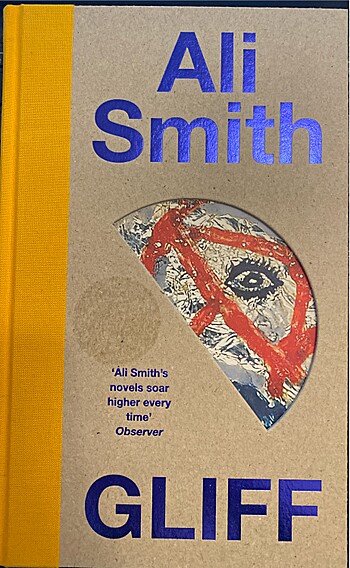
Gliff by Ali Smith

Hamish Hamilton, 2024, 280 p.

Even without reading a word, a glance at the interior of this book would immediately let you know it is by Ali Smith. It has her usual unjustified right margin, giving the text a ragged appearance, the Sabon MT Pro font, and the uncapitalised section titles (here horse, power, lines) rendered in bold type.

As to the novel itself, it is a kind of follow-on to Smith’s Seasons quartet (quintet if you include Companion Piece)  Set in an unspecified future in an apparently authoritarian state (though one never explicitly spelled out as such) where people can be designated UV (unverifiable) it tells the story of Briar (Bri, the non-binary male who narrates it) and their sister Rose.

Their mother kept them off-grid, therefore unverified. She refused them smartphones, told them, “There are different realities, and the net is a reality with designs on general reality, and I’ll prefer it if you both experience the real realities as your foremost realities.”

They had lived with their mother and her man friend Leif before their mother left to look after her sister’s interests. After visiting her one day, they come home with Leif to find the house surrounded by a red painted line, rendering them personae non grata. They have to leave in their campervan. That night the campervan also has a red line painted round it while it is parked. Leif takes off, ostensibly to find their mother and the siblings are left to fend for themselves.

As they are travelling the pair come across a field with horses in it and are accosted by a boy named Colon who says the horses belong to his father. Colon notices their bare wrists and wants to know where their educators are (pointing to where his is) and is confused when they say they don’t have any.

In a later encounter Colon’s brother, Posho, spouts all sorts of mysogynistic nonsense to Rose but lets her know of the Adult retraining centres, Arks, and child retraining centres, Circuses, where the unverified are set to work, on “majorly foul jobs” and, if they refuse, they disappear. Rose takes to one of the horses, calling it Gliff (a word meaning glimpse, or glance, a fright, a brief moment or a gleam of light – or everything and nothing at the same time.)

In later sections it becomes clear Bri is narrating this in retrospect when he has been separated from Rose but accepted into the authoritarian system and is trying to subvert it from within.

Gliff is a propulsive book about forced alienation and the difficulty, as well as the need, to resist it.

The people who need to read Gliff almost certainly won’t. The people who do read it will most likely be convinced of its message before they do.


Pedant’s corner:- No entries.

All Passion Spent by Vita Sackville-West

Virago, 1990, 303 p, including xii p Introduction by Victoria Glendinning. First published in 1931.

When the book opens, Lord Slane, former Ambassador, Viceroy of India and an ex-Prime Minister, has just died. His – mostly unappealing – children gather round to dispose of the estate and decide on what rotation to house their mother in her widowhood. Lady Slane (now the dowager Lady, I suppose,) has other ideas. After a lifetime of following her husband’s path, dutifully performing her roles as Ambassadress and Vicereine, she has no desire to conform to their wishes. Instead, she will take a house in Hampstead – one she saw years ago and has always hankered after.

As a youth she had seen a future for herself as a painter but Henry Holland’s marriage proposal had put an end to that. In the Hampstead house she remembers her confusion at the proposal and the swiftness with which her parents and sisters welcomed it; “never had the rays of approval beaten down so warmly upon her.” But “there was only one employment open to women.” (That would certainly be so for women of her class.)  And the painting never materialised. Ruefully she had reflected that, “It would not do, in such a world of assumptions, to assume she had equal rights with Henry.”

With Genoux, her French maid, she passes the time in Hampstead with desultory visits from her children but more frequent ones from Mr Bucktrout, the housing agent who let it out to her, Mr Gosheron, a builder necessary for renovations, and Mr FitzGeorge, a connoisseur whom she had met in India decades ago and who still holds a torch for her, but withholds that information, with all of whom she has more common ground than with her children. She feels more affinity with her great granddaughter, Deborah, who desires to be a musician and will – perhaps – have more chance of pursuing a career than she did.

Indicative of the times, Lady Slane’s thoughts on her life at one point touch on, “Labour, that new and alarming party.”

Though Sackville-West apparently disliked the term this is undoubtedly a feminist book – outlining as it does the constrictions women endured in the Victorian and Edwardian eras, freed from them only when old age and a husband now gone finally allowed.

Pedant’s corner:- In the Introduction “Keats’ house” (Keats’s house,) concensus (consensus.) Otherwise; “the French government were sending a representative” (the French government was sending,) “a Cabinet Minister of England” (there is no – and never has been an – English Cabinet. That system of government was only introduced well after the formation of the UK in 1707,) “in Genoux’ imagination” (Genoux’s – which was used later. In any case, Genoux surely is not even pronounced with a terminal ‘s’ hence its possessive must have one. There was also a later instance of Genoux’,) “oblivious of” (oblivious to,) “‘me who love him better than anything in heaven or earth’”  (‘me who loves him’ seems more natural,) tight-rope (nowadays ‘tightrope’,) “Keats’ house” (Keats’s house.) Balmy (it meant ‘slightly off his head’, so: Barmy,) “a confidant” (the confidant was female, so ‘confidante’.)


The Children of Jocasta by Natalie Haynes

Mantle, 2017, 344 p, including 1 p Author’s Note, 7 p Afterword and 2 p Acknowledgements.

Greek myth is still a fertile ground for novelists. Both Madeline Miller and Pat Barker have recently revisited the Trojan War from the perspective of hitherto minor characters. This book is Haynes’s take on the three Theban plays of Sophocles (though in her Afterword Haynes tells us each play is in fact a sole survivor of three different trilogies written decades apart) and tells the stories of Jocasta (or Epicaste,) Oedipus and their children.

After the Prologue, set many years before the main narratives during a time of plague known to the characters as the Reckoning, we are given two interleaved viewpoints; a third person account focused on Jocasta and a first person one as written by her youngest daughter, Ismene.

The start of Jocasta’s tragedy is that at fifteen she is made to marry the King, Laius, even though he is ten years older than her father. Laius then proceeds to ignore her (in this account he prefers men) and the necessary heir is provided by his attendant, Oran, but the boy child is taken away at birth with Jocasta told he did not survive by Laius’s maidservant Teresa.

This is where the prophecy of which Laius is so afraid – and on which the whole story depends – (that he will be killed by his son,) for me unravels, since the boy is not Laius’s. I doubt it was Haynes’s intention to undermine the legend and she is free to put whatever spin on it she wishes especially since the sources she is drawing on do not all agree with each other on the details. Nevertheless, it is a noteworthy discrepancy. Then again, and the point is made in the text, Greek oracles were notoriously imprecise. But the prophecy concerned seems much more clear cut.

When Oedipus turns up at Thebes with the news of Laius’s death Haynes makes his part in that much softer and inadvertent than the myth would have it – though it is only his word we have for it – and he is presented throughout as a sympathetic character. And what evolves is also his tragedy as much as Jocasta’s.

Four children later (Polynices, Eteocles and Antigone along with Ismene,) the Reckoning returns and the people of Thebes look for blame, finding it in the thought that Oedipus, coming as he did from the not to be trusted Outlying, the lands beyond Thebes, is indeed the son taken from Jocasta many years before and that their relationship is thereby incestuous. Here Haynes allows the reader room for doubt about Oedipus’s parentage, the question remains open, possible but not proved. Moreover, Jocasta’s subsequent suicide is not shown as an act of guilt but rather one of sacrifice as she recognises signs of plague in herself and wishes not to pass it on to her children.

On her death the kingship passes to her two sons by Oedipus. In Ismene’s account they have been rotating possession of the office yearly. But their uncle Creon, Jocasta’s brother, is a jealous man bent on revenge for one of Jocaata’s actions during the Reckoning and also on achieving the crown for himself. Further tragedy is inevitable.

Haynes evokes the world views and belief systems of the ancient Greeks all but effortlessly. The source material is all an author could wish for by way of inspiration, containing as it does love, jealousy, ambition, betrayal; perennial themes in literature.


Pedant’s corner:- hisown (his own,) facethe (face the,) brotherwould (brother would.) Thecity (The city,) Jocastaand (Jocasta and.) There are more examples of words inexplicably run together like this. Helios’ (Helios’s,) “the scene of my both my brothers’ deaths (omit that first ‘my’,) “staunch my tears” (stanch,) Polynices’ (Polynices’s.) In the Acknowledgements: Oedipus’ (Oedipus’s,) “an audience who doesn’t know” (an audience which doesn’t know,) Sophocles’ (x2, Sophocles’s.)

free hit counter script