Lethe by Tricia Sullivan
Posted in Reading Reviewed, Science Fiction at 13:00 on 29 January 2012
Gollancz, 1995, 384p
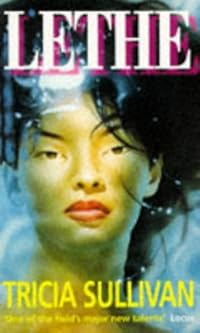
The book is set several generations after the devastating Gene Wars of the late twenty-first century. Varieties exist of humans genetically altered by what Sullivan terms virii (though why “viruses” would not have sufficed is difficult to see.) Unaltered, true humans cannot survive on Earth in the open but are confined to reservations, known as rez. Society is now run by a group of disembodied Heads – known as “the Pickled Brains” – who were found in the ruins of the buildings occupied by Ingenix, the company largely responsible for the Wars.
A series of interplanetary portals has been found at Underkohling, somewhere in the outermost reaches of the Solar System, from some of which no-one returns. The fugitive bosses of Ingenix were thought to have escaped through one of these. When indications show that travel back through this gate may be possible Daire Morales goes to investigate and is drawn through the portal.
On Earth, Jenae Kim, an altermode who has gills and so can breathe underwater – such altermoders can also communicate telepathically with dolphins – is employed by the Heads to help decode the data from the Underkohling gate and is aided by her dolphin pod.
Morales finds a strange world beyond the gate, inhabited by children and adolescents who only have time to reproduce before a “distortion” changes them into something inhuman and inimical. Those who show signs of distorting are driven out before they can inflict damage. The surroundings of this world – the lywyn – are a repository of memory mediated by the “ghosts” of those who have distorted. (Lethe is classical Greek for forgetfulness and was one of the rivers of the underworld.)
Jenae Kim gradually becomes drawn into conflict with the Heads and the threads of the novel draw together with a hijacked expedition to the gate.
This was Sullivan’s first novel and as such it is impressive. The main characters’ motivations are comprehensible and distinct.
There is always a problem in such a scenario with how to depict non-humans in the round. Too often they can be one or two-dimensional at best. Here the altered humans known as One Eyes are not particularly fleshed out – to be fair they are mainly background – but most of the children beyond the gate are merely ciphers while the main agent in this setting, their leader Tsering, has an attribute which is largely due to plot necessity and alters as a due result.
You may recall I had not been overly impressed with Sullivan’s Someone to Watch Over Me. Her last year’s BSFA Award nominee Lightborn was more engaging – and shows an interesting parallel with Lethe as regards motifs – but I still would probably not have bought this but for sighting it in a second hand bookshop (in Haworth.) It is good stuff, though.


