Archives » Kathleen Jamie

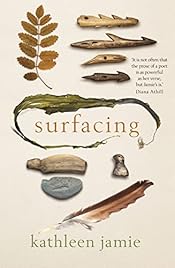
surfacing by Kathleen Jamie

Sort of Books, 2019, 253 p.

Jamie is known as a poet. She is, of course a former Scottish Makar.

This, though, is a prose work or, rather, twelve essays variously about her encounters with the natural world, the two architectural digs of which she has been part, and a trip to as near Tibet she could get. (Getting into Tibet itself would have been difficult at any time but as this coincided with the Tiananmen Square events, reaching Tibet was impossible. It also meant she and her companions were arrested for a short time.)

Her writing about the natural world shows a keen eye for detail; as you would expect from a poet. The account of her trip to China reads almost like a novella.

The first dig she visited was on the Pacific coast of Alaska at Quinhagak village, the dig site was called Nunallaq. The finds were shown to the community where the elders were (usually) able to recall their significance to their Yup’ik culture, giving the younger inhabitants a way to rediscover their traditions, which they were in danger of losing. Jamie’s sympathy with the locals and appreciation of the efforts of the archaeologists is evident.

The other dig was at the Links of Noltland in Orkney and had been ongoing for about ten years. However, time pressure was building as the funding from Historic Scotland (as was) was running out and unlikely to be renewed. And this on a site whose significance is seemingly as great or greater even than Skara Brae.

Curiously the locals weren’t too interested in the ancient remains since apparently Orcadians and Shetlanders identify with the Vikings rather than their much longer ago neolithic ancestors. Jamie quotes one of the archaeologists, “‘The Vikings “won”,’ said Hazel.’ …. ‘After the Vikings arrived, all traces of the older culture ceased. That’s what the archaeology is suggesting.’”

This is an engaging and informative work showing Jamie’s prose is as worth paying attention to as her poetry.

Pedant’s corner:- I have no idea why the title is not capitalised on the book’s cover and spine – nor indeed why the author’s name isn’t either. On the title page both are. Otherwise “Quanset hut” (I’ve previously only ever seen this spelled as ‘quonset’,) “‘kids from his village’” (‘kids from this village’ makes more sense.) “Posters went up the school and store” (Posters went in up the school and store,) “a wintery atmosphere” (wintry,) “and begin to speak” (the earlier part of the sentence was in the past tense so ‘began to speak’.) “Sat right there on their village wall” (Sitting, or Seated,) “sat on seats” (again: sitting; or seated,) “sprung up” (sprang up.) “He was laid on his bed” (he was lying on his bed,) “they were all glad for the diversion” (glad of the diversion.)

The Keelie Hawk by Kathleen Jamie

Poems in Scots. Picador, 2024, 124 p, including 4 p Afterword

In her afterword, Jamie, a former Scottish Makar, says these 43 poems are her effort at a literary, lyrical Scots. The poems are mostly quite short (none strays over more than three, sparsely covered, pages) but pack a punch. Each is provided with a translation into English on the lower part of the even numbered pages opposite them. Those English versions tend to seem insipid when set beside the more vigorous originals. Jamie thinks that has something to do with the vowel sounds. For myself I think Scots, as a language – which it still is, however neglected since its heyday as one of the great languages of mediæval Europe – tends to be more earthy, rooted as it was in the land. Also, its consonants are more to the fore.

Four of the works here are Scots versions of poems by others, two by Friedrich Hölderlin (tailored from the English translations of Michael Hamburger) and two by Uyghur writer Chemengül Awut (now sadly disappeared into a re-education camp) translated into English by Munawwar Abdulla. Jamie has adapted Hölderlin poems before.

Jamie had initially envisaged this publication as a pamphlet but her editor at Picador saw no reason why a major London publishing house shouldn’t publish a whole book of poems in Scots, so she “scrievit some mair.”

I’m glad she did. They’re worth reading.

Pedant’s corner:- No entries

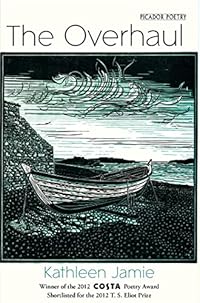
The Overhaul by Kathleen Jamie

Picador, 2012, 59 p

 The Overhaul cover

Winner of the 2012 Costa Poetry Award, shortlisted for the 2012 T S Eliot Prize.

35 poems, most one pagers, one six pages, the rest two. 2 are eftir Hölderlin (as is one in Jamie’s later collection The Bonniest Companie). Hölderlin seems to be one of her favourite models. Most poems here are in English with the odd Scots word but some are entirely Scots. Nature, or those working in the outdoors, is an inspiration for many and there is an abiding seriousness to her poems, though she is not beyond essaying a pun for a last line. An odd quirk was that some poems had missing full stops at their conclusion, as if they’re unfinished. Understandable enough for those two entitled Fragment 1 and Fragment 2.

I most enjoyed Excavation and Recovery with its evocation of deep time partly because I have seen (in Perth and Abernethy Museums respectively) the log boat whose archaeological recovery it partly describes and a depiction of the dig process.

The Bonniest Companie by Kathleen Jamie

Picador, 2015, 70 p including 1p Notes and Acknowledgements.

The Bonniest Companie cover

This, Jamie’s latest book of poetry, won the Saltire Society Book of the Year Award for 2016.

There are 47 poems here of which only two stretch over 1 page in length. Most take the form, if not the formal structure, of a sonnet, though Soledades has eight lines of what look like prose before opening out in its last three lines. Some are very short indeed. The last, Gale, has only 16 syllables, shorter than a haiku. The longest, Another You, bears out the potency of cheap music, the titular deer in The Hinds are “the bonniest companie”. Ben Lomond refers to the bonny banks in a poem which, like the song containing those lines, is about death and remembrance. 23/9/14 is an injunction to gird up again after the Scottish Independence Referendum. High Water compares ocean tides to an adulterous affair, Scotland’s Splendour scopes out the delights of memories from a book stumbled on in a charity shop, Wings Over Scotland is a litany of the recorded deaths of birds of prey on various landed estates, taken – verbatim it would seem – from the original reports.

The language Jamie uses goes from standard English to various degrees of Scots depending on the poem. Migratory II, (eftir Hölderlin) is the most uncompromisingly Scottish. The prevalence of poems about animals or landscape places Jamie’s poetry firmly within the tradition of Scottish literature.

Pedant’s corner:- midgies (I know Scottish spelling is a moveable feast but midges, please,) “one less left” (“one fewer” sounds more natural to me.)

free hit counter script