Archives » Islam

Salman Rushdie

It ought to be obvious from the fact that on this blog I have reviewed four of his books, but I admire Salman Rushdie as a writer. Not everything he has written of course. Some books are better than others.

As a man however I cannot imagine how he carried on under the circumstances of his life. That perhaps is the most admirable thing about him.

Yet what was the alternative? To back down, to retreat into obscurity, to hide away from the world would have been understandable but it would also have been to give in. Let us be clear that that would have been giving in to bullying, yielding to intolerance, giving up the right to think for yourself.

Some people believe that what they have been told is the word of god trumps whatever anyone else might hold dear. That they may be mistaken in their beliefs does not seem to occur to them. And if their faith cannot stand criticism then it does not say much for what they believe in nor for the strength of that belief. If it is so fragile that it cannot bear criticism it is a poor, misbegotten thing. Maybe that is what these deniers of alternative views are afraid of.

When I read The Satanic Verses I could not see how it had blasphemed against Islam. I did not detect in it any reproof of that (or any other) religion nor, indeed, of its prophet. Only a counsel to treat religious texts judiciously and with due care. The book was, in any case, more concerned with other matters. (Or was it that which perhaps was its offence?)

In the light of the recent attempted murder of Rushdie – in full view of an audience, so making a not guilty plea somewhat laughable – George R R Martin of Game of Thrones fame has written a passionate defence of the right of a writer to write and of freedom of speech more generally. He says it much better than I could.
SF Beats Academics To It.

An article by Tom Holland in Saturday’s guardian review about the aftermath of the Roman Empire argued that there was no sudden change from classical to mediƦval times, no instant forgetting, but rather a long interregnum in which the rise of Islam was an important feature.

Holland points out that the transition was all a messy business, triggering the evolution of legends of various sorts, which in Britain involved the King Arthur stories plus the evocation of elves and orcs to account for the gigantic ruins of Roman buildings. He sees Tolkien’s endeavours as an attempt to restore these myths to the culture.

The article surprisingly, to my mind, mentions Science Fiction favourably in that Asimov’s Foundation Trilogy and Herbert’s Dune sequence both recognised what Holland sees as the salient aspect of the transformation somewhat before it gained foothold in academe.

When I read the books it was easy to recognise that Asimov’s trilogy was modelled on the fall of the Roman Empire but it is the character of the Mule that Holland finds interesting – a Muhammad like figure with unusual powers. (That the Mule upset the apple cart of the Foundation’s “psychohistory” suggests to me a reflection of Asimov’s world-view.)

The parallels of the Dune sequence with Arab culture were of course unmistakeable even as a very young teenager. Paul Atreides (Muad’Dib) as Muhammad was at that time a step beyond me but is unmissable now. Herbert did seem to be in sympathy with Arab culture if not necessarily the religion it spawned. At the time I took his critique to be of the phenomenon of religion as a whole rather than Islam per se and I see no reason to alter it.

(The article further ponders the historical evidence surrounding the life of Muhammad, a matter on which I am not in a position to judge.)

Historically, the Roman Empire’s fall cannot be seen as anything other than significant. That authors still continue to see it as a template within which to set their stories – Holland mentions Star Wars and Battlestar Galactica as other not so rigorous examples – is testament to the endurance of its legacy.

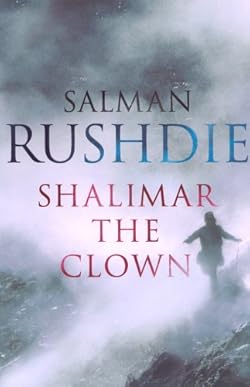
Shalimar The Clown by Salman Rushdie

QPD, 2005, 398p

Shalimar The Clown cover

After the relatively disappointing aberration of Fury this novel sees Rushdie return for his setting to the locales and interests from which he made his name. He treated with Indira Ghandi’s India in Midnight’s Children, Pakistan in Shame and Islam in The Satanic Verses, before returning to (modern) India with The Ground Beneath Her Feet. In Shalimar The Clown it is Kashmir on which he focuses. In this sense the novel’s start is misleading as it begins in California with the daughter of a former ambassador in the days leading up to his assassination by his chauffeur/factotum, the titular Shalimar the Clown.

The book ranges far and wide with many digressions. In a strange resonance with the previous book that I read the ambassador, Maximilian Ophuls, [why Rushdie chose for his character the name of a film director is somewhat obscure; to me at any rate] was a (Jewish) native of Alsace forced to flee, leaving the family printing business behind, after the Germans took over in 1940. He became a leading member of the French Resistance, was involved in US-French relations, emigrating to the US at the end of the war, and was appointed ambassador to India in the 1960s. This novel is not without incident.

The story arc of the book deals, though, with the relationship between Noman Sher Noman and Boonyi Kaul (both of whom, along with Max and his daughter are given sections of the book – I was going to say to themselves, but other characters pop up all the time all over the book, in typically Rushdiean profusion) and the two villages in Kashmir, Pachigam and Shirmal, where they grew up. It seems all of life is here; the picture of a community, a way of life, is detailed. The plot of the novel is almost buried at times – yet this is true of every section. And is the placid, comradely, nature of existence there before the tensions between India and Pakistan led to strife in the region a touch overplayed? Whatever, the growth of Islamic fundamentalist influence, the deterioration in the situation and the horror of communal conflict is well depicted. Neither the Pakistan backed Muslim terrorists nor the Indian Army are spared implicit criticism.

When Ophuls visits the villages Boonyi seizes her chance to escape, only to end up in a different kind of entrapment. Noman meanwhile burns for revenge. He is recruited as a terrorist and suppresses his character while training. In this context the use of his name (no man) as a signifier seemed perhaps a little trite.

A short review can only touch the surface of the myriad elements which go into a novel which, like this, tries to deal with a big issue. There has to be some kind of story on which to hang the subject matter but at times, here, the human dimension is lost in a surfeit of detail. Do we really, for example, need to know the history of the main characters’ parents? This is a trope which Rushdie has employed in previous books. (A similar trait annoyed me in Norman Mailer’s The Naked and the Dead where, every time the author switched to a new viewpoint, we were treated to the character’s whole life story to that point, fatally interrupting the novel’s flow.) In Shalimar The Clown moreover, many passages are told rather in the style of a historical narration than a novel. I shall not reveal the true identity of Shalimar, even though it’s not hard to guess.

While I could have done without the ascent into fantasy in the final section, Rushdie’s sympathies are always in the right place and, despite the various horrors the book describes, overall it is, as perhaps all fiction should be, life-enhancing. After Fury, it represents a return to form.

free hit counter script