Archives » George R R Martin

Salman Rushdie

It ought to be obvious from the fact that on this blog I have reviewed four of his books, but I admire Salman Rushdie as a writer. Not everything he has written of course. Some books are better than others.

As a man however I cannot imagine how he carried on under the circumstances of his life. That perhaps is the most admirable thing about him.

Yet what was the alternative? To back down, to retreat into obscurity, to hide away from the world would have been understandable but it would also have been to give in. Let us be clear that that would have been giving in to bullying, yielding to intolerance, giving up the right to think for yourself.

Some people believe that what they have been told is the word of god trumps whatever anyone else might hold dear. That they may be mistaken in their beliefs does not seem to occur to them. And if their faith cannot stand criticism then it does not say much for what they believe in nor for the strength of that belief. If it is so fragile that it cannot bear criticism it is a poor, misbegotten thing. Maybe that is what these deniers of alternative views are afraid of.

When I read The Satanic Verses I could not see how it had blasphemed against Islam. I did not detect in it any reproof of that (or any other) religion nor, indeed, of its prophet. Only a counsel to treat religious texts judiciously and with due care. The book was, in any case, more concerned with other matters. (Or was it that which perhaps was its offence?)

In the light of the recent attempted murder of Rushdie – in full view of an audience, so making a not guilty plea somewhat laughable – George R R Martin of Game of Thrones fame has written a passionate defence of the right of a writer to write and of freedom of speech more generally. He says it much better than I could.

Phyllis Eisenstein

I see from George R R Martin’s blog that Phyllis Eisenstein died last month – from Covid-19 though she had suffered a cerebral hæmorrhage much earlier in the year. Another sad departure for a year too full of them. Not that this year is looking much better at the moment, vaccine apart.

I first read her work in the Magazine of Fantasy and Science Fiction way back in the day but it wasn’t till recently that I read her two novels relating the adventures of Alaric the minstrel, Born To Exile and In the Red Lord’s Reach.

I have another of her books on the tbr pile. It will be read with a sense of sorrow.

Phyllis Eisenstein: 26/2/1946 – 7/12/2020. So it goes.

Ben Bova and Chuck Yeager

I see from George R R Martin’s blog that SF writer and editor Ben Bova has died.

Martin is particularly indebted to Bova as it was he as editor of Analog who helped Martin’s career (and those of many others) by accepting his stories for publication.

As a writer Bova’s style was in that USian hard SF tradition, which isn’t entirely to my taste. Looking at my records it seems I only bought two of his novels, Millenium and Kinsman.

Benjamin William (Ben) Bova: November 8/11/1932 – 29/11/2020. So it goes.

I also saw (on CNN as it happens) that legendary test pilot Chuck Yeager, first to person to fly faster than the speed of sound (in air,) yesterday passed away. (The link is to his Guardian obituary.) I read Tom Wolfe’s book The Right Stuff (and also watched the film made from it) about Yeager’s era of piloting and the early US space programme.

Charles Elwood (Chuck) Yeager; 13/2/1923 – 7/12/2020. So it goes.

Also gone from us is former golfer and TV commentator Peter Alliss. His style had gone a bit past its sell-by date in recent times but it cannot be denied that his knowledge of golf and its history was immense.

Peter Alliss; 28/2/1931 – 5/12/2020. So it goes.

SF Bookshelf Travelling for Insane Times (vi)

(This week’s entry for Judith’s meme at Reader in the Wilderness.)

Again these are small-size (original size) SF paperbacks. Again they are housed in the garage and again are double-parked.

It was difficult to get back far enough to fit these all into the photo.

They start at Stanisław Lem and finish at Connie Willis. There’s a whole shelf of Robert Silverberg in here. Other notables: George R R Martin, Ian McDonald, Larry Niven, Christopher Priest, Tim Powers, Kim Stanley Robinson, Bob Shaw, Cordwainer Smith, James Tiptree Jr (aka Alice Sheldon,) Harry Turtledove and Ian Watson.

Science FIction Books

The 1981 Annual World’s Best SF Edited by Donald A Wollheim

Daw Books, 1981, 250 p.

 The 1981 Annual World’s Best SF  cover

In Variation on a Theme by Beethoven by Sharon Webb humans have developed an immortality treatment but it comes at the expense of their creativity. A reluctant David, who is musically gifted, is plucked from his boyhood life on Vesta to be taken to Renascence, on Earth, to be trained for sixty lunar months before deciding if he wants to be immortal or creative.
Beatnik Bayou by John Varley is set in his future where medical modification of the human body is commonplace and sex changes unremarkable – even desirable. This one deals with what growing up in such a society might entail and the problems with having age-altered personal tutors as constant companions. Tonally the narration is not consistent.
Elbow Room by Marion Zimmer Bradley is one of those confessional stories within which the narrator becomes riddled with self-doubt. She is the director of a Vortex station, institutions which oversee wormholes and had a history of their operators committing suicide or else murdering one another. So a system was evolved in which only a few people would inhabit the stations meeting only occasionally so as they have elbow room. The narrator therefore has her own cook, her own gardener, her technician, her personal priest; even perhaps her own male whore. The crisis comes when a malfunctioning ship arrives at the Vortex and she has to board it, thereby encountering strangers.
The Ugly Chickens by Howard Waldrop finds Paul Lindberl, biology assistant at the University of Texas, setting out on a wild bird chase after a woman on the bus refers to seeing in her childhood the “ugly chickens” he was looking at in his book of Extinct and Vanishing Birds of the World.
Prime Time by Norman Spinrad is a take on the future of entertainment where people retire to Total Television Heaven able to access tapes (how soon the future becomes obsolete!) containg their favourite programming and real-time-share them with their nearest and dearest or not-so-dearest as the case may be. The story also has a rather conventional view of the lineaments of male and female desire.
Though typically well written George R R Martin throws a lot of SF tropes into Nightflyers – cloning, telepathy, ancient star travellers, holograms, telekinesis, a backdrop of an extended time-line, the mad woman in the attic (or in this case, a spaceship’s control systems.) Karoly d’Branin has assembled a crew of xenobiologists, linguists, a xenotechnologist, a telepath, a cyberneticist and an ‘improved model’ human to find the almost mythical volcryn, said to have cruised the galaxy at sublight speed for millenia. The ship’s captain, Royd Eris, is secretive though, never emerging from his quarters, appearing only as a hologram. Things begin to go wrong when the telepath feels a stange presence before dying violently.
The first sentence of A Spaceship Built of Stone by Lisa Tuttle is reminiscent of Shelley’s poem Ozymandias but the scene it describes is occurring in a dream. The dreams, apparently of the stone-built city of the ancient Anasazi culture, are being experienced simultaneously by many people round the world. Narrator Rick comes to suspect they are a softening up exercise for a quiet alien invasion.
In Window by Bob Leman, an experimenter on telekinesis has disappeared, along with his work cabin, and been replaced by a transparent cube one hundred feet to a side. The scene it shows, of another reality, looks idyllic. Then, during the brief time there is an interface, one of the obsevers steps through.
The Summer Sweet, The Winter Wild by Michael G Coney is one of the very few pieces of fiction to be written in the first person plural. (Another is my own This is the Road.) Here the We of the narrator(s) is a herd of caribou, some of whose members a while ago developed the telepathic ability to make the Herd and other animals feel their pain when they were injured or attacked. Wolves then back off, also humans (thought of by the Herd as ‘You’,) hence the weak and ill of the Herd do not die, therefore go on to breed.
A disillusioned artist wanders a beach in Achronous by Lee Killough and finds he has stepped into a bubble in time, with people from the far future taking refuge from the end of their world. It gives him new inspiration.

Pedant’s corner:- In the Table of Contents; Killiugh (Killough.) Othjerwise; “a series of performance halls were displayed” (a series … was displayed,) “wasn’t what what he’d be doing?” (wasn’t that what he’d be..,) “a muttered tympani” (a muttered tympanum,) “angle-length maternity gown” (ankle-length,) Argus’ (Argus’s,) tepee (tepee is the preferred spelling,) “‘I thought what happens was…’” (what happened was,) “in the first found” (first round,) a missing comma before a piece of direct speech, “on my master’s” (Master’s,) the Chicksaw Nation (Chickasaw, as used previously,) band-new (brand-new,) “none of the soaps were personalized” (none of the soaps was personalised,) “was, What would …” (either enclose the ‘What would ….’ phrase in quotation marks or drop the comma and the capital W at What,) an opening quote mark where none is required and therefore not subsequently closed, Reeves’ (Reeves’s,) “because that is an instinct. We all have” (due to the plural nature of the narrator and its/their capitalisation elsewhere that should be ‘because that is an instinct we all have’ with no full stop,) grill (several times, grille,) Pometheus (elsewhere Prometheus,) D’Branin (usually d’Branin, but D’Branin at the beginning of a sentence – why?- and, once, within one,) Eris’ (Eris’s,) “‘I have not had much a life anyway’” (much of a life,) spasticly (spastically.)

Gene Wolfe

And they keep coming. (I suppose, really, that should be going.)

Yesterday, via George R R Martin’s Not a Blog, I learned of the death of Gene Wolfe.

I have been an admirer of his work ever since his novel The Shadow of the Torturer, the first of his sequence set in Urth, with the overall title The Book of the New Sun.

This was followed by Soldier of the Mist set in ancient times, whose hero, Latro, can not remember things from one day to the next, and two more books with the same protagonist.

Two other series, The Book of the Long Sun and The Book of the Short Sun, appeared in the 1990s and early 2000s along with two books related to each other The Wizard and The Knight.

Many stand alone novels were published before, during and after these series books.

I have 24 of Wolfe’s books, 20 novels and 4 collections of his shorter work, but have not yet read them all. (So many books to read, so little time.)

Ursula Le Guin was a great admirer of Wolfe’s writing, calling him “our Melville”, (our in the context of the SF and Fantasy field.)

The last of his novels to be published, A Borrowed Man, 2015, I had the privilege of reviewing for Interzone. I had the impression that was to be the first in another series of books, which sadly are now probably lost for ever.

I’ve got those unread ones to look forward to though.

Gene Rodman Wolfe: 7/5/1931 – April 14/4/2019. So it goes.

Review, the Guardian, Saturday, 16/8/14

I usually read all the stuff about fiction in the Guardian’s Saturday Review as well as some of the non-fiction reviews.

Last week’s contained three items of particular interest to me.

The cover piece, Steven Pinker’s An Anti-stickler’s Manifesto was about ten “grammar rules” he thinks it’s okay to break sometimes. He says that some of them aren’t actually rules at all and others aren’t rules in English. You may be surprised to read that by and large I agree with him. But I do believe it is important to know what the rules are. This is in order that when you break them it is for a purpose.

Then there was an article about Martin Amis. In this Amis was quoted as saying, “Prose is foremost, and ‘if the prose isn’t there, then you’re reduced to what are merely secondary interests, like story, plot, characterisation, psychological insight and form.'” Secondary interests? Psychological insight is a secondary interest? Story is a secondary interest? Characterisation is a secondary interest? Is this last not what certain purveyors of genre (no names, no pack drill) are pilloried for not providing?

The final piece was an interview with George R R Martin, in London for the Science Fiction Worldcon after first appearing at the Edinburgh Book Festival.

A Dance With Dragons by George R R Martin

Harper Voyager, 2011, 959p (plus 56p of genealogies.)
Book 5 of A Song of Ice and Fire and a wristbreaker. For my thoughts on book 4 see here.

The action this time is mostly set over the sea from Westeros; following the adventures of Tyrion and Daenerys in Andalos and Valyria but Jon Snow’s problems at the Wall and other matters in the North are also prominent.
The writing is not always as assured as it was in Books 1-4 but still drags you in. Martin’s adaptation of his usual chapter heading (the viewpoint character’s name) – resorting at times to uses such as “The Wayward Bride” and “The Spurned Suitor” instead – also muddies things. In these cases it can take a little time to work out who the section is about especially as Martin’s modus is to start with a scene not immediately following the one his character had most recently appeared in before then filling in the gap.

Martin again employs the sly trick at a chapter’s end of apparently killing off a character only to reveal several sections on that death has been averted.

I’ve always visualised Tyrion as looking like Antony Worrall Thompson, an image I just can’t get rid of when reading about him. As in A Storm of Swords the complexities of his character means the reader’s expectations can be confounded but he remains consistently interesting. Daenerys, though, here seems curiously indecisive.

With 956 pages to get through a sense of marking time begins to grow but in this volume the overall story arc of A Song of Ice and Fire is cranked up by the emergence of a lost Targaryen heir to the Iron Throne closer in line than Daenerys.

Martin’s focus is perhaps inevitably on nobles and their doings. While the scope of his vision is broad we do not see much of the small folk, who appear mostly in the background. Then again in a mediæval world how likely is it that such people would be able to become movers and shakers, drivers of plot?

The possible Science-Fictional aspect to Martin’s cycle is again alluded to in mentions of the First Men. As well as the obvious comparison with the Wars of the Roses minor parallels with our own world are understated but present. (The Valyrians left not only their steel but also roads which have survived centuries.)

In earlier volumes of A Song of Ice and Fire it was possible to imagine there might be but as the saga wears on it becomes clearer that there’s not much scope for hope in Martin’s invented world. The outcomes seem unremittingly depressing. Perhaps in Vol 6, The Winds of Winter?

Legends edited by Robert Silverberg

Voyager, 1998, 591p.
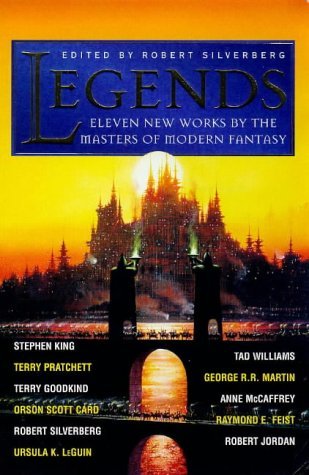
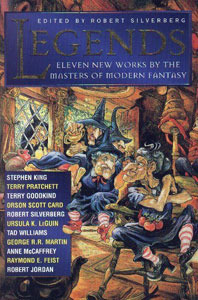
This is a collection of fantasy stories set in the various worlds created by “the best known and most accomplished modern creators of fantasy fiction.” There are two cover paintings, the first one on the right is in the normal orientation, the one on the right below being upside down on the back cover.

The Little Sisters of Eluria by Stephen King. (Set in the milieu of The Dark Tower.)

A gunslinger staggers into town with his knackered horse, which promptly dies. He gets beaten up by zombies and handed over to a set of nurses who wish to feed on him and is saved only by the medallion he removed from a dead body earlier.
I’ve never read any Stephen King before – horror isn’t much my thing – and after this I doubt I’ll be reading any more. I wasn’t drawn in, nor was I engaged with the main character at all and as a result didn’t much care what happened to him. This story also betrays an inordinate fondness for the word mayhap. Four instances in fifty pages is at least three too many. Arguably four.

The Sea and Little Fishes by Terry Pratchett. (A Discworld story.)

Granny Weatherwax is asked not to compete in this year’s Witch Trials because she always wins. She accedes, graciously, and everyone else is spooked.
I have read some Pratchett previously and this is the mix much as usual, competently written, diverting, but not earth shattering.
Debt of Bones by Terry Goodkind. (The Sword of Truth.)

A young woman petitions The First Wizard for help to rescue her husband and daughter who have been captured by the evil invaders the D’Hara. For reasons of his own the Wizard assents, but not without seeming reluctance. From there the story unfolds as you might expect, though Goodkind throws in the odd twist or two. The resolution depends on the utilisation of magic; which is always bothersome. If anything can be done (no matter the cost in terms of deterioration to the health of the caster of the spells) then nothing is of consequence. In short, where is the real peril? And why was the good magic not used long since to prevent the bad situation occurring? (Except, of course, to provide us with a story.) On a less philosophical note, just before the climax of the story – the obligatory pyrotechnics and illusions – one of the enemy sorceresses, a Mord-Sith – is, unconvincingly I would have thought, fixated on her immediate task and as a result is overcome too easily. But this is required for plot purposes. In addition, the story’s dénouement is not as dark as the setup warrants.
Goodkind is also new to me. While his writing is readable, I wasn’t moved to seek him out further.

Grinning Man by Orson Scott Card. (The Tales of Alvin Maker.)

Alvin Maker and his companion, Arthur Stuart, meet a man who enters grinning contests with bears. (The winner gains power over the other.) They then travel on to a small town where they at first – due to the grinning man’s lies – encounter mistrust but are accommodated by a miller with dodgy business practices which Alvin eventually reveals with the aid of a bear. The bear, with Alvin’s intervention, has taken the grinning man as a kind of slave. This all sounds bizarre but within the tale it has its own logic.
I have read Card before; and was never enthused by him. This is entertaining enough, but slight.

The Seventh Shrine by Robert Silverberg. (Majipoor.)

Lord Valentine, now Pontifex of Majipoor, delighted to escape The Labyrinth to which his position normally confines him, investigates a murder in the former capital of the aboriginal inhabitants of the planet, the shapeshifting Metamorphs. The Metamorph archaeologist Dr Huukaminaan (or Huukaminaam; the two spellings appear annoyingly interchangeable) has been found dismembered in an ancient Metamorph religious site. Lord Valentine eventually solves the puzzle of the untimely death.
Silverberg is one of my favourite authors. His early stuff was standard 1950s SF but since his re-entry into the field in the late 1960s he has been a major figure, even at his worst never less than interesting. (Silverberg’s worst is always technically accomplished and a cut above the best of most writers in the SF and fantasy fields.) The Majipoor tales, which are from relatively late in his career, are entertainment. The Seventh Shrine duly entertains. Not vintage Silverberg though.

Dragonfly by Ursula K Le Guin. (Earthsea)

Dragonfly is the first female ever to be admitted to the establishment on the island of Roke where mages are trained. The reasons for this, her journey to that point, the reluctance of some of the mages to accept her, are rendered with Le Guin’s characteristic sympathy and attention to detail.
Le Guin is my favourite author of SF/fantasy. Her understanding of the human condition is profound. Her characters’ motivations are always clear and understandable. She can even overcome my reluctance to engage with stories which feature dragons.

The Burning Man by Tad Williams. (Memory, Sorrow and Thorn)

A young woman, Breda, whose widowed mother remarried but died a few years later, tries to understand the remoteness at the heart of her stepfather, Sulis, a political refugee from a foreign country, but one who has retained a retinue of armed guards. The burning man of the title is one of the old Powers, summoned by a witch under duress in order to relieve Sulis of his existential angst. Williams is also new to me. His writing here is impressive, particularly his invocation of the infatuated love affair Breda has with a young soldier, Tellarin. However, he gives his narrator a tendency not so much to foreshadow as to lay out future events. Fair enough, in that she is relating the defining time of her life from the perspective of old age but the habit was a more than a touch relentless and crucially failed to prefigure adequately Tellarin’s core and the choice Breda has to make at the climax.

The Hedge Knight by George R R Martin (A Song of Ice and Fire)

Dunk, squire to Ser Alan of Pennytree, takes over the old man’s possessions when he dies. Despite never having been dubbed he passes himself off as a hedge knight, Ser Duncan the Tall. He travels to a large tournament where he hopes to succeed in a challenge and thereby make his fortune. Along the way he picks up a stable lad, who seeks training as his squire. So far, so predictable. Martin, however, complicates and recomplicates his narrative – much as he does the larger Song of Ice and Fire cycle – to great effect. This world of aristocratic houses, heraldry, jousting, (some) chivalry and war, while a straight lift from history, seems to be rendered whole. Each walk on character is believable.* For a story this long, though, there are too many names. Too many Sers clump each other on the tournament field before we get to the point.
*Perhaps my familiarity with A Song of Ice and Fire helped.

Runner of Pern by Anne McCaffrey (Pern)

A young graduate carrier of messages between the various outposts of civilisation on Pern (the runner of the title) suffers a mishap in her first great long journey across the world. Her convalescence and medical treatment are described in detail as is her outfitting for the Gather to take place in the Hold where she is rehabilitating. There is little conflict, if any, only misunderstandings (telegraphed at that.) None of the characters are in any way wicked, sinful or bad. Nothing much happens here. Move on.
I read some McCaffrey many years ago, Dragonflight and The Ship Who Sang. This hasn’t encouraged me to enlarge that experience further.

The Wood Boy by Raymond E Feist (The Riftwar Saga)

Topped and tailed by a crude framing device which highlights the unreliable point of view in the main narrative this is the story of a young servant boy who survives the massacre of his household by another of its retainers and tracks the perpetrator (and the young girl who was his co-conspirator) both of whom die in the struggle that ensues when he catches up with them.

New Spring by Robert Jordan (The Wheel Of Time)

A long tale with two main viewpoint characters, Moiraine, one of the Aes Sedai who can channel powers and Lan, the now stateless King of the Malkieri, where a black sisterhood within the Aes Sedai is trying to prevent the coming of age of a boy who can channel. The familiar mayhem and bloodshed ensue. An unusual touch has a coup de grace in a magic duel not delivered by magic.

Feist and Jordan were also new to me but too generic for my tastes.

Overall I found this a bit of a slog. Some of the settings in Legends are arguably SF rather than fantasy ones but there is a tendency to stock mediævality in too many of the outright fantasies which I find both deadening and disheartening. Is the modern world so unappealing that the comfort of a hierarchical social order is a necessary palliative? Can no-one write a fantasy story set in the here and now?

But then, any sufficiently advanced magic would be indistinguishable from technology.

Legends II is on my tbr pile. It may be some while.
A Feast For Crows by George R R Martin

Bantam, 2006

This is a nigh on 1,000 page fantasy novel, fourth in a series called A Song Of Ice And Fire. In the main I dislike fantasy novels and series both – not to mention books resembling doorstops. Martin, however, wrote a fair few short stories and novels in his early career that I greatly admired (even including a vampire novel, Fevre Dream, and I cannot usually take vampire stories seriously) so I was prepared to give his fantasy a go. I still resisted starting off reading A Song Of Ice And Fire as Martin hadn’t completed the cycle and I didn’t want to be kept waiting too long for the conclusion. When this fourth volume came out the fifth was promised soon, so I embarked on the first, A Game Of Thrones, and was immediately enthused.

This is a fully envisioned world. This feels real. You could call the setting a default mediaeval one but there is a grittiness to this and an attention to detail that sets it far above most fantasy novels. Every named character, even minor ones, even ones we meet only fleetingly, has an extensive back story and a fully fledged psychology. The environments and habitats described are also convincingly delineated and differentiated.

It’s a cruel, nasty and vicious world to be sure. There is so much killing, rape, pillage and worse that it makes you wonder whether Martin’s world will run out of people to suffer these outrages or take part in the various battles, conspiracies etc but then this is what happens when the dogs of war are let slip and anarchy is loosed upon the world.

It is possible that Martin is reworking the Wars Of The Roses in a fantasy setting. (There is a set of warring houses, one of which is called Lannister, a crookback prince, battles galore, with various crowns changing hands, betrayals and shifting allegiances; there is strife within as well as between families.) If he is, for an American to be doing so is remarkable but (to my limited knowledge of those times) he has strayed far from that template. The scope of A Song Of Ice And Fire is enormous.

So much so that at times the detail can be overwhelming. How Martin keeps track of who is who among his assorted Kings, Lords, Ladies, Bannermen, Knights, Squires, sellswords, bandits and smallfolk is a miracle as it can be confusing to the readers if they do not pay enough attention. A helpful cast of characters listed by Royal House is appended to each book. This is one of the few occasions where such an affectation may be justified.

Each section has a different viewpoint character, some of whom are antagonistic to each other. Martin manages to make all of their internal musings believable and even to engage our sympathies with them all, despite their conflicts, as the unfolding story is revealed through their individual activities and interactions. His technique echoes that of Gabriel Garcia Marquez, not in that he reveals the meat or meaning of a scene at the start, but that he grows it towards the climax. In A Feast For Crows this more often than not twists the story in a new direction.

The setting of A Song Of Ice And Fire is largely inimical to Martin’s female characters, of course, but, as is natural for our less hide-bound 21st century times, he gives his readers a fair few strong ones, some of whom kick against the prejudices inherent in their world.

There are some suggestions in the text that this may actually be Science Fiction rather than fantasy, that people arrived on this world some time in the distant past from elsewhere and wiped out the original inhabitants. Phew! Fantasy prejudice saved. However; here be dragons! (I’ve always wanted to write that.) The dragons, though, are merely mentioned in A Feast For Crows. We met them earlier in the series but there is so much here that their story and that of some characters encountered in earlier books have been held over for volume five. There are also: a profusion of religions, reanimated corpses and apparently supernatural weirdnesses of other sorts. (In previous volumes we had direwolves with a telepathic link to particular humans and wights who can only be killed with obsidian.) So maybe not SF then.

Four years on we are still waiting for publication of the fifth book, whose content Martin has significantly foreshadowed in A Feast For Crows. Martin has been subject to criticism and even abuse for this delay. I’m not surprised he is experiencing difficulty, the number of corners he has potentially painted himself into.

As far as I’m concerned Martin can take as long as he likes to finish; or not as the case may be. I want the rest of the series to be as good as the first four offerings. He needs time to make sure it/they are. If it/they never arrive we’ll all just have to make up our own fitting endings. And we’ll still have a feast in the books already printed.

free hit counter script