Archives » French Fiction

Ignorance by Milan Kundera

faber and faber, 2003, 197 p. Translated from the French L’Ignorance by Linda Asher.

Kundera left Czechoslovakia (as it then was) in 1975 to live in France. His last few books have all been written in French and he wishes them to be considered as French literature, not Czech. This novel could have been designed as a riposte to anyone who questions that wish, dealing as it does with the condition of the émigré, especially one who makes a return to his/her original country.

He tells us, “the émigré is always thought to be forever longing for his/her homeland” and, citing the Odyssey as a template, says, “Homer glorified nostalgia with a laurel wreath and thereby laid out a moral hierarchy of emotions.”

Kundera begs to differ. For his émigré characters here, that hierarchy (taken as read by others) is an unwarranted assumption. They do not have such a longing. They have made a life for themselves elsewhere, have memories of those lives and do not have the same memories as those who stayed. There is a mutual incomprehension there, “for memory to function well it needs constant practice.” That practice is not available to someone no longer living in a country and “nostalgia does not heighten memory’s activity, it does not awaken recollections; it suffices unto itself, unto its own feelings, so fully absorbed is it by its suffering and nothing else.” Indeed on return even the native language appears at first to be barely intelligible.

Kundera also notes the unthinking cruelty of a US journalist who asked the composer Schoenberg only a few years after the Holocaust had led him to leave Europe, “Does an artist’s inspiration wither when it no longer has the roots of their native soil to nourish it?” Well, no. But what insensitivity.

Kundera’s absence from his native land has certainly not quenched his inspiration. Ignorance is saturated with thoughts of Czech identity, the Czech experience. Twice, he says, in 1938 and 1968, Czechs had been willing to die “to keep that landscape their own.” He says, “To be willing to die for one’s country: every nation has known that temptation to sacrifice.” However, the patriotism of large nations is different: “they are buoyed by their glory, their importance, their universal mission. The Czechs loved their country not because it was glorious but because it was unknown; not because it was big but because it was small and in constant danger. Their patriotism was an enormous compassion for their country.”

Geography is a factor in this. “The Scandinavians, the Dutch, the English are privileged to have had no important dates since 1945.” (Actually, as far as the English are concerned, twenty years on from when that thought was published, it is arguable that that ‘privilege’ has had a baleful effect.)

The two émigrés in Ignorance, Irena and Josef, meet by chance in a Paris airport waiting for a flight to Prague. Irena believes she had a connection to Josef when they were still in Czechoslovakia but Josef cannot remember her. They tentatively arrange to meet once they get to Prague. Both have unfortunate encounters with their relatives or friends who stayed behind and when they get together in a hotel room the outcome is as disheartening as might be expected.

Then again, the modern world is a constant distraction. Kundera tells us Schoenberg said, “Radio is an enemy …it force-feeds us music,” over the hearing of which we have no choice, hence music becomes just noise. I wondered idly if, to Kundera, sex, or the description of it, is just noise. In Ignorance it isn’t necessarily joyful. For example, in her absence, Irene’s husband Gustaf, who has set up a branch of his business in Prague, is seduced by her mother. Surprised, his initial reaction is “an immemorial error of men: having appropriated for themselves the role of seducers, they never even consider any women but the ones they might desire; the idea doesn’t occur to them that a woman who is ugly or old, or who simply stands outside their erotic imagining, might want to possess them.” The thought doesn’t stop him though.

Despite discussing what might be called high ideas Kundera invites us to mistrust them. “Conversations carried on in the stratospheres of the mind are always myopic about what goes on, with no reason or logic, down below: two great armies are battling to the death over sacred causes; but some minuscule plague bacterium comes along and lays them both low.”

Josef’s past life, when he rejected a girlfriend, leading to a bizarre consequence unknown to him, seems like a different world. Perhaps because it is; both to him as an émigré and to us as readers in translation.

Pedant’s corner:- Odysseus’ (Odysseus’s,) “by the emotion wracking that beauty and distorting it” (racking.)
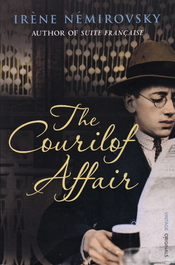
The Courilof Affair by Irène Némirovsky

Vintage, 2008, 174 p. Translated from the French L’Affaire Courilof, (Éditions Grasset, 1933,) by Sandra Smith.

The Courilof Affair cover

The narrative here has a prologue set in Nice in the 1920s which acts as a framing device but the subsequent chapters are delivered to us in the form of Léon M’s memoirs. The son of would-be Russian revolutionaries, Léon was brought up in exile, and assigned by the Revolutionary Committee to kill the Russian Education Secretary, Courilof, a notoriously harsh man, known as the Killer Whale. To enable this and to worm himself into Courilof’s household he takes up a position, under the name Marcel Legrand, as Courilof’s physician. At once warming to his charge and disgusted by him, “Legrand” has a ringside seat at the ins and outs of the higher echelons of the pre-revolutionary system, watching Courilof fall from favour as a result of his marriage to his second wife (who has a past) before his restoration following a scandal involving his successor.

Despite Courilof’s elevated position he nevertheless has the capacity to observe, “‘An ordinary man has the right to be greedy, because he knows that otherwise he would starve to death. But these people who have everything – money, friends in high places, property – they never have enough! I just don’t understand it.’” Plus ça change.

This is the only one of Némirovsky’s novels to be set more or less entirely in her native Russia – and (almost certainly non-coincidentally) it is the most concerned with politics and the usage of power. Affairs of the heart are incidental here as it is the wielding of, and manœvring to maintain, influence, and the single-mindedness of those opposing the regime which are the book’s main themes. Léon’s subsequent acts as an instrument of the revolutionary government – a far more implacable proposition than Courilof ever was – are related briefly and quite off-handedly, simply as things that had to be done. Léon’s fall from grace is glossed over, we never quite find out why he ends up living in exile – though we can guess.

This isn’t Némirovsky at the peak of her powers but it is an interesting examination of the mind-set of would-be revolutionaries eager to be seen to be activists (the assassination requires as big an audience as possible) but more in thrall to the idea than the action – as well as, in Courilof, the exigencies of assiduous service to a monarch who doesn’t warrant devotion.

Pedant’s Corner:- “the Pierre and Paul Fortress” (usually Peter and Paul Fortress in English,) hung (hanged, x3, though there was a ‘hanged’ and one of the ‘hung’s on page 168,) Nevsky river, (it’s the Neva river that flows through St Petersburg,) “fishermen ….must have the same feeling as they contemplate their dazzling catch” (catches, surely, since its fishermen, plural,) sterling (as a fish. Is there such a creature?) “A great crowd of people were silently listening to music” (a crowd was silently listening,) Léon as Legrand is referred to in speech as ‘Monsieur Legrand’ (the English would be Mister Legrand, but then back in the day educated Russians spoke French and the speaker thought ‘Legrand’ knew no Russian so would be addressing him in that language,) hiccoughs (hiccups, it’s not – and never has been – a cough of any sort,) “I wanted to lay down right there” (lie down.) In the translator’s Afterword: Camus’ (Camus’s, x2.)

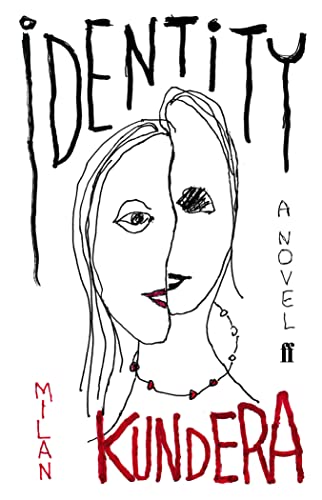
Identity by Milan Kundera

faber and faber, 1999, 155 p. Translated from the French L’identité (Gallimard, 1998?) by Linda Asher.

Identity cover

After the loss of a baby from a previous marriage, the constant refrain from her husband and his family that another child would set things right Chantal left to take up with Jean-Marc, who feels he only engages with the world through her but is fearful that is only an illusion and without her he’d lose any connection to the world. Her realisation that, ‘Men don’t turn to look at me any more,’ is the starting point of the couple’s estrangement. She begins to receive anonymous letters, keeping them from Jean-Marc, and imagines who might be their writer. Eventually their contents contain too many details of her activities to be the work of someone who does not know her well. The confrontation that ensues sees Chantal take a trip to London, in part to escape.

In its early stages this book reminded me of the work of John Banville but then it took a left turn into a phantasia of unlikely occurrences which it is a tribute to Kundera’s skill are nevertheless entered seamlessly without any jarring to the reader.

Identity, the awareness of self, is of course the theme of the book. “Remembering our past, carrying it with us always, may be the necessary requirement for maintaining the wholeness of the self.” Saying friends help to bolster this sense, Jean-Marc calls into evidence Dumas’s four musketeers and claims friendship is, “proof of the existence of something stronger than ideology, than religion, than the nation,” but Chantal tells him. “Friendship is a problem for men. It’s their romanticism. Not ours.”

Chantal works at an advertising agency. One of her colleagues declares, “‘Only a very small minority really enjoys sex.’” When challenged, he adds, ‘If someone interrogates you on your sex life, are you going to tell the truth?….. while everyone may covet the erotic life everyone also hates it, as the source of their troubles, their frustrations, their yearnings, their complexes, their sufferings.’” Sex is never far from the surface in a Kundera book. Here advertising is characterised as, “Toilet paper, nappies, detergent, food. That is man’s sacred circle, and our mission is not only to discover it, seize it, and map it, but to make it beautiful, to transform it into song.” We are, “condemned to food and coitus and toilet paper.”

Identity is a slight volume at 155 pages but packs a lot in. However, the simile in, “her voice wavering like the lament of a woman raped,” strikes an off-note.

Pedant’s corner:- Patroclus’ (Patroclus’s,) Alexandre Dumas’ (Dumas’s,) unfriendlike (is that a translation of a French word for which there is no direct English equivalent?) “an burdensome thing” (a burdensome thing, surely? Or was it a peculiar emphasis in the French?) a missing comma before a piece of direct speech, Britannicus’ (Britannicus’s,) “to épater les bourgeois” (not translated, but italicised,) a curious shift to past tense for one paragraph in a section otherwise rendered in the present.

All Our Worldly Goods by Irène Némirovsky

Chatto & Windus, 2008, 206 p. Translated from the French Les Biens de ce Monde by Sandra Smith. (First published by Éditions Albin Michel, Paris, 1947.)

All Our Worldly Goods cover

I have frequently alluded to love, sex and death as the three main novelistic concerns. In All Our Worldly Goods Némirovsky focuses on the first of these but throws class and family dynamics into the mix. Interestingly, despite the scope of the narrative extending over the two World Wars, there are only two deaths explicitly dealt with in the text. (A myriad others occur off-stage of course.)

We start in the first decade of last century, on Wimereux Plage, where the Hardelot and Florent families are spending the summer. Normally not mixing much due to their different social standing, on their annual pilgrimages to the beach such niceties are not so strictly observed. Pierre Hardelot’s fiancée, Simone Renaudin, is also present. The engagement is at the behest of the domineering Hardelot patriarch Charles, owner of the paper mill in their home town Saint-Elme, desirous of Renaudin money for investment in the company but also a stickler for protocol. But grandson Pierre does not even like Simone. He and Agnès Florent are in love but resigned never to be together.

Back in Saint-Elme the planned futures all unravel when someone sees the pair on what they believe is their last meeting in a local wood and their association is revealed. As a result Pierre is cut off by Charles, as he marries Agnès and they go to live in Paris. The ramifications of their attachment will resound throughout their lives and the book, which, despite the passages involving their parents and children, is the story of their commitment.

Along with everyone else’s the certainties of Charles Hardelot’s life are thrown into turmoil by the Great War. Pierre is called up, the women from Saint-Elme join the refugees from the German advance. Charles remains behind and spends the war under German occupation. After the war Saint-Elme and the family business are rebuilt and Simone’s husband, whom she met during the retreat, is taken into the business, along with her money.

The book has several jumps in time in which Némirovsky lays out the history of the Hardelot family and the first half of the twentieth century but the wider world (except in so far as it impinges directly on Pierre and Agnès) tends to remain in the background. Still, the hopes and feelings of the immediate post-Great War period are summed up by Pierre’s thought, “It was the final war. There would never be another. The thirst for blood had been satisfied. Not only was it necessary to forget the war. It had to be vilified in people’s memory,” and the strangeness of the post-war world by, “Paris seemed bled dry.”

One of the episodes concerns the relationship Pierre and Agnès’s son Guy with a woman not known to the family and whose conduct leads to his suicide attempt. Years later in the pre-umbra of a future war Guy falls for his father’s former fiancée Simone’s daughter Rose. This description might make the book appear to be soap-opera like but the reality is far from that.

As Guy marches off to the Phoney War in 1939 Pierre notes that unlike in 1914 there were no flowers, no fanfares as the young went off ….. “’they know that all our sacrifices were useless…. they’ve read, or seen, or heard everything that happened then … how do you think they’re supposed to bear it?’” Perhaps this is Némirovsky’s view on why France’s resistance collapsed so quickly in 1940.

Once again in the turmoil of a German advance the women and the men are separated. During this evacuation, in what struck me as an unlikely coincidence, Agnès encounters the woman who betrayed Guy years before but is magnanimous towards her. Agnès’s struggle to return to Pierre in Saint-Elme underlines the book’s theme of closeness between her and Pierre.

“All our Worldly Goods” seems a bit off the mark as a translation for Les Biens de ce Monde (“The Good Things of This World”) but Sandra Smith gives reasons in her translator’s note as she says the spiritual and material nuances of les biens are almost impossible to translate and she wanted to emphasise the marriage connection.

In the end the book is an affirmation. Irony though it may be given the author’s own fate in Auschwitz in All Our Worldly Goods Némirovsky is telling us that despite all the upheavals to which we may be subjected we must cling to the human.

Pedant’s corner:- Charles refers in August 1914 to the start of a world war. It wasn’t called a world war till later; shimmer-ing (no need for the hyphen in the middle of a line,) a missing comma at the end of a thought quote, both start and end commas missing, or the end one placed externally, at other thought quotes, frugalness (frugality?)

free hit counter script